How to Choose Senior Care: A Step-by-Step Guide for First-Time Family Caregivers
How to Choose Senior Care: A Step-by-Step Guide for First-Time Family Caregivers
A structured, five-step action plan for adult children who need to make a senior care decision after a crisis. Learn how to assess functional ability, match needs to the right care level, determine your budget, evaluate facilities, and plan a smooth transition.
By Editorial Team
Why Most Families Choose the Wrong Care Level First
When a parent falls, receives a dementia diagnosis, or is discharged from the hospital, the instinct is to act fast. Families often start by searching for "the best" facility in their area, touring a few places, and picking the one that feels right. This approach has a fundamental flaw: it skips the most important question. The right facility for your parent depends entirely on the level of care they actually need, not on a community's amenities or reputation.
Three common errors drive this mistake:
Emotional urgency. After a crisis, the pressure to "do something" leads families to make quick decisions based on availability rather than appropriateness.
Lack of functional assessment. Most adult children have never formally evaluated what their parent can and cannot do independently. They either overestimate the help they've been providing or underestimate the parent's remaining abilities.
Comparing apples to oranges. Touring an assisted living community when the parent needs skilled nursing, or evaluating a nursing home when the parent only needs help with medication management, wastes time and leads to bad matches.
The most expensive choice families make is choosing the wrong care level first. Moving a parent twice — once to a facility that cannot meet their needs and again to the appropriate setting — costs thousands of dollars in move-in fees, deposits, and emotional strain. This guide provides a five-step process designed to prevent that outcome.
Step 1: Assess Your Parent’s Functional Ability Using ADLs and IADLs
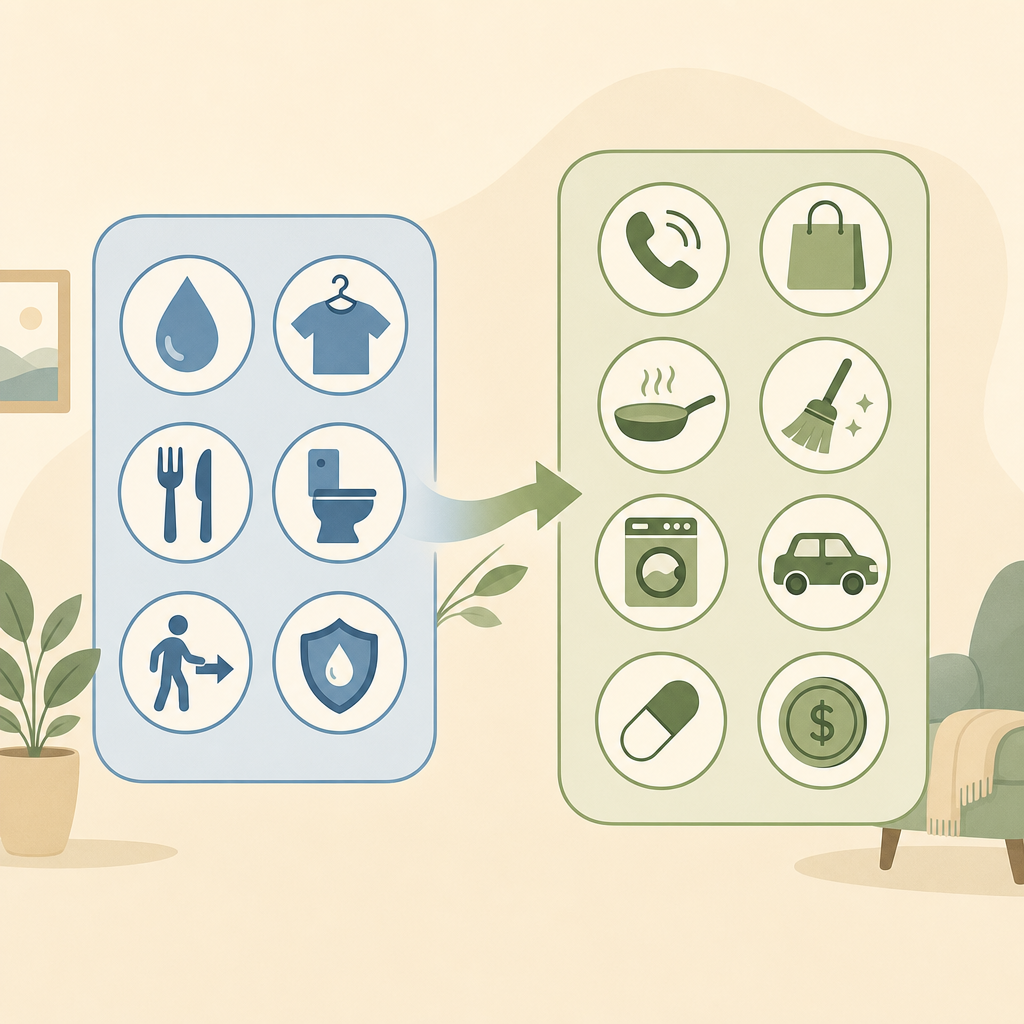
Before you look at a single facility, you need an honest, objective picture of what your parent can do on their own. This is where standardized assessment tools become invaluable. The Katz Index of Independence in Activities of Daily Living (ADLs) and the Barthel ADL Index are two widely used frameworks that provide a structured baseline.
Start with the six basic ADLs. These are the fundamental self-care tasks that determine whether someone can live safely without hands-on assistance:
Bathing
Dressing
Eating
Toileting
Transferring (getting in and out of bed or a chair)
Continence
Next, evaluate the eight Instrumental Activities of Daily Living (IADLs). These are more complex tasks that support independent living in the community:
Using the telephone
Shopping
Preparing meals
Housekeeping
Doing laundry
Managing transportation
Managing medications
Managing finances
For each task, note whether your parent can perform it independently, needs supervision or verbal prompting, requires hands-on assistance, or is completely dependent. Be honest. It is common for family caregivers to underestimate the amount of help they provide because they have gradually absorbed tasks over time.
The ADL and IADL frameworks provide an objective baseline for matching care needs to the appropriate setting.
Step 2: Map Functional Deficits to the Right Care Level
Once you have a clear picture of your parent’s functional status, you can match their deficits to the appropriate care type. This is a matching step, not a facility comparison. The goal is to identify which category of care setting can meet their needs before you evaluate specific communities.
Matching functional deficits to the appropriate care level before evaluating specific facilities.
Functional Profile
Appropriate Care Type
Key Considerations
Independent in all ADLs and most IADLs; may need help with transportation or medication reminders
Independent Living or Home Care (a few hours per week)
Focus on social engagement and safety monitoring; no hands-on personal care needed
Independent in ADLs but needs help with several IADLs (cooking, housekeeping, medication management)
Home Care (several hours daily) or Adult Day Services
Adult day services provide structured daytime care and social activities; home care offers flexibility
Needs help with 1–2 ADLs (bathing, dressing) and most IADLs
Assisted Living (Level 1 or 2 care)
Assisted living uses tiered pricing; costs rise as care needs increase
Needs help with 3 or more ADLs; may have moderate cognitive impairment
Assisted Living (Level 3 care) or Memory Care
Memory care is specifically designed for dementia-related behaviors and wandering safety
Needs help with most or all ADLs; requires 24/7 skilled nursing supervision
Skilled Nursing Facility (Nursing Home)
Medicare may cover short-term stays after a hospitalization; long-term care is typically private pay or Medicaid
End-stage illness; focus on comfort rather than curative treatment
Hospice Care (at home, in a facility, or in a dedicated hospice center)
Hospice is covered by Medicare, Medicaid, and most private insurance for eligible individuals
Step 3: Determine Your Budget Reality with 2026 Cost Data
Cost is often the most stressful part of the decision, but facing it early prevents painful surprises later. The following table presents national median cost ranges based on the most recent data available (2025–2026). Actual costs vary significantly by state, facility, and room type.
National median cost ranges for senior care types. Actual costs vary by state, facility, and room type.
Care Type
National Median Cost (2025–2026)
Source
Adult Day Services
$95 per eight-hour day
CareScout 2025 Cost of Care Survey; U.S. News (April 2026)
Independent Living
$3,523 per month
U.S. News (April 2026)
Home Care (non-medical)
$35 per hour ($80,080/year at 44 hrs/week)
CareScout 2025; U.S. News (April 2026)
Assisted Living
$5,419–$6,200 per month
A Place for Mom (March 2026); CareScout 2025
Memory Care
$6,690–$7,645 per month
A Place for Mom (March 2026); U.S. News (April 2026)
Nursing Home (semi-private room)
$9,581–$9,842 per month
CareScout 2025; SeniorLiving.org (June 2026)
Nursing Home (private room)
$10,798–$11,294 per month
CareScout 2025; SeniorLiving.org (June 2026)
A critical point: staying at home with paid care at 44 hours per week costs approximately $80,080 per year. In many states, this exceeds the cost of a private room in a nursing home. Do not assume that home care is the most affordable option.
Payment sources to consider include:
Private pay (personal savings, retirement income, selling a home)
Medicaid (covers nursing home costs for qualifying low-income individuals; asset and income limits vary by state)
VA Aid and Attendance benefit (single veterans up to $2,424/month, married veterans up to $2,874/month, surviving spouse up to $1,558/month)
Long-term care insurance (policies vary widely; check for elimination periods and benefit caps)
Comparing the relative costs of in-home care, assisted living, and nursing home care. Actual costs vary significantly by location and level of care needed.
Step 4: Research and Tour Facilities with a Critical Eye
Once you know the care level you need and have a realistic budget, you can begin researching specific facilities. The National Institute on Aging recommends a structured approach that goes beyond a single scheduled tour.
Start with these resources:
Medicare’s Care Compare tool. This online database provides star ratings, health inspection results, staffing data, and quality measures for every Medicare- and Medicaid-certified nursing home in the country.
State licensing inspection reports. Every state conducts regular inspections of assisted living and nursing home facilities. These reports are public records and reveal violations, complaints, and corrective actions.
The Joint Commission’s Quality Check. This tool provides accreditation status and performance data for facilities that have chosen to undergo voluntary accreditation.
The Eldercare Locator (800-677-1116). A public service of the U.S. Administration on Aging that connects you to local Area Agencies on Aging and long-term care ombudsman programs.
When you tour, use the Medicare Nursing Home Checklist as your guide. Key questions to ask include:
What is the staff-to-resident ratio during the day and overnight?
What is the annual staff turnover rate? High turnover is a red flag for quality of care.
How often does a physician visit residents? Is a nurse practitioner or physician assistant available on-site?
What activities are available? Are they appropriate for your parent’s cognitive and physical abilities?
Is there outdoor space? Can residents access it independently?
How does the facility handle transportation to medical appointments?
Is there a dedicated memory care unit? If so, what is the staff training for dementia care?
What are the infectious disease protocols? How were they handled during the most recent outbreak season?
Step 5: Plan the Transition — Family Meeting, Trial Stays, and Emotional Preparation
The transition to a new care setting is as much an emotional process as a logistical one. The Family Caregiver Alliance recommends holding a family meeting that includes the older adult whenever possible. The goal is to share the assessment results, discuss the options, and reach a consensus before making a final decision.
A structured family meeting should cover:
The functional assessment results and what they mean for care needs.
The care level options identified in Step 2 and why each was considered.
The budget reality from Step 3, including what each family member can contribute.
The touring findings from Step 4, including any red flags or concerns.
A timeline for the transition, including trial stays if the facility offers them.
If the older adult is resistant to the idea of moving, do not force the conversation. Use a scripted approach that acknowledges their feelings and focuses on safety and quality of life rather than on their deficits. Our guide on How to Talk to an Aging Parent Who Refuses Help: A Scripted Communication Guide for Adult Children provides specific language and strategies for handling this difficult conversation.
If the facility offers trial stays, take advantage of them. A short-term stay (one to two weeks) allows the older adult to experience daily life in the community before making a permanent commitment. It also gives you a chance to observe how they adjust and whether the care level is appropriate.
When to Bring in a Professional: Geriatric Care Managers and Elder Law Attorneys
For complex situations, professional guidance can save time, money, and emotional energy. Two types of professionals are particularly valuable during the senior care decision process.
A geriatric care manager (also called an aging life care professional) is a trained specialist who conducts comprehensive assessments, coordinates care across providers, and helps families navigate the long-term care system. They are especially useful when:
The older adult has multiple chronic conditions requiring coordination between specialists.
Family members live out of state and cannot visit frequently to evaluate facilities.
The family is struggling to reach consensus on the best course of action.
To find a geriatric care manager, contact the Aging Life Care Association at 520-881-8008 or use the Eldercare Locator at 800-677-1116.
An elder law attorney specializes in legal issues affecting older adults, including Medicaid planning, powers of attorney, asset protection, and guardianship. They are essential when:
You need to qualify for Medicaid to cover nursing home costs and must structure assets within state limits.
The older adult has not executed a durable power of attorney for healthcare or finances.
There is disagreement among family members about who should make decisions.
To find an elder law attorney, contact the National Academy of Elder Law Attorneys (NAELA). Many offer free initial consultations.
Making a senior care decision is one of the most consequential choices a family will face. By following this five-step process — assess, match, budget, research, and transition — you can move from crisis to clarity with confidence. The goal is not to find the "best" facility in the abstract. It is to find the right setting for your parent’s specific needs, at a cost you can sustain, with a transition that honors their dignity and your relationship.


Comments
Join the discussion with an anonymous comment.