
Clinical term
Senior Care Options by Level of Need: A Decision Framework for Families
Why Needs Assessment Must Come Before Option Shopping
When a parent begins to struggle — meals go unmade, bills pile up, a fall sends them to the ER — the instinct is to search for a care option. Assisted living? Home care? A nursing home? The search itself is the problem. Families routinely compare options that serve entirely different levels of need, pitting independent living against skilled nursing or assuming that any facility labeled "senior living" will fit. This mismatch is the single most common and costly mistake in care planning.
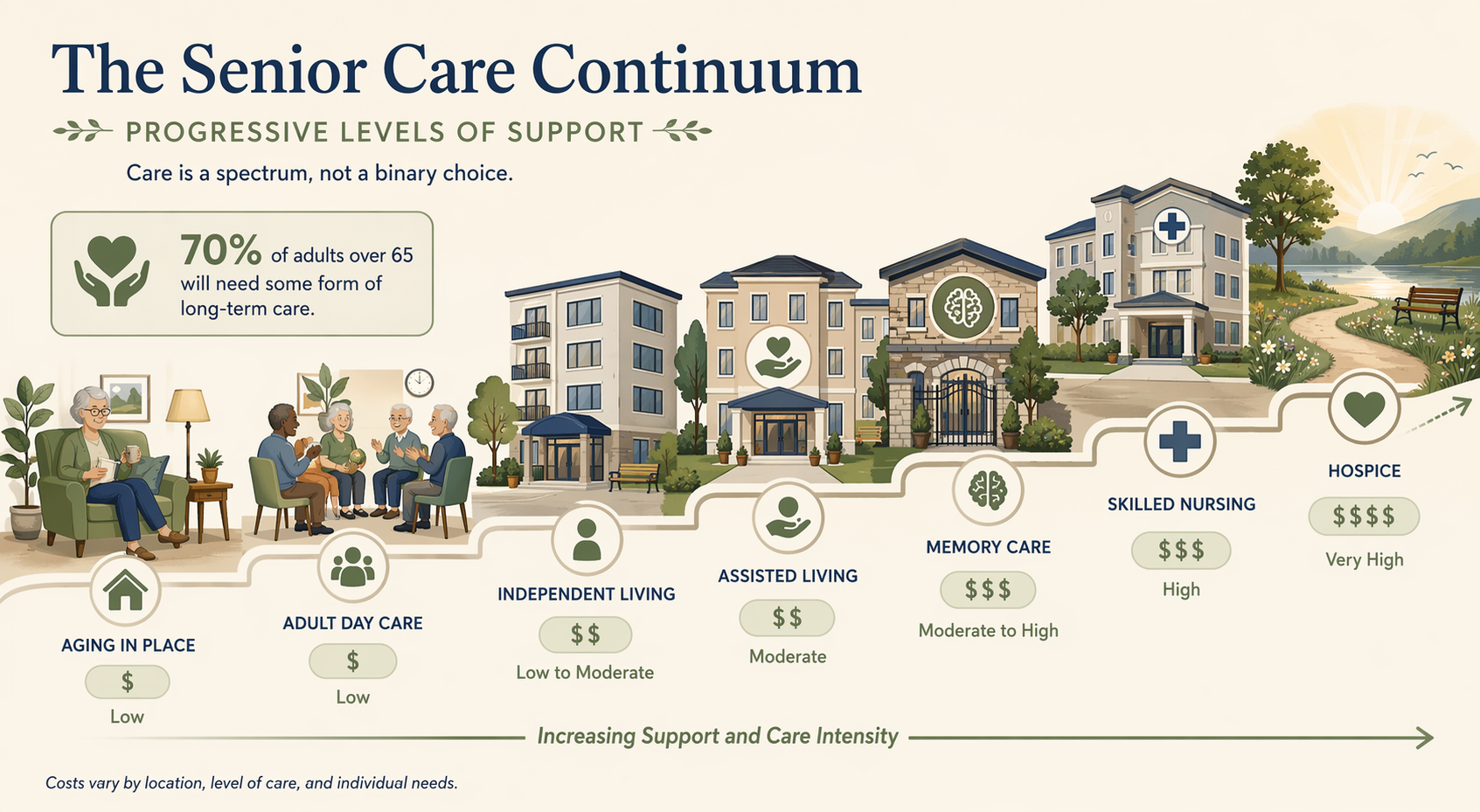
The alternative is a decision-first framework: assess the senior's actual functional deficits first, then match those deficits to the appropriate care type. This approach eliminates confusion, produces more predictable costs, and reduces the likelihood of a second crisis-driven move six months later. Nearly 70% of Americans over 65 will need some form of long-term care, according to New LifeStyles, yet most families begin planning only after a crisis — a hospitalization, a dementia-related incident, or a fall — which severely limits their options and timeline.
Understanding ADLs and IADLs: The Foundation of Care Matching
Before evaluating any care option, you need a clear picture of what your parent can and cannot do independently. Clinicians and care providers use two standardized frameworks to measure functional ability: Activities of Daily Living (ADLs) and Instrumental Activities of Daily Living (IADLs). These are not academic categories — they are the criteria that determine eligibility for assisted living, Medicaid home- and community-based services, long-term care insurance payouts, and nursing home placement.
Activities of Daily Living (ADLs)
ADLs are the fundamental self-care tasks that a person must be able to perform to live safely without daily assistance. The six core ADLs, as defined by the Senior Care Authority glossary and used across the care industry, are:
- Bathing and personal hygiene
- Dressing (selecting and putting on clothes)
- Toileting (getting to and from the toilet, cleaning oneself)
- Transferring (moving from bed to chair, or in and out of a car)
- Continence (controlling bladder and bowel function)
- Feeding (getting food from plate to mouth)
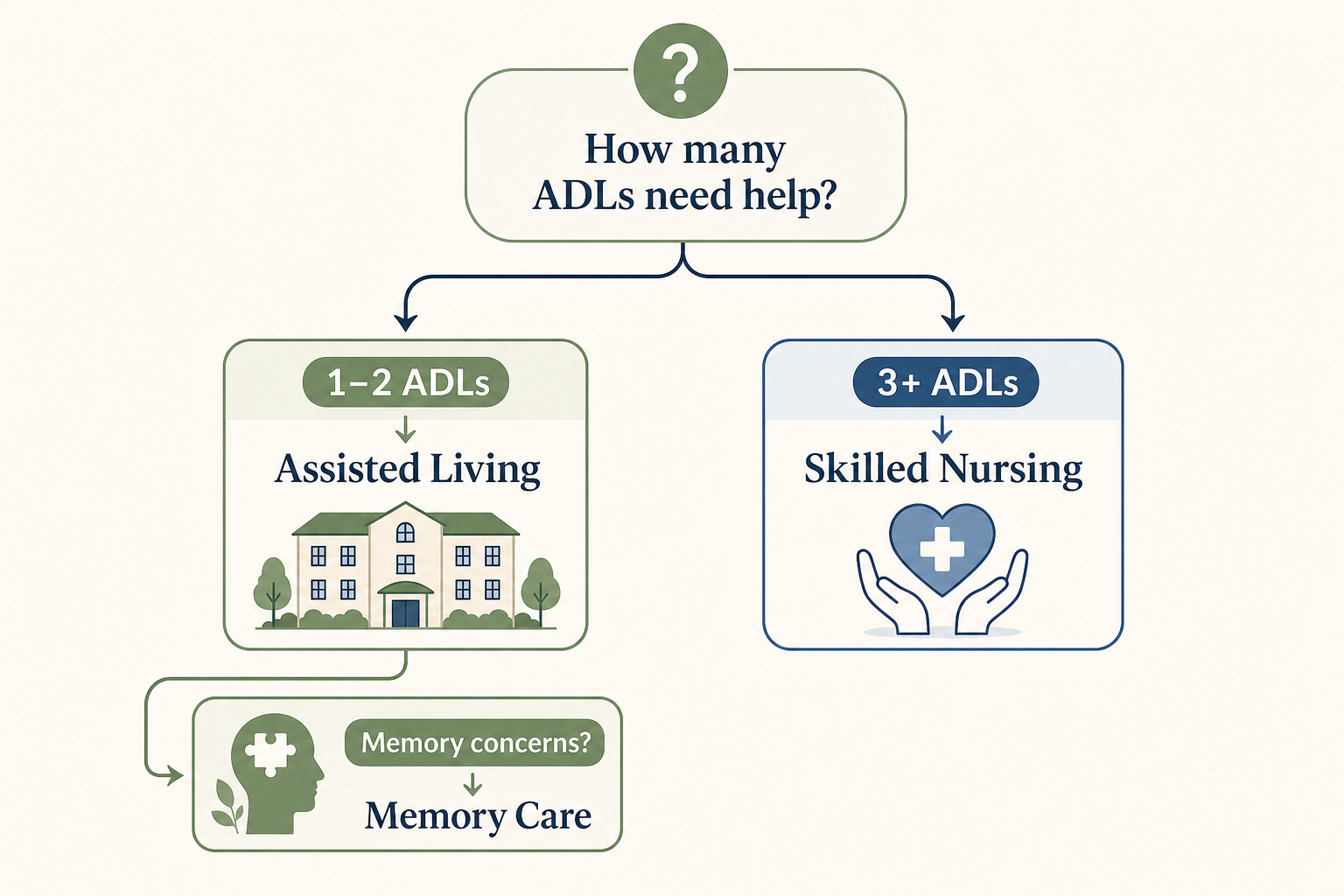
A senior who needs help with one or two ADLs is typically a candidate for assisted living or home care. A senior who needs help with three or more ADLs — especially if they involve transferring or continence — is likely approaching the level of care provided by a skilled nursing facility.
Instrumental Activities of Daily Living (IADLs)
IADLs are more complex tasks that support independent living in the community. Decline in IADLs typically precedes decline in ADLs by months or even years, making IADL assessment an early warning system for proactive planning. The key IADLs include:
- Meal preparation and planning
- Medication management (ordering, organizing, taking correct doses)
- Housework and home maintenance
- Financial management (paying bills, budgeting, avoiding scams)
- Transportation (driving, using public transit, arranging rides)
- Communication (using phone, email, managing appointments)
If your parent is struggling with IADLs but still managing ADLs independently, they may be a candidate for home care, adult day services, or independent living with supportive services. Ignoring IADL decline often leads to a crisis — a missed medication dose, an unpaid utility bill, a kitchen fire — that forces a more abrupt and expensive transition than necessary.
Self-Assessment Checklist for Families
Use the following checklist to evaluate your parent's current functional level. For each item, note whether they can perform the task independently, need occasional reminders or supervision, need hands-on assistance, or cannot perform it at all. This assessment will map directly to the care continuum in the next section.
| Domain | Task | Independent | Needs Reminders | Needs Assistance | Unable |
|---|---|---|---|---|---|
| IADL | Prepare meals | ☐ | ☐ | ☐ | ☐ |
| IADL | Manage medications | ☐ | ☐ | ☐ | ☐ |
| IADL | Pay bills and manage finances | ☐ | ☐ | ☐ | ☐ |
| IADL | Drive or arrange transportation | ☐ | ☐ | ☐ | ☐ |
| IADL | Perform housework | ☐ | ☐ | ☐ | ☐ |
| IADL | Use phone or communicate | ☐ | ☐ | ☐ | ☐ |
| ADL | Bathe or shower | ☐ | ☐ | ☐ | ☐ |
| ADL | Dress | ☐ | ☐ | ☐ | ☐ |
| ADL | Use the toilet | ☐ | ☐ | ☐ | ☐ |
| ADL | Transfer from bed to chair | ☐ | ☐ | ☐ | ☐ |
| ADL | Control bladder and bowel | ☐ | ☐ | ☐ | ☐ |
| ADL | Feed themselves | ☐ | ☐ | ☐ | ☐ |
The Care Continuum: Mapping Functional Deficits to Care Types
Once you have a clear picture of your parent's functional deficits, the next step is matching those deficits to the appropriate care level. The senior care continuum ranges from minimal support (aging in place with occasional help) to 24-hour skilled medical care (nursing homes and hospice). Each level serves a distinct ADL/IADL profile, and each has clear warning signs that a transition to the next level may be needed.
| Care Level | Who It Serves | Typical ADL/IADL Profile | Key Services Included | Transition Warning Signs |
|---|---|---|---|---|
| Aging in Place with Home Care | Seniors who can live at home safely but need help with IADLs or 1–2 ADLs | IADL deficits (meals, meds, housework); may need help with bathing or dressing | Non-medical personal care, meal prep, light housekeeping, medication reminders, companionship | Falls, weight loss, missed medications, unsafe home environment, caregiver burnout |
| Adult Day Services | Seniors who live with a caregiver but need supervision and social engagement during the day | Mild to moderate IADL deficits; may need help with 1 ADL; cognitive impairment common | Supervision, meals, social activities, some health monitoring, transportation | Wandering, agitation at home, caregiver exhaustion, need for more medical monitoring than center can provide |
| Independent Living | Seniors who are largely independent but want a maintenance-free lifestyle and social community | Minimal to no ADL deficits; may have mild IADL challenges (housework, meals) | Apartment or cottage, meals, housekeeping, social activities, transportation | Declining ability to manage medications, increasing need for personal care, cognitive decline |
| Assisted Living | Seniors who need help with 1–2 ADLs but do not require 24-hour skilled nursing | Needs help with bathing, dressing, or medication management; IADL deficits significant | Private apartment, meals, personal care assistance, medication management, 24-hour supervision, social activities | Frequent falls, weight loss, wandering, incontinence, need for skilled nursing or rehabilitation |
| Memory Care | Seniors with Alzheimer's disease or other dementia who need a secure, structured environment | ADL deficits vary by stage; significant cognitive impairment; wandering, agitation, or safety risks common | Secured unit, specialized dementia programming, 24-hour supervision, personal care, meals, medication management | Aggression, elopement attempts, rapid cognitive decline, need for skilled nursing or hospice |
| Skilled Nursing Facility | Seniors who need 24-hour skilled nursing care, rehabilitation, or complex medical management | 3+ ADL deficits; often includes incontinence, immobility, feeding difficulties, or complex medical conditions | 24-hour nursing care, rehabilitation therapy, wound care, medication management, meals, personal care | Stable but no longer needs skilled nursing; may transition to assisted living or return home after rehab |
| Hospice | Seniors with a terminal illness (prognosis of 6 months or less) who choose comfort-focused care | Significant ADL deficits; focus shifts from curative treatment to comfort and quality of life | Pain and symptom management, emotional and spiritual support, respite for caregivers, bereavement support | N/A — hospice is an end-of-life care philosophy, not a step in the continuum |
The National Institute on Aging provides authoritative definitions for each care type. Assisted living, for example, offers help with daily care but not as much as a nursing home — typically in a setting of 25–100+ residents with private apartments, meals, personal care, medication help, and 24-hour supervision. Nursing homes, by contrast, provide a wide range of health and personal care with a focus on medical care, 24-hour supervision, and rehabilitation services. Board and care homes (20 or fewer residents) offer personal care and meals but generally no nursing or medical care.
Cost Impact by Care Level: What Families Need to Know in 2026
Cost is often the deciding factor in care decisions, but comparing costs across care levels without accounting for functional needs is misleading. The table below presents 2026 national median costs from multiple sources. Note that figures vary by source due to different data collection methodologies, geographic coverage, and timing — we cite specific sources for each figure rather than averaging conflicting numbers.
| Care Level | Monthly Cost (National Median) | Annual Cost (National Median) | Source |
|---|---|---|---|
| Independent Living | $3,523 | $42,276 | U.S. News / CareScout 2025 Survey |
| Adult Day Services | $95 per day (~$2,090/month for 22 days) | ~$25,080 | U.S. News / CareScout 2025 Survey |
| Home Care (non-medical, 44 hrs/week) | $6,673 | $80,080 | U.S. News / CareScout 2025 Survey ($35/hour) |
| Assisted Living | $5,419 – $6,313 | $65,028 – $75,756 | A Place for Mom 2026 Report / SeniorLiving.org May 2026 |
| Memory Care | $7,645 | $91,740 | U.S. News / CareScout 2025 Survey |
| Board and Care Home (private room) | $7,300 | $87,600 | U.S. News / CareScout 2025 Survey |
| Skilled Nursing (semi-private room) | $9,581 | $114,972 | U.S. News / CareScout 2025 Survey |
| Skilled Nursing (private room) | $10,798 | $129,576 | U.S. News / CareScout 2025 Survey |
| Respite Care | $350 per day | Varies | U.S. News / CareScout 2025 Survey |
The Home Care Cost Myth
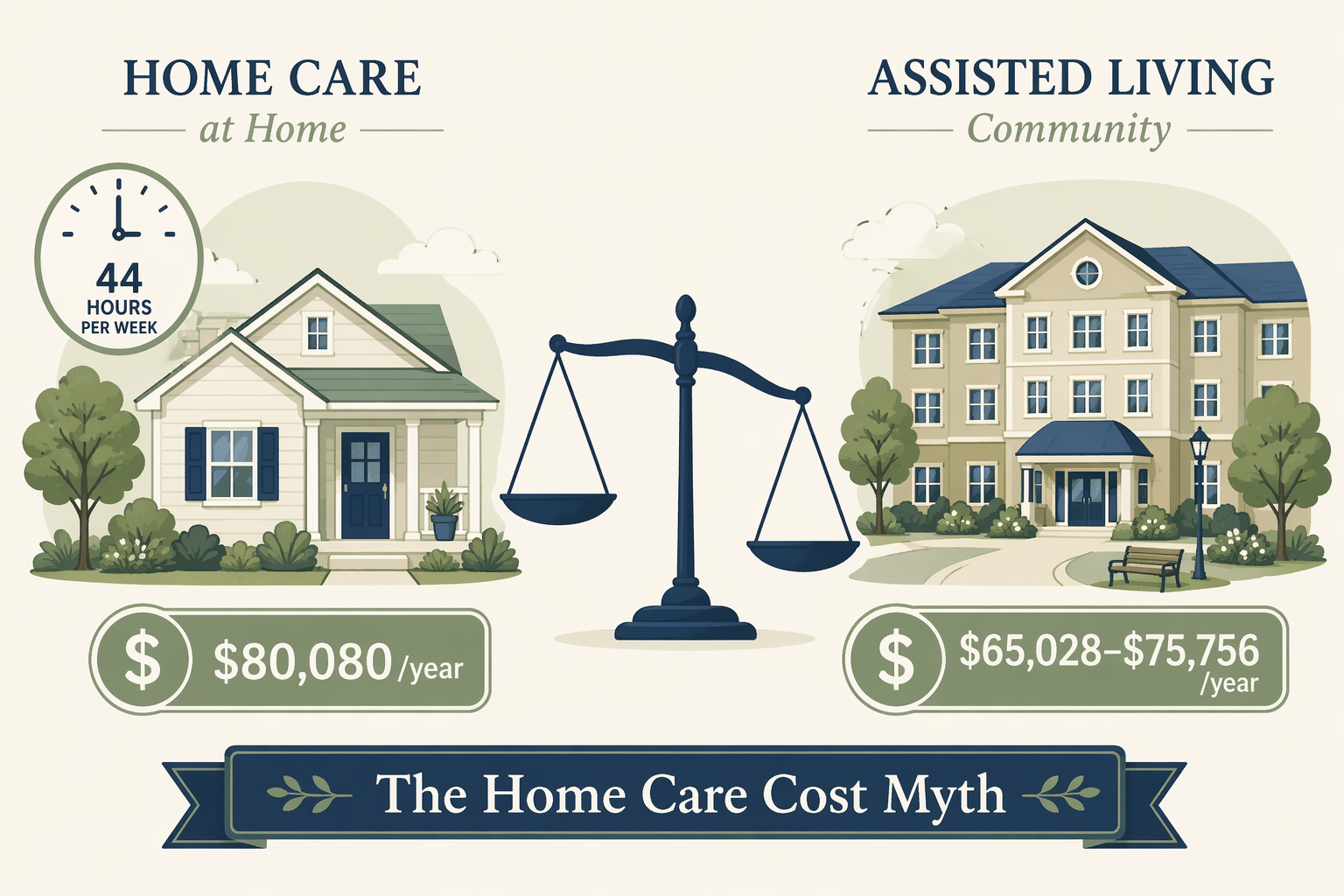
One of the most persistent misconceptions in senior care is that staying at home with care is always cheaper than moving to a facility. The data tells a different story. At 44 hours per week — roughly the amount of care needed by a senior who requires help with several IADLs and 1–2 ADLs — in-home care costs approximately $80,080 per year ($35/hour, per U.S. News/CareScout). That exceeds the annual cost of assisted living, which ranges from $65,028 to $75,756 depending on the source.
As Jacqui Clark, an expert quoted in the U.S. News article, states: "Staying at home with care is the most expensive option. It's a big myth that it's cheaper to stay at home with care."
For a deeper analysis of when home care costs more than assisted living and the break-even point for different care hours, see our guide When Home Care Costs More Than Assisted Living: The Break-Even Point Families Need to Know.
Decision Flowcharts for Common Scenarios
The following decision pathways address four common entry scenarios. Each starts with a triggering event and guides you through key questions about functional deficits and safety to map to the appropriate care level.
Scenario 1: Post-Fall
A fall is often the first clear signal that a senior's functional abilities have declined beyond what family caregivers can manage. After the immediate medical needs are addressed:
- If the senior has no ADL deficits and only mild IADL challenges, consider home care (a few hours per week) or adult day services for supervision and social engagement.
- If the senior needs help with 1–2 ADLs (bathing, dressing) and has significant IADL deficits, assisted living is likely appropriate.
- If the fall resulted in a fracture or hospitalization requiring rehabilitation, a short-term stay in a skilled nursing facility may be needed before transitioning to a lower level of care.
- If the senior has 3+ ADL deficits or significant cognitive impairment, skilled nursing or memory care may be the appropriate setting.
For a step-by-step timeline on setting up services after a fall or diagnosis, see From Crisis to Plan: A 30-Day Timeline for Setting Up Aging in Place Services After a Parent's Fall or Diagnosis.
Scenario 2: Dementia Diagnosis
A new dementia diagnosis changes the care planning timeline. Unlike gradual physical decline, cognitive decline can accelerate unpredictably, and safety risks (wandering, leaving the stove on, falling for no apparent reason) may emerge before ADL deficits are significant.
- In early-stage dementia, the senior may still manage most ADLs independently but need help with IADLs (medication management, finances, transportation). Home care or adult day services can provide structure and supervision.
- In middle-stage dementia, when wandering, agitation, or safety risks emerge, memory care (a secured, specialized unit) is often the safest option. Memory care costs approximately $7,645/month (U.S. News/CareScout), about 20–30% more than standard assisted living.
- If the senior has 3+ ADL deficits or complex medical needs alongside dementia, a skilled nursing facility with a dementia unit may be necessary.
Scenario 3: Post-Hospital Discharge
Hospital discharge is a high-risk transition point. Medicare covers short-term skilled nursing facility stays after a qualifying hospital stay: the first 20 days are fully covered, days 21–100 require a $217/day coinsurance (2026), and after day 100 the patient pays 100% (NCOA). The key question is whether the senior needs short-term rehabilitation or long-term custodial care.
- If the senior is expected to recover and return to their previous functional level within weeks, a short-term rehab stay in a skilled nursing facility is appropriate.
- If the senior's functional decline is permanent and they now need help with 1–2 ADLs they previously managed independently, assisted living may be the new baseline.
- If the senior now needs 3+ ADLs or has a new diagnosis requiring ongoing skilled care, long-term placement in a skilled nursing facility may be necessary.
For a deeper understanding of the difference between short-term rehab and long-term custodial care, see Short-Term Care vs. Long-Term Care for Seniors: A Family Caregiver's Decision Framework.
Scenario 4: Gradual Decline
Gradual decline is the most common but most insidious scenario. There is no single triggering event — just a slow accumulation of missed meals, unpaid bills, weight loss, and social withdrawal. Families often normalize each individual change until a crisis forces action.
- If the senior has IADL deficits but no ADL deficits, start with home care (a few hours per week for meal prep, housekeeping, medication management) or adult day services.
- If IADL deficits are significant and the senior is socially isolated, independent living with supportive services may provide a better quality of life at a lower cost than home care.
- If ADL deficits have emerged (bathing, dressing, toileting), assisted living is likely the appropriate level.
- If the senior has 3+ ADL deficits or significant cognitive decline, skilled nursing or memory care should be evaluated.
Avoiding the One-Level-Too-Low and Over-Care Traps
Two common decision errors plague families navigating the care continuum: choosing a care level that is too low (leading to crisis and rapid transition) or too high (paying for services not needed). Both are costly, but in different ways.
The One-Level-Too-Low Trap
This occurs when families underestimate the senior's functional deficits and choose a care level that cannot meet their needs. The most common example is placing a senior with significant cognitive impairment or multiple ADL deficits in independent living or standard assisted living without memory care. The result is a crisis within weeks or months — the senior is asked to leave, or the family must arrange an emergency transfer to a higher level of care. Emergency moves are more expensive, more stressful, and offer fewer choices than planned transitions.
Warning signs that a care level is too low include:
- The facility recommends a higher level of care within the first 30 days
- The senior experiences falls, weight loss, or medication errors despite receiving care
- The senior is socially isolated or agitated because the environment does not match their cognitive level
- Family caregivers are still providing significant hands-on care beyond what the facility offers
The Over-Care Trap
The over-care trap is less common but equally costly. This occurs when families choose a higher level of care than the senior needs — for example, placing someone in a skilled nursing facility who only needs assisted living, or choosing memory care when standard assisted living with a dementia-friendly approach would suffice. The cost difference is substantial: skilled nursing at $9,581–$10,798/month vs. assisted living at $5,419–$6,313/month.
Over-care also has quality-of-life implications. A senior placed in a setting that is too medically oriented may lose independence they could have maintained in a less intensive environment. The key is to match the care level to the senior's actual functional deficits, not to their diagnosis or age.
How to Get a Professional Assessment and What to Ask
The self-assessment checklist in this guide is a starting point, not a substitute for professional evaluation. A geriatric care manager (also called an aging life care professional) can conduct a comprehensive in-home assessment, identify functional deficits, recommend appropriate care levels, and help coordinate transitions. The National Institute on Aging also provides guidance on how to choose a nursing home or other facility, including checklists for tours and interviews.
Where to Find a Professional Assessment
- Geriatric Care Manager: Search the Aging Life Care Association directory for certified professionals in your area. Costs range from $100–$200 per hour for assessment and care coordination.
- Area Agency on Aging (AAA): Your local AAA can provide free or low-cost assessments, information about Medicaid waiver programs, and referrals to community resources. Find yours through the Eldercare Locator (eldercare.acl.gov).
- Hospital Social Worker or Discharge Planner: If your parent is hospitalized, the discharge planner can arrange a skilled nursing facility assessment or connect you with home care services.
- Primary Care Provider: A geriatrician or primary care doctor can assess functional decline and provide medical documentation needed for long-term care insurance claims or Medicaid eligibility.
Key Questions to Ask When Touring Facilities or Interviewing Home Care Agencies
- "What is the typical ADL/IADL profile of residents/clients here?" — This tells you whether the facility serves people at your parent's functional level.
- "How do you assess a new resident's needs, and how often do you reassess?" — Regular reassessment is critical as needs change.
- "What happens when a resident's needs exceed what you can provide?" — The answer should include a clear transition protocol, not a vague "we'll figure it out."
- "What is your staffing ratio for direct care workers?" — For assisted living, ask about caregiver-to-resident ratios during day and night shifts.
- "Do you accept Medicaid? If so, what is the process for transitioning from private pay to Medicaid?" — This is critical for long-term financial planning.
- "What is your policy on family involvement in care planning?" — Look for facilities that welcome family input and provide regular updates.
Browse more in the Glossary.