
Room checklist
How to Pay for a CAPS-Guided Home Modification: Grants, Tax Deductions, and Financing Options in 2026
A funding-focused guide for adult children and spousal caregivers who have decided to work with a CAPS professional and now need to navigate payment for home modifications. Learn how a CAPS assessment report unlocks VA grants, Medicaid waivers, USDA loans, tax deductions, and nonprofit programs.
The Cost Reality: What CAPS-Guided Projects Typically Cost by Scale
Before mapping out a funding strategy, it helps to have a clear picture of what a CAPS-guided project actually costs. The total depends entirely on the scope of work — from a few hundred dollars for targeted safety upgrades to well over $50,000 for a full home renovation. Understanding these tiers early helps you match the right funding sources to the right scale of work.
| Project Scale | Typical Cost Range | Common Modifications |
|---|---|---|
| Minor | $100 – $5,000 | Grab bars ($100–$300), lever door handles, improved lighting, non-slip flooring in one room, handrails |
| Moderate | $5,000 – $25,000 | Walk-in tub ($5,000–$15,000), stairlift ($3,000–$5,000), wheelchair ramp ($1,500–$5,000), widened doorways |
| Major | $25,000 – $100,000+ | Full bathroom accessibility remodel, kitchen modification ($15,000 minimum), roll-in shower, first-floor bedroom addition, whole-home reconfiguration |
The gap between what a family can pay out-of-pocket and what a comprehensive modification costs is where the funding strategy comes in. The encouraging news is that most families do not need to cover the full amount themselves. A combination of VA benefits, Medicaid waivers, USDA grants, tax deductions, and nonprofit programs can dramatically reduce the net cost — and the key that unlocks most of these streams is the CAPS assessment report itself.
VA Benefits: HISA, SAH, and SHA Grants for Veterans and Surviving Spouses
For veterans and surviving spouses, the Department of Veterans Affairs offers three primary grant programs that can cover a significant portion — sometimes all — of a CAPS-guided home modification. Each program targets a different level of disability and type of modification, but all require the same foundational documentation: medical justification, contractor estimates, and photographic evidence of the current conditions. This is where a CAPS assessment report becomes invaluable.
| Grant Program | Maximum Award | Eligibility Focus | Typical Covered Projects |
|---|---|---|---|
| HISA (Home Improvements and Structural Alterations) | Up to $6,800 (non-service-connected); $20,000+ (service-connected) | Medically necessary modifications for any disability — service-connected or not | Roll-in showers, grab bars, widened doorways, ramps, stair lifts, kitchen accessibility |
| SAH (Specially Adapted Housing) | Varies by disability level (major structural changes) | Specific service-connected disabilities affecting mobility | Major structural changes: home additions, full bathroom remodels, extensive ramp systems |
| SHA (Special Home Adaptation) | Varies by disability level | Qualifying mobility or vision impairments (service-connected) | Widened doorways, lever handles, visual fire alarms, bathroom modifications |
Application Readiness Checklist
Before submitting any VA grant application, gather the following items. A CAPS professional can help produce most of these during the assessment process.
- Medical justification from a physician or specialist explaining why the modification is medically necessary
- Photographs of the current home conditions (the areas to be modified)
- Itemized contractor bids or estimates — ideally from a CAPS-certified professional
- Proof of homeownership or landlord permission for the modifications
- A CAPS assessment report that includes a home floor plan, prioritized recommendations, and cost estimates
Medicaid HCBS Waivers: State-by-State Coverage for Home Modifications
Medicaid Home and Community-Based Services (HCBS) waivers are one of the most powerful — but also most variable — funding sources for home modifications. These waivers allow states to use Medicaid funds to pay for services and modifications that help people remain in their homes rather than moving to institutional care. The catch is that coverage, annual funding caps, and waiting lists vary dramatically from state to state.
Most HCBS waiver programs require prior authorization before any work begins, and many require an assessment by a licensed occupational therapist (OT) in addition to — or instead of — a CAPS assessment. This does not mean a CAPS report is wasted; rather, it means the CAPS assessment and the OT evaluation complement each other. The CAPS report provides the detailed construction scope and cost estimates, while the OT assessment provides the clinical justification for why each modification is medically necessary.
- Contact your state Medicaid office or HCBS waiver intake line to ask about coverage for home modifications and whether a CAPS assessment report can be submitted alongside an OT evaluation.
- Ask about annual funding caps — some states limit modification spending to $5,000–$10,000 per year, which may require phasing the project.
- Inquire about waiting lists. Some states have years-long waitlists for HCBS waivers, while others have immediate availability.
- Contact your local Area Agency on Aging — they often have case managers who can walk you through the application process for your specific state.
USDA Section 504 Home Repair Program: Up to $10,000 for Low-Income Seniors 62+
The USDA Section 504 Home Repair Program is a lesser-known but highly valuable funding source for very-low-income homeowners aged 62 and older. The program offers grants of up to $10,000 for safety-related home repairs and modifications — exactly the kind of work a CAPS professional typically recommends.
Eligibility is income-based: applicants must be very-low-income as defined by USDA guidelines for their area, own and occupy the home, and be unable to obtain affordable credit elsewhere. The grant does not need to be repaid as long as the homeowner lives in the home for at least three years after the work is completed.
How a CAPS Report Supports the USDA Application
The USDA Section 504 application requires an itemized scope of work with cost estimates. A CAPS assessment report provides exactly this: a professional, documented list of recommended modifications with prioritized phases and estimated costs. Having a CAPS-certified professional's report attached to the application can strengthen the case that the requested modifications are necessary for safety and accessibility, not cosmetic improvements.
- Grant amount: Up to $10,000 per household (lifetime limit)
- Eligibility: Very-low-income homeowners aged 62 and older
- Covered projects: Safety-related repairs and modifications — grab bars, ramps, handrails, lighting, non-slip flooring, bathroom modifications
- Documentation needed: Itemized scope of work with cost estimates (CAPS report), proof of income, proof of homeownership
Tax Deductions: Using IRS Pub 502 to Write Off Medically Necessary Modifications
Many families overlook one of the most straightforward ways to offset the cost of home modifications: the medical expense tax deduction. Under IRS Publication 502, medically necessary home modifications may be deductible as medical expenses — but the rules around capital improvements require careful attention.
The key distinction is whether the modification increases the value of the home. If it does not — for example, a grab bar or a ramp that is specifically designed for a medical condition and does not add general resale value — the full cost is deductible as a medical expense. If the modification does increase the home's value (such as a full bathroom remodel that adds square footage), only the cost exceeding the value increase is deductible.
- Widening doorways and hallways for wheelchair or walker access
- Ramps at entrances and exits
- Railings and grab bars in bathrooms, hallways, and stairways
- Porch lifts and stairlifts
- Lowering electrical outlets, light switches, and fixtures
- Modifying stairways for accessibility
- Changing door hardware to lever handles
Taxpayers can deduct medical expenses that exceed 7.5% of their annual adjusted gross income (AGI). For example, if your AGI is $60,000, you can deduct medical expenses exceeding $4,500. A $10,000 bathroom modification would yield a $5,500 deduction in this scenario.
Nonprofit Programs and State Assistive Technology Loan Programs
When federal grants and tax deductions are not enough — or while waiting for applications to process — nonprofit organizations and state-level loan programs can fill the gap. These programs typically focus on smaller, high-impact modifications that improve immediate safety.
Rebuilding Together
Rebuilding Together is a national nonprofit that provides free home repairs and modifications for low-income homeowners, including older adults. Their scope typically covers grab bars, handrails, small ramps, improved lighting, and non-slip flooring — the kinds of modifications that a CAPS assessment often prioritizes as immediate safety needs. Applications are local, so availability and wait times vary by affiliate.
Habitat for Humanity Aging-in-Place Programs
Many local Habitat for Humanity affiliates offer aging-in-place modification programs that go beyond their traditional new-home construction. These programs may cover ramp installation, bathroom safety modifications, and exterior accessibility improvements. Like Rebuilding Together, the scope is typically limited to smaller projects, but the cost to the homeowner is often reduced or subsidized.
State Assistive Technology Loan Programs
Nearly every state has an assistive technology loan program that offers low-interest financing for home modifications and assistive devices. These programs are designed specifically for people with disabilities and older adults who need modifications to remain independent. Interest rates are typically well below market rates, and some programs offer deferred payment options for low-income borrowers.
- Search for your state's assistive technology loan program through the Association of Assistive Technology Act Programs (ATAP) directory.
- Ask about loan amounts, interest rates, and repayment terms — many programs offer loans from $1,000 to $30,000.
- A CAPS assessment report with itemized cost estimates can serve as the documentation needed to qualify for the loan.
How a CAPS Assessment Report Unlocks Funding: The Documentation Strategy
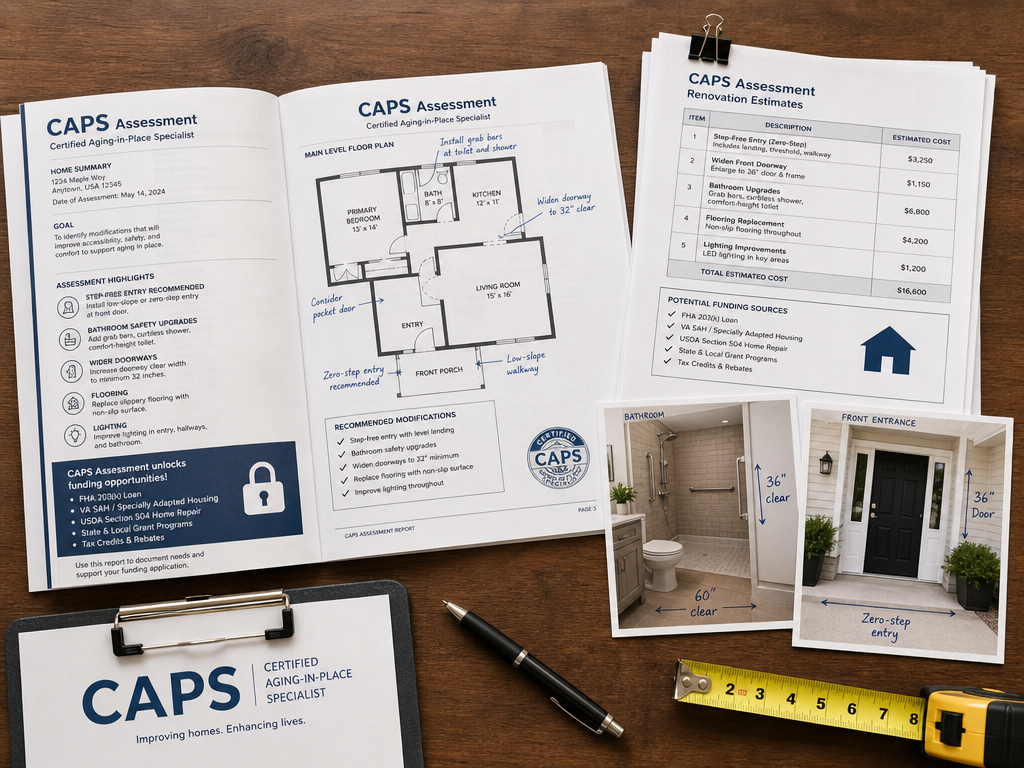
The single most important takeaway of this guide is this: the CAPS assessment report is not just a planning tool — it is a funding document. A well-prepared CAPS assessment report ($300–$1,000 depending on the specialist's experience and location) can be submitted to multiple funding sources simultaneously, serving as the clinical documentation, itemized estimate, and photographic evidence required by each program.
What a Complete CAPS Assessment Report Should Include
- Home floor plan with measurements and accessibility notes
- Photographs of current conditions in each area to be modified
- Prioritized list of recommended modifications (safety-critical first, then convenience and long-term planning)
- Itemized cost estimates for each modification, including materials and labor
- Phased project plan showing which modifications can be done immediately and which can wait
- Medical necessity justification language that can be used in VA, Medicaid, and tax deduction applications
With this single document package, you can apply for a VA HISA grant, submit to your state's Medicaid HCBS waiver program, apply for a USDA Section 504 grant, document the expense for an IRS medical deduction, and qualify for a state assistive technology loan — all using the same CAPS assessment as the foundation.
Staging Modifications Over Time to Match Funding Availability
Few families can fund an entire home modification project at once — and few need to. A phased approach that matches the urgency of each modification with the timeline of each funding source is the most practical strategy. The key is to start with high-safety-impact, lower-cost items while the larger grant applications are being processed.
| Phase | Timeline | Modifications | Funding Source |
|---|---|---|---|
| Phase 1: Immediate Safety | Month 1–2 | Grab bars ($100–$300), improved lighting, non-slip flooring in bathroom, lever handles | Out-of-pocket or Rebuilding Together (if eligible) |
| Phase 2: Urgent Access | Month 2–4 | Ramp ($1,500–$5,000), stairlift ($3,000–$5,000), widened doorways | VA HISA grant application submitted; state assistive technology loan |
| Phase 3: Major Renovation | Month 4–8 | Walk-in tub ($5,000–$15,000), full bathroom remodel, kitchen modifications | VA SAH/SHA grant, USDA Section 504, Medicaid HCBS waiver |
| Phase 4: Long-Term Planning | Month 8–12+ | First-floor bedroom addition, whole-home reconfiguration, smart home integration | Tax deduction (IRS Pub 502) for all phases; additional grants as available |
A CAPS professional can help design a phased plan that aligns with funding availability. They understand which modifications are most likely to be approved by each funding source and can structure the project so that the most critical safety needs are addressed first, while larger structural changes wait for grant approvals.
The path from deciding to work with a CAPS to completing a funded home modification is not always quick, but it is navigable. Start with the CAPS assessment. Use that report to apply for every funding source for which you may qualify. Phase the work to match the funding timeline. And remember: the cost of the assessment itself — typically $300 to $1,000 — is often the best investment you can make, because it unlocks access to thousands of dollars in grants, deductions, and loans that would otherwise remain out of reach.
For a broader perspective on whether home modifications make financial sense compared to moving, see our decision framework for aging-in-place remodels vs. moving to senior care. And for a deeper look at how the cost of modifications compares to the cost of assisted living, read our financial roadmap comparing home care, assisted living, and nursing homes in 2026.
Related reading
Need a professional assessment?
Find a CAPS-credentialed professional or local aging services through our outbound resource list — we never name or rank individual contractors.
Find Local HelpNoticed something outdated or inaccurate on this page? Flag a correction. We review every report against CDC, NIA, and AARP HomeFit guidance before updating a page.