
Room checklist
When an Aging-in-Place Remodel Makes Financial Sense vs. Moving: A Caregiver's Decision Framework
A balanced decision framework for adult children weighing whether to invest in modifying a parent's home or move them to assisted living. Includes cost comparisons, hidden caregiver costs, and a decision matrix to help families make an informed, budget-realistic choice.
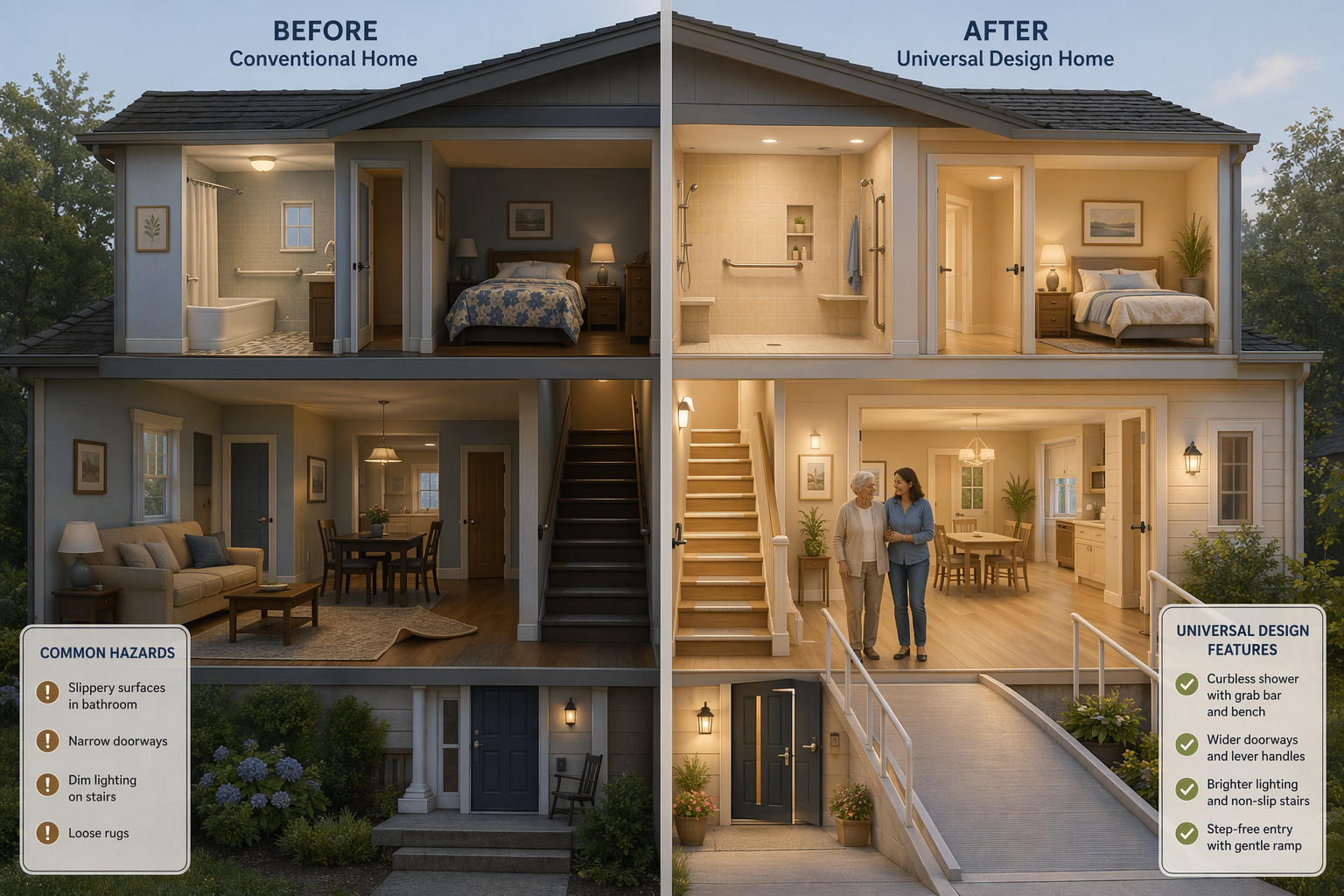
The Common Assumption: 'Staying Home Is Cheaper'
When a parent's mobility declines or a fall happens, the first instinct for many adult children is to modify the family home. The logic feels straightforward: a one-time investment in grab bars and a walk-in shower has to be less expensive than the monthly bill for assisted living. And emotionally, the home carries decades of memories. But the financial math is rarely that simple.
The reality is that aging in place involves two distinct cost layers that families often conflate: the one-time expense of modifying the physical structure and the ongoing, often escalating cost of in-home care. A 2022 National Poll on Healthy Aging found that while 88% of Americans age 50–80 consider it important to remain in their homes, only 34% said their home definitely has the features needed to do so safely. Another 19% said it does not. When the home itself is working against the goal, the cost to bridge that gap can quickly rival — or exceed — the cost of a move.
When Remodeling Makes Financial Sense
For many families, investing in home modifications is the clearly superior option. The key is that the home and the care situation must align. Here are the conditions under which remodeling tends to be the right financial and practical call.
The Home Is Structurally Suitable
A single-story home, or a two-story home with a first-floor bedroom and full bathroom, is the strongest candidate for a cost-effective remodel. A 2020 report estimated that only 10% of U.S. homes meet basic aging-ready criteria — a step-free entryway, a first-floor bedroom and bathroom, and accessible bathroom features. If the home already has a bedroom and bath on the main level, the modification scope shrinks dramatically. You are likely looking at bathroom upgrades, grab bars, lighting improvements, and threshold ramps — work that typically falls in the $3,000 to $15,000 range for basic modifications.
Modification Costs Stay Under $15,000–$30,000
When the total estimated cost of necessary modifications is under $15,000 to $30,000, the math strongly favors remodeling. A comprehensive bathroom remodel with a walk-in shower, grab bars, and non-slip flooring typically runs $20,000–$25,000. A stair lift for a straight staircase averages $2,000–$5,000. These are significant sums, but they are one-time costs. Compare that to a single year of assisted living at approximately $54,000 annually (Genworth Cost of Care Survey), and the remodel pays for itself in less than a year.
A 2025 systematic review of 20 studies on home modifications found that 65% confirmed their effectiveness in fall prevention, functional independence, and cost savings. One study within the review (Carnemolla et al., 2019) reported a 42% reduction in weekly care hours after modifications — informal care dropped by 46% and formal care by 16%. That reduction in care hours translates directly into lower monthly costs.
The Parent Has Strong Social Supports and Manageable Health Needs
Remodeling works best when the older adult is not isolated. A 2022 University of Michigan poll found that only 67% of older adults have someone who could help with personal care tasks, and 28% live alone. Those living alone were far more likely to lack help with personal care (48% vs. 27%). If your parent has nearby family, friends, or a spouse who can provide occasional assistance, and their health conditions are manageable with periodic check-ins, modifications can extend safe independent living for years.
Local In-Home Care Is Available and Affordable
Even with a perfectly modified home, most older adults will eventually need some paid care. The national median hourly rate for home care aides is $27. At 40 hours per week, that adds up to roughly $56,000 per year. In areas where home care is more affordable or where the parent needs only a few hours per week, the combined cost of modifications plus part-time care can still be less than assisted living. But in rural areas or regions with thin service availability, finding reliable in-home care at any price can be the deciding factor against remodeling.
- Home is single-story or has first-floor bedroom and bath
- Total modification cost estimated under $15,000–$30,000
- Parent has nearby family or social support network
- Health conditions are manageable with periodic assistance
- Reliable in-home care is available at a reasonable hourly rate
When Remodeling May Not Be the Right Choice
There is a quieter, less discussed side of the aging-in-place conversation: the situations where pouring money into modifications is not the best use of the family's resources. These are the scenarios where moving — whether to an accessible single-story home, an apartment, or an assisted living facility — may be the more honest and financially sound decision.
The Home Requires $50,000+ in Modifications Plus Ongoing Care
When the modification list includes major structural work — widening hallways and doorways ($600–$2,000 per doorway), installing a stair lift for a curved staircase (starting at $10,000), adding a home elevator ($20,000–$50,000), and a full bathroom gut renovation ($20,000–$25,000) — the total can easily exceed $50,000 to $100,000. At that point, the one-time investment is roughly equivalent to one to two years of assisted living. If the parent also needs significant in-home care on top of that, the combined monthly cost can exceed assisted living from day one.
The Home Has Multiple Levels Without a First-Floor Bedroom or Bath
A two-story home where the only bedroom and full bathroom are upstairs is one of the most expensive scenarios to retrofit. Adding a first-floor bedroom and bathroom often requires structural changes, plumbing relocation, and significant square footage reconfiguration. In many cases, the cost of creating a ground-floor living suite rivals or exceeds the cost of moving to a single-level home or an apartment designed for accessibility. If you are facing this situation, it is worth reading our comparison of stair lifts vs. home elevators vs. moving to understand the full cost picture.
The Parent Lives Alone with Multiple Chronic Conditions
According to the National Council on Aging, 94.9% of adults aged 60 and older have at least one chronic health condition, and 78.7% have two or more. When a parent lives alone with multiple chronic conditions — diabetes, heart disease, arthritis, and cognitive decline — the safety risk escalates even in a perfectly modified home. Falls among older adults cost over $50 billion per year in medical expenses (CDC), and one-third of adults 65+ experience a fall each year, with two-thirds of those falls occurring in or around the home. If the parent's health trajectory suggests that a move to a higher level of care will be needed within one to two years anyway, spending $50,000 on modifications that will only be used for a short time is hard to justify.
Rural Areas with Thin Service Availability
In rural communities, the availability of both home care aides and contractors qualified for aging-in-place modifications can be severely limited. A home may be structurally suitable for modifications, but if no one is available to install them or to provide the ongoing care the parent will need, the remodel plan stalls. In these cases, moving closer to a family member or to a community with better service infrastructure is often the only viable path.
- Total modification cost exceeds $50,000 (structural changes, elevator, full bathroom reconfiguration)
- Home has multiple levels with no first-floor bedroom or bathroom
- Parent lives alone with two or more chronic conditions
- Health trajectory suggests a move will be needed within 1–2 years
- Rural location with limited access to home care and qualified contractors
Cost Comparison: One-Time Modifications vs. Ongoing Care
The table below lays out the major cost categories side by side. The critical insight is that a one-time comprehensive modification ($15,000–$60,000) can cost less than a single year of assisted living ($54,000) or nursing home care ($95,000). But that comparison only works if the parent does not also need significant ongoing in-home care. When you add $56,000 per year for 40 hours per week of home care to a $50,000 modification, the combined first-year cost exceeds $100,000.
| Option | Typical Cost Range | Cost Type | Key Consideration |
|---|---|---|---|
| Basic home modifications (grab bars, lighting, rails) | $3,000–$15,000 | One-time | Suitable for homes with good baseline accessibility |
| Comprehensive modifications (bathroom remodel, stair lift, ramps) | $15,000–$60,000 | One-time | Can cost less than one year of assisted living |
| Extensive structural modifications (elevator, full reconfiguration) | $50,000–$100,000+ | One-time | May approach or exceed 2 years of assisted living costs |
| In-home care (40 hrs/week at $27/hr median) | ~$56,000/year | Ongoing | Cost varies significantly by region |
| Assisted living (national average) | ~$54,000/year | Ongoing | Genworth Cost of Care Survey; includes housing, meals, some care |
| Nursing home (semi-private room) | ~$95,000/year | Ongoing | Skilled nursing care; highest level of support |
For a more detailed breakdown of the pro-remodel financial argument, see our companion article: Does an Aging-in-Place Remodel Pay for Itself? That piece builds the case for remodeling as a financial investment. This article presents the balanced counterpoint: when it works and when it does not.
The Hidden Caregiver Cost: $304,000 in Lost Lifetime Wages

One of the most overlooked factors in the remodel-versus-move decision is the financial toll on the family caregiver — typically an adult child in their 40s or 50s. The average unpaid family caregiver loses an estimated $304,000 in lifetime wages and benefits due to reduced work hours, career interruptions, and early retirement. Approximately half of all family caregivers pay at least $5,000 per year out of pocket for their aging loved one's expenses.
This hidden cost affects the decision in two ways. First, if remodeling allows the parent to remain at home with less hands-on care from family, it can reduce the caregiver's lost wages. The Carnemolla et al. 2019 study found that home modifications reduced informal (family) care hours by 46%. That is a meaningful reduction in the time a working adult child must take off from their job. Second, if the caregiver is already stretched thin, the decision to remodel rather than move may actually increase the caregiving burden — and the associated wage loss — if the parent needs more daily assistance than modifications alone can provide.
If you are facing resistance from a parent who does not want to discuss modifications or a move, our conversation guide for reluctant parents offers practical scripts and strategies for having that difficult discussion.
Funding Sources Checklist for Home Modifications
If the decision leans toward remodeling, the next question is how to pay for it. Several funding sources exist, though eligibility varies by state, income, and individual circumstances. This checklist provides a starting point. For full details on each program, see our comprehensive guide to funding sources for home modifications.
- Medicaid Home and Community-Based Services (HCBS) waivers: Cover home modifications in many states for income-eligible individuals. Eligibility and covered services vary significantly by state.
- USDA Section 504 Home Repair Loan and Grant: Provides up to $40,000 in loans and up to $10,000 in grants for very-low-income homeowners aged 62+ to remove health and safety hazards. Must live in an eligible rural area.
- VA Aid and Attendance benefit: For veterans and surviving spouses who need assistance with daily activities. Can be used to pay for home modifications that support independent living.
- Community Development Block Grants (CDBG): Federal grants administered by local governments that may fund home rehabilitation and accessibility improvements for low-income homeowners.
- Local Area Agencies on Aging (AAA): Provide information and referral services for local funding programs, including state-specific grants and nonprofit assistance programs.
- Habitat for Humanity Aging in Place Program: Some local affiliates offer home modification services for low-income older adults, including ramp building and bathroom safety upgrades.
Decision Matrix: Remodel or Move?
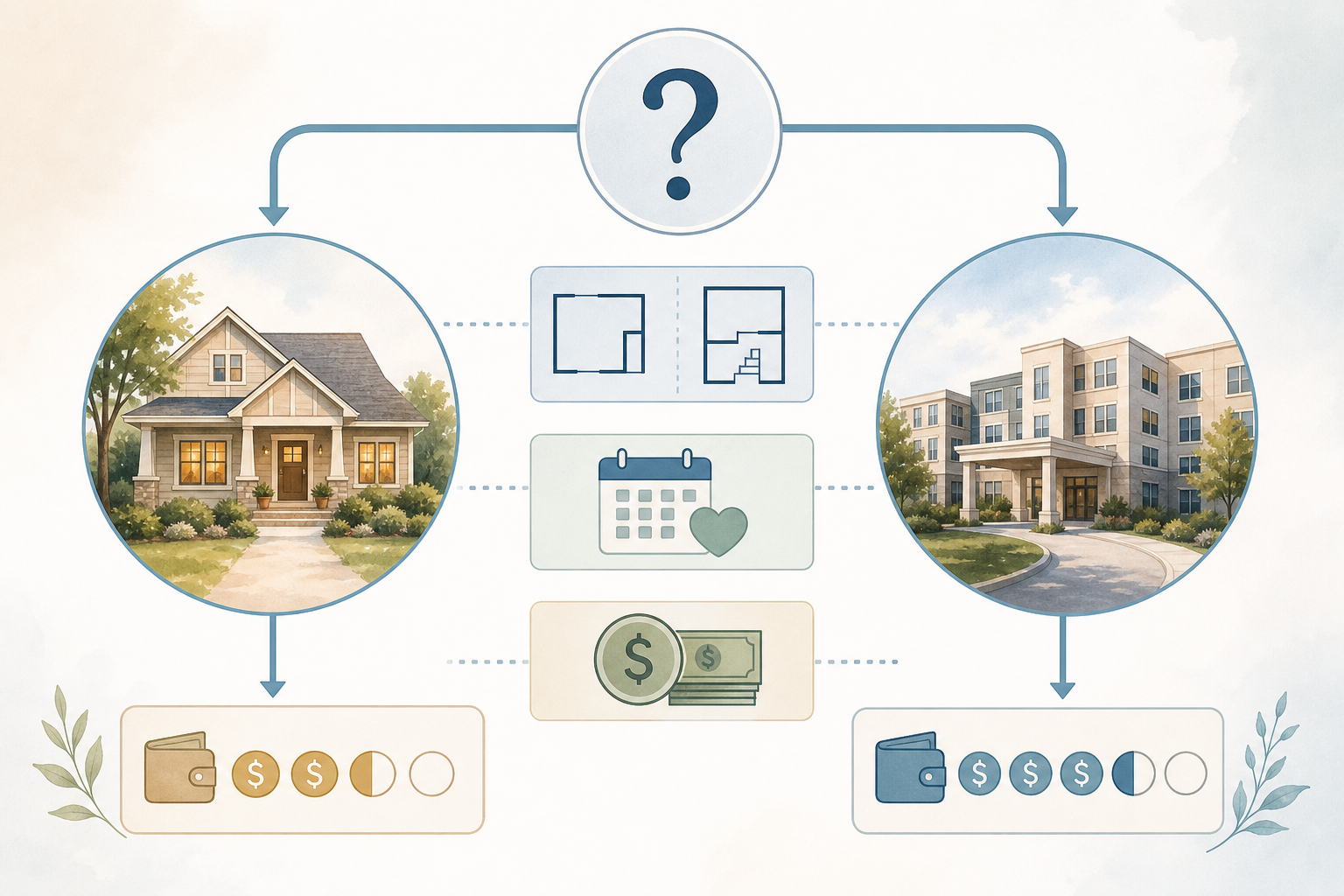
The following matrix is designed to help your family evaluate your specific situation. Rate each factor on a scale of 1 (strongly favors moving) to 5 (strongly favors remodeling). Total your score and use the guidance below to interpret the result.
| Decision Factor | 1 (Favors Moving) | 3 (Neutral) | 5 (Favors Remodeling) | Your Score |
|---|---|---|---|---|
| Home accessibility score | Multi-level, no first-floor bedroom/bath, narrow doorways | Some features present, some missing | Single-story or has first-floor bedroom/full bath, step-free entry | |
| Estimated modification cost | Over $50,000 (structural changes, elevator) | $15,000–$50,000 | Under $15,000 (grab bars, lighting, basic bathroom mods) | |
| Parent's health trajectory | Multiple chronic conditions, declining, likely needs move within 1–2 years | Stable with some progression expected | Manageable conditions, good mobility, slow progression | |
| Availability of local in-home care | Rural area, no reliable home care agencies within 30 minutes | Some options but limited availability or high cost | Multiple agencies, competitive rates, aides available | |
| Caregiver proximity and capacity | Caregiver lives 2+ hours away, has full-time job and young children | Caregiver lives 1–2 hours away, moderate flexibility | Caregiver lives nearby, has schedule flexibility and backup support | |
| Parent's social support network | Lives alone, no nearby family or friends, isolated | Some social connections but limited | Strong local network of family, friends, or community | |
| Total projected 5-year cost (mods + care vs. move) | Moving is clearly less expensive over 5 years | Costs are roughly equivalent | Remodeling is clearly less expensive over 5 years |
How to Interpret Your Score
- Score 28–35: Strongly favors remodeling. Your home is structurally suitable, modification costs are manageable, and the parent has good support. Proceed with a detailed cost estimate from a CAPS-certified contractor.
- Score 21–27: Leans toward remodeling, but with caution. Review the lower-scoring factors carefully. If modification costs are high or the parent's health is declining, consider a phased approach — start with the most critical modifications and reassess in 12 months.
- Score 14–20: Leans toward moving. The combination of high modification costs, limited support, or a declining health trajectory suggests that moving may be the better long-term choice. Visit a few assisted living or accessible housing options before making a final decision.
- Score 7–13: Strongly favors moving. The home requires extensive modifications, the parent has significant care needs, or local support is unavailable. Prioritize finding an accessible living arrangement that can meet current and future needs.
Related reading
Need a professional assessment?
Find a CAPS-credentialed professional or local aging services through our outbound resource list — we never name or rank individual contractors.
Find Local HelpNoticed something outdated or inaccurate on this page? Flag a correction. We review every report against CDC, NIA, and AARP HomeFit guidance before updating a page.