
Room checklist
How to Pay for a Senior Bathroom Remodel in 2026: Medicare, Grants, and Tax Deductions
Aging-in-place bathroom remodels don't have to drain savings. Learn about Medicare coverage, VA grants, Medicaid waivers, and tax deductions that can help pay for modifications in 2026.
The first mistake families make with a bathroom remodel for an older parent is assuming the whole bill has to come from savings. The second mistake is believing every “grant” headline. The useful middle ground is less dramatic: check the payers in the right order, ask for the right document, and do not let a contractor estimate become the first and only financial plan.
That order matters more in 2026 because Medicare is no longer completely outside the bathroom conversation. Starting January 1, 2026, Medicare coverage is reported to include home accessibility assessments performed by doctors, occupational therapists, or other qualified professionals.[1] That does not mean Medicare now pays to tear out a tub and install a roll-in shower. It means an eligible professional assessment may help document what is medically needed before the family starts chasing plan benefits, VA grants, Medicaid waiver language, tax deductions, or local help.
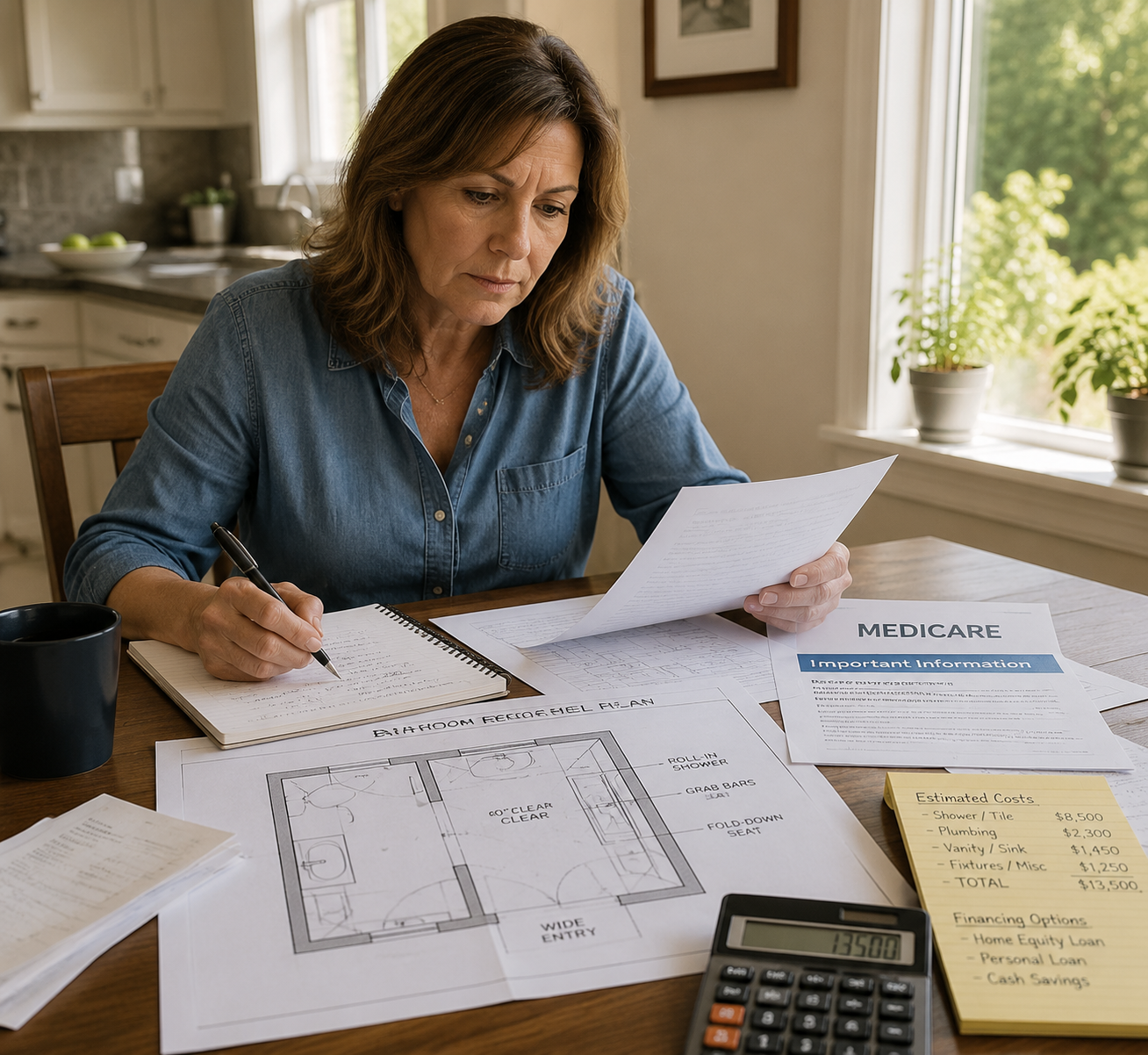
Start With Assessment, Not Demolition
A bathroom can feel urgent after a fall, but funding programs usually move on paperwork, not panic. Before signing a remodel contract, get the need described in clinical or functional terms: trouble stepping over a tub wall, need for grab bars at transfer points, wheelchair access, inability to bathe safely without help, or a doorway too narrow for a mobility device.
The 2026 Medicare assessment change is useful because it can put a professional’s words between the family’s worry and the contractor’s proposal. An occupational therapist may describe bathing tasks, transfer risks, and equipment needs differently from a remodeler. A doctor may document medical necessity. A qualified accessibility professional may connect the physical problem to specific modifications. Those distinctions can matter later if a plan, waiver, tax preparer, or grant administrator asks why the work was needed.
If you are deciding who should evaluate the bathroom first, the practical difference between clinical and construction roles matters. An occupational therapist can assess functional need; a CAPS-trained remodeler can translate aging-in-place goals into construction decisions. For a fuller comparison, see Aging in Place Specialist vs. Occupational Therapist before you pay for overlapping opinions.
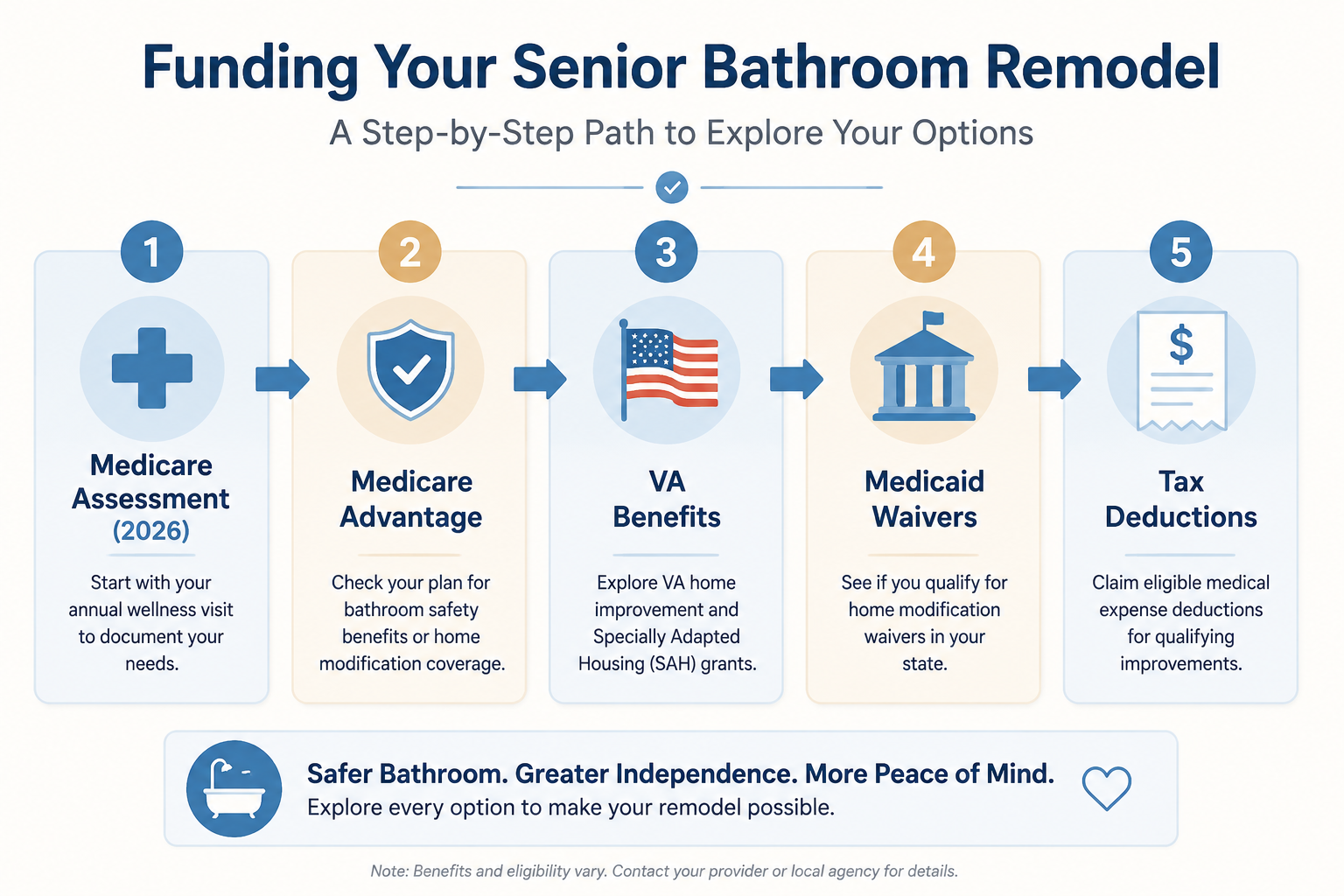
The Funding Check Should Run in This Order
There are many possible sources of help, but they are not equal. Some depend on the parent’s health coverage. Some depend on military service. Some depend on income, disability level, state waiver rules, or rural location. A family trying to make calls during lunch breaks needs a sequence, not a pile of tabs.
| Checkpoint | Why it comes here | What to ask for |
|---|---|---|
| Original Medicare | New 2026 assessment coverage may document need, but remodel coverage remains limited. | Ask whether the assessment is covered and whether any prescribed bathroom safety equipment qualifies. |
| Medicare Advantage | Some plans offer supplemental in-home support benefits, but coverage varies by plan. | Ask for the Summary of Benefits language on bathroom safety, grab bars, shower modifications, and in-home supports. |
| VA benefits | For eligible veterans, housing adaptation grants can be large enough to reshape the project budget. | Ask whether the veteran may qualify for SAH or other adaptive housing assistance. |
| Medicaid HCBS waiver | For income- and care-need-eligible older adults, some states cover environmental accessibility adaptations. | Ask whether bathroom modifications are covered, whether there is a waitlist, and what assessment is required. |
| Tax and local programs | These may reduce the remaining burden even when they do not replace primary funding. | Ask what documentation, income rules, homeownership rules, and receipts are required. |
What Medicare Can and Cannot Do in 2026
Original Medicare still should not be treated as a bathroom remodel payer. It typically does not cover home renovations. The more realistic Medicare question is narrower: will it cover an accessibility assessment, and will it cover specific medically necessary equipment?
For equipment, grab bars may be covered as durable medical equipment when they are medically prescribed, with Medicare paying 80% after the usual requirements are met; a physician’s certification of medical necessity is required.[2] That is not the same as paying for tile work, plumbing relocation, a full shower conversion, or widening a doorway. If a family keeps those categories separate, the call with Medicare becomes less frustrating.
The assessment change deserves attention because it can create a cleaner paper trail. If the assessment says a parent cannot safely step over the tub wall, that does not magically fund construction. But it can support the next calls: Medicare Advantage, Medicaid waiver intake, a VA housing grant application, a tax file, or a nonprofit repair program. Before relying on the 2026 assessment benefit, verify current coverage details with Medicare or the plan administrator, and check CMS guidance when available.
Medicare Advantage Needs a Plan-Specific Call
Medicare Advantage is where families often hear just enough to get hopeful and not enough to know what to do. In 2020, 148 of 3,148 Medicare Advantage plans offered in-home support benefits that included items such as grab bars and shower modifications.[2] That figure is old and may undercount current offerings, but it is still useful for one reason: it proves these benefits exist in some plans, not all plans.
Do not ask the plan, “Do you pay for bathroom remodels?” That wording invites a fast no. Ask for the current Summary of Benefits and the Evidence of Coverage sections on supplemental benefits, in-home support services, home safety devices, bathroom safety equipment, and shower modifications. Then ask whether prior authorization, a provider network, a physician order, or an in-home assessment is required.
If the representative says the plan covers grab bars, pin down whether that means the bars only, installation, a vendor allowance, or a broader shower modification. Write down the date, name or ID of the representative, and the exact phrase they used. Families lose time when “covered” turns out to mean “covered only through a contracted vendor after approval.”
If There Is Military Service, Check VA Benefits Early
For a veteran with qualifying disability-related housing needs, VA adaptive housing help can change the scale of the whole project. The Specially Adapted Housing grant is listed at up to $117,014 for 2026 and can be used for eligible adaptive housing modifications, including bathroom renovations.[3] That ceiling is high enough that it belongs near the top of the funding search, not after a family has already drained savings.
The VA question is not simply whether the parent served. Eligibility depends on the veteran’s circumstances and the program’s disability and housing criteria. A bathroom project may need to be tied to mobility, transfer safety, wheelchair access, or another qualifying need. The practical first step is to gather discharge papers, current VA disability information if available, medical documentation, and any assessment describing why the existing bathroom is unsafe.
If a contractor is already involved, do not let the estimate stand alone. Ask for a scope that separates accessibility elements from general upgrades: roll-in shower, widened doorway, grab bars, non-slip flooring, toilet clearance, or other features connected to safe use. That makes the application easier to review and reduces the chance that medically necessary work gets buried inside a cosmetic remodel.
Medicaid Waivers Can Help, But the State Rules Decide
Medicaid Home and Community-Based Services waivers are often the biggest surprise in this search. In many states, these waivers can fund “Environmental Accessibility Adaptations,” a category that may include roll-in showers, widened doorways, grab bars, and ramps.[3][4] For an older adult who meets income rules and care-need rules, that category can be much more relevant than a general home repair grant.
This is also where optimism needs a brake. HCBS waivers are state-specific. Covered services, financial eligibility, functional eligibility, assessment requirements, provider rules, and waitlists vary. Some states may have years-long waitlists.[3] A family facing an immediate bathing safety problem may still need a temporary solution while the waiver process moves.
The call should be specific: “Does our state’s Medicaid HCBS waiver cover environmental accessibility adaptations for bathroom safety, such as a roll-in shower or doorway widening?” Then ask who performs the assessment, whether work must wait for approval, whether contractors must be Medicaid-approved, and whether the parent can be reimbursed after paying upfront. Do not assume the answer from another state applies to yours.
Keep Tax Records Even If No Grant Comes Through
Tax deductions do not solve a cash-flow problem before construction starts, but they can reduce the after-tax cost for families who qualify. Medically prescribed home modifications may be deductible as medical expenses to the extent total qualifying medical expenses exceed 7.5% of adjusted gross income.[3] If a modification increases the home’s value, the increase generally has to be subtracted from the deductible amount.[3]
That rule rewards boring recordkeeping. Keep the medical prescription or assessment, contractor invoices, proof of payment, before-and-after scope descriptions, and any note showing which part of the project was for medical access rather than preference. A tax preparer can make the final call, but the family has to preserve the evidence while the project is still fresh.
For example, replacing a tub with a low-threshold shower because a parent cannot safely step over the tub wall may be easier to document as medically related than replacing all bathroom cabinetry for style. The point is not to play tax lawyer at the kitchen table. It is to separate necessity from upgrades before every receipt looks the same.
Secondary Help That Can Still Matter
Not every source has to pay for a full remodel to be worth checking. Bathroom modification costs can span a wide range. A 2026 cost report cited a national range of $6,600 to $28,000 for aging-in-place bathroom modifications, while smaller home modifications may cost $150 to $2,000.[5][6] That means a modest grant, donated labor, or sliding-scale contractor fee can still close a painful gap.
- Area Agencies on Aging: ask about local home modification funds, caregiver support programs, fall-prevention partnerships, and nonprofit repair referrals.
- Rebuilding Together: check whether local affiliates offer safety repairs or accessibility modifications for older homeowners.[4]
- USDA Rural Repair and Rehabilitation Grants: very-low-income rural homeowners age 62 or older may qualify for grants up to $41,000.[3]
- Contractor payment options: some contractors offer sliding-scale fees based on income, and some smaller modifications may be affordable before a full remodel is possible.[6]
These checks should not replace Medicare Advantage, VA, or Medicaid waiver calls when those may apply. They are the next layer: useful for gaps, timing problems, or households that do not qualify for the larger programs.
Match the Bathroom Scope to Coverage Language
A funding file should describe the bathroom in the language programs use. “Beautiful new bathroom” does not help. “Shower modification for safe transfer,” “grab bars at toilet and shower,” “roll-in shower for wheelchair access,” or “doorway widening for mobility device clearance” is closer to the way benefits and waivers tend to think.
This does not mean every bathroom has to become clinical and ugly. It means the estimate should separate safety work from preference work. If the family chooses nicer tile, a larger vanity, or extra storage, that may be perfectly reasonable, but it should not blur the part of the project that a payer might classify as durable medical equipment, a supplemental benefit, an environmental accessibility adaptation, or a medically necessary improvement.
Once funding options are clearer, the next professional decision becomes easier. A CAPS-certified specialist can help translate accessibility needs into a remodel plan; a general contractor may be enough for limited work if the scope is already clear. The NAHB aging-in-place remodeling checklist can help families see which accessibility issues belong in the conversation before bids are compared.[7]
For hiring help after the funding calls, see How to Hire a CAPS-Certified Aging-in-Place Specialist and CAPS, OT, or General Contractor: Which Professional Should Handle Your Parent’s Home Modifications?.
The Calls and Documents to Make Before Signing
The fastest way to lose track is to call everyone with a different version of the story. Use the same basic packet each time: medical need, current coverage, veteran status if relevant, income or Medicaid status if relevant, homeownership status, and a draft scope of accessibility work.
- Ask Medicare or the clinician’s billing office how the 2026 home accessibility assessment is covered and which professionals qualify.
- Call the Medicare Advantage plan, if there is one, and request the current Summary of Benefits language for bathroom safety equipment, home supports, and shower modifications.
- If the parent is a veteran, contact VA benefits support before reducing the project scope, especially if mobility or disability-related housing needs are involved.
- Call the state Medicaid office or waiver intake line and ask specifically about environmental accessibility adaptations, waitlists, assessments, and approved contractors.
- Ask the local Area Agency on Aging about repair programs, nonprofit partners, and emergency safety modifications.
- Keep medical letters, assessment notes, plan denials or approvals, contractor estimates, invoices, and proof of payment for tax review.
If only one call gets made today, make it the one that can create documentation: the Medicare-covered accessibility assessment if available, or an occupational therapy evaluation if that is the route your coverage recognizes. A contractor can price the work. The funding search needs proof of why the work has to happen.
References
- Medicare to Cover Home Accessibility Assessments Starting 2026, AllAboutAccess
- Does Medicare Cover Home Improvements?, SeniorList
- Loans, Grants & Financial Aid for Home Modifications, PayingForSeniorCare
- Getting Help to Pay for Home Repairs or Modifications, Age Safe America
- Bathroom Remodel for Elderly 2026 Guide, BuildWithinInspiration
- How Much Do Home Modifications Cost for Aging in Place?, ElderLife Financial
- Aging-in-Place Remodeling Checklist, National Association of Home Builders
Related reading
Need a professional assessment?
Find a CAPS-credentialed professional or local aging services through our outbound resource list — we never name or rank individual contractors.
Find Local HelpNoticed something outdated or inaccurate on this page? Flag a correction. We review every report against CDC, NIA, and AARP HomeFit guidance before updating a page.