
Room checklist
Aging in Place Specialist vs. Occupational Therapist: Who Should You Call for Home Modifications?
Many family caregivers are unsure whether to call a CAPS-certified aging-in-place specialist or an occupational therapist for home safety assessments and modifications. This guide explains the distinct roles of each professional, where they overlap, and how a growing number of dual-credential experts offer the best of both worlds.
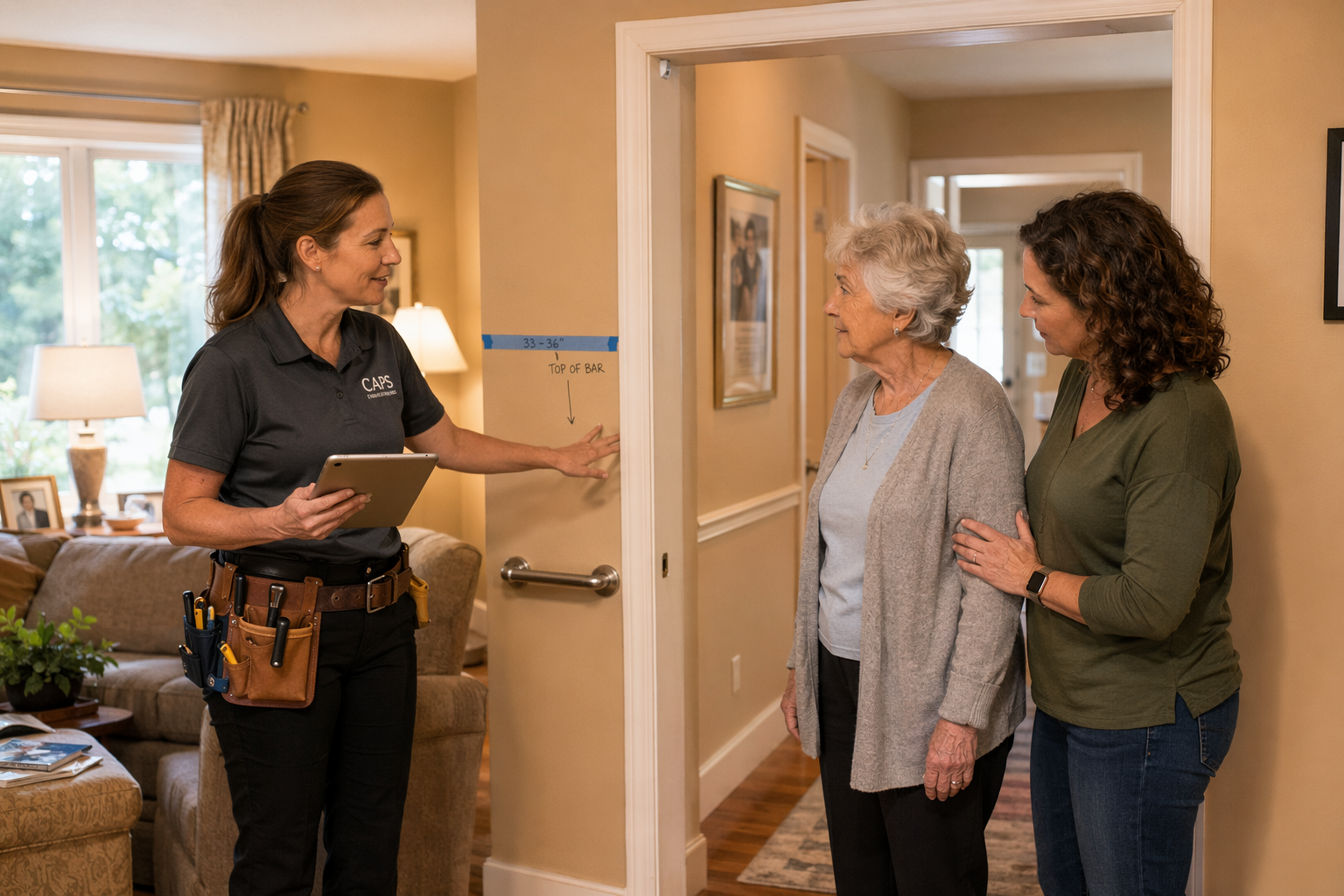
Should You Call an OT or a CAPS? The Dilemma Families Face
You have just watched your mother struggle to step out of the bathtub. Or your father has started using a cane but the hallway is too narrow for him to pass comfortably. Your instinct is clear: the house needs to change. But the next question stops you cold. Who do you call?
The medical world points you toward an occupational therapist (OT). The construction world points you toward a Certified Aging-in-Place Specialist (CAPS). Both professionals can evaluate a home and recommend modifications. Both focus on safety. But they are not interchangeable, and choosing the wrong one first can cost you time, money, and — most importantly — leave a critical safety gap unfilled.
This article breaks down exactly what each professional does, where their expertise overlaps, where it diverges, and how a growing number of dual-credential experts now offer an integrated solution. By the end, you will know which path fits your family's situation — and when you need both.
What Is a CAPS-Certified Aging-in-Place Specialist?
The Certified Aging-in-Place Specialist (CAPS) designation is a professional credential offered jointly by the National Association of Home Builders (NAHB) and AARP since 2002. It was created to address a specific gap: most contractors and remodelers knew how to build beautiful kitchens and bathrooms, but few understood the design principles that make a home safe and functional for someone whose mobility, balance, or vision is changing.
The CAPS program consists of three courses:
- CAPS I — Marketing and Communicating Aging in Place: Understanding the client's needs and the three key market segments for aging-in-place services.
- CAPS II — Design Concepts and Methods for Livable Homes: Learning universal design principles, barrier-free layouts, and how to plan modifications that work for a range of abilities.
- CAPS III — Details and Solutions for Livable Homes: The hands-on course covering specific products, installation techniques, and code requirements for grab bars, ramps, roll-in showers, and other modifications.
A critical detail that surprises many families: there are no prerequisites for enrolling in the CAPS program. You do not need to be a licensed contractor, an architect, or a designer. According to the NAHB and CAPS educator Steve Hoffacker, students come from backgrounds as varied as general contracting, interior design, nursing, social work, real estate, and occupational therapy. This means a CAPS credential alone does not tell you what the professional's original field was — only that they have completed the three-course training and passed the exam.
In practice, most CAPS professionals are remodelers, contractors, or designers who added the credential to their existing construction expertise. Their strength lies in knowing how to build: what materials hold up in a wet bathroom, how to anchor a grab bar to a stud, which door widths meet accessibility standards, and how to coordinate subcontractors for a full renovation.
What Does an Occupational Therapist Bring to Home Modifications?
An occupational therapist approaches home modifications from the opposite direction. Instead of starting with the house, the OT starts with the person.
Occupational therapists are licensed clinicians trained to evaluate how an individual's physical, sensory, cognitive, and emotional abilities interact with their environment. They use a framework called the Person-Environment-Occupation (PEO) model, which examines the dynamic relationship between what a person can do (their strength, balance, vision, memory), where they do it (the home's layout, lighting, surfaces), and what they need to do (bathing, cooking, walking to the mailbox).
When an OT conducts a home assessment, they are not just looking at the physical structure. They are evaluating:
- Musculoskeletal function — joint range of motion, muscle strength, and endurance for tasks like standing at the sink or stepping over a tub edge.
- Neurological and cognitive status — balance, reaction time, spatial awareness, and the ability to sequence steps (e.g., turning off the stove before leaving the kitchen).
- Vision and perception — depth perception, contrast sensitivity, and glare tolerance, which directly affect stair safety and night-time navigation.
- Daily activity patterns — how the person actually moves through their morning routine, where they pause, where they reach for support, and where they feel unsteady.
This clinical lens produces recommendations that are tailored to the individual, not the average user. An OT might specify that a grab bar be placed at 38 inches rather than the standard 34 inches because the user is tall and has limited shoulder flexion. They might recommend a specific type of handrail because the user has peripheral neuropathy and cannot feel smooth metal. They might identify that the real fall risk is not the bathroom floor but the transition from a low sofa to standing — a problem a contractor would never think to look for.
Where CAPS and OTs Overlap — and Where They Differ
The confusion families experience is understandable because the two roles do share significant common ground. Both professionals conduct home assessments, both recommend modifications, and both prioritize safety. But the table below clarifies where their expertise aligns and where it diverges.
| Dimension | Occupational Therapist (OT) | CAPS Specialist |
|---|---|---|
| Primary focus | The person's functional abilities and how they interact with the home environment | The home's physical structure and how to modify it safely and to code |
| Assessment method | Clinical evaluation using the PEO model; observes the person performing daily tasks | Visual inspection of the home; measures doorways, steps, and clearances |
| Who they serve | Individuals with specific medical, functional, or cognitive limitations | Homeowners seeking safer, more accessible living spaces |
| Key output | A written plan specifying what modifications are needed and why, based on the person's clinical profile | A scope of work, material specifications, and contractor-ready drawings |
| Installation role | Rarely performs installation; may recommend products and oversee the functional outcome | Often performs or manages installation; ensures work meets building codes |
| Regulation | Licensed by state; governed by a professional board of occupational therapy | Certified by NAHB/AARP; may or may not hold a contractor's license |
| Insurance coverage | Medicare Part B may cover home assessments if deemed medically necessary | Services are typically private-pay; not covered by Medicare |
The most important distinction to remember: an OT tells you what to do and why; a CAPS tells you how to do it and who will do it. The OT's value is in the clinical reasoning behind the recommendation. The CAPS's value is in the construction expertise to execute it.
Why the Distinction Matters: Assessment vs. Installation
The practical consequences of choosing the wrong professional first become clear with a concrete example. Consider the humble grab bar — the most common home modification and the one most likely to be installed incorrectly.
An OT evaluates your mother's specific situation: she has arthritis in her right shoulder, reduced grip strength, and a history of feeling unsteady when stepping out of the shower. The OT watches her transfer from the shower bench to the bathroom floor and notices she instinctively reaches for the towel bar — which is not anchored to a stud. The OT determines that a 24-inch grab bar placed at a 45-degree angle on the side wall, plus a vertical bar at the entry, will give her the support she needs at the exact moment she needs it. The OT also notes that the current shower threshold is 6 inches high and recommends a low-threshold or roll-in option for the next renovation cycle.
A CAPS specialist takes that recommendation and makes it real. They know that the wall needs blocking between studs to support the bar at the specified angle. They know which stainless steel grade resists corrosion in a wet environment. They know the local building code for grab bar load capacity. They install the bar so it will hold 300 pounds of dynamic load — not just the 50 pounds a towel bar can handle. They also know that the current shower threshold cannot be modified without waterproofing the entire pan, so they plan a phased approach that addresses the immediate grab bar need now and the full bathroom remodel next year.
If you call a CAPS first without an OT assessment, you might get a perfectly installed grab bar in the wrong location — one that your mother cannot reach comfortably or that does not support her specific transfer pattern. If you call an OT first without a CAPS, you might get a brilliant modification plan that no contractor can build because it does not account for the home's structural limitations.
For a detailed room-by-room breakdown of what modifications to prioritize and in what order, see our Aging in Place Home Modifications: A Room-by-Room Prioritization Guide for Families.
The Dual-Credential Trend: OTs Who Also Hold CAPS
A growing number of professionals are eliminating the assessment-versus-installation dilemma by earning both credentials. These dual-credential experts — typically occupational therapists who have completed the CAPS program — offer integrated services that span clinical evaluation, modification planning, contractor coordination, and installation oversight.
The logic is straightforward. An OT who holds CAPS certification understands both the clinical reasoning behind a recommendation and the construction constraints that determine whether it can be built. They can walk into a home, assess the person's functional status using the PEO model, identify the environmental barriers, design modifications that address both the medical and structural realities, and then either oversee the installation or hand off a contractor-ready plan to a builder.
For OTs who want to add aging-in-place expertise to their practice, the Age Safe America Senior Home Safety Specialist (SHSS) certification provides an alternative pathway. The SHSS program includes 17 modules covering fall prevention, bathroom and kitchen safety, fire safety, dementia-friendly home design, scam prevention, and how to conduct a complete home safety assessment. The self-paced online course costs $397 and is approved for 0.5 CEUs by the American Occupational Therapy Association (AOTA). Upon completion, OTs earn the title of Certified Senior Home Safety Specialist.
For families, the dual-credential professional offers a single point of accountability. There is no risk of miscommunication between the clinician and the builder. There is no finger-pointing if a modification does not work as intended. The same person who assessed your parent's needs also ensured the solution was installed correctly.
- Ask directly: "Do you hold both an OT license and CAPS certification?" Many professionals list both credentials on their websites or business cards.
- If you cannot find a dual-credential professional in your area, hire an OT for the assessment and a CAPS for the installation — and ask them to communicate directly before work begins.
- For smaller projects (single grab bar, non-slip flooring, lighting upgrades), a CAPS alone may be sufficient if you have a clear sense of what is needed. For complex cases involving multiple health conditions or significant cognitive decline, start with an OT.
Cost Comparison: OT vs. CAPS Professional Services
When comparing costs, it is important to separate the cost of the professional's time and expertise from the cost of the actual modifications. The table below covers only the professional service fees — the assessment, consultation, and plan development — not the construction or product costs.
| Service | Typical Cost Range | Notes |
|---|---|---|
| Home safety assessment (CAPS) | $300 – $1,000 | Includes visual inspection, measurements, and a written report with recommendations. Some CAPS professionals charge a flat fee; others bill hourly. |
| Home safety assessment (OT) | $300 – $1,000 | May be covered by Medicare Part B or private insurance if deemed medically necessary and ordered by a physician. Coverage varies by plan and region. |
| Hourly consultation (CAPS) | $75 – $200 per hour | Typical for ongoing project oversight, contractor coordination, and follow-up visits. |
| Hourly consultation (OT) | $75 – $200 per hour | Rates vary by setting (hospital-based vs. private practice) and geographic region. |
| Comprehensive evaluation with visuals (CAPS) | $500 (flat fee example) | Some CAPS professionals, like Gina Knight quoted on Care.com, offer a personalized evaluation with photos and a detailed plan for a flat fee. |
Related reading
- CAPS vs. Occupational Therapist vs. General Contractor: Who Should You Hire for Aging-in-Place Home Modifications?
- OT vs. CAPS First for Home Modifications: Why the Clinical Evaluation Should Come Before the Construction Plan
- Aging-in-Place Specialist vs. General Contractor vs. Occupational Therapist: Who Should You Hire for Home Modifications?
Need a professional assessment?
Find a CAPS-credentialed professional or local aging services through our outbound resource list — we never name or rank individual contractors.
Find Local HelpNoticed something outdated or inaccurate on this page? Flag a correction. We review every report against CDC, NIA, and AARP HomeFit guidance before updating a page.