
Room checklist
Stair Lift vs. Home Elevator vs. Moving: Which Is Right for Aging in Place?
Compare stair lifts, home elevators, platform lifts, downstairs conversions, and moving to decide the best aging-in-place solution for your home and budget. Learn which option fits your mobility needs and financial situation.
The Fall Hazard: Why Stairs Demand a Solution
For older adults living in multi-story homes, the staircase is the single most dangerous feature of the house. According to the CDC, one in four older adults falls each year, and falls are the leading cause of both fatal and non-fatal injuries among people aged 65 and older. In 2021 alone, falls caused approximately 38,000 deaths and led to 3 million emergency department visits. The total healthcare cost of non-fatal falls in 2020 reached $80 billion, a figure projected to exceed $101 billion by 2030.
The good news is that multiple solutions now exist — each suited to different mobility levels, home configurations, and budgets. The challenge is choosing the right one. Below we compare five common approaches: stair lifts, home elevators, platform lifts, downstairs conversions, and moving. The goal is to give you a data-backed framework so you can make a confident decision that balances safety, cost, and long-term livability.
Stair Lifts: Fast, Affordable, but Not for Everyone
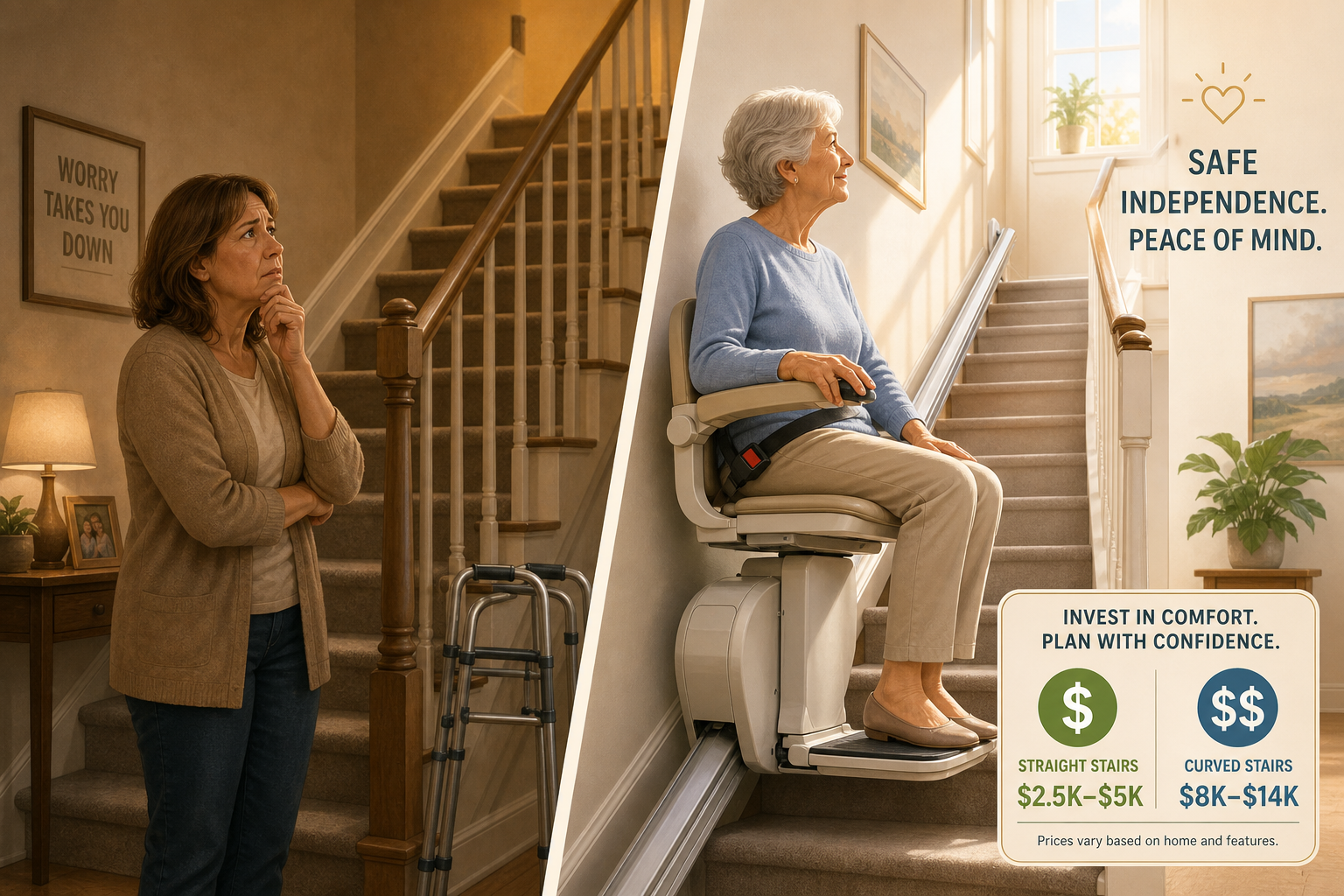
For the majority of older adults who can still stand and transfer safely, a stair lift is the most cost-effective and least disruptive option. Installed costs range from $2,500 to $15,000 depending on rail type (straight, curved, or outdoor), and installation typically takes 3 to 8 hours with no structural modifications to the home. The rail attaches directly to the stair treads, not the wall, and requires only a dedicated electrical outlet.
The National Council on Aging (NCOA) reports that stair lifts have a lifespan of approximately 10 years and that 92% of surveyed users (600 older adults) reported a positive or very positive impact on their lives, with 65% citing enhanced mobility. Annual maintenance plans cost $100–$300, and battery replacements run $200–$300 every 1–3 years.
- Cost: $2,500–$15,000 installed (straight $2,500–$5,000; curved $8,000–$14,000; outdoor $4,000–$10,000)
- Installation: 3–8 hours, no construction, no wall damage
- Lifespan: ~10 years
- Key limitation: the user must be able to transfer from a wheelchair or walker to the seat at the bottom and back at the top. Stair lifts do not carry wheelchairs.
- Not suitable for progressive conditions that will soon require a wheelchair on both floors.
Home Elevators and Platform Lifts: Full Accessibility at a Higher Cost
When a person uses a wheelchair full-time or has a progressive condition (such as ALS, multiple sclerosis, or late-stage arthritis) that will soon make transferring impossible, a stair lift becomes an inadequate solution. Home elevators and platform lifts provide true vertical accessibility — the user remains seated in their wheelchair or mobility device throughout the ride.
Home elevators (both shafted and shaftless models) typically range from $35,000 to $100,000 or more, including installation. They require significant construction — a shaft, pit, overhead structure, and electrical work — and can take several weeks to install. On the positive side, they add resale value to the home, have a lifespan of 20 years or more with proper maintenance, and can accommodate both wheelchair users and ambulatory passengers.
Platform lifts (sometimes called wheelchair lifts) are a middle ground, costing roughly $10,000 to $20,000. They operate on a vertical or inclined track and can carry a wheelchair user between levels. However, they are limited in vertical travel distance (typically 8–14 feet) and require adequate landing space at both floors. Installation is less invasive than an elevator but still requires planning and sometimes permits.
Downstairs Conversions and Moving: Long-Term Alternatives
Not every family needs a mechanical lift. In many homes, the smartest solution is to eliminate the need for stairs altogether by converting a ground-floor room into a bedroom or adding a bathroom on the main level. The cost of a downstairs conversion varies widely: converting an existing room into a bedroom can be as low as $5,000 if minimal changes are needed, while adding a full bathroom and modifying doorways for wheelchair access can run $15,000–$30,000 or more.
A downstairs conversion is a permanent structural change that makes the home truly single-level for daily living. It avoids reliance on any mechanical device and works for all mobility levels. It also preserves the upstairs for guests, storage, or future needs. The downside: not every home has a suitable room on the ground floor, and the scope of work can quickly escalate if plumbing or structural changes are needed.
Moving to a single-level home, a ranch-style house, or an accessible apartment is the most comprehensive solution — and often the most emotionally difficult. It eliminates all stairs, not just the main staircase, and can open up a wider community of services and social connections. However, moving costs, real estate transaction fees, and the emotional toll of leaving a familiar home must be weighed. Assisted living is another option, but it carries its own high monthly costs and lifestyle changes. Because these costs are highly variable and location-dependent, we do not present specific figures here.
Comparison at a Glance
| Option | Typical Cost (Installed) | Installation Time | Space Requirements | User Mobility Level Needed | Wheelchair Accessible? | Resale Value Impact | Lifespan |
|---|---|---|---|---|---|---|---|
| Stair lift | $2,500–$15,000 | 3–8 hours (no construction) | Minimal; rail on stair treads | Must be able to transfer to seat | No | Neutral to slight positive | ~10 years |
| Home elevator | $35,000–$100,000+ | Several weeks (construction) | Shaft, pit, overhead clearance | Any; full wheelchair access | Yes | Adds value | 20+ years |
| Platform lift | $10,000–$20,000 | 1–3 days (some construction) | Landing space at both floors | Any; wheelchair stays on platform | Yes (limited vertical travel) | Neutral to positive | 15–20 years |
| Downstairs conversion | $5,000–$30,000 | 1–4 weeks (construction) | Ground-floor room + possible bath | Any; eliminates need for stairs | Yes (if doorways widened) | Adds value (if well done) | Permanent |
| Moving to single-level home | Variable (cost of sale + purchase) | Weeks to months | New home selection | Any (if chosen appropriately) | Depends on home | N/A (new home purchase) | As long as you live there |
Making the Right Choice: A Decision Framework
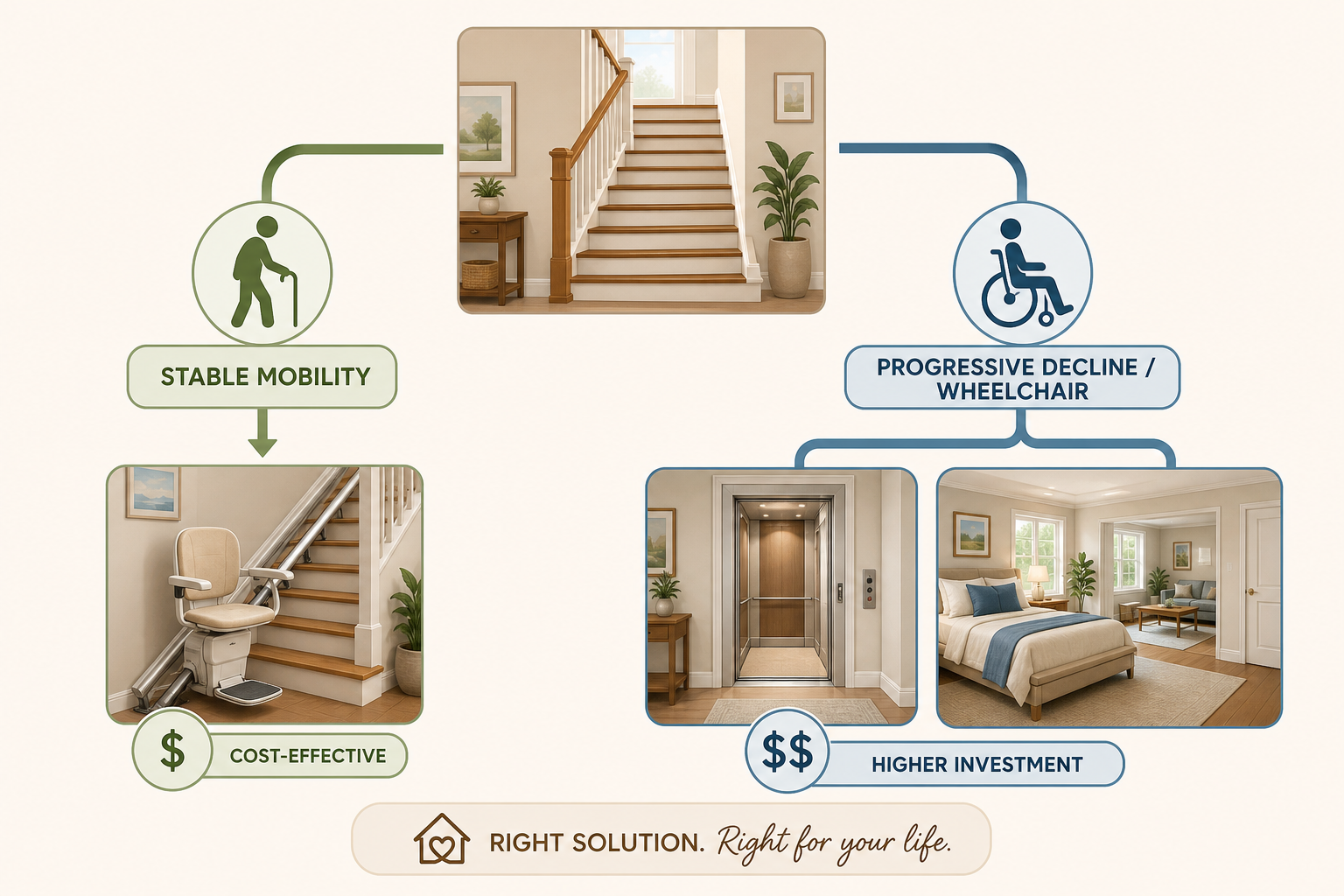
The right choice depends on three factors: the user's current mobility level, the likely trajectory of their condition, and the family's financial and emotional readiness for either construction or relocation.
Scenario 1: Stable Mobility (No Wheelchair Use Anticipated)
If the older adult can still stand, pivot, and sit independently — even with a walker or cane — a stair lift is the fastest, most affordable way to regain safe access to the second floor. The 92% user-satisfaction rate from NCOA's survey underscores that for most people, the device restores independence without the disruption of construction or moving. We recommend starting with a stair lift and reassessing every 12 months as mobility changes.
Scenario 2: Progressive Decline or Full-Time Wheelchair Use
For conditions that are expected to worsen — Parkinson's, late-stage arthritis, ALS, or advanced MS — a stair lift may only provide a year or two of usefulness before transferring becomes impossible. In these cases, a platform lift or home elevator is a better long-term investment. If the home has a suitable ground-floor room, a downstairs conversion may be the most cost-effective permanent solution, freeing the family from reliance on any mechanical lift.
Scenario 3: Emotional Resistance and Family Dynamics
Even the best technical solution will fail if the older adult refuses to use it. Resistance to stair lifts and home modifications is common — it can stem from feelings of loss of independence, denial about mobility decline, or the fear of looking "old" in the home. Addressing these emotions is as important as choosing the right equipment. Our guide on Why Seniors Resist Stair Safety Changes and How to Help Them Accept It offers practical conversation strategies that can make the difference between a solution that sits unused and one that becomes part of daily life.
Next Steps
No article can replace an in-person assessment of your home and your loved one's abilities. Here are concrete actions to move forward:
- Get at least three quotes from local stair lift dealers and elevator installers. Ask about site surveys, permits, and warranty terms.
- Consult a CAPS-certified contractor to evaluate your home for a downstairs conversion or elevator installation. They can provide a realistic scope and cost estimate.
- Read our detailed guide on Stair Lift Cost and Funding Options for pricing specifics, Medicare and VA funding, and rental options.
- If your home also needs ramp access, see our Home Ramp Installation Guide to compare ramp types and costs.
- Discuss the options with the older adult openly. Use the conversation tips in our article on overcoming resistance to stair safety changes to navigate any hesitance.
Remember: the goal is not just to move up and down stairs — it is to preserve independence, safety, and the comfort of home for as long as possible. The right solution is the one that fits your situation today and adapts to what tomorrow brings.
Related reading
- Bathroom Remodel vs. Assisted Living: Which Makes More Financial Sense for Your Aging Parent?
- CAPS vs. Other Aging-in-Place Certifications: Which Credential Should You Trust for Your Parent’s Home Modifications?
- The Evidence for Aging-in-Place Home Modifications: What Research Says About Fall Prevention, Independence, and Cost Savings
Need a professional assessment?
Find a CAPS-credentialed professional or local aging services through our outbound resource list — we never name or rank individual contractors.
Find Local HelpNoticed something outdated or inaccurate on this page? Flag a correction. We review every report against CDC, NIA, and AARP HomeFit guidance before updating a page.