
24-Hour Care at Home for Elderly Parents With Dementia vs. Memory Care: A Decision Guide
This guide helps adult children of parents with Alzheimer's or dementia decide between 24/7 in-home care and a memory care facility. It covers when home care works, when it becomes unsafe, the surprising cost gap ($24,733/mo vs. $6,690/mo), and key decision factors like wandering, sundowning, and caregiver burnout.
The Dementia Care Crossroads: Staying Home vs. Moving to Memory Care
You have reached the point where your parent can no longer be left alone. The diagnosis has progressed. The daytime confusion is more frequent. The nighttime wandering has started. You are now facing a decision that carries both emotional weight and financial consequence: should you bring 24-hour care into their home, or should you begin the process of finding a memory care community?
This guide is designed for adult children standing at exactly that crossroads. It does not rehash the general question of when a person with dementia needs round-the-clock supervision — that timing perspective is covered in our companion article, At What Point Does a Person With Dementia Need 24-Hour Care? A Stage-Based Guide. Instead, this article addresses the next question: once you know 24-hour care is needed, should that care happen at home or in a memory care facility?
The decision framework that follows is built around three realities that every dementia caregiver must confront: the safety inflection points that make home care unsustainable, the surprising cost gap between 24/7 home care and memory care, and the practical differences in what each setting actually delivers for a person with progressive cognitive decline.

When 24-Hour Home Care Works Best for Dementia
In-home care is not a one-size-fits-all solution for dementia, but for many families it is the right choice during the early-to-moderate stages. The key is matching the care setting to the person's current cognitive and behavioral profile, not to their diagnosis alone.
24-hour home care tends to work well when the following conditions are present:
- The person is in the early-to-moderate stage of dementia. They still recognize their surroundings, can follow simple directions, and do not exhibit severe behavioral symptoms like aggression or psychosis.
- The familiar home environment provides comfort and orientation. For someone with dementia, a known space reduces confusion and agitation. The layout of their own home — where the bathroom is, which chair they sit in, the view from the kitchen window — serves as a cognitive anchor that a new environment cannot replicate.
- Wandering is manageable with proactive measures. If wandering is occasional and responds to door alarms, bed monitors, and redirection, a well-trained home care team can manage it effectively. The Alzheimer's Association recommends asking potential providers specifically about their experience with dementia-related wandering before hiring.
- The family can closely supervise care quality. Home care requires someone to manage the caregivers — scheduling, training, quality checks, and backup planning. When a family member lives nearby or can visit regularly, this oversight is feasible.
- The primary needs are safety monitoring and personal care assistance. If the main challenges are reminding the person to eat, helping with bathing and dressing, and preventing falls, a home care team can handle these tasks effectively.
TheKey, a national home care provider, notes that for people with mild-to-moderate cognitive impairment, home care can actually provide more personalized, one-on-one engagement than a facility setting. A dedicated caregiver can tailor activities to the person's interests and history — looking through old photo albums, listening to their favorite music, or preparing familiar meals — in a way that group programming in a memory care community cannot always match.
When Home Care Becomes Unsafe or Unsustainable
There comes a point in the progression of dementia when the home environment — even with professional caregivers — can no longer provide adequate safety. Recognizing these inflection points early is critical, because waiting until a crisis forces the decision often leads to a rushed, stressful transition.
The following situations signal that home care may no longer be sufficient:
- Advanced dementia with aggressive or unpredictable behaviors. When the person becomes physically aggressive toward caregivers, attempts to leave the house repeatedly despite all interventions, or experiences hallucinations that cause distress, the home setting becomes difficult to secure. Memory care units are designed with locked, secured environments that prevent elopement — something that is extremely hard to replicate in a private home.
- 24/7 skilled nursing needs. If the person becomes bedbound, develops pressure sores, requires tube feeding, or needs frequent medical monitoring, home care agencies may not be equipped to provide the level of skilled nursing required. Medicare covers intermittent home health care (less than 7 days per week or less than 8 hours per day), but not the round-the-clock custodial care that advanced dementia often demands.
- Escalating wandering that home safety measures cannot contain. When door alarms no longer deter, the person learns to disable locks, or they become agitated by the very measures meant to keep them safe, the home becomes a hazard. TheKey specifically recommends 24-hour care for people who wander, sundown, or need frequent nighttime assistance — but even that may not be enough if the wandering is persistent and the home cannot be made truly escape-proof.
- Caregiver health failing due to chronic sleep deprivation and stress. Family caregivers who are managing the supervision of in-home staff while also providing direct care themselves often reach a breaking point. TheKey lists family caregiver sleep deprivation and chronic stress as one of the ten signs that a senior needs 24/7 care — and when the caregiver's own health deteriorates, the entire care arrangement becomes unstable.
The Cost Reality Check: 24/7 Home Care vs. Memory Care
This is the number that stops most families mid-conversation: the national median cost of 24/7 in-home dementia care in 2026 is $24,733 per month, according to data from A Place for Mom. The national median cost of a memory care community is $6,690 per month. The difference is not small — it is nearly four times more expensive to keep someone at home with round-the-clock care than to move them to a memory care facility.
| Care Option | Monthly Cost (National Median) | Key Details |
|---|---|---|
| 24/7 in-home dementia care | $24,733 | Three 8-hour shifts or two 12-hour shifts; overnight caregiver stays awake |
| Full-time in-home care (44 hrs/week) | $6,478 | Comparable to memory care cost; not true 24/7 coverage |
| Live-in home care | $8,000 – $12,000 | Caregiver sleeps 8 hours; not available in all states (e.g., California) |
| Memory care community | $6,690 | Locked/secured units; dementia-trained staff; structured programming |
The cost gap is driven by a simple staffing reality. True 24/7 care requires either two caregivers working 12-hour shifts or three working 8-hour shifts, with the overnight caregiver staying awake to monitor for wandering, sundowning, bathroom needs, and medication reminders. That is three full-time salaries plus agency overhead. Live-in care, where the caregiver receives 8 hours of uninterrupted sleep, is less expensive — ranging from $8,000 to $12,000 per month according to Ann Collette of Masonicare — but some states, including California, do not legally permit this staffing model.
It is also worth noting that part-time in-home care at 44 hours per week — roughly the equivalent of a full-time work week — costs $6,478 per month, which is comparable to memory care. This option works for families who can fill the remaining hours themselves, but it is not a substitute for 24/7 coverage when the person with dementia cannot be left alone.
What 24-Hour Dementia Home Care Actually Looks Like
Understanding what 24/7 dementia care at home involves is essential for making an informed decision. It is not simply having a companion in the house. It is a structured, multi-person care operation that must be designed around the specific challenges of dementia.
Here is what a typical 24-hour dementia home care arrangement includes:
- Two or three caregivers on rotating shifts. The most common model is two 12-hour shifts or three 8-hour shifts. The overnight caregiver stays awake — this is critical for dementia care, because nighttime is when wandering, sundowning, and bathroom accidents are most likely to occur.
- Specialized dementia training for all caregivers. The Alzheimer's Association recommends asking every potential provider: "Do you have experience working with someone with dementia?" and "Are you trained in dementia care?" General home care experience is not sufficient — dementia-specific training covers communication techniques, redirection strategies, and behavior management.
- Wandering prevention protocols. These include door alarms, bed monitors, motion sensors, and GPS trackers. A detailed wandering safety plan should be in place before the first overnight shift. For a comprehensive guide, see our Dementia Wandering Safety Plan for Caregivers at Home.
- Sundowning management strategies. Late-afternoon and evening agitation requires specific interventions: reducing stimulation, maintaining consistent lighting, and having a predictable evening routine. Our guide on When Your Parent Wanders at Night: Understanding Sundowning and Building a Nighttime Safety Plan covers these protocols in depth.
- Personal care assistance with bathing, dressing, toileting, and eating. As dementia progresses, the person may forget how to perform these basic tasks or may resist help. Caregivers need training in gentle redirection and preserving dignity during personal care.
The Alzheimer's Association also recommends completing a Personal Facts and Insights form to share with in-home caregivers. This document captures the person's life history, preferences, routines, and triggers — information that helps caregivers provide more personalized, effective care.
What Memory Care Provides That Home Care Cannot
Memory care communities are not simply assisted living facilities with a dementia wing. They are purpose-built environments designed specifically for the cognitive, behavioral, and safety needs of people with Alzheimer's and other dementias. Several features of memory care are difficult or impossible to replicate in a private home.
- Secured, locked units designed to prevent wandering. Memory care communities have controlled access points that require a code to exit. This eliminates the single greatest safety risk of home care for someone with dementia: the possibility of wandering out the front door unnoticed. TheKey notes that most memory care units are locked and accessible only with a code specifically to manage wandering.
- Higher staff-to-resident ratios with dementia-trained staff. Memory care communities staff at higher ratios than assisted living or home care agencies can typically provide for a single client. Staff receive ongoing training in dementia care techniques, behavior management, and communication strategies.
- Structured daily programming for cognitive engagement. Memory care communities offer scheduled activities designed to maintain cognitive function and provide meaningful engagement: music therapy, art therapy, reminiscence groups, physical exercise, and sensory stimulation. These programs are led by trained activity professionals and are built into the daily routine.
- Peer social interaction to combat isolation. Social isolation is a real risk of in-home care for people with dementia. TheKey specifically identifies this as a decision factor: in-home care may lead to isolation, while memory care offers peer engagement with other residents at similar cognitive stages. Even the most dedicated home caregiver cannot replicate the social environment of a group setting.
- 24/7 monitoring by a team, not individual caregivers. In a memory care community, multiple staff members are always on duty. If one caregiver is occupied with another resident, others are available. At home, if the sole overnight caregiver needs to use the bathroom or becomes ill, there is no immediate backup.
For readers who are also weighing assisted living as an intermediate option, our guide on Assisted Living vs. Memory Care: A Decision Framework for Dementia Caregivers provides a detailed comparison of these two facility types.
Key Decision Factors: How to Choose Your Path
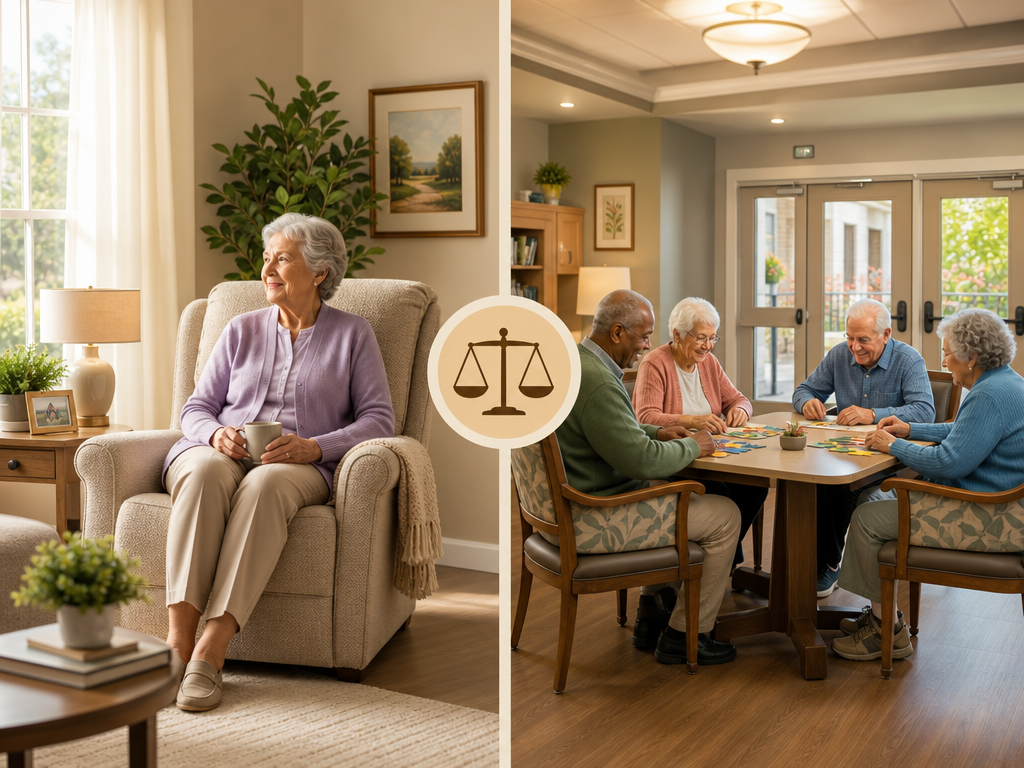
The decision between 24/7 home care and memory care is rarely clear-cut. The following framework organizes the key factors that should drive your choice, based on guidance from TheKey, the Alzheimer's Association, and the cost data discussed above.
| Decision Factor | Favors 24/7 Home Care | Favors Memory Care |
|---|---|---|
| Level of cognitive impairment | Early-to-moderate stages; person recognizes surroundings and follows simple directions | Moderate-to-advanced stages; severe confusion, aggression, or psychosis present |
| Wandering behavior | Occasional wandering that responds to door alarms and redirection | Frequent or persistent wandering; person attempts to elope despite safety measures |
| Nighttime needs | Occasional nighttime waking; can be managed with a live-in caregiver | Frequent sundowning, sleep disturbances, or nighttime wandering requiring awake overnight staff |
| Family supervision capacity | Family member lives nearby and can regularly oversee care quality | Family is long-distance or unable to provide consistent oversight of in-home staff |
| Social isolation risk | Person is content with one-on-one interaction and does not seek peer engagement | Person shows interest in social activities or seems lonely despite caregiver presence |
| Local memory care quality | No high-quality memory care options within reasonable distance | Reputable memory care communities are available and have openings |
| Budget | Family can afford $24,733/month or can supplement with family caregiving hours | Family needs the lower cost of memory care ($6,690/month) or qualifies for Medicaid |
A 2024 AARP report found that 75% of adults over 50 want to remain in their own homes as they age. This preference is powerful, and it should not be dismissed. But dementia progression often makes extended in-home care unsustainable. The question is not whether your parent wants to stay home — it is whether staying home can be made safe, and at what cost to everyone involved.
Questions to Ask Home Care Agencies and Memory Care Facilities
Whether you are leaning toward home care or memory care, the quality of the provider matters enormously. The following questions, drawn from recommendations by the Alzheimer's Association and TheKey, will help you evaluate both options.
Questions for Home Care Agencies
- "Do you have experience working with someone with dementia?" — The Alzheimer's Association recommends this as the first question you ask.
- "Are your caregivers trained in dementia care?" — Ask about specific training programs, not just general experience.
- "How do you divide shifts?" — Confirm whether they use two 12-hour shifts or three 8-hour shifts, and whether the overnight caregiver stays awake.
- "What is your policy on caregiver continuity?" — Will the same caregivers be assigned regularly, or will there be different people each shift?
- "What is your backup plan if a caregiver calls in sick?" — TheKey recommends hiring through a licensed agency specifically for this backup support.
- "Do you have a wandering prevention protocol?" — The agency should have specific procedures for door monitoring, bed alarms, and nighttime checks.
Questions for Memory Care Facilities
- "What is your staff-to-resident ratio during the day and overnight?" — Lower ratios mean more individual attention.
- "How is the unit secured to prevent wandering?" — Confirm that exits are locked and alarmed, and ask about their elopement prevention record.
- "What does a typical day of activities look like?" — Look for structured programming that includes cognitive, physical, and social engagement.
- "How do you handle medication management?" — Ask about their system for tracking and administering medications, especially for residents who resist taking them.
- "What is your transition support process?" — How do they help new residents adjust? Do they have a gradual move-in option?
- "What happens if my parent's needs escalate?" — Ask about their policy for residents who develop aggressive behaviors or require more intensive care.
A Staged Approach: Start at Home, Transition When Needed
The decision between home care and memory care does not have to be permanent. Many families successfully use a staged approach: starting with in-home care during the early-to-moderate stages, then transitioning to memory care when the person's needs escalate beyond what the home environment can safely provide.
This staged approach has several advantages. During the earlier stages, the familiar home environment provides comfort and orientation that no facility can match. The person with dementia benefits from one-on-one attention from a caregiver who can tailor activities to their personal history and preferences. And the family has time to research memory care options, visit communities, and plan the transition without the pressure of an emergency.
The cost math also supports this approach for some families. Full-time in-home care at 44 hours per week ($6,478/month) is comparable to memory care ($6,690/month). If a family member can cover the remaining hours — evenings, overnights, and weekends — the monthly cost stays in the same range as a facility. This hybrid model can work well during the moderate stage, when the person needs significant support during the day but may still sleep through the night.
The average duration of in-home care services is 15 to 20 months, according to Todd Austin, president and COO of Activated Insights. This suggests that many families do use home care as an intermediate step before transitioning to a facility. The key is recognizing when that transition point has arrived — and having a plan in place before a crisis forces the decision.

For a broader view of dementia home care options through all stages — including how to structure care at each level of need — see our comprehensive guide: Dementia Home Care: A Stage-by-Stage Guide to Options, Costs, and When to Transition.
Related reading
Noticed something outdated or inaccurate on this page? Flag a correction. We review every report against CDC, NIA, and AARP HomeFit guidance before updating a page.
Part of the Fall Prevention section.