
Senior Care Help: A Complete Guide to Finding the Right Support for an Aging Parent
Feeling overwhelmed by the range of senior care options? This guide helps adult children identify the specific care gap their parent needs, explains seven distinct types of help with costs and coverage, and provides a step-by-step action plan to get started.

You Know Your Parent Needs Help — But Where Do You Start?
You've noticed the signs. The unopened mail piling up on the counter. The dented car door that no one can explain. The freezer full of expired frozen dinners because grocery trips have become too difficult. Or maybe it was a single, sharp event — a fall, a hospital discharge, a diagnosis — that made the reality unavoidable: your parent needs more help than they (or you) can manage alone.
If you've typed "senior care help" into a search bar, you're not alone. Over 53 million Americans are family caregivers, and roughly 40% of them have had to reduce their work hours or leave jobs entirely to meet care demands, according to the National Council on Aging. The average family caregiver spends about $7,200 per year out of pocket on care-related expenses.
The problem is that "senior care help" is too vague to act on. It covers everything from someone stopping by to do laundry to a nurse managing complex medications. The first step is not choosing a service. It is identifying the specific gap in your parent's life — and your own — that needs to be filled.
5 Questions to Identify What Kind of Help Your Parent Actually Needs
Before you call an agency or compare costs, take ten minutes to answer these five questions. Your answers will point directly to the type of service that fits your situation.
- Does my parent need medical care or personal care? Medical care means skilled nursing, wound care, physical therapy, or medication management ordered by a doctor. Personal care means help with bathing, dressing, toileting, eating, and moving around the house. These are two completely different services with different payment sources.
- Is my parent safe and engaged during the day? If they are home alone for long stretches, lonely, or at risk of wandering, the need is supervision and social engagement — not necessarily hands-on medical care.
- Am I the one who needs a break? Caregiver burnout is real. Roughly 20% of family caregivers experience depression. If you are exhausted, irritable, or neglecting your own health, respite care is the right category of help — not more hands-on care for your parent.
- What daily tasks are falling through the cracks? Is it meals? Transportation to appointments? Housekeeping? Medication management? Each gap points to a different service type.
- Who is coordinating all of this? If you live in another city, or if your parent has multiple doctors and complex conditions, you may need a professional care manager to keep everything organized.
The 7 Types of Senior Care Help: What Each Service Does, What It Costs, and Who Pays
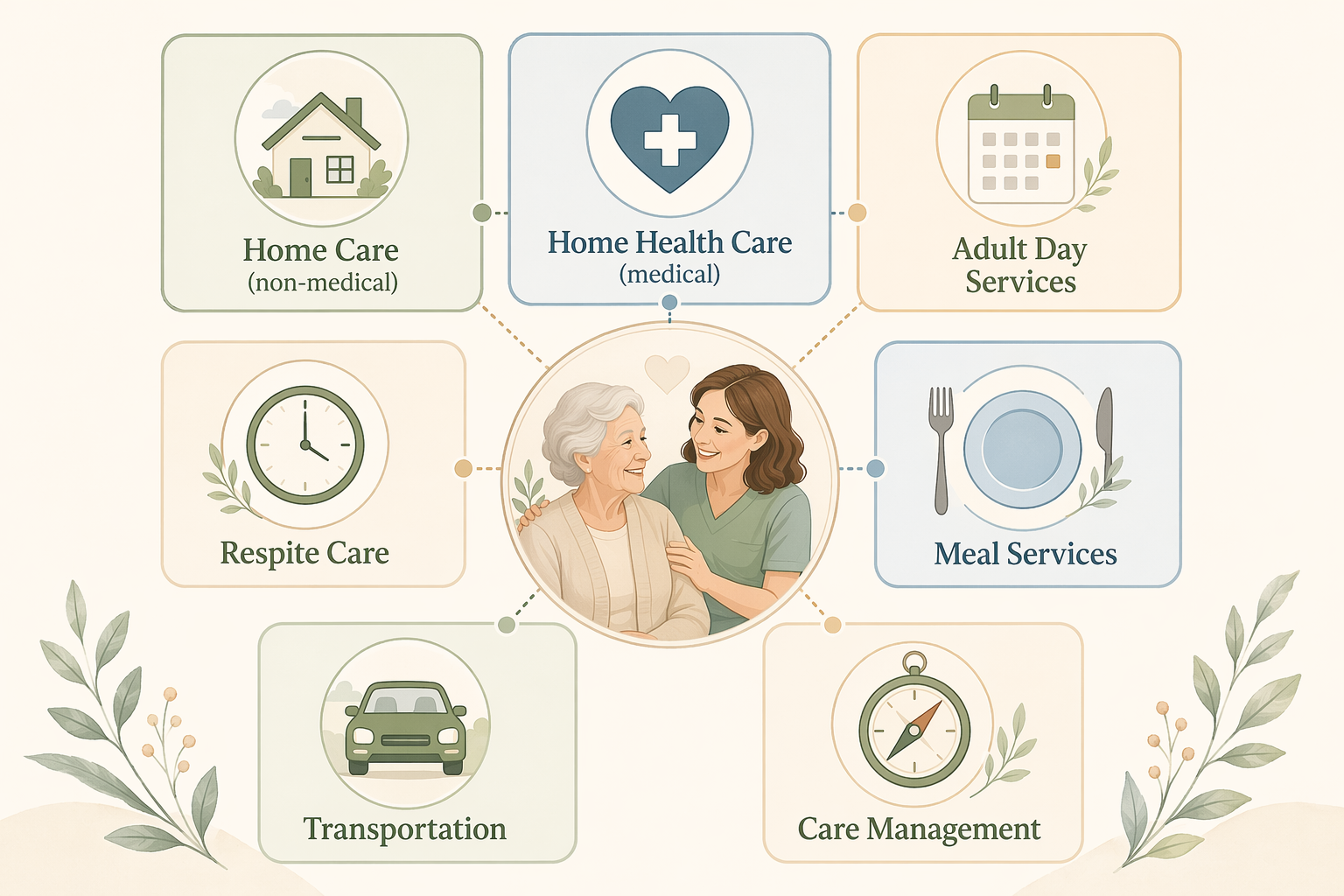
Once you know the gap, you can match it to the right service. Here is a detailed breakdown of the seven main categories of senior care help available in the United States.
| Service Type | What It Does | Typical Cost | Primary Payment Sources |
|---|---|---|---|
| Home Care (Non-Medical) | Help with bathing, dressing, toileting, meals, light housekeeping, companionship, transportation. Provided by home care aides or companions. | $25–$35 per hour | Out-of-pocket; some long-term care insurance (LTCI) plans; Medicaid HCBS waivers (varies by state) |
| Home Health Care (Medical) | Skilled nursing, wound care, physical/occupational/speech therapy, medication management. Ordered by a physician. | Varies (charged per visit or per hour) | Medicare (short-term, skilled need only); Medicaid (varies by state); most private insurance does not cover long-term |
| Adult Day Services | Supervision, social activities, meals, personal care, and some health services in a group setting during daytime hours. | $75–$150 per day | Out-of-pocket; Medicaid may cover (varies by state); Medicare does not pay; some LTCI plans cover a portion |
| Respite Care | Short-term relief for the primary caregiver. Can be provided at home, in an adult day center, or as a short facility stay. | Varies (hourly for in-home; daily rate for facility) | Medicare Part A (up to 5 consecutive days for hospice patients); Medicaid waivers; VA benefits; some LTCI |
| Meal Services | Home-delivered meals (e.g., Meals on Wheels) or congregate meal programs at senior centers. | Free to low-cost (donation suggested for some programs) | Older Americans Act funding; Area Agencies on Aging; some state and local programs |
| Transportation Services | Rides to medical appointments, grocery stores, and social activities. May be volunteer-based or specialized senior transit. | Free to low-cost (donation or small fee) | Area Agencies on Aging; volunteer programs; some Medicaid non-emergency medical transportation |
| Care Management | Assessment, care planning, coordination of services, and ongoing monitoring by a geriatric care manager (often a nurse or social worker). | $100–$200 per hour (varies by region and complexity) | Almost always out-of-pocket; Medicare and Medicaid do not pay; some LTCI policies may cover assessment |
The Critical Distinction: Home Care vs. Home Health Care
This distinction is worth repeating because it is the source of the most confusion — and the most financial surprises. Home care (non-medical) helps with activities of daily living: bathing, dressing, toileting, eating, and moving around. The workers are home care aides or companions. Medicare generally does not pay for this, and most private insurance does not either. Families pay out of pocket, though some long-term care insurance policies and state Medicaid waiver programs may help.
Home health care (medical) is skilled care ordered by a physician — nursing, physical therapy, wound care. Medicare covers home health care, but only under specific conditions: the person must be homebound, the care must be part-time or intermittent, and it must be for a skilled need. It is not designed for long-term personal care. Once the skilled need resolves, Medicare coverage ends.
If your parent needs help bathing every day but is medically stable, you are looking for home care, not home health care. If your parent just had hip surgery and needs physical therapy and wound care at home, you are looking for home health care — and Medicare may cover it for a limited time.
Which Service Fits Your Situation? A Decision Matrix for Family Caregivers
Use this matrix to match your specific situation to the most appropriate service type. Read down the left column to find the scenario that sounds most like yours.
| Your Situation | Primary Service to Consider | Secondary Options to Explore |
|---|---|---|
| Parent needs help with bathing, dressing, or toileting but is medically stable | Home Care (non-medical aide) | Adult Day Services (if they need supervision during the day) |
| Parent was recently hospitalized and needs skilled nursing or therapy at home | Home Health Care (medical, physician-ordered) | Care Management (to coordinate discharge and follow-up) |
| Parent is home alone all day, lonely, or at risk of wandering | Adult Day Services | Home Care (companion services); Volunteer visitor programs |
| You are exhausted, stressed, or neglecting your own health | Respite Care | Adult Day Services; Home Care (to give you a break) |
| Parent cannot cook safely or is not eating well | Meal Services (Meals on Wheels or congregate meals) | Home Care (meal preparation assistance) |
| Parent can no longer drive and has no reliable way to get to appointments | Transportation Services | Home Care (accompaniment to appointments) |
| You live far away and need someone to oversee care and communicate with doctors | Geriatric Care Manager | Home Care (for daily check-ins); Monitoring Technology |
| Parent has multiple chronic conditions and complex medication schedules | Home Health Care (skilled nursing assessment) | Care Management; Home Care (medication reminders) |
Your Step-by-Step Action Plan: Where to Start Today
Once you have identified the type of help your parent needs, here is a concrete action plan to get started. These steps are designed to move you from overwhelm to action without requiring you to make a perfect decision on day one.
- Talk to your parent's doctor. The doctor can assess whether your parent qualifies for home health care (skilled services) and can write the necessary orders. They can also refer you to a hospital social worker or discharge planner who knows local resources. This is the single most important first step because it opens the door to Medicare-covered services if your parent qualifies.
- Call the Eldercare Locator. This is the most underused entry point in the entire senior care system. The Eldercare Locator (800-677-1116) is a public service of the U.S. Administration on Aging that connects you to your local Area Agency on Aging (AAA). The AAA can tell you what services are available in your parent's community, what they cost, and whether your parent qualifies for any subsidized programs.
- Contact your local Area Agency on Aging. Your AAA is the hub for community-based services: Meals on Wheels, transportation programs, senior centers, adult day services, caregiver support programs, and information about Medicaid waivers. Many of these services are free or low-cost. The AAA can also help you navigate the application process for programs like Medicaid and SNAP.
- Explore community resources. Contact Meals on Wheels America (888-998-6325) for home-delivered meals. Search for adult day centers through the National Adult Day Services Association (877-745-1440). Find respite care through the ARCH National Respite Locator. These organizations can tell you about availability, costs, and eligibility in your area.
- Interview one or two providers. Once you know what type of service you need, call one or two agencies. Ask the questions from the checklist below. Do not feel pressured to sign a contract on the first call. A good agency will encourage you to ask questions and will offer a free in-home assessment.
How to Pay for Senior Care: Medicare, Medicaid, VA, and Long-Term Care Insurance
The money question is usually the most stressful part of care planning. Here is a clear summary of what each major payment source covers — and, just as importantly, what it does not cover.
| Payment Source | What It Covers | What It Does NOT Cover | Key Details |
|---|---|---|---|
| Medicare (Part A & B) | Home health care (skilled nursing, therapy) — short-term, part-time, for a skilled need. Hospice care. Up to 5 days of respite care in a facility for hospice patients. | Long-term personal care (bathing, dressing, toileting). Adult day services. Most home care (non-medical). Custodial care in a nursing home. | Medicare covers home health only if the person is homebound and the care is ordered by a physician. Coverage ends when the skilled need resolves. |
| Medicaid | Personal care services and home and community-based services (HCBS) waivers. May cover adult day care, respite care, and home care aides. Varies significantly by state. | Medicare-covered services (Medicaid is a separate program). Not all states offer the same waivers. Eligibility is based on income and assets. | Some states allow Medicaid to pay family caregivers through HCBS waivers, at rates of $13–$18/hour or more. Contact your local AAA to learn about your state's programs. |
| VA Benefits | Aid and Attendance (monthly cash allowance for veterans/surviving spouses needing help with ADLs). Housebound Pension Benefit. Program of Comprehensive Assistance for Family Caregivers (PCAFC). Veteran Directed Care (pilot in 43 states + DC + PR). Up to 30 days of respite care in a VA facility. | Services not related to a service-connected disability (for some programs). Not all veterans qualify — depends on service history, disability rating, and income. | VA benefits are among the most generous but also the most underclaimed. Contact your local VA office or a Veterans Service Officer to check eligibility. |
| Long-Term Care Insurance (LTCI) | May cover home care, personal care, adult day services, respite care, and care management — depending on the policy. Some policies pay family caregivers. | Most policies have a waiting period (elimination period) before benefits begin. Pre-existing condition limitations may apply. | Only about 3% of adults over 50 have long-term care insurance. If your parent has a policy, read it carefully or ask a geriatric care manager to review it. |
| Out-of-Pocket (Private Pay) | Any service the family chooses to pay for directly. This is how most long-term home care is paid for in the U.S. | No coverage limits — but no reimbursement either. | The average family caregiver spends about $7,200/year out of pocket. Costs vary widely by region and level of care needed. |
Questions to Ask Before Hiring Any Senior Care Provider
Once you have identified a potential provider — whether a home care agency, an adult day center, or a care manager — use this checklist to vet them before signing anything. These questions will help you avoid common pitfalls and ensure you are hiring a reputable, reliable service.
- Are you licensed, bonded, and insured? This is non-negotiable. Ask for proof. If they cannot provide it, move on.
- Do you perform background checks on all employees? Ask what level of check (state, federal, fingerprint-based) and whether it is repeated annually.
- What training do your caregivers receive? For dementia care, ask specifically about dementia-specific training. For home health, ask about the credentials of the nurses and therapists.
- What is your backup plan if a caregiver calls in sick? A reliable agency should have a system for sending a replacement quickly. Ask how they handle last-minute cancellations.
- How do you communicate with families? Do they provide daily logs? A phone call after each visit? A secure app? Clear communication is essential, especially if you are a long-distance caregiver.
- What is your billing process? Get a written fee schedule. Ask about overtime rates, holiday rates, and any additional fees for supplies or travel. Ask how they handle billing for Medicare, Medicaid, or LTCI if applicable.
- Can you provide references from current or past clients? A reputable agency should be able to connect you with other families who have used their services. Call those references.
- Do you offer a free in-home assessment? Most good home care agencies will send a nurse or care coordinator to the home to assess needs before creating a care plan. If they try to sell you a package over the phone without an assessment, that is a red flag.
When to Call a Geriatric Care Manager
A geriatric care manager (also called an aging life care professional) is a specialist — typically a nurse, social worker, or gerontologist — who assesses your parent's needs, creates a comprehensive care plan, coordinates services, and monitors the situation over time. They charge by the hour, and Medicare and Medicaid generally do not pay for their services. Most families pay out of pocket.
A care manager is worth the cost in these specific situations:
- You live far away. A care manager can be your eyes and ears on the ground — visiting your parent, assessing their home environment, and communicating with doctors and agencies.
- Your parent has complex medical needs. Multiple chronic conditions, multiple specialists, and a confusing medication regimen are exactly the kind of situation where a care manager's expertise pays for itself.
- There is family conflict about care decisions. A neutral professional can assess the situation objectively and make recommendations that are harder for family members to argue with.
- You have tried coordinating services yourself and it is not working. If you are spending more time managing care than providing it, a care manager can take over the coordination burden.
To find a qualified geriatric care manager, contact the Aging Life Care Association at 520-881-8008. They can provide referrals to certified professionals in your parent's area.
Related reading
- When Home Care Isn't Enough: A Decision Framework for Knowing When to Add Professional Help, Palliative Care, or Transition to a Facility
- Home Care vs. Assisted Living vs. Memory Care: A Continuum Decision Guide for Dementia Caregivers
- The Preparedness Gap: How to Start Caring for Aging Parents Before a Crisis Hits
Noticed something outdated or inaccurate on this page? Flag a correction. We review every report against CDC, NIA, and AARP HomeFit guidance before updating a page.
Part of the Fall Prevention section.