
Caring for a Senior with Dementia at Home: A Room-by-Room Safety and Daily Care Guide
This guide provides family caregivers with a unified system for caring for a loved one with moderate-stage dementia at home. It covers evidence-based room-by-room safety modifications, structured daily care routines for bathing, dressing, and eating, a behavior-response map for common dementia symptoms, and an embedded caregiver self-preservation plan.
Why the Home Environment Matters in Dementia Care
When a person with Alzheimer's or another dementia lives at home, the physical environment is not just a backdrop — it is an active participant in their daily experience. Dementia changes how the brain processes visual information, depth perception, and spatial relationships. A floor pattern that shifts from carpet to tile can be misread as a step, causing a fall. A dark hallway at dusk can become a source of confusion and fear. A cluttered kitchen counter can trigger agitation rather than hunger.
The National Institute on Aging (NIA) notes that people with Alzheimer's experience changes in depth perception that cause them to misread a change in floor pattern — carpet to tile, for example — as a step. This is not a behavioral issue; it is a perceptual one. The solution is not to correct the person but to correct the environment.
The stakes are high. Over 90% of older adults prefer to age in place, according to data from the Census Bureau and AARP, yet only about 10% of homes are considered "aging ready." And only about 1 in 4 family caregivers report feeling completely prepared when caregiving began, according to a 2025 survey by A Place for Mom. Most caregivers learn by trial and error — a costly approach when the errors involve falls, burns, or wandering incidents.
Room-by-Room Safety Modifications for Dementia
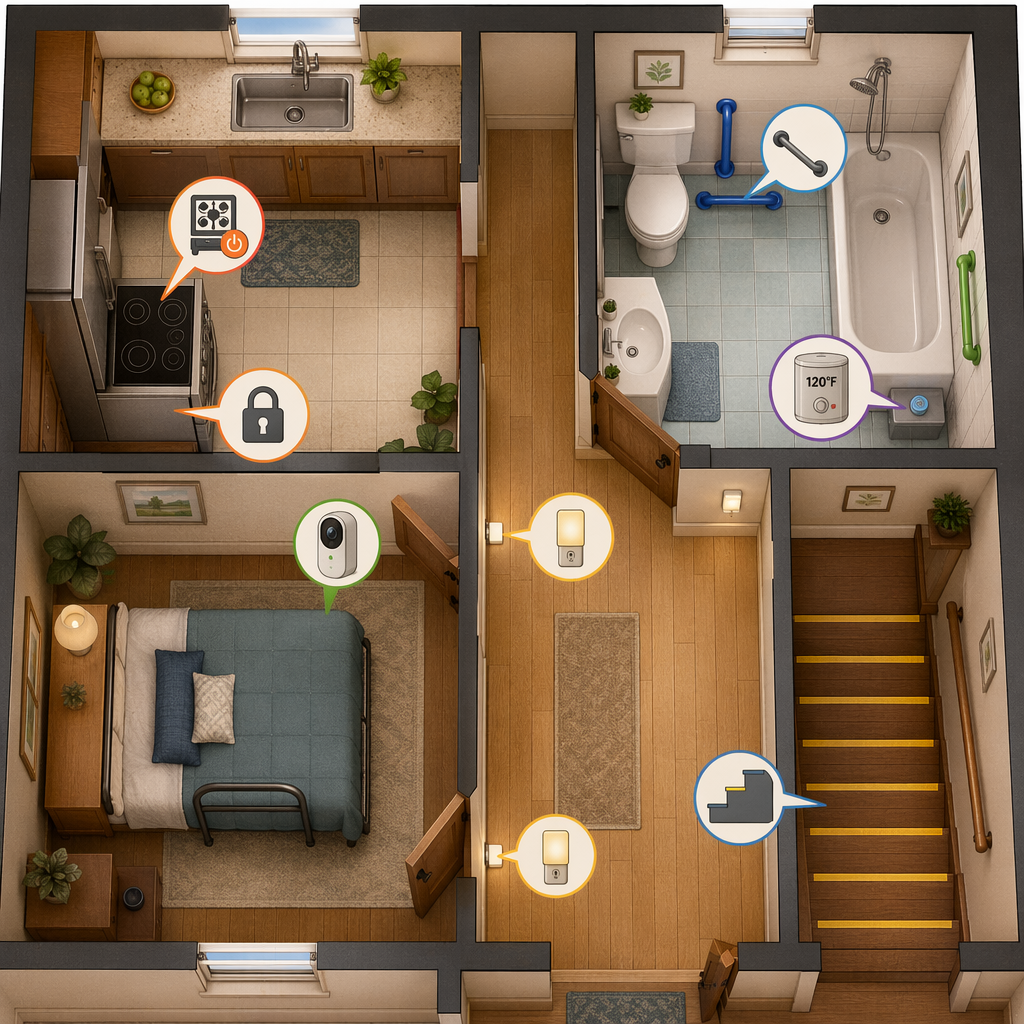
The following modifications are drawn from NIA and Alzheimer's Association guidelines. They address the specific perceptual and cognitive changes of dementia — not general aging. Each recommendation targets a known risk: falls, burns, wandering, or confusion.
| Room | Key Modifications | Why It Matters |
|---|---|---|
| Kitchen | Install stove auto-shutoff device; lock cabinets containing cleaning products, knives, and matches; remove small appliances from counters; use contrasting-colored dishes on solid placemats | Reduces fire risk and prevents accidental ingestion of toxic substances; visual contrast helps the person distinguish objects from surfaces |
| Bathroom | Install grab bars in contrasting color (not white on white); set water heater to 120°F; use a sturdy shower chair and hand-held shower head; add non-skid strips in tub and shower; pad sharp faucet corners with foam cover | Contrasting grab bars are easier to see; 120°F prevents scalding; shower chair reduces fall risk during bathing |
| Bedroom | Use a room monitoring device to alert to falls or need for help at night; install bed rails if the person is at risk of rolling out; place nightlights between bed and bathroom; remove clutter from floor | Monitoring devices provide nighttime safety without constant supervision; nightlights reduce disorientation during nighttime waking |
| Stairs | Ensure at least one handrail; mark step edges with brightly colored tape; install carpet or safety grip strips on each step; improve lighting at top and bottom of stairs | Color-contrasted edges compensate for depth perception loss; grip strips prevent slipping |
| General Areas | Make walls a lighter color than floors to create contrast; remove busy-patterned rugs and curtains; clear away unused furniture and small rugs; ensure good lighting in all rooms; use brightly colored signs or pictures to label rooms | Busy patterns can be misinterpreted as obstacles or holes; clear pathways reduce fall risk; room labels support wayfinding |
When selecting grab bars, choose a color that contrasts with the wall — a chrome bar on a white tile wall may be nearly invisible to someone with impaired depth perception. The same principle applies to step edges: a strip of brightly colored tape is far more effective than a subtle paint line.
Structured Daily Care Routines: Bathing, Dressing, and Eating
Daily care tasks — bathing, dressing, and eating — are often the most challenging moments for both caregiver and care recipient. The key is to establish a consistent routine and to adapt the approach to the person's current abilities, not to what they could do six months ago.
Bathing: When the Traditional Approach Causes Distress
Many people with dementia find bathing frightening or confusing. The sensation of water spraying from above, the cold air on wet skin, and the unfamiliar environment of a shower stall can trigger agitation or refusal. The Family Caregiver Alliance describes an evidence-based alternative called the towel bath method.
- Warm a large bath towel and two washcloths in a dryer or microwave (test temperature carefully).
- Place the towel and washcloths in a plastic bag with warm water and no-rinse soap.
- Cover the person with the warm, damp towel and massage gently over the body, one section at a time, keeping the rest of the body covered and warm.
- Use the damp washcloths for face and hands.
- No rinsing is needed — the soap is no-rinse formula.
This method reduces the sensory overload of traditional bathing. The person stays warm and covered throughout, which preserves dignity and reduces the urge to resist. The NIA also recommends using a sturdy shower chair and a hand-held shower head if the person tolerates seated showering better.
Dressing: Reduce Choices, Reduce Frustration
Dressing requires sequencing, decision-making, and fine motor coordination — all of which decline in moderate-stage dementia. The Family Caregiver Alliance recommends laying out one article of clothing at a time in the order it is to be worn: underwear first, then pants, then shirt, then socks, then shoes. Hand each item one at a time rather than presenting a pile.
- Choose loose-fitting, comfortable clothing with elastic waistbands, fabric fasteners, or large zipper pulls — avoid buttons, small snaps, and ties.
- Allow the person to do as much as possible independently, even if it takes longer. Rushing increases agitation.
- If the person insists on wearing the same outfit every day, buy multiple identical items and rotate them. This is not a problem to solve; it is a preference to accommodate.
Eating: Small Meals, Finger Foods, and Routine
Eating difficulties in dementia are often related to attention span, not appetite. A full plate at a large meal can be overwhelming. The Family Caregiver Alliance and the NIA recommend offering 5 to 6 smaller meals throughout the day instead of three large ones. Finger foods — sandwich quarters, cheese cubes, banana slices, cooked vegetable pieces — support independence because they do not require utensils.
- Serve meals in the same place at the same time each day to build a predictable routine.
- Use a straw or a sippy cup if holding a glass has become difficult.
- Give the person enough time to eat — do not rush the meal.
- Use contrasting-colored plates on a solid placemat to help the person distinguish food from the plate.
Behavior-Response Mapping: Wandering, Agitation, Sundowning, and Repetitive Speech
Dementia behaviors are not random. They are responses to internal discomfort, environmental triggers, or unmet needs. When you understand what is driving the behavior, you can respond effectively — without resorting to medication or restraint.
| Behavior | Common Triggers | Recommended Response |
|---|---|---|
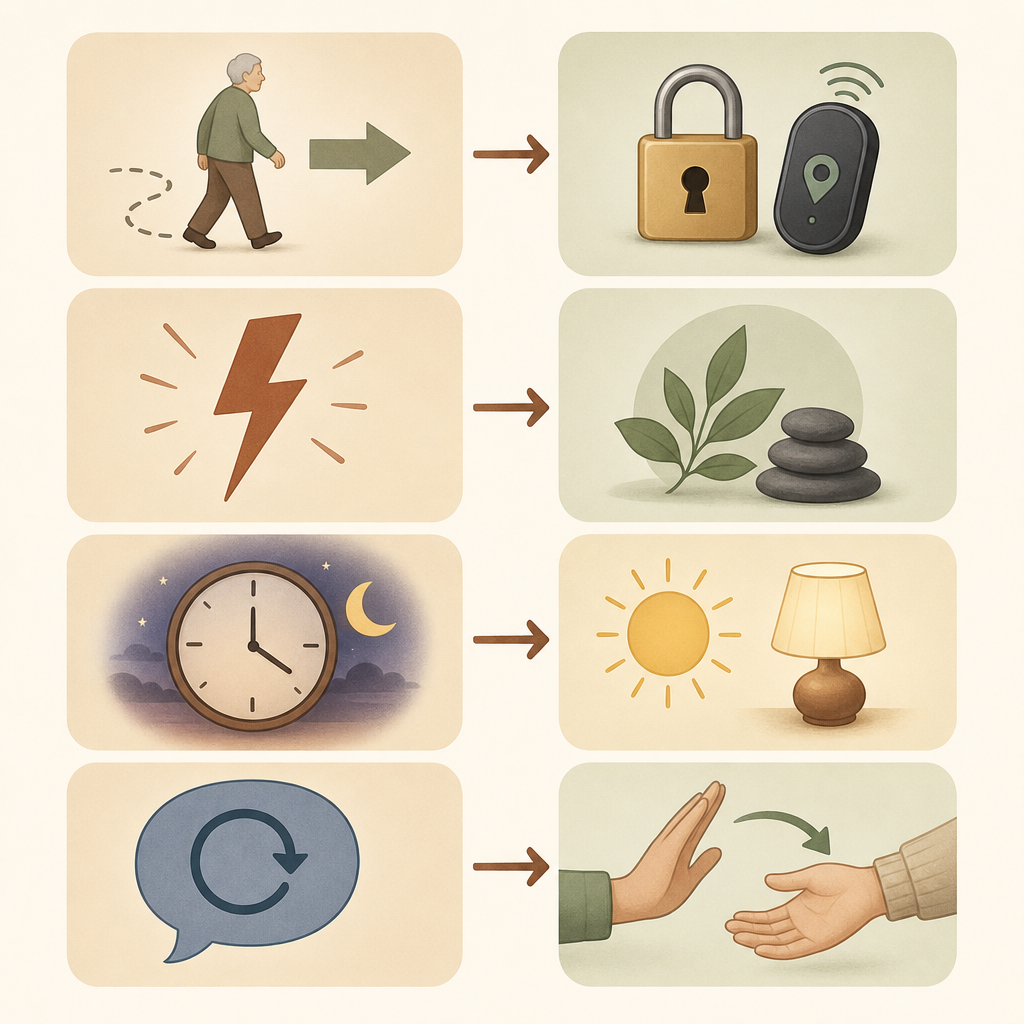
| Wandering | Restlessness, disorientation, need for exercise, searching for something familiar | Install locks requiring a key positioned high or low on the door (out of line of sight); use a curtain or painted panel to mask the door; consider a GPS tracking device worn as a watch or clipped on a belt; register the person with the Alzheimer's Association Safe Return program |
| Agitation | Noise, clutter, fatigue, hunger, pain, overstimulation | Reduce environmental noise and clutter; maintain consistent daily routines; keep familiar objects and photographs visible; try gentle touch, soothing music, or a short walk |
| Sundowning | Late-afternoon fatigue, dimming light, shadows, disruption of circadian rhythm | Increase daytime physical activity; plan quiet, calm afternoons and evenings; turn on lights well before sunset; close curtains at dusk to minimize shadows; keep a nightlight in the bedroom, hallway, and bathroom |
| Repetitive Speech | Anxiety, memory loss, need for reassurance | Use redirection: acknowledge the question briefly, then shift attention to a different activity ("I hear you asking about that. Let's look at this photo album together."); do not argue or correct |
For wandering specifically, the Family Caregiver Alliance recommends a layered approach: environmental barriers (locks, door masks), identification (Safe Return program), and tracking technology (GPS devices). No single intervention is sufficient — combine at least two.
Building a Caregiver Self-Preservation Plan into Your Daily Schedule
You cannot provide consistent, patient care if you are running on empty. The 2025 A Place for Mom caregiver survey found that 78% of caregivers experience burnout, and 50% report trouble sleeping at least weekly. The same survey found that 87% experience stress or anxiety, and 84% feel overwhelmed. These are not signs of personal failure — they are predictable consequences of a role that demands constant vigilance.
A self-preservation plan is not optional. It is a structural part of the care system, just like grab bars and meal routines. Here is how to embed it into your daily schedule:
- Schedule at least one 30-minute break every day. This is not negotiable. Use it for a walk, a nap, a phone call, or simply sitting in another room with the door closed.
- Protect your sleep. If the person wakes at night, consider a room monitoring device that alerts you only when movement or a fall is detected — rather than sleeping with one eye open.
- Identify one source of respite care. The NIA notes that respite care can be provided at home, in a facility, or through adult day care centers. Medicare covers up to 5 consecutive days of respite for those enrolled in hospice. Even one afternoon per week of relief can prevent burnout.
- Track your own health. The AARP/NAC 2025 report found that 20% of family caregivers report fair or poor health directly attributable to caregiving. Do not skip your own medical appointments.
As care intensity increases, you may need to consider whether 24-hour home care is the right next step. Our guide Is 24-Hour Home Care Right for Your Parent? A Decision Guide for Recognizing When Around-the-Clock Care Is Needed can help you evaluate when the current system needs to expand.
Putting It All Together: A Unified Daily Care System
The room-by-room modifications, daily care routines, behavior-response strategies, and self-preservation plan are not separate checklists. They are one system. When the environment is safe, daily tasks are easier. When daily tasks are predictable, behaviors are more manageable. When behaviors are manageable, you have the energy to care for yourself. And when you care for yourself, you can sustain the system.
| System Component | Daily Action | Weekly Check |
|---|---|---|
| Environment | Walk through each room and remove trip hazards; ensure nightlights are on at dusk | Check that grab bars are secure; test stove auto-shutoff; replace burned-out bulbs |
| Daily Care | Follow the same bathing, dressing, and meal schedule; offer finger foods at small meals | Assess whether the current routine is still working; adjust timing or method as needed |
| Behavior Response | Use the behavior-response map when symptoms appear; redirect instead of correct | Note any new or worsening behaviors; consult the NIA or Alzheimer's Association for updated strategies |
| Self-Preservation | Take your scheduled 30-minute break; go to bed at a consistent time | Check in with yourself: sleep quality, stress level, emotional state; schedule respite if needed |
You do not need to implement everything at once. Start with the room where the most time is spent — typically the bathroom or kitchen — and add one modification at a time. Then introduce one routine change. Then add one behavior-response strategy. The system builds gradually, and each piece makes the next one easier.
The goal is not a perfect home. The goal is a home where a person with dementia can live with dignity and safety, and where you can provide care without losing yourself in the process.
Related reading
Noticed something outdated or inaccurate on this page? Flag a correction. We review every report against CDC, NIA, and AARP HomeFit guidance before updating a page.
Part of the Fall Prevention section.