Senior Citizen Home Types: A Decision Framework for Family Caregivers Navigating Memory Care Decisions
stage guideearly, middle, late stagewandering, agitation, exit-seekingReviewed: 2026-06-20
Senior Citizen Home Types: A Decision Framework for Family Caregivers Navigating Memory Care Decisions
By Editorial Team
memory care
assisted living
dementia care
senior living options
caregiver decision guide
Why “Senior Citizen Home” Is a Misleading Umbrella Term
When a parent receives a dementia diagnosis or experiences a sudden functional decline, the search for a “senior citizen home” often begins within hours. The phrase feels concrete, but it conceals a decision space that spans five fundamentally different care models — each with its own cost structure, staff qualifications, safety architecture, and resident profile. Treating them as interchangeable options is one of the most common and costly mistakes families make.
The confusion is most acute around memory care. According to SeniorLiving.org, 42% of assisted living residents have Alzheimer’s or another form of dementia. Yet the vast majority of assisted living communities are not designed, staffed, or licensed to manage the behavioral and safety challenges that dementia creates. A 2026 analysis by A Place for Mom found that 88% of memory care communities are secure facilities with wandering management systems, and 79% provide specialized dementia care training for staff — features that are not standard in general assisted living. The gap between what families assume they are getting and what they actually receive is wide, and it has real consequences for safety and quality of life.
This guide is built around a single thesis: understanding which type of senior living fits your loved one’s specific cognitive and physical needs is the critical first decision, and memory care is a distinctly misunderstood category that deserves its own evaluation framework. Rather than presenting a neutral survey of options, we will walk through a needs-assessment process, compare the five major care types across the dimensions that matter most, and provide a decision algorithm that centers on when and why memory care is the right choice.
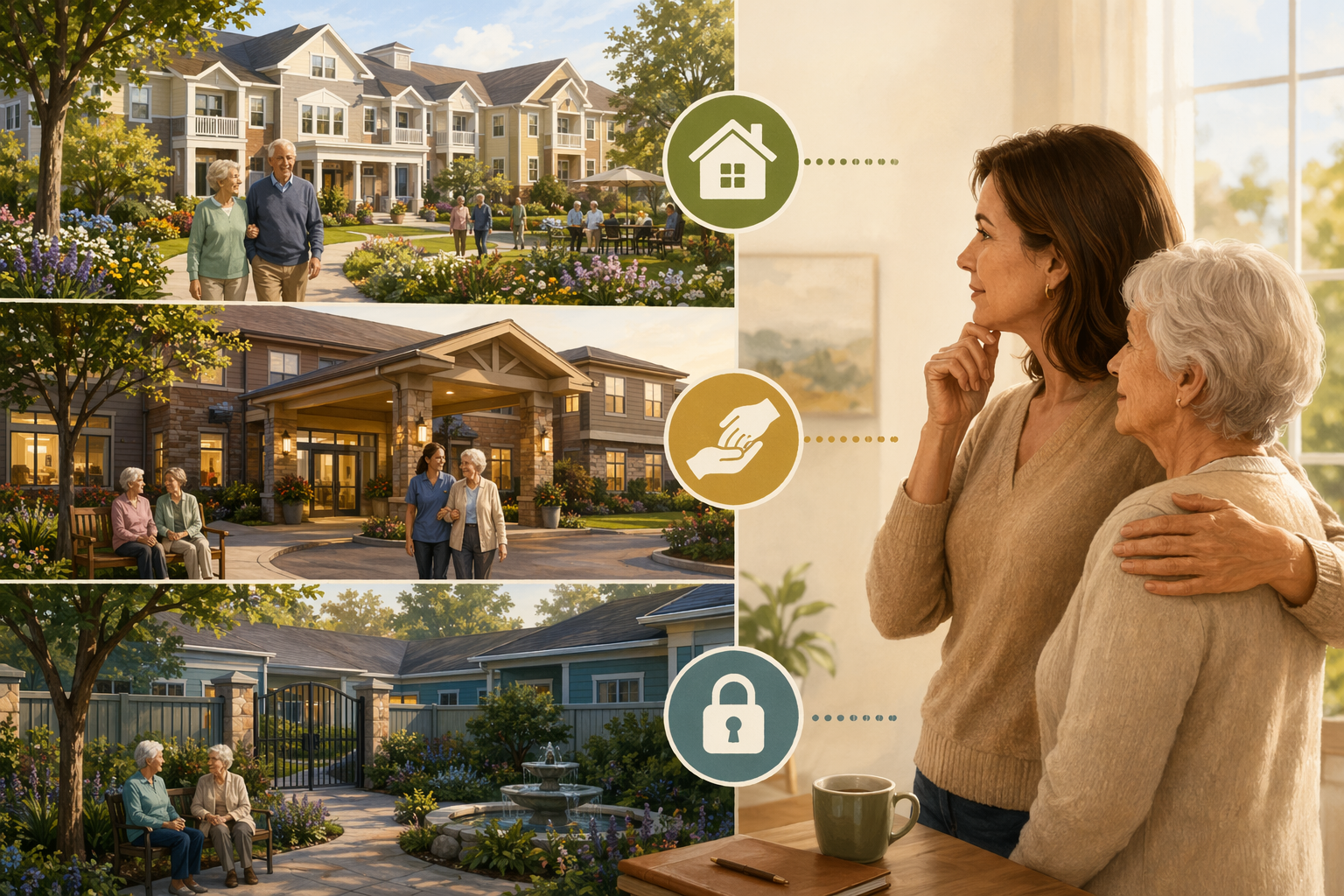
The phrase “senior citizen home” collapses five distinct care models. Matching the right type to your loved one’s needs is the critical first decision.
A Needs-Assessment Framework: Matching Care to Your Loved One’s Situation
Before comparing facility types, it is essential to assess your loved one’s current needs across four dimensions. This framework will help you filter out options that are clearly inappropriate and focus on the settings that match the level of support required.
Dimension 1: Cognitive Stage
Dementia is a progressive condition, and the care setting that works in the early stage will be inadequate in the middle or late stage. The staged decision guide for dementia caregivers on this site provides a deeper dive into stage-specific planning, but for the purposes of this framework, the key question is whether cognitive decline is the primary driver of care needs. If the answer is yes, memory care or a dementia-specific unit within a larger community should be at the top of your list.
Dimension 2: ADL Dependence
Activities of daily living (ADLs) — bathing, dressing, toileting, transferring, eating, and continence management — are the standard measure of functional need. Assisted living is generally designed for residents who need help with up to two ADLs. Memory care communities typically provide a higher staff-to-resident ratio and more intensive assistance with ADLs, particularly for residents who cannot communicate their needs. If your loved one requires help with three or more ADLs, or if they are incontinent and unable to manage toileting independently, a setting with 24/7 skilled nursing or specialized dementia care is likely necessary.
Dimension 3: Medical Complexity
Chronic conditions such as heart disease, diabetes, and depression are common in older adults. According to The Senior List, 34% of assisted living residents have diagnosed heart disease and 31% suffer from depression. If your loved one has multiple chronic conditions that require regular monitoring by a nurse or physician, a nursing home or a CCRC with on-site skilled nursing may be more appropriate than a standard assisted living or memory care community. Medicare does not cover the room-and-board costs of residential care, but it may cover certain medical services such as physical therapy, doctor visits, and medications within those settings.
Dimension 4: Safety Risk
Wandering, exit-seeking, leaving stoves on, and falls are the most common safety risks for people with dementia. The CDC identifies falls as the leading cause of fatal and nonfatal injuries in people over 65. If your loved one has wandered from home, attempted to leave the house at night, or sustained an injury from a fall, the safety architecture of the living environment becomes the top priority. Memory care communities are designed with secure perimeters, wandering management systems, and enclosed courtyards — 78% of A Place for Mom’s partner memory care communities offer an enclosed courtyard, and 41% feature a dedicated wandering management system. Standard assisted living communities typically lack these features.
Five Senior Living Options Compared
The table below compares the five major senior living options across the dimensions that matter most for a family caregiver making a decision. Cost data is drawn from 2025–2026 sources and should be treated as national medians; actual costs vary significantly by location, level of care, and facility amenities.
Comparison of five senior living options across key decision dimensions. Cost data is from 2025–2026 sources and represents national medians; actual costs vary by location and level of care.
Dimension
Independent Living
Assisted Living
Memory Care
Nursing Home (Skilled Nursing)
CCRC (Life Plan Community)
Staff Training & Qualifications
No 24/7 caregivers; nurse on site a few days per week (LTCFEDS).
24-hour caregivers; may not have dementia-specific training. 18.2% of facilities have designated memory care units (The Senior List).
79% provide specialized dementia care training (A Place for Mom, 2026 partner data). Staff trained in behavior management, communication, and safety.
24/7 licensed nursing care (RNs, LPNs). Regulated by federal and state governments (Alzheimer’s Association).
Multiple levels of care on one campus; staff qualifications vary by level. Reduces transition trauma (LTCFEDS).
Cost (National Median, 2026)
~$3,000/month (LTCFEDS estimate).
$5,419/month (A Place for Mom); $6,259/month (SeniorLiving.org).
$6,690/month (A Place for Mom, 2026).
$9,555/month semiprivate; $10,965/month private (Genworth 2025 data via SeniorLiving.org).
Basic; no secure perimeter. Resident responsible for own safety.
Some have call systems; typically no wandering management. Not designed for dementia safety.
88% are secure facilities with wandering management (A Place for Mom). 78% have enclosed courtyards. 41% feature wandering management systems.
Secure units available but not universal. High staff-to-resident ratio for monitoring.
Varies by level; independent living has minimal safety features; on-site skilled nursing provides higher monitoring.
Activities & Therapies
Social activities, fitness, outings. No structured therapeutic programming.
Social activities, some exercise programs. May not offer dementia-specific therapies.
Reminiscence therapy (61%), sensory-based programs (60%), light therapy (33%), cognitive games, music, gardening (A Place for Mom; Harvard Health).
Physical, occupational, and speech therapy. Medical rehabilitation focus.
Varies by level; independent living offers social activities; higher levels offer therapy and memory care programming.
Appropriate Resident Profile
Active adults 60+ who are fully independent and do not need daily assistance (LTCFEDS).
Residents needing help with up to 2 ADLs. Average age ~85; nearly 75% have dementia (A Place for Mom).
Residents with Alzheimer’s or other dementia who need a secure environment, specialized programming, and higher staff ratios.
Residents needing 24/7 skilled nursing care, post-hospital rehabilitation, or management of complex medical conditions.
Residents who want to “age in place” on one campus, moving between levels as needs change.
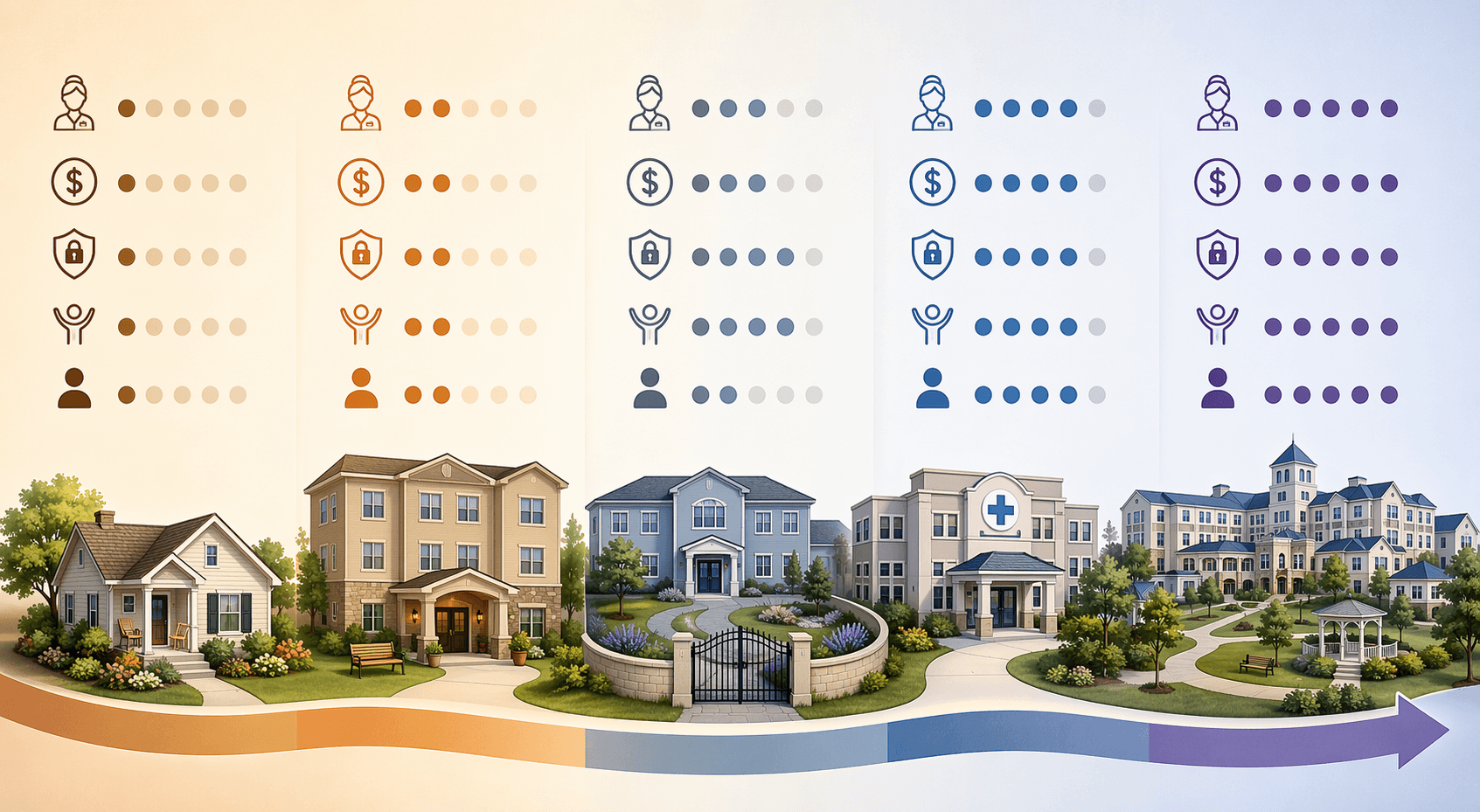
The table makes one pattern clear: memory care occupies a distinct middle ground between assisted living and nursing homes. It costs more than assisted living (a median premium of $1,271/month according to A Place for Mom’s 2026 data) but less than a nursing home. That premium buys specialized staff training, a secure physical environment, and programming designed specifically for cognitive impairment — features that general assisted living rarely provides.
A visual comparison of the five senior living options across key decision dimensions. Memory care occupies a distinct middle ground between assisted living and nursing homes.
When to Choose Memory Care: Concrete Signs and Decision Triggers
Memory care is not simply “assisted living for people with dementia.” It is a distinct care category defined by specialized staff training, a secure environment, and programming designed to manage the behavioral and psychological symptoms of dementia. The decision to move a loved one into memory care is emotionally difficult, but certain concrete signs indicate that the current setting — whether home or assisted living — is no longer safe or sustainable.
Concrete Signs It Is Time to Consider Memory Care
Wandering and exit-seeking behavior: If your loved one has wandered from home, attempted to leave at night, or become lost in familiar surroundings, the risk of injury or death is acute. Memory care communities are designed with secure perimeters and wandering management systems — 89% of A Place for Mom’s partner memory care communities offer services for restlessness, pacing, and wandering, and 82% address exit-seeking behaviors.
Falls or unexplained injuries: Falls are the leading cause of fatal and nonfatal injuries in people over 65 (CDC). If your loved one has fallen at home or in an assisted living setting, the environment may lack the safety features — grab bars, non-slip flooring, clear pathways, 24/7 monitoring — that memory care communities provide as standard.
Struggle with activities of daily living: When a person with dementia can no longer bathe, dress, toilet, or eat independently, the care burden shifts to family or understaffed assisted living facilities. Memory care communities typically offer higher staff-to-resident ratios and staff trained in dementia-specific ADL assistance.
Behavioral changes that threaten safety: Agitation, aggression, anxiety, and confusion can escalate to the point where a person with dementia becomes a danger to themselves or others. A Place for Mom reports that 52% of partner memory care communities offer services for anxiety, agitation, and aggression — services that are rarely available in standard assisted living.
Caregiver burnout: The Alzheimer’s Association and A Place for Mom both identify caregiver burnout — characterized by headaches, poor sleep, anxiety, withdrawal, and resentment — as a legitimate sign that facility-based care may be necessary. A burned-out caregiver cannot provide safe care, and the transition to memory care is often as much about protecting the caregiver’s health as it is about the care recipient’s safety.
Neglect of health and home: Forgetting to eat, take medications, or maintain basic hygiene, as well as neglecting pets or home maintenance, are signs that the current living situation is no longer sustainable. A Place for Mom notes that neglect can be considered a form of elder abuse, even when it is unintentional.
A Decision Algorithm for Choosing the Right Setting
The following decision algorithm guides you through the key questions that distinguish one care type from another. It is designed to be used after completing the needs-assessment framework above.
Is cognitive decline the primary driver of care needs? If yes, proceed to Question 2. If no — if the primary need is physical assistance or medical monitoring — skip to Question 4.
Is wandering, exit-seeking, or nighttime confusion a safety risk? If yes, memory care is the most appropriate setting. If no, consider whether the person can safely remain in assisted living with dementia-specific services — 80% of A Place for Mom’s partner assisted living communities offer some memory care services, though the level of specialization varies.
Does the person need 24/7 skilled nursing care? If yes, a nursing home or a CCRC with a skilled nursing unit is required. Memory care communities do not typically provide the level of medical monitoring that a nursing home offers.
Is the person fully independent with ADLs but needs social engagement and a maintenance-free lifestyle? If yes, independent living or a retirement community is appropriate.
Does the person need help with up to two ADLs but does not have significant cognitive impairment? If yes, assisted living is the appropriate setting.
Does the family want to minimize future transitions by choosing a campus that offers multiple levels of care? If yes, a CCRC (life plan community) may be worth the higher entry cost, provided the person is healthy enough to qualify for independent living at move-in.
What to Look for on a Tour: A Memory Care Checklist
Touring a memory care community is different from touring an assisted living facility. You are evaluating not just the physical environment but the staff’s ability to manage the behavioral and psychological symptoms of dementia. The following checklist, drawn from the A Place for Mom memory care checklist and the Alzheimer’s Association questions to ask, covers the critical areas to assess.
Staff Training and Qualifications
What specific dementia care training do staff members receive? Is it ongoing or a one-time session? (79% of partner memory care communities provide specialized training, per A Place for Mom.)
What is the staff-to-resident ratio during the day, at night, and on weekends?
Is there a licensed nurse on site 24/7, or is nursing available only during certain hours?
How does the facility handle behavioral challenges such as agitation, aggression, or anxiety? (52% of partner memory care communities offer services for these symptoms.)
Safety and Security Features
Is the community a secure facility? (88% of partner memory care communities are secure, per A Place for Mom.)
Does it have a wandering management system? (41% of partner communities feature one.)
Is there an enclosed courtyard or secure outdoor space? (78% of partner communities offer one.)
How does the facility manage exit-seeking behaviors? (82% of partner communities offer services for exit-seeking.)
Are there grab bars, non-slip flooring, and clear pathways to reduce fall risk?
Activities and Therapeutic Programming
Does the facility offer reminiscence therapy? (61% of partner communities do.)
Are sensory-based programs available? (60% of partner communities offer them.)
Is light therapy offered? (33% of partner communities offer it.)
Are there structured daily routines that include cognitive games, music, gardening, and exercise? (Harvard Health notes these as standard memory care activities.)
How does the facility adapt activities for residents in different stages of dementia?
Questions to Ask About Cost and Contracts
What is the base monthly fee, and what services are included? What services incur additional charges?
Is there an entry fee or community fee?
What happens if the resident’s care needs increase — is there a tiered pricing structure, or will the resident need to move to a different unit or facility?
Does the facility accept Medicaid, VA benefits, or long-term care insurance? If not, what are the options if the resident’s funds are depleted?
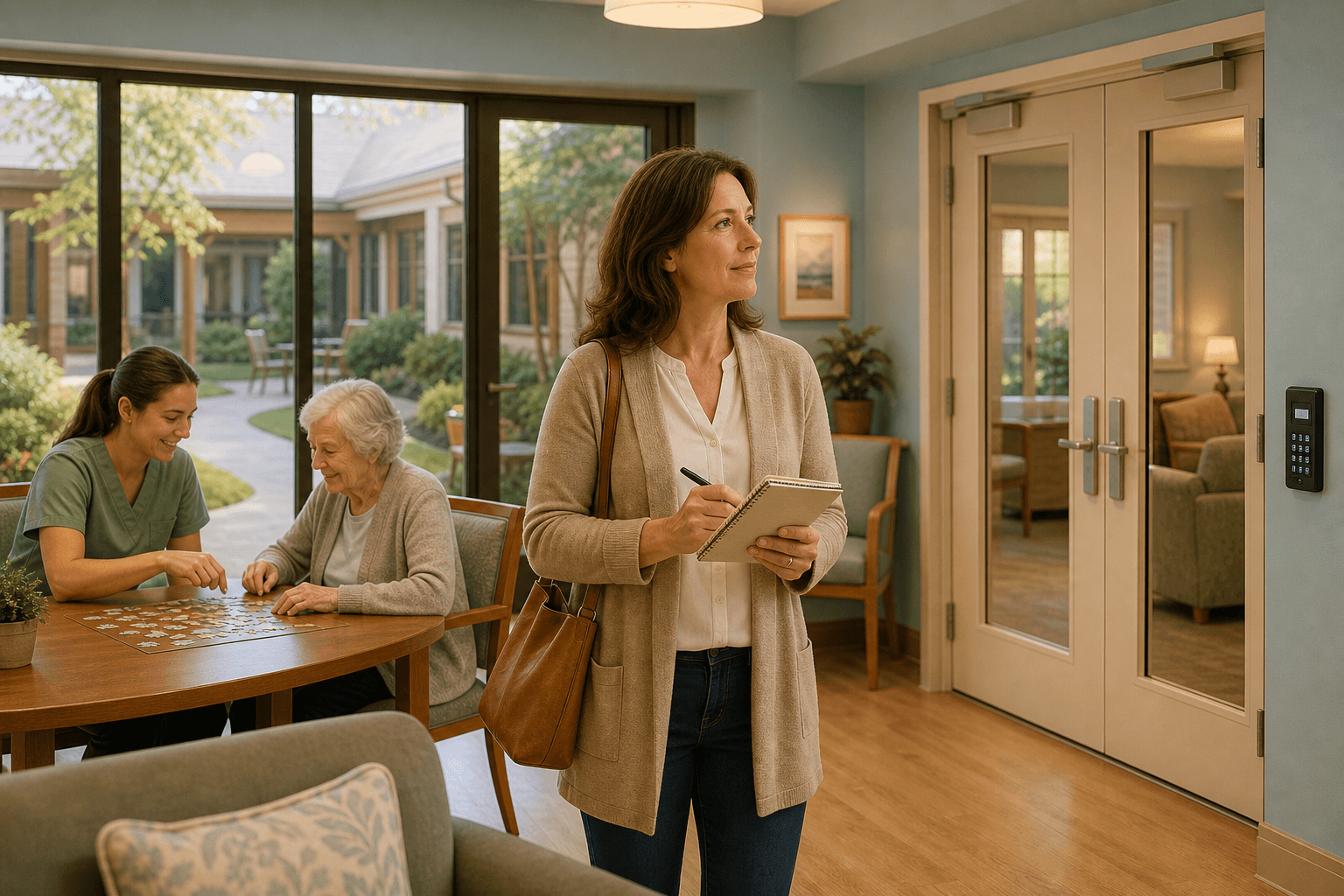
Touring a memory care community requires evaluating staff training, security features, and therapeutic programming — not just the physical environment.
Summary: Making an Informed, Compassionate Decision
The phrase “senior citizen home” masks a decision that is far more nuanced than most families realize. Independent living, assisted living, memory care, nursing homes, and CCRCs serve fundamentally different populations, and the cost of choosing the wrong setting is measured not just in dollars but in safety, dignity, and quality of life.
The data makes a clear case for treating memory care as a distinct category: 42% of assisted living residents have dementia, yet most assisted living communities lack the specialized staff training, secure environment, and therapeutic programming that memory care provides. The median premium of $1,271/month (A Place for Mom, 2026) buys features that directly address the most dangerous dementia symptoms — wandering, exit-seeking, agitation, and falls.
Use the needs-assessment framework to evaluate your loved one’s cognitive stage, ADL dependence, medical complexity, and safety risk. Use the decision algorithm to filter out inappropriate options. And use the tour checklist to evaluate memory care communities with the same rigor you would apply to any major investment in your family’s well-being.
You are not looking for a “senior citizen home.” You are looking for the right care setting for a specific person at a specific stage of their journey. That distinction matters — and it is the foundation of every good decision you will make from here.

Comments
Join the discussion with an anonymous comment.