
Early-Stage Alzheimer’s Care Priorities and Daily Routine Guide for Family Caregivers
A step-by-step framework for adult children navigating the first year after a parent’s early-stage Alzheimer’s diagnosis. Learn how to build a collaborative care partnership, establish a structured daily routine, complete essential legal and financial planning, and protect your own wellbeing — all while preserving your loved one’s independence.
What Early-Stage Alzheimer’s Means for Your Family
An early-stage Alzheimer’s diagnosis changes everything, but it does not change everything at once. According to the Alzheimer’s Association, most people in the early stage function independently — they may still drive, work, volunteer, and participate in social activities. The early stage can last for years, not months. This creates a window that many families do not fully use: a period when the person living with the diagnosis can still be an active partner in planning the road ahead.
The natural instinct after a diagnosis is to focus on medical management — finding the right doctor, understanding medications, scheduling follow-ups. Those are important, but they are not the highest-impact priorities for the first year. The evidence and experience of dementia care experts point to a different set of actions that preserve independence, reduce conflict, and build a sustainable care rhythm before significant functional decline begins.
This guide is written for adult children in their 40s and 50s who have recently learned of a parent’s early-stage Alzheimer’s diagnosis. It integrates five priorities with a practical daily routine framework — because the first year is not just about what to do, but how to live together differently, starting today.
Priority #1: Finding Your Role as a Care Partner
The single most important shift you can make in the first year is moving from a child-parent relationship to a care partnership. This is not about taking over. It is about learning to offer support in a way that preserves your parent’s dignity and autonomy.
The Help Signal
The Alzheimer’s Association recommends a simple but powerful tool called the help signal. This is an agreed-upon phrase or cue that the person with dementia can use to confirm whether they want or need support. For example, you might agree to say, "Is there anything I can do to help?" — and your parent knows they can answer honestly without feeling judged. The help signal puts control in their hands. It transforms assistance from something that is done to them into something that is offered with them.
The Positive Assumption
Another core principle from the Alzheimer’s Association is to make a positive assumption: assume that the person with dementia is capable of completing the task unless they indicate otherwise. This does not mean ignoring real difficulties. It means starting from a place of trust rather than surveillance. When you assume capability, you give your parent the chance to succeed — and when they struggle, you are there to step in gently, not to take over preemptively.
When to Step In vs. Step Back
This is the hardest judgment call in early-stage caregiving. A useful rule of thumb: step in when safety is at risk or when the person is clearly frustrated and asking for help. Step back when the task is being completed, even if it is not being done the way you would do it. Your parent may put the dishes in a different cabinet or fold towels in a way that seems odd. If it works, let it go. Preserving their sense of competence is more valuable than having perfectly organized cabinets.
- Ask before helping: "Would you like me to help with that?"
- Wait for a clear answer — silence is not consent.
- If they say no, respect it unless there is an immediate safety concern.
- If they say yes, help only as much as needed, then step back.
Priority #2: Building a Daily Routine Together
A structured daily routine is one of the most effective tools in early-stage Alzheimer’s care. The Alzheimer’s Association advises that structured and pleasant activities can reduce agitation and improve mood. For the person with dementia, a predictable schedule reduces anxiety because the world becomes more familiar. For the caregiver, it reduces the mental load of constant decision-making.
The key is to build the routine together. Do not impose a schedule. Sit down with your parent, look at how they currently spend their day, and ask what they enjoy and what feels difficult. The National Council of Certified Dementia Practitioners (NCCDP) emphasizes: "Let the person with dementia help guide the day’s routine. Honoring their preferences, what they want to do and when, can reduce conflict and help prevent distressing behaviors."
Sample Daily Routine Template
The following template is adapted from the Alzheimer’s Association daily care plan and the NCCDP framework. It is designed for early- to middle-stage dementia and should be adjusted to match your parent’s preferences, energy levels, and lifelong habits.
| Time of Day | Suggested Activities | Key Considerations |
|---|---|---|
| Morning | Wake up, hygiene, dress in comfortable clothes. Prepare and eat breakfast together. Have a conversation over coffee. Discuss the newspaper, try a craft project, or reminisce over old photos. | Most people function best in the morning. Allow ample time — do not rush. Break tasks into simple steps. |
| Midday | Prepare and eat lunch. Read mail, wash dishes together. Listen to music, do crossword puzzles, or watch a familiar TV show. Take a short walk or do light gardening. | Include a rest or short nap if needed. Hydrate regularly. Avoid crowded or noisy places. |
| Evening | Prepare and eat dinner at a familiar hour. Clean up the kitchen together. Reminisce over coffee and dessert. Play cards, watch a movie, or give a gentle hand massage. | Wind-down activities should be calming. Avoid stimulating TV or arguments before bed. Keep wake-up and bedtime consistent. |
| Night | Take a bath or shower, get ready for bed. Read a book or listen to relaxing music. Lights out at a regular time. | A consistent bedtime routine helps prevent sleep disturbances and sundowning. Use nightlights if needed. |
The NCCDP notes that consistency is powerful — repeating tasks at the same time each day reduces anxiety and promotes cooperation — but flexibility is equally important. Some days your parent will have more energy; some days they will need more rest. The routine is a guide, not a prison.
The Four R’s of Dementia Care
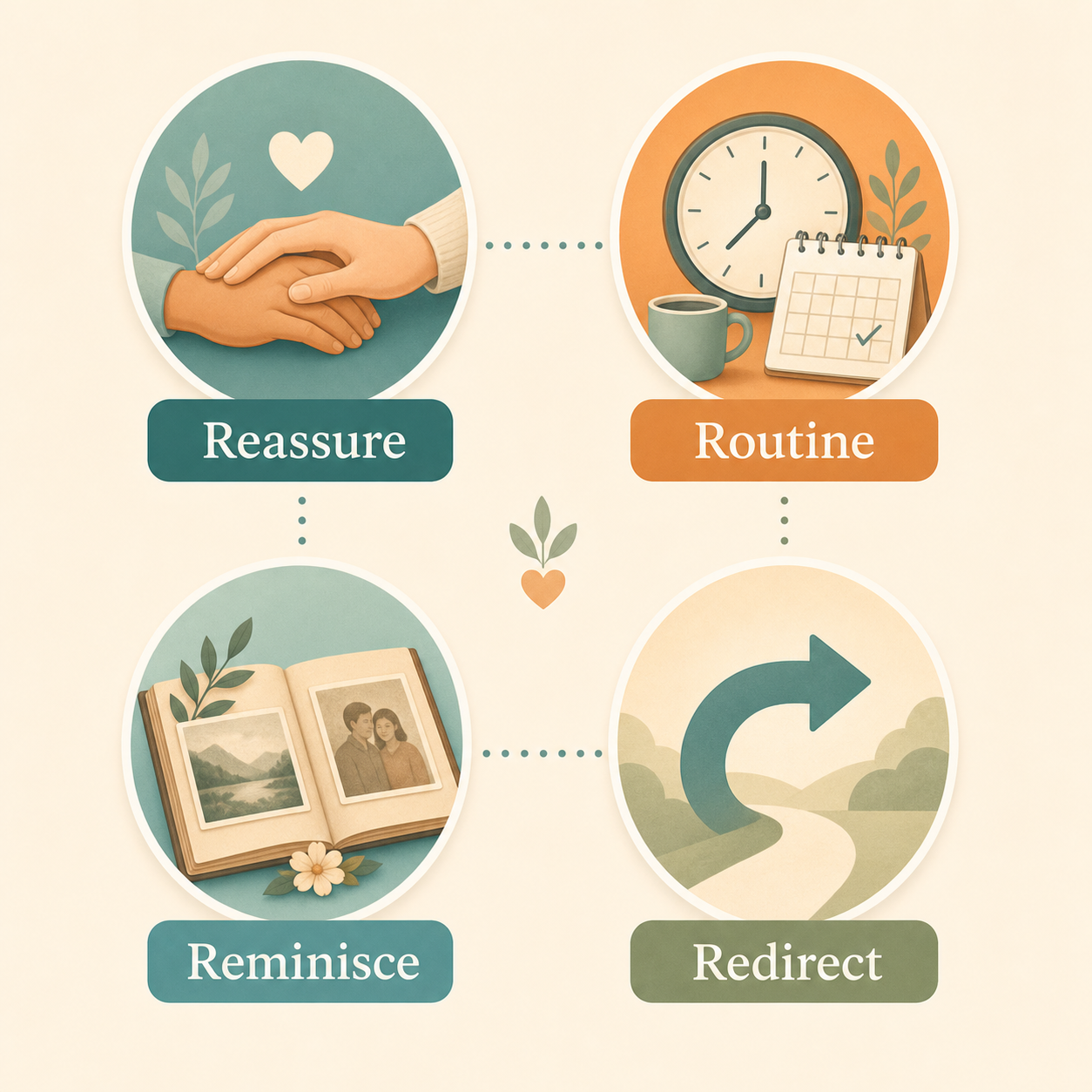
The NCCDP’s Four R’s framework provides a practical behavioral guide that works across the early stage and beyond. Keep these four principles in mind throughout the day:
- Reassure: Speak calmly, use a soothing tone, and provide physical comfort like a gentle touch. Ensure the environment feels safe and familiar.
- Routine: Create a daily schedule with regular times for meals, activities, and rest. Break tasks into simple steps. Maintain consistency but remain flexible.
- Reminisce: Look through photo albums, play music from your parent’s past, encourage storytelling, and create memory boxes with sentimental items. Reminiscing builds connection and reinforces identity.
- Redirect: If your parent becomes agitated or frustrated, use distraction rather than correction. Move to a quieter area, offer a simple engaging activity, or suggest a different topic. Never argue.
Priority #3: Getting Organized — Legal, Financial, and Home Safety
The early stage is the time to get legal and financial documents in order — while your parent can still participate in decisions and express their wishes. The National Institute on Aging (NIA) advises: "Start discussions early with your family members. Put important papers in one place and make sure a trusted person knows where. Update documents as situations change."
Essential Documents to Prepare
- Advance directives: A living will and a durable power of attorney for health care. These documents ensure your parent’s medical wishes are known and respected.
- Financial planning documents: A will, durable power of attorney for finances, and a living trust. These protect your parent’s assets and ensure bills and accounts are managed if they become unable to do so.
- Long-term care plan: Begin discussing where your parent will live, what services are available, and how to pay for them. The NIA recommends starting this planning as soon as possible so the person can make decisions while still capable.
For legal help, the NIA recommends contacting the Eldercare Locator at 800-677-1116 and the National Academy of Elder Law Attorneys at 703-942-5711.
Medication Management Systems
Even in the early stage, medication management can become challenging. The NIA recommends using weekly pillboxes, automatic dispensers, or smartphone alarms. Set up automated payments for bills to reduce financial stress. Consider grocery delivery services or Meals on Wheels America (888-998-6325) to simplify daily tasks.
Brief Home Safety Audit
A full wandering-focused safety review is beyond the scope of this guide, but a few quick adjustments can prevent common accidents in the early stage:
- Remove unused items and throw rugs that could cause tripping.
- Install automatic shut-off switches on stoves.
- Set water heater temperature to 120°F to prevent burns.
- Add nonskid mats and grab bars in the bathroom.
- Ensure smoke and carbon monoxide detectors are working.
- Carry a medical ID bracelet or card.
Priority #4: Building Your Support System Early
The Alzheimer’s Association advises: "Build a support network before you think you need it." This is not pessimism — it is strategic planning. Nearly 13 million Americans provide unpaid care for people with Alzheimer’s or other dementias, according to the Alzheimer’s Association’s 2026 Facts and Figures report. In 2025, those caregivers provided more than 19 billion hours of care valued at over $446 billion. You are not alone, and you do not need to figure this out by yourself.
Here are the key resources to connect with in the first year:
- Alzheimer’s Association 24/7 Helpline: 800-272-3900. Available any time, every day. Trained professionals can answer questions, provide crisis support, and connect you to local resources.
- Support groups: Both in-person and online support groups are available through the Alzheimer’s Association and local community organizations. Hearing from others who are walking the same path reduces isolation and provides practical tips.
- Eldercare Locator: 800-677-1116. A public service of the U.S. Administration on Aging that connects you to local services for older adults and their families.
- Community services: Area Agencies on Aging, local senior centers, and faith-based organizations often offer respite care, meal delivery, transportation, and social activities.
Building this network early means you will know who to call when a crisis arises — and you will have already established relationships, so asking for help feels natural rather than desperate.
Priority #5: Caring for Yourself as a Caregiver
The statistics on caregiver stress are sobering. The Alzheimer’s Association reports that 59% of dementia caregivers feel high to very high emotional stress. About 30% of caregivers are age 65 or older themselves. A 2026 survey of 1,029 family caregivers found that 75% feel stressed or anxious at least monthly, 71% feel overwhelmed, and 47% say their physical health has declined since taking on caregiving duties.
These numbers are not meant to scare you — they are meant to normalize the experience. If you are feeling stretched, you are not failing. You are responding to an extraordinarily demanding situation.
Early Warning Signs of Burnout
- Feeling exhausted even after sleeping
- Becoming easily irritated or short-tempered
- Withdrawing from friends and activities you used to enjoy
- Frequent headaches, stomach issues, or other physical symptoms
- Feeling hopeless or helpless about the future
Respite Strategies for the Early Stage
Respite does not have to mean hiring a professional caregiver (though that is an option). In the early stage, respite can look like:
- A trusted friend or family member staying with your parent for a few hours while you run errands or meet a friend for coffee.
- An adult day program that provides structured activities and social engagement for your parent.
- A scheduled weekly activity your parent enjoys independently, like a book club or gardening group.
The NIA advises caregivers to: ask for help when needed, eat nutritious foods, join a caregiver support group, take breaks each day, spend time with friends, get exercise, practice meditation, and consider seeking help from mental health professionals.
For a deeper look at burnout recognition and recovery, read our guide on Caregiver Burnout: Warning Signs and How to Recover.
When to Adjust the Routine as the Disease Progresses
The early stage does not last forever. The Alzheimer’s Association notes that people age 65 and older survive an average of four to eight years after an Alzheimer’s diagnosis, though some live as long as 20 years. The transition from early to middle stage is gradual, but certain signs indicate it is time to adjust your approach:
- Your parent begins needing more help with basic activities like bathing, dressing, or toileting.
- They become confused about time, place, or familiar people more frequently.
- They can no longer be left alone safely for extended periods.
- Driving becomes unsafe and you need to have the driving cessation conversation.
- The current daily routine no longer feels manageable for either of you.
When these changes appear, the care priorities shift. The collaborative, independence-preserving approach of the early stage gives way to a more hands-on, safety-focused model. Our Middle-Stage Alzheimer’s Care: A Planning Guide provides a detailed roadmap for that next phase, including decision timelines, safety protocols, and care coordination strategies.
For a broader understanding of how functional abilities typically change over time, the ADL and IADL Decline Timeline article explains the progression of activities of daily living and instrumental activities of daily living in more depth.
Your First-Year Roadmap: Key Takeaways
The first year after an early-stage Alzheimer’s diagnosis is not a countdown to decline. It is a window of opportunity — a time to build a partnership, establish rhythms, complete essential planning, and create a support system that will sustain you both through the years ahead.
Here is your actionable checklist for the first year:
- Establish a help signal and practice the positive assumption approach.
- Build a daily routine together using the sample template and the Four R’s framework.
- Complete legal and financial planning while your parent can still participate.
- Set up medication management systems and perform a basic home safety audit.
- Connect with the Alzheimer’s Association 24/7 helpline, support groups, and the Eldercare Locator.
- Monitor your own stress levels and build respite into your schedule from the start.
- Watch for signs of transition to middle-stage and know where to find the next level of guidance.
You do not need to do everything at once. Start with the first priority — finding your role as a care partner — and build from there. The routine, the documents, the support network, and the self-care practices will all grow more naturally when the foundation of trust and collaboration is in place.

Related reading
Noticed something outdated or inaccurate on this page? Flag a correction. We review every report against CDC, NIA, and AARP HomeFit guidance before updating a page.
Part of the Fall Prevention section.