
Home Care vs. Memory Care: The 2026 Cost-Benefit Analysis Every Family Caregiver Needs Before Making the Transition
This article helps family caregivers of a parent with dementia compare the true costs of home care versus memory care. It reveals when home care becomes more expensive than a facility and provides a stage-by-stage decision framework.
Head-to-Head Cost Comparison: Home Care vs. Memory Care in 2026
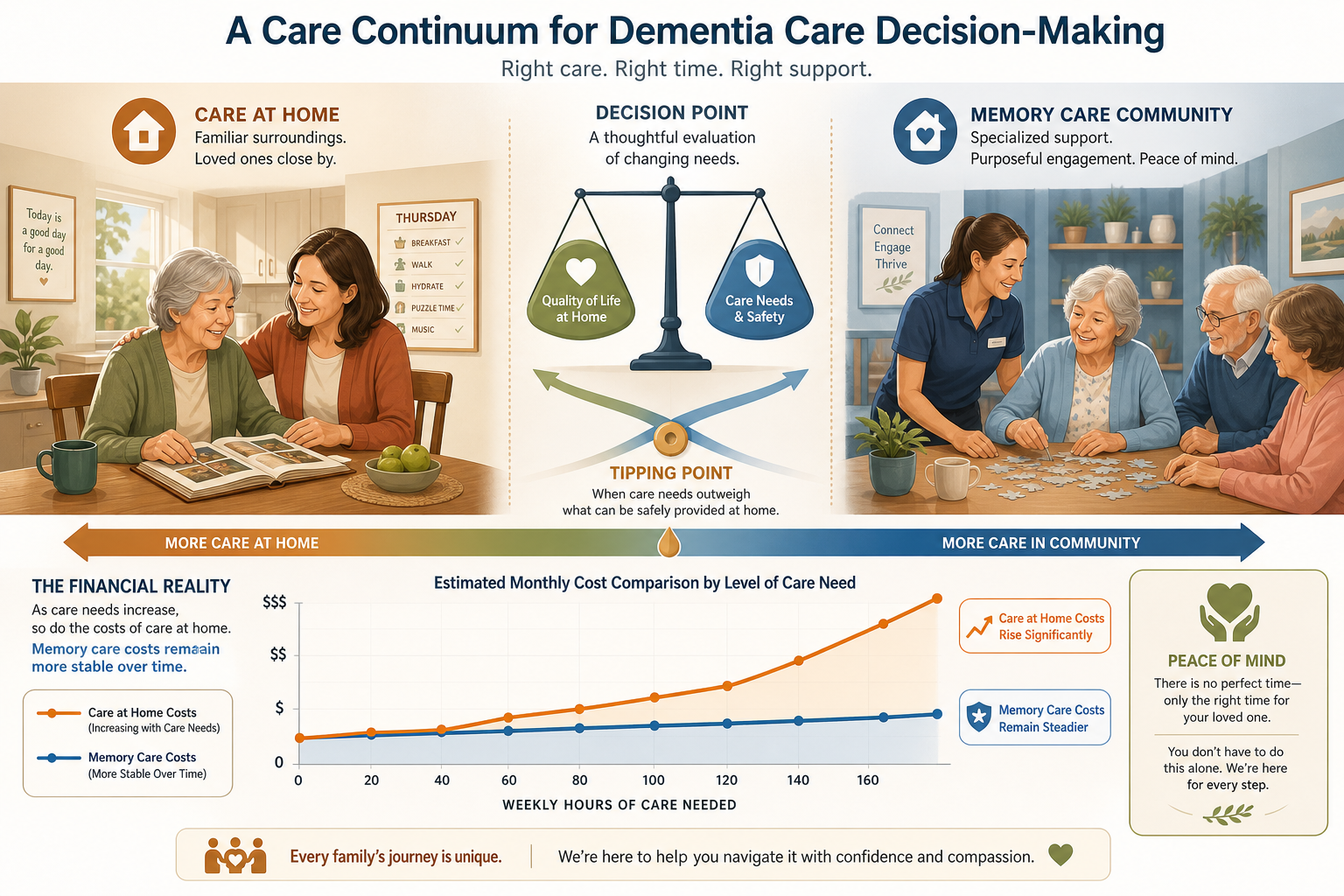
The first question most families ask is straightforward: which option costs less? The answer, however, is anything but simple. The cost of home care is variable and scales with the number of hours a senior needs supervision. Memory care, by contrast, is a flat monthly fee that bundles housing, meals, 24/7 oversight, and specialized programming. To make a fair comparison, you have to look at the full picture of care hours required.
According to data from U.S. News and the Alzheimer's Association, the national average for a home health aide is $35 per hour. At 44 hours per week — a common threshold for a senior who cannot be left alone for a full workday — that adds up to roughly $80,080 per year. Memory care, on the other hand, carries a national median cost of $8,019 per month, or about $96,228 per year, according to SeniorLiving.org's May 2026 analysis. The gap between the two is narrower than most people assume.
| Cost Category | Home Care | Memory Care |
|---|---|---|
| Hourly rate / daily rate | $35/hour (national average) | $267/day (national median) |
| Weekly cost (40 hours) | $1,400/week | $1,850/week |
| Annual cost (44 hrs/week) | ~$80,080/year | ~$96,228/year |
| Cost structure | Variable — increases with hours | Flat monthly fee |
| What's included | Personal care, companionship, light housekeeping | Housing, meals, 24/7 supervision, programming, activities |
It is also important to note that memory care costs are typically 15–25% higher than standard assisted living, reflecting the added security, specialized staff training, and structured programming required for residents with dementia. The AARP reports that memory care units increased nearly 84% from 2013 to 2023, reaching 162,100 units nationally, and occupancy has rebounded to pre-pandemic levels — a sign that demand is strong and options are expanding.
The Cost Tipping Point: When Home Care Becomes More Expensive Than Memory Care
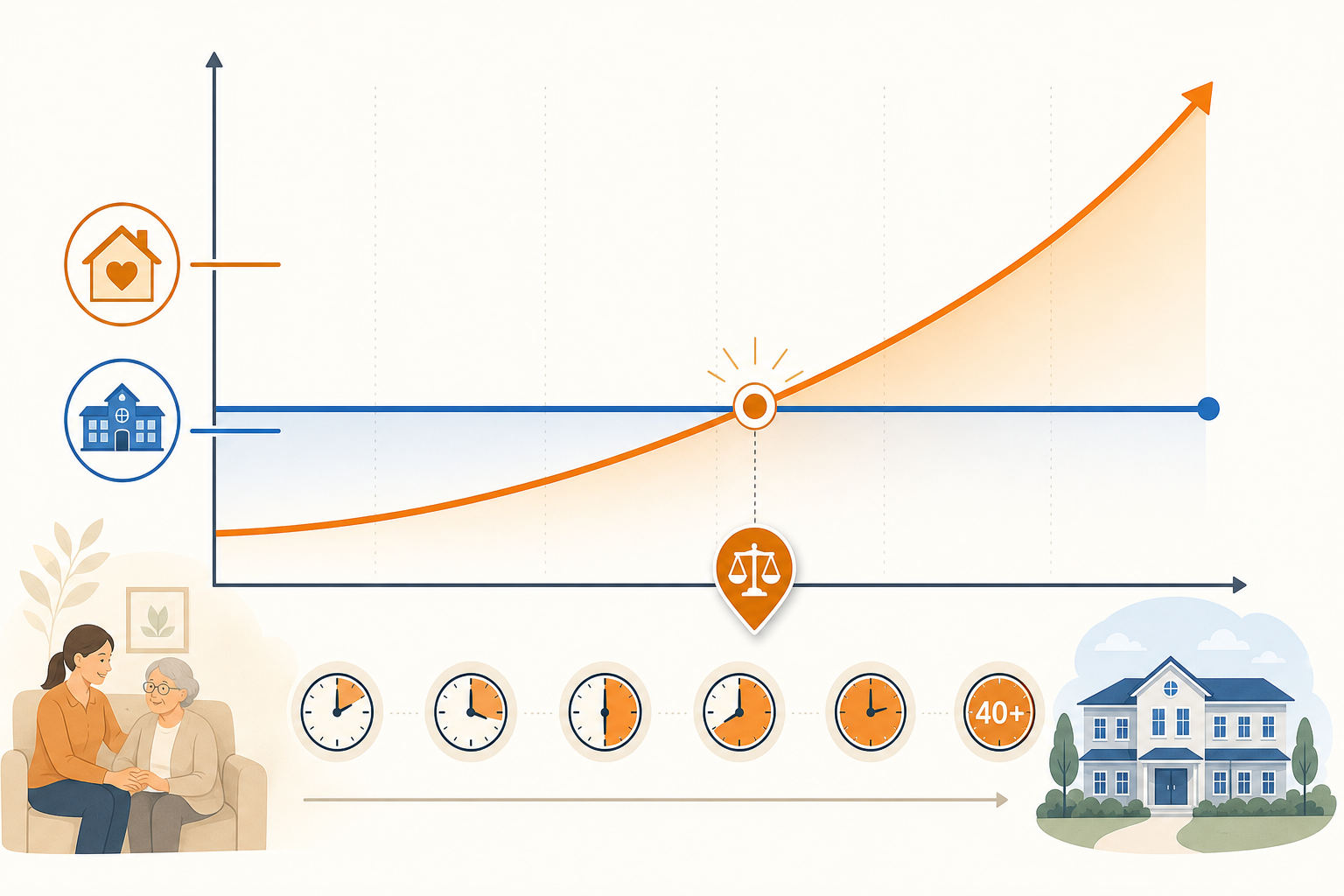
Here is the counterintuitive finding that changes the math for most families: home care is not cheaper than memory care once a senior needs more than about 8 to 10 hours of daily supervision. At that point, the variable hourly cost of home care overtakes the flat monthly fee of a memory care facility.
Consider a senior with moderate dementia who cannot be left alone safely. If they need 12 hours of paid care per day — a common arrangement for a family caregiver who works during the day and needs overnight coverage — the weekly cost at $35/hour is $2,940. That is $12,740 per month, or roughly $152,880 per year. Compare that to the $8,019/month national median for memory care, and the difference is stark: home care costs nearly 60% more.
| Daily Care Hours | Weekly Home Care Cost | Monthly Home Care Cost | Monthly Memory Care Cost (Median) | Which Is Cheaper? |
|---|---|---|---|---|
| 4 hours | $980 | $4,200 | $8,019 | Home care |
| 8 hours | $1,960 | $8,400 | $8,019 | Roughly equal |
| 10 hours | $2,450 | $10,500 | $8,019 | Memory care |
| 12 hours | $2,940 | $12,600 | $8,019 | Memory care |
| 24 hours (two shifts) | $5,880 | $25,200 | $8,019 | Memory care |
The tipping point is not just a theoretical exercise. As Jacqui Clark, a senior care consultant, told U.S. News: "Staying at home with care is the most expensive option. It's a big myth that it's cheaper to stay at home with care." This is the central insight that every family caregiver should understand before making a decision.
Beyond the Price Tag: Safety, Wandering, Burnout, and Socialization
Cost is only one dimension of the decision. For dementia caregivers, safety and quality of life often carry equal or greater weight. Memory care facilities are designed specifically to address risks that are difficult — sometimes impossible — to manage at home.
Wandering Risk
According to the Alzheimer's Association, six in 10 people living with dementia will wander at least once, and many do so repeatedly. Wandering can be life-threatening: individuals who wander are often found within 1.5 miles of where they disappeared, and the Association advises calling 911 if the person is not found within 15 minutes. A memory care facility provides a secured environment with alarmed doors, enclosed outdoor spaces, and staff trained to redirect wandering behavior — protections that are difficult to replicate in a private home without expensive monitoring systems and constant vigilance.
Caregiver Burnout
The emotional and physical toll on family caregivers is staggering. SeniorLiving.org reports that caregiver burnout affects 59% of those providing 40 or more hours of care per week. Unpaid family caregivers provide an estimated $247 billion in economic value annually for Alzheimer's and dementia care alone, according to USC research cited in the same report. That figure represents real wages lost, careers derailed, and health consequences for caregivers who are often in their 40s and 50s, managing their own families and jobs alongside caregiving duties.
Socialization and Structured Programming
Memory care communities offer something that home care cannot easily replicate: a built-in social environment with peers, structured activities, and staff trained in dementia-specific engagement techniques. Social isolation is a known risk factor for cognitive decline, and a home care aide — no matter how skilled — cannot provide the same level of group interaction and cognitive stimulation that a well-run memory care program can.
- Safety: Secured environments, alarmed exits, enclosed outdoor spaces, and 24/7 staff presence reduce wandering and fall risks.
- Burnout: 59% of high-hour caregivers experience burnout. Memory care shifts the 24/7 responsibility to trained professionals.
- Socialization: Group activities, communal dining, and peer interaction provide cognitive and emotional benefits that are hard to achieve at home.
- Specialized care: Staff are trained in dementia-specific communication, behavior management, and non-pharmacological interventions.
The Hidden Costs of Staying Home
The hourly rate for a home health aide is only the most visible expense. Families who choose to keep a loved one with dementia at home often encounter a cascade of additional costs that are easy to overlook when making the initial comparison.
- Home modifications: Grab bars, ramps, stair lifts, widened doorways, and bathroom safety upgrades can cost anywhere from a few hundred to tens of thousands of dollars.
- Monitoring technology: Medical alert systems, motion sensors, GPS trackers, and video monitoring systems add monthly subscription fees and upfront equipment costs.
- Lost caregiver wages: The $247 billion in unpaid dementia care annually represents real income that family caregivers forgo. Many reduce work hours, take unpaid leave, or leave the workforce entirely.
- Health costs for the caregiver: Caregivers experiencing burnout are at higher risk for depression, anxiety, and chronic health conditions, leading to increased medical expenses.
- Emergency and backup care: When the primary caregiver is sick or needs a break, last-minute replacement care often costs a premium.
For families considering a live-in caregiver as an alternative to memory care, the costs and logistics are substantial. Our Live-In Caregiver for a Parent with Dementia: A Complete Guide covers hiring, training, and safety considerations at every stage of dementia progression.
Payment Options: What Medicare, Medicaid, VA, and Insurance Cover for Each Scenario
Understanding what each payment source covers — and does not cover — is critical to an accurate cost comparison. The rules differ significantly between home care and memory care, and many families discover too late that a key expense is not covered.
| Payment Source | Home Care Coverage | Memory Care Coverage |
|---|---|---|
| Medicare | Does not cover custodial care (bathing, dressing, eating). May cover short-term skilled nursing or therapy after a hospital stay. | Does not cover room and board or custodial care. May cover some medical services (doctor visits, physical therapy, medications) while in a facility. |
| Medicaid | Coverage varies by state. Some states offer home- and community-based services (HCBS) waivers that cover in-home care for eligible individuals. | May cover memory care in facilities that accept Medicaid. However, memory care communities accept Medicaid less frequently than other senior care types. |
| VA Aid and Attendance | Can be used to pay for in-home care, including home health aides and adult day care. | Up to $2,424/month for a single veteran, $2,874/month for a married veteran, and $1,558/month for a surviving spouse (American Council on Aging). Can be applied to memory care costs. |
| Long-Term Care Insurance | Policies vary widely. Many cover in-home care up to a daily or monthly benefit amount. | Policies vary. Some cover memory care in licensed facilities. Check the policy's definition of covered care settings. |
| Out of Pocket | Most common payment method for home care. Families pay the aide directly or through an agency. | Most common payment method for memory care. AARP notes that most families pay out of pocket for memory care. |
The VA Aid and Attendance benefit is particularly worth investigating. It provides up to $2,424 per month for a single veteran and $2,874 per month for a married veteran, and it can be applied to either home care or memory care costs. This benefit is significantly underutilized — many eligible families do not know it exists.
Stage-by-Stage Decision Framework: Matching Care to Dementia Progression
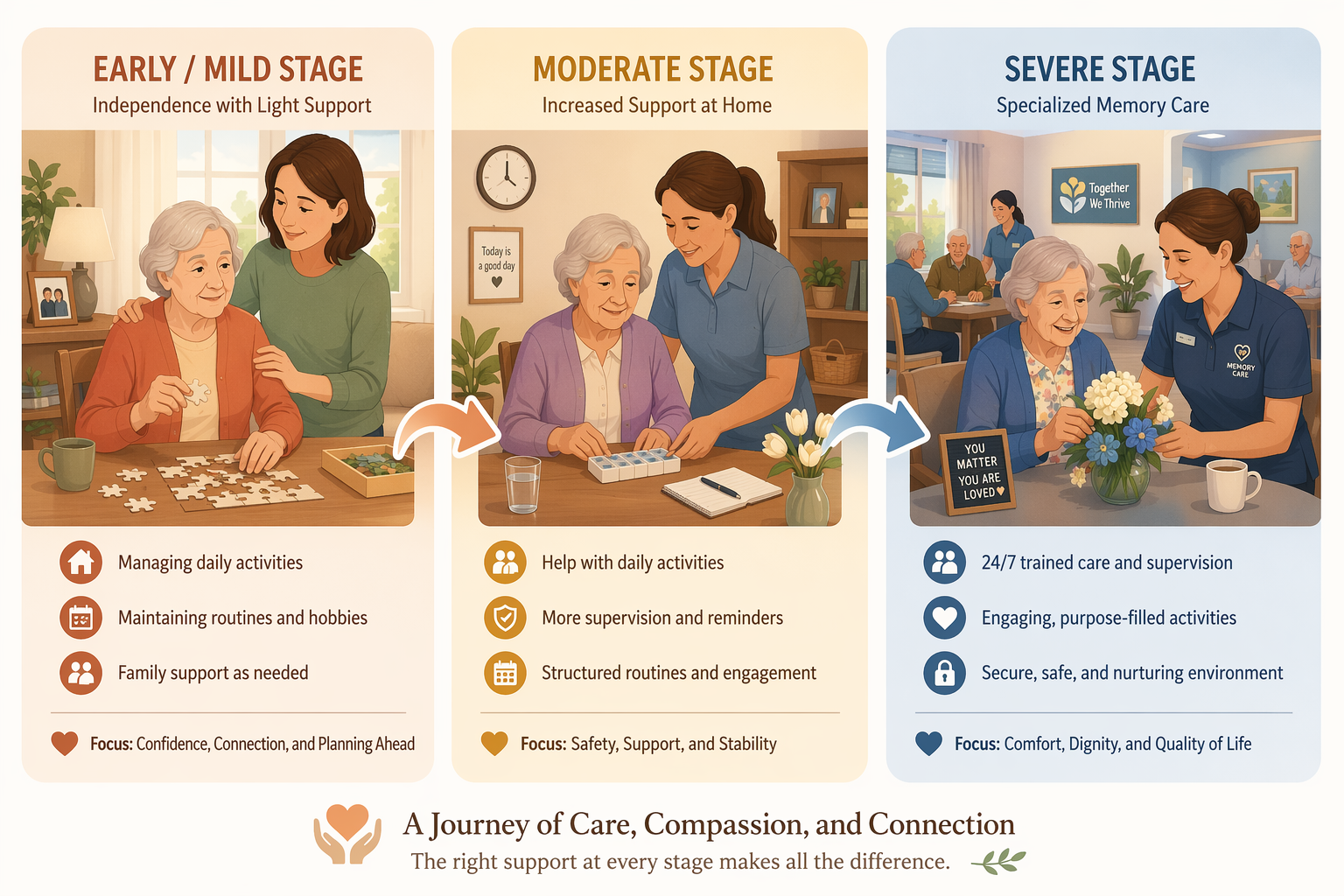
The right care setting depends heavily on where the person is in their dementia journey. What works in the early stages may become unsafe or inadequate as the disease progresses. The following framework maps care options to each stage, with the cost tipping point as a key decision signal.
| Dementia Stage | Typical Care Needs | Home Care Feasibility | Memory Care Consideration |
|---|---|---|---|
| Early / Mild | Medication reminders, transportation, light supervision. May still be safe alone for short periods. | Highly feasible. 4–8 hours of paid care per day is often sufficient. Cost is lower than memory care. | Usually premature. Focus on planning, touring facilities, and understanding financial options. |
| Moderate | Requires supervision for most activities. Wandering risk increases. Needs help with bathing, dressing, and eating. | Becomes expensive. 8–12 hours of paid care per day pushes costs past memory care. Caregiver burnout risk is high. | Strongly consider. The cost tipping point is reached. Safety and socialization benefits become significant. |
| Severe / Late | 24/7 supervision. Needs full assistance with all ADLs. May have mobility issues, incontinence, and difficulty swallowing. | Prohibitively expensive for full-time paid care. Two shifts of aides cost $25,200+/month. | Most appropriate setting. 24/7 secured environment with trained staff. Cost is lower than round-the-clock home care. |
For a deeper look at what daily care actually looks like at each stage, including the specific supervision levels and care tasks involved, see our 24-Hour Care for a Parent with Dementia: A Stage-by-Stage Guide. That guide walks through the practical realities of providing care at home as dementia progresses, which can help you assess whether your current setup is sustainable.
For a broader view of how memory care fits into the full landscape of senior care options, including cost benchmarks for assisted living and nursing homes, refer to our companion article: Senior Care Options in 2026: A Cost Reality Check for Families.
Related reading
- The Real Cost of a Live-In Companion in 2026: What Families Pay, What They Get, and the Hidden Trade-Offs vs. Assisted Living
- The Caregiver Sleep Crisis: Why 94% of Dementia Caregivers Are Sleep-Deprived and a Practical Recovery Plan
- Live-In Caregiver for a Parent with Dementia: A Complete Guide to Hiring, Training, and Safety at Every Stage
Noticed something outdated or inaccurate on this page? Flag a correction. We review every report against CDC, NIA, and AARP HomeFit guidance before updating a page.
Part of the Fall Prevention section.