Overnight Care for Elderly: A Complete Guide to Options, Costs, and Getting Started
By Editorial Team
overnight care
caregiver exhaustion
dementia care
sundowning
home care costs
respite care
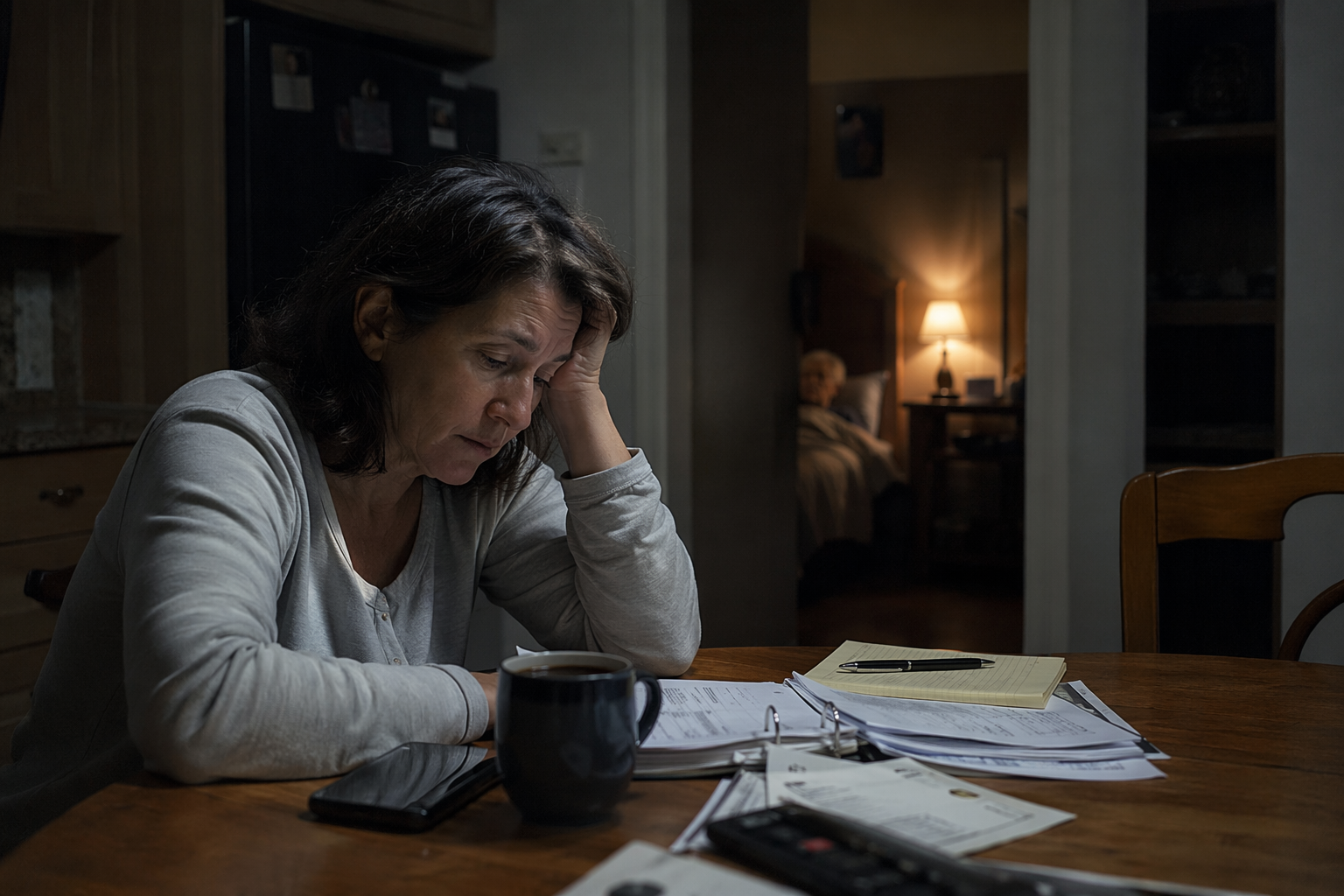
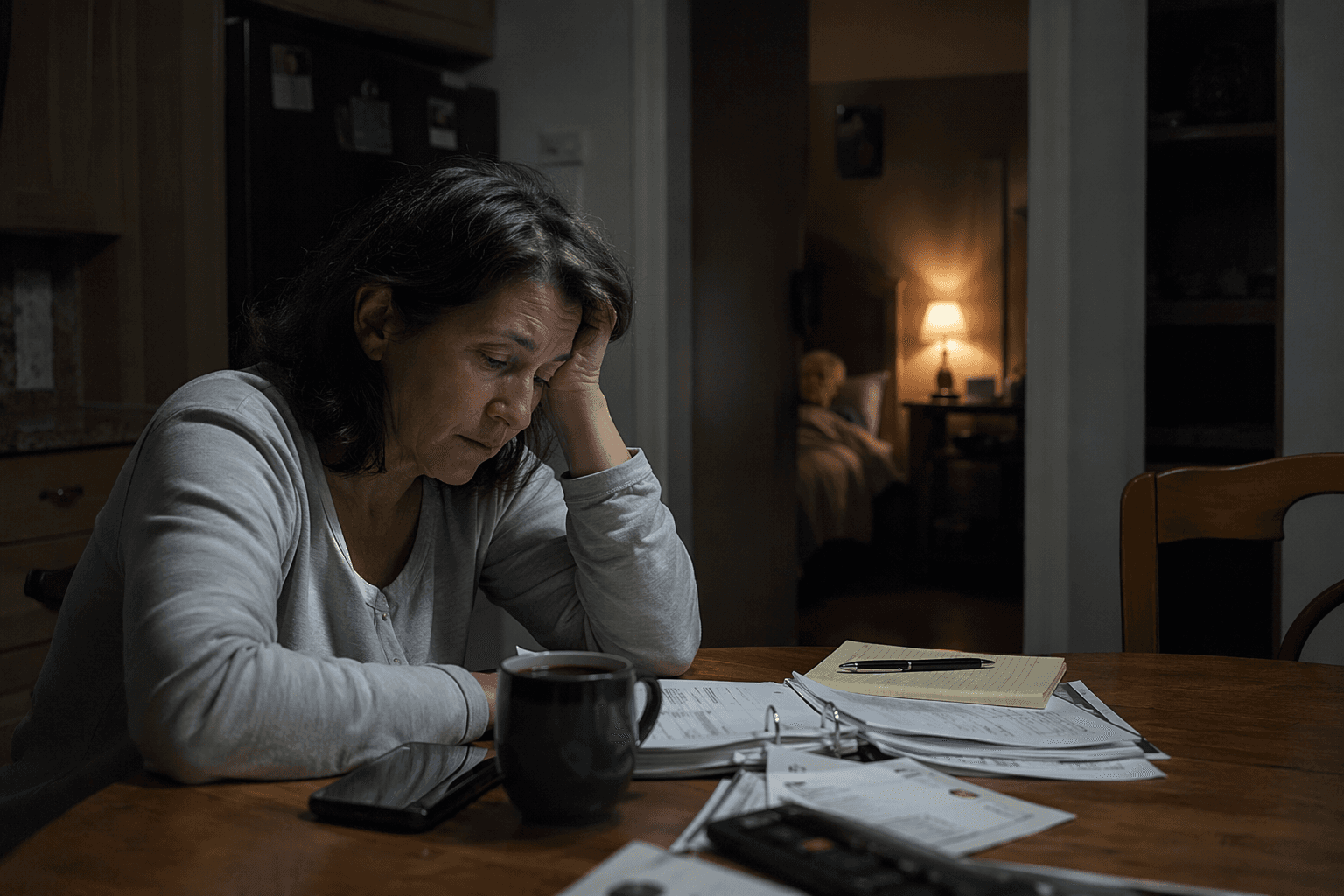
Caregiver exhaustion at night is one of the clearest signals that the current care arrangement is no longer sustainable.
Is Overnight Care Right for Your Situation?
Most family caregivers reach the overnight care decision not through a single dramatic event, but through a slow accumulation of broken nights. You wake at 2 a.m. to the sound of your parent calling out, or you lie awake listening for movement, or you simply cannot fall back asleep after the third bathroom trip. At some point, the math stops working: your need for restorative sleep and their need for nighttime support become incompatible.
The data on caregiver sleep loss is stark. Family caregivers lose an average of 2 hours of sleep per night, according to the Family Caregiver Alliance, and a systematic review of 22 studies found that up to 76% of caregivers report poor sleep quality (PSQI >5). For dementia caregivers specifically, a meta-analysis of 35 studies published in JAMA Network Open found they lose 2.5 to 3.5 hours of sleep per week due to difficulty falling and staying asleep. This is not a minor inconvenience — it is a documented health risk.
Here are the concrete warning signs that overnight care may be needed:
Frequent nighttime bathroom trips with fall risk. Nocturia — waking to urinate two or more times per night — is linked to a 28% increased fall risk in older adults, according to the UAB Study of Aging. A fall in the dark, on the way to the bathroom, is one of the most common and dangerous nighttime events.
Sundowning or wandering in dementia. Agitation, confusion, and pacing that intensify in the late afternoon and evening are hallmarks of dementia. An estimated 7.2 million Americans aged 65 and older are living with Alzheimer's in 2026 (Alzheimer's Association), and a significant portion experience sundowning. If your parent is trying to leave the house at 3 a.m. or becoming agitated and confused, a sleeping caregiver cannot respond safely.
Your own declining health. A 2026 survey of 1,029 family caregivers found that 67% have trouble sleeping with some regularity, 72% feel overwhelmed, and 47% say their physical health has declined since taking on caregiving. The average annual lost income for caregivers is $21,500. If you are catching every cold, missing work, or feeling irritable and depleted, your body is telling you the current arrangement is unsustainable.
The senior cannot be left alone at night. This includes people who need repositioning every 2-3 hours to prevent pressure sores, those who require scheduled medication, and those who are at high risk for aspiration or other medical events during sleep.
The Three Models of Overnight Care: Awake, Sleep, and Live-In
One of the most common mistakes families make is treating overnight care as a single service. In reality, there are three distinct models, and choosing the wrong one means either paying for more than you need or — worse — getting less support than the situation requires.
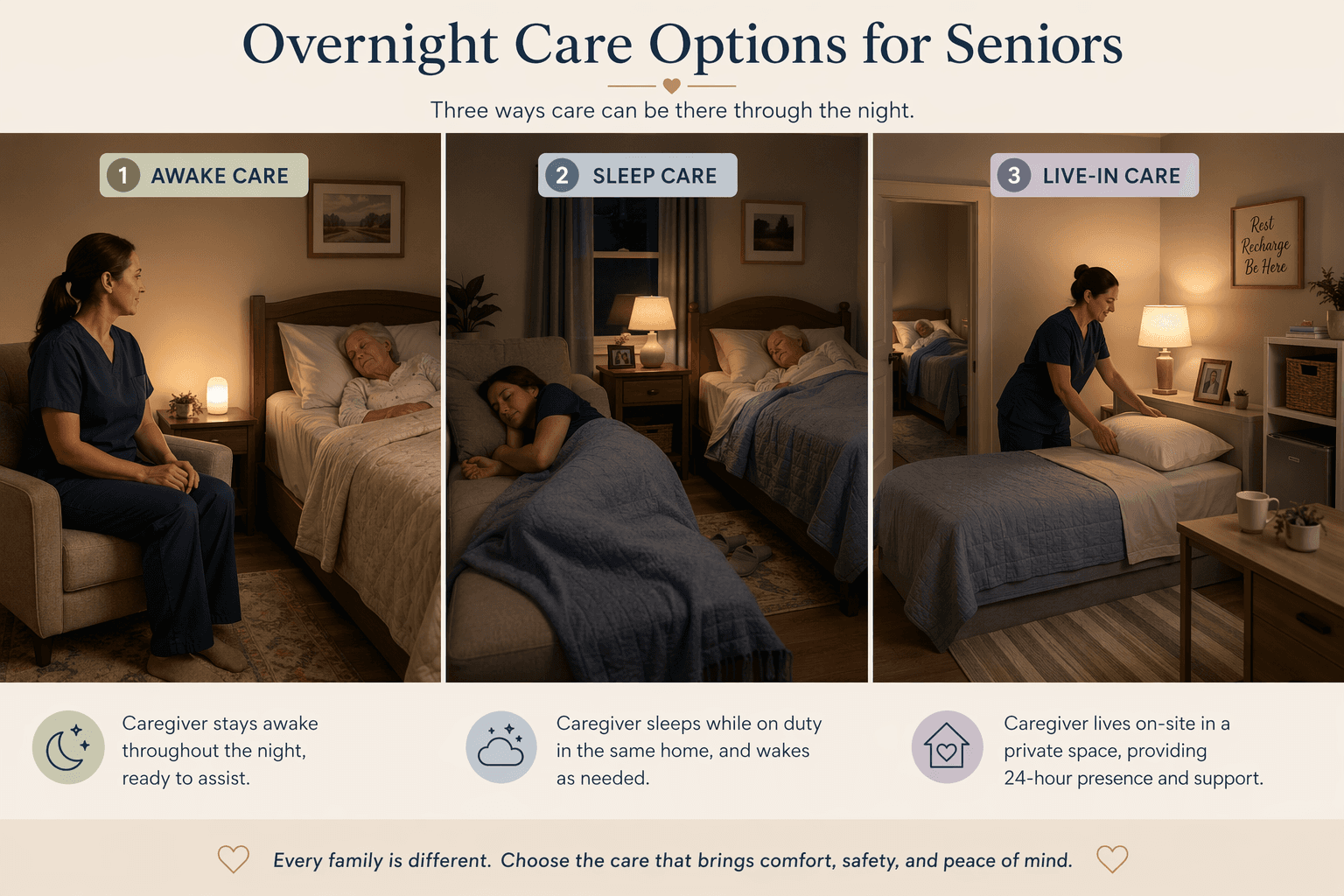
The three models of overnight care differ in caregiver availability, cost, and suitability for different risk levels.
Comparison of the three overnight care models and their primary use cases.
Model
Caregiver State
Best For
Typical Cost Impact
Awake Care
Alert and awake throughout the shift
High-risk situations: wandering, severe confusion, frequent transfers, fall risk, sundowning
Lower per-hour cost; caregiver is paid for fewer hours if FLSA deduction applies
Live-In Care
24-hour presence with own sleeping space
Around-the-clock needs where the senior cannot be left alone at any time
Potentially lower hourly equivalent due to FLSA sleep-time deduction, but higher total weekly cost
Awake Care
In awake care, the caregiver remains alert for the entire shift. This is the appropriate model when the senior has a high risk of falling, wanders, experiences severe sundowning, or needs frequent repositioning or bathroom assistance. The caregiver does not sleep. Shifts are typically 8-12 hours, and because the work is demanding and supply of awake caregivers is low, agencies often surcharge these shifts to $50/hour or more.
Sleep Care
In sleep care, the caregiver sleeps in the home — typically in a nearby room or a bed in the senior's room — but can wake quickly to respond to calls, bathroom needs, or minor issues. This model works when the senior is generally stable at night but needs occasional help. Under the Fair Labor Standards Act (FLSA), an employer may exclude up to 8 hours of sleep time from a live-in caregiver's paid hours, provided the caregiver gets at least 5 hours of uninterrupted sleep and has adequate accommodations. This can significantly reduce the cost of sleep care compared to awake care.
Live-In Care
Live-in care means a caregiver resides in the home 24 hours a day, typically working a schedule that includes both awake and sleep periods. The caregiver has their own private space. This model is for seniors who cannot be left alone at any time — day or night. The FLSA sleep-time deduction often applies, meaning the caregiver is paid for approximately 16 hours of work per day rather than 24, which can make the hourly equivalent more affordable than awake care. However, 12 states have special overtime laws for live-in caregivers: California, Hawaii, Massachusetts, Maryland, Maine, Minnesota, New Jersey, Nevada, New York, and Oregon. Families in these states should consult a local employment attorney or agency for state-specific guidance.
What an Overnight Caregiver Actually Does
Understanding the specific tasks an overnight caregiver handles helps families match the right model to their needs and also helps set clear expectations with the caregiver. The scope of work varies significantly between awake and sleep care.
Bathroom assistance and incontinence care. This is the most common nighttime task. The caregiver helps the senior transfer safely to the bathroom, manages incontinence products, and cleans up any accidents. For seniors with nocturia, this can happen 2-4 times per night.
Repositioning every 2-3 hours. For seniors who are bed-bound or have limited mobility, regular repositioning is essential to prevent pressure sores (bedsores). The National Pressure Injury Advisory Panel recommends repositioning at least every 2 hours. This is an awake-care task — a sleeping caregiver cannot perform it on schedule.
Medication administration. Some medications must be taken at specific times during the night, including pain management, diuretics, or medications for Parkinson's or dementia. The caregiver ensures the right dose is taken at the right time.
Managing sundowning and confusion. For dementia caregivers, the night shift often involves redirecting a confused or agitated person back to bed, offering reassurance, and preventing wandering. This requires patience, training, and a calm demeanor — not just physical presence.
Fall prevention and monitoring. The caregiver ensures pathways are clear, nightlights are on, and the senior does not attempt to get up unassisted. They also monitor for signs of distress, changes in breathing, or other medical issues.
Watching for medical changes. Caregivers are trained to notice subtle changes in condition — increased confusion, labored breathing, signs of infection — that may warrant a call to the family or a healthcare provider.
In sleep care, the caregiver handles only the tasks that arise when the senior calls for help. In awake care, the caregiver performs scheduled tasks (repositioning, medication) and is continuously monitoring. This distinction is why awake care costs more: the caregiver is working continuously, not resting between calls.
How Much Does Overnight Care Cost?
Cost is the single biggest barrier to overnight care for most families. The national median cost for nonmedical in-home care in 2026 is $34 per hour, according to A Place for Mom's 2026 report. But that figure masks wide variation by location, care model, and whether you hire through an agency or directly.
State-by-state median hourly rates for nonmedical in-home care, 2026 (Source: A Place for Mom / Genworth CareScout). Monthly estimates are approximate.
State
Median Hourly Rate (2026)
Estimated Monthly Cost (30 hrs/week)
Mississippi
$25
$3,250
Texas
$29
$3,770
Florida
$30
$3,900
Ohio
$31
$4,030
California
$35
$4,550
New York
$38
$4,940
Massachusetts
$40
$5,200
South Dakota
$44
$5,720
Agency overnight care is often surcharged to $50/hour or more due to low supply and high demand for overnight shifts. Families may face weeks-long waits to staff overnight shifts through an agency, according to CareYaya. At $50/hour for an 8-hour awake shift, a single night costs $400. For 30 nights, that is $12,000 per month — a figure that is simply out of reach for most families.
There are lower-cost alternatives. Some families hire college students studying nursing or medicine for overnight care at $15-20/hour through services like CareYaya. This model works best for sleep care — where the caregiver can study or rest during the shift — and for seniors whose needs are moderate. It is not appropriate for high-risk situations requiring a trained professional.
Agency vs. Private Hire: Pros, Cons, and Tradeoffs
Once you know which care model you need, the next decision is whether to hire through a home care agency or find a private caregiver directly. Each path has significant tradeoffs in cost, risk, and management burden.
Key differences between hiring through an agency and hiring a private caregiver directly.
Factor
Agency
Private Hire
Cost
Higher ($35-50+/hour)
Lower ($15-30/hour)
Screening and training
Agency handles background checks, bonding, and training
Family must conduct background checks and verify credentials
Backup coverage
Agency provides replacement if caregiver is sick
No backup — family must have a contingency plan
Payroll and taxes
Agency handles all payroll, taxes, and insurance
Family must handle payroll taxes if paying $2,800+/year (IRS Publication 926)
Liability insurance
Agency carries liability and workers' compensation
Family may need to purchase their own liability coverage
Scheduling flexibility
Less flexible — agency sets shift minimums
More flexible — can negotiate directly
Consistency
May send different caregivers
Same caregiver every shift — builds relationship
The IRS threshold is important: if you pay a household employee $2,800 or more in a calendar year, you are required to withhold and pay Social Security and Medicare taxes, and you may need to pay federal unemployment tax. Many families who hire privately are unaware of this obligation until tax season. An agency handles all of this automatically.
For families with a moderate budget and low tolerance for administrative hassle, an agency is the safer choice. For families on a tight budget who have the time and organizational capacity to manage a private hire, the cost savings can be substantial — but the risk and responsibility are also higher.
How to Get Started: A Step-by-Step Plan
If you have read this far, you are likely in the decision-making phase. Here is a practical sequence to move from overwhelm to action.
Assess the senior's nighttime needs and risks. For one week, keep a log: How many times does your parent get up at night? Do they seem confused or agitated? Have they fallen or come close to falling? Are they trying to leave the house? This log will tell you whether you need awake care, sleep care, or something in between.
Choose the care model. Use the log to match the level of risk to the appropriate model. If the senior is stable and only needs occasional help, sleep care is likely sufficient. If they are wandering, sundowning, or at high fall risk, awake care is the safer choice.
Decide agency vs. private hire. Consider your budget, your tolerance for administrative work, and the level of risk. If you choose private hire, start researching background check services and consult IRS Publication 926 for payroll obligations.
Conduct interviews and background checks. Whether through an agency or privately, interview candidates specifically about their experience with overnight care, dementia, and the specific tasks your parent needs. Ask for references and run a background check.
Set up a trial period. Start with a short trial — 2-3 nights — while you are still in the home. This allows you to see how the caregiver and your parent interact, and whether the care model is working. It also gives the caregiver a chance to assess the situation before committing.
Create a care plan and emergency protocol. Write down: medication schedules, bathroom routines, preferred redirection techniques for sundowning, emergency contacts, and the plan for medical emergencies. Share this with the caregiver before the first shift. A written plan reduces confusion and ensures consistency.
Financial Help and Payment Options
The honest answer is that most families pay for overnight care out of pocket. Medicare does not cover long-term in-home care. But there are some sources of financial help worth exploring.
Long-term care insurance. If your parent has a long-term care insurance policy, check whether it covers in-home care, including overnight shifts. Policies vary widely in what they cover and what waiting periods apply.
Medicaid waivers. Some states offer Home and Community-Based Services (HCBS) waivers that can help pay for in-home care, including overnight support. Eligibility is based on income and assets, and waitlists can be long. Contact your local Area Agency on Aging to learn about options in your state.
VA benefits. Veterans and surviving spouses may qualify for the Aid and Attendance pension, which can be used to pay for in-home care. The benefit is not automatic — it requires an application and documentation of medical need.
Family contributions and pooled resources. Many families split the cost among adult children or other relatives. A transparent conversation about who can contribute what — and for how long — is essential before committing to a recurring expense.
The decision to bring overnight care into your home is not an easy one. It involves cost, trust, and a shift in the family dynamic. But the alternative — continuing to run on 4-5 hours of broken sleep while managing a senior's nighttime needs — is not sustainable for anyone. The data is clear: caregivers who do not get adequate rest experience declining health, increased stress, and reduced ability to provide care. Overnight care is not a luxury. For many families, it is the thing that makes it possible to keep a loved one at home.

Comments
Join the discussion with an anonymous comment.