Senior Care Options by Dementia Stage: Matching Care Level to Disease Progression
stage guideReviewed: 2026-06-24
Senior Care Options by Dementia Stage: Matching Care Level to Disease Progression
A stage-based decision framework for families navigating dementia care. This guide maps senior care options—from home care to memory care—to each phase of cognitive decline, with stage-specific costs and clear triggers for when it’s time to transition to a higher level of support.
By Editorial Team
early-stage Alzheimer's
middle-stage Alzheimer's
late-stage Alzheimer's
memory care
Forty-five percent of adults over 65 think Medicare pays for a nursing home stay. That is not just a knowledge gap. It is the reason families delay decisions until a crisis — a fall, a wandering episode, a hospitalization — and then scramble into the first available bed, which is often the wrong level of care. A 2022 KFF survey found that 62% of people who had used a long-term care facility in the previous two years said it was difficult to find one that met their needs. Another 62% said affording it was hard. The two problems are connected: when you do not plan for the trajectory of dementia, you end up paying more for a place that is not right, then paying again to move.
I’ve watched too many families make the wrong move because they picked based on today’s needs without thinking about next year. The right senior care option depends on where the person is in their dementia progression — early/mild, middle/moderate, or late/severe stages. A stage-matched decision framework reduces the number of disruptive transitions and prevents the financial and emotional cost of moving too soon or too late.
Three phases of dementia, one critical decision point
Healthcare providers use the Global Deterioration Scale (GDS) to assess the seven stages of dementia, from GDS 1 (no cognitive impairment) to GDS 7 (very severe decline). For care planning, the seven stages group into three phases. The table below shows the key characteristics and typical durations.
GDS stages grouped into three care phases. Source: A Place for Mom citing Alzheimer's Society.
Phase
GDS Stages
Key Characteristics
Typical Duration
Early / Mild
1–3
Memory lapses, routine still possible, no daily assistance needed.
Variable; may last years, often overlooked
Middle / Moderate
4–5
ADL assistance needed, behavior changes, safety concerns emerge. Stage 5 is the critical decision point.
Stage 5 alone: 2–4 years (Alzheimer's Society)
Late / Severe
6–7
Around-the-clock care, incontinence, loss of verbal ability, full dependence.
1–3 years on average
Most families miss the inflection at Stage 5. Stage 5 — moderately severe decline — often lasts two to four years and is the point where a person can no longer carry out normal activities of daily living without help. They assume the current level of function will hold, and they wait until a fall or a behavioral crisis forces a move to a setting that is either too restrictive or not restrictive enough. I cannot emphasize this enough: Stage 5 is the moment to plan the next transition, not to wait.
The four concrete signs that it's time to move
General warnings like "when the caregiver is overwhelmed" are not specific enough. I look for these four observable, stage-tied signs that most reliably signal a transition point, based on clinical guidance and the functional sign decision guide.
Wandering or exit-seeking (GDS 5–6). Harvard Health notes that wandering signals that living at home has become unsafe. More than 40% of memory care communities have wandering management systems in place. If the person gets lost or tries to leave the house, a secure setting is no longer optional.
Uncontrolled incontinence (GDS 6). At this point, the hygiene demands exceed what most family caregivers can manage alone, and the person's dignity suffers.
Aggression or agitation (GDS 5–6). These behaviors are not the person's fault, but they can make a home environment unsafe for both the caregiver and the person. The Dementia Behavior Toolkit offers strategies, but if they do not stabilize the situation, a memory care setting with staff trained in behavioral management (79% of memory care communities provide specialized training) becomes the safer option.
Caregiver burnout that cannot be relieved (can happen at any stage, but acute at Stage 5). When the caregiver's own health deteriorates — sleep loss, depression, chronic stress — the decision is no longer about the person with dementia alone. It is about the collapse of the care system.
Stage 5: when home care costs as much as memory care
Families often assume that home care is cheaper than residential care. That belief is the single biggest financial pitfall in dementia care planning. I’ve run the numbers, and here is the comparison.
National median costs from CareScout 2025 and A Place for Mom 2026. Local costs may vary significantly.
Option
National Median Cost
Source
Home care (44 hrs/week)
$80,080/year ($35/hr)
CareScout 2025
Assisted living
$6,200/month ($74,400/year)
CareScout 2025
Memory care
$6,690/month
A Place for Mom 2026 (proprietary)
Nursing home (semi-private)
$9,581/month
CareScout 2025
Nursing home (private)
$10,798/month
CareScout 2025
At Stage 5, the typical care need exceeds 44 hours per week of home care — roughly six hours a day, seven days a week. That annual cost of $80,080 is already higher than the national median for assisted living ($74,400) and approaching the median for memory care ($6,690/month = $80,280/year). And home care hours only increase as the disease progresses. By the time incontinence or wandering requires round-the-clock supervision, home care can exceed $150,000 a year.
The financial argument for stage-matched care is not that residential care is cheap. It is that delaying the move usually costs more. A well-timed transition to assisted living with an on-site memory care bridge avoids the cost of two moves and the emergency premium for last-minute placements.
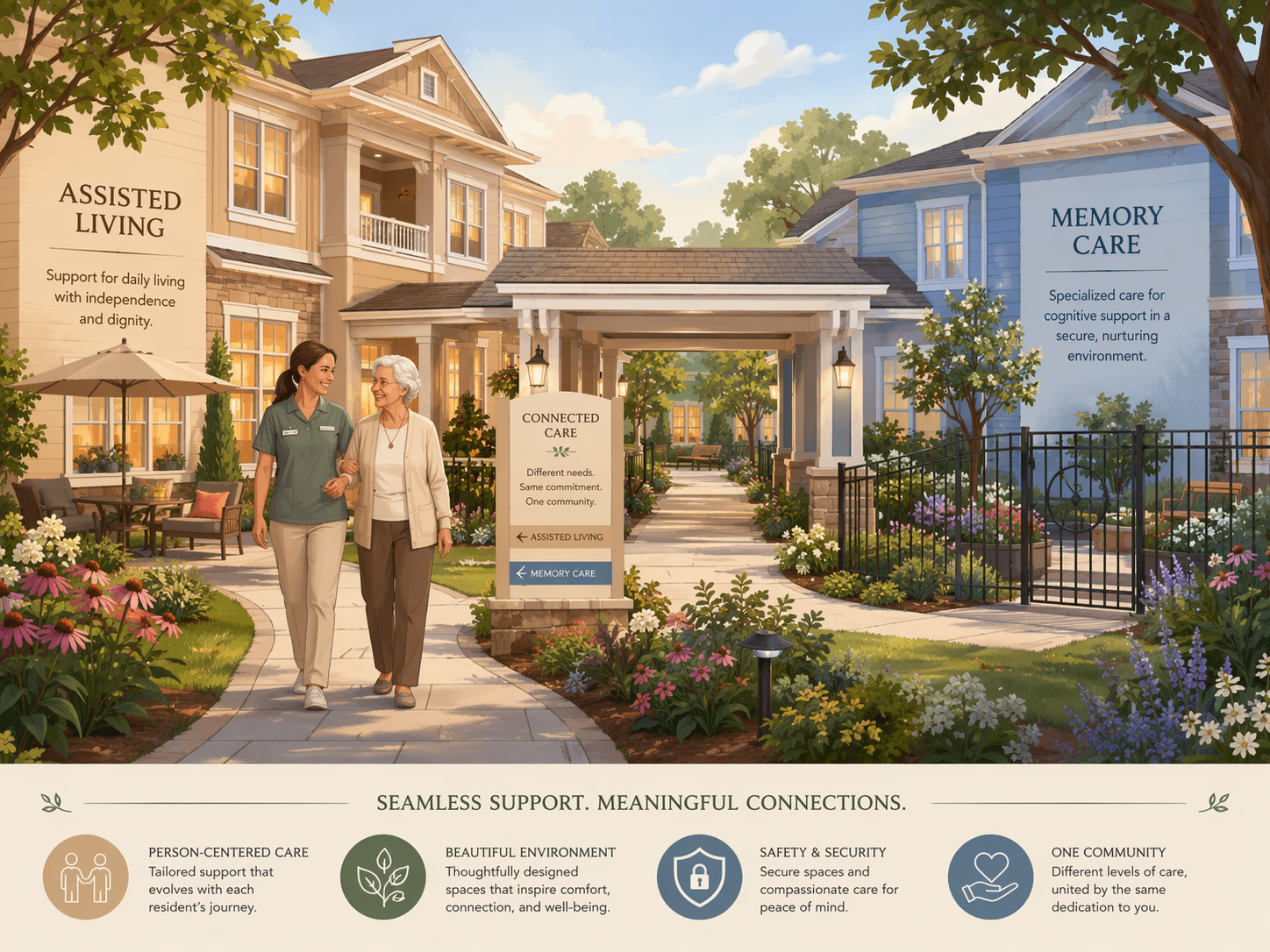
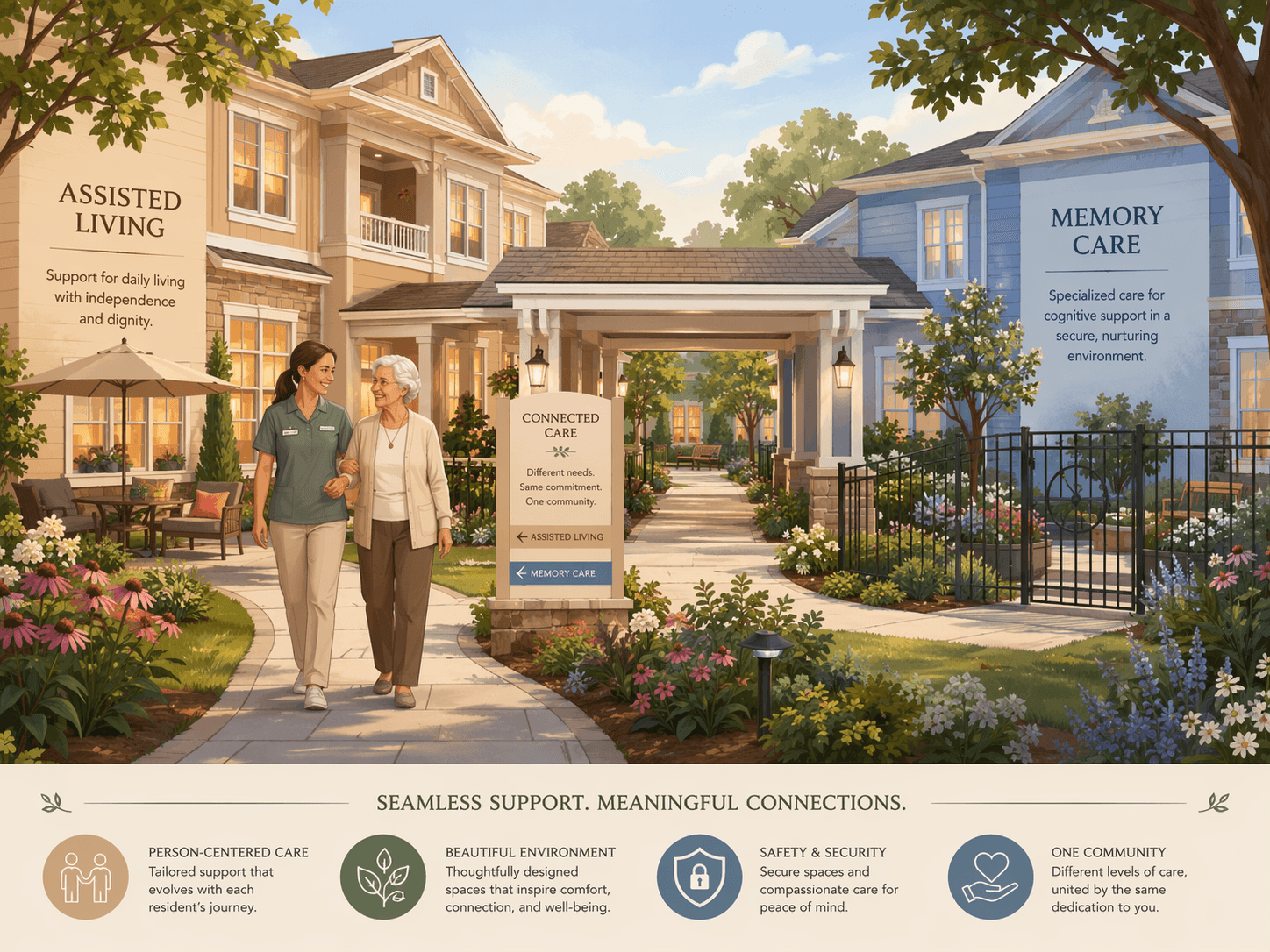
Most assisted living now has memory care — but check what it actually is
Among communities that work with A Place for Mom, roughly 80% of assisted living communities also offer memory care on-site. That means a move to assisted living does not have to be a permanent disruption. If the person's needs progress, they can often transition to a memory care neighborhood within the same campus — familiar environment, staff who already know them, no new building to adjust to.
But not every on-site memory care program is equal. When you tour, check three things:
Are the memory care staff dedicated to that unit, or rotated from assisted living? (79% of partner communities have specialized training — ask for it.)
Is the unit secure? (88% of partner memory care communities are fully secure, with locked doors and enclosed outdoor spaces.)
Is the programming tailored, not just a generic activity calendar? Look for structured engagement designed for cognitive decline.
A good AL-to-MC bridge means the resident does not have to leave the community when the disease advances. That matters enormously for emotional continuity and for reducing the number of traumatic moves.
Many assisted living communities now include a memory care wing on the same campus, allowing a smoother transition as dementia progresses.
Five questions to ask before you tour
When I tour a community, I use this checklist to see if it can accommodate the trajectory of dementia, not just the current snapshot. If the answer to any question is "we don't have that yet" or "we transfer residents to another facility," you have identified a future disruption.
'What happens if we need more hours of care? Can you add home health aides or adult day services without moving?'
'Does this community have an on-site memory care transition pathway? Is the memory care program staffed by dedicated, specialized personnel?'
'What is the staff-to-resident ratio during the day and at night? How are agitation and exit-seeking managed? What is the policy for incontinence care?'
'What happens if we need to move within the community — is there a waiting list, fee, or assessment process?'
'Can we speak with a current resident's family about their experience? How has the level of care changed for their loved one over time?'
The goal is not to find the perfect place for today. It is to find a system that can flex as the disease flexes — so the person you care for does not have to keep leaving home.

Comments
Join the discussion with an anonymous comment.