
Caregiver decision guide
10 Signs Your Parent Needs 24/7 Care — And the Exact Next Steps to Take
Recognize the 10 critical warning signs that indicate your parent needs round-the-clock care at home, and follow a step-by-step action plan—from free assessments to arranging immediate help—designed for crisis‑driven adult children.

The Moment You Realize Something Has to Change
You find your mother on the bathroom floor at 3 a.m. She says she just slipped, but this is the third time this month. Or you get a call from a neighbor: your father was walking down the street in his pajamas at midnight. Or you come over for your usual Sunday visit and notice the refrigerator is full of expired food and your mother has lost eight pounds since last month.
That moment — the one where you realize the current arrangement is not working — is exactly the right time to act. Not after a fall that leads to a broken hip. Not after a hospitalization that could have been avoided. Now.
77% of seniors want to stay in their own homes as they age. You probably want that too. But wanting doesn’t make it safe. The point of this article is to help you spot the ten clearest signs that your parent needs round-the-clock care — and then give you exact steps to get that care, without wasting time on vague advice or sales pitches.
Ten Signs It’s Time for 24/7 Care
One incident could be a fluke. Two might be bad luck. Three or more? The pattern is clear. These signs come from TheKey and Visiting Angels — they’ve seen these patterns thousands of times. Don’t wait for a fourth.
- Frequent falls or worsening balance. More than two falls in six months is a red flag. Falls are the leading cause of fatal injury in older adults. Each fall increases the risk of the next one.
- Wandering or sundowning. Your parent gets disoriented at dusk, tries to leave the house, or walks aimlessly. This isn’t just confusion — it’s a safety crisis that requires someone awake to respond.
- Incontinence escalation. More frequent accidents, inability to get to the bathroom in time, or refusing to wear protection. This increases fall risk and can lead to skin breakdown.
- Unsafe medication management. Missed doses, double doses, mixing up pill bottles, or forgetting to take heart medication. After a hospitalization this risk skyrockets.
- Unintended weight loss or poor nutrition. The refrigerator is empty or full of spoiled food. Your parent is losing weight because cooking has become too difficult or they forget to eat.
- Caregiver burnout or sleep deprivation. If you — the family caregiver — are getting less than six hours of sleep, skipping your own meals, or feeling constantly anxious, the current arrangement has already failed. Period. Your health matters, and this sign is as urgent as any fall. The real cost of caregiving shows up in your own health first.
- Post-hospital vulnerability. After a surgery or hospitalization, your parent needs constant monitoring — not just part-time help. The first two weeks home are when most readmissions happen. Recovery care after a fall is distinct from long-term 24/7 care, but it often shows you what’s really needed.
- Fire or safety incidents. Burned pots left on the stove, appliances left on, leaving the house with the door unlocked. These are signs that judgment is slipping faster than you think.
- Severe mobility decline. Your parent can no longer transfer from bed to chair without help, or struggles to walk even with a walker. That level of dependence needs someone present for every transfer.
- Advanced dementia behaviors. Agitation, aggression, repetitive questioning, or losing the ability to recognize familiar faces. These behaviors can’t be managed by a part-time aide or a family member who needs to sleep. A stage-based guide for dementia care can help you understand what to expect next.
Match the Signs to the Right Care Model
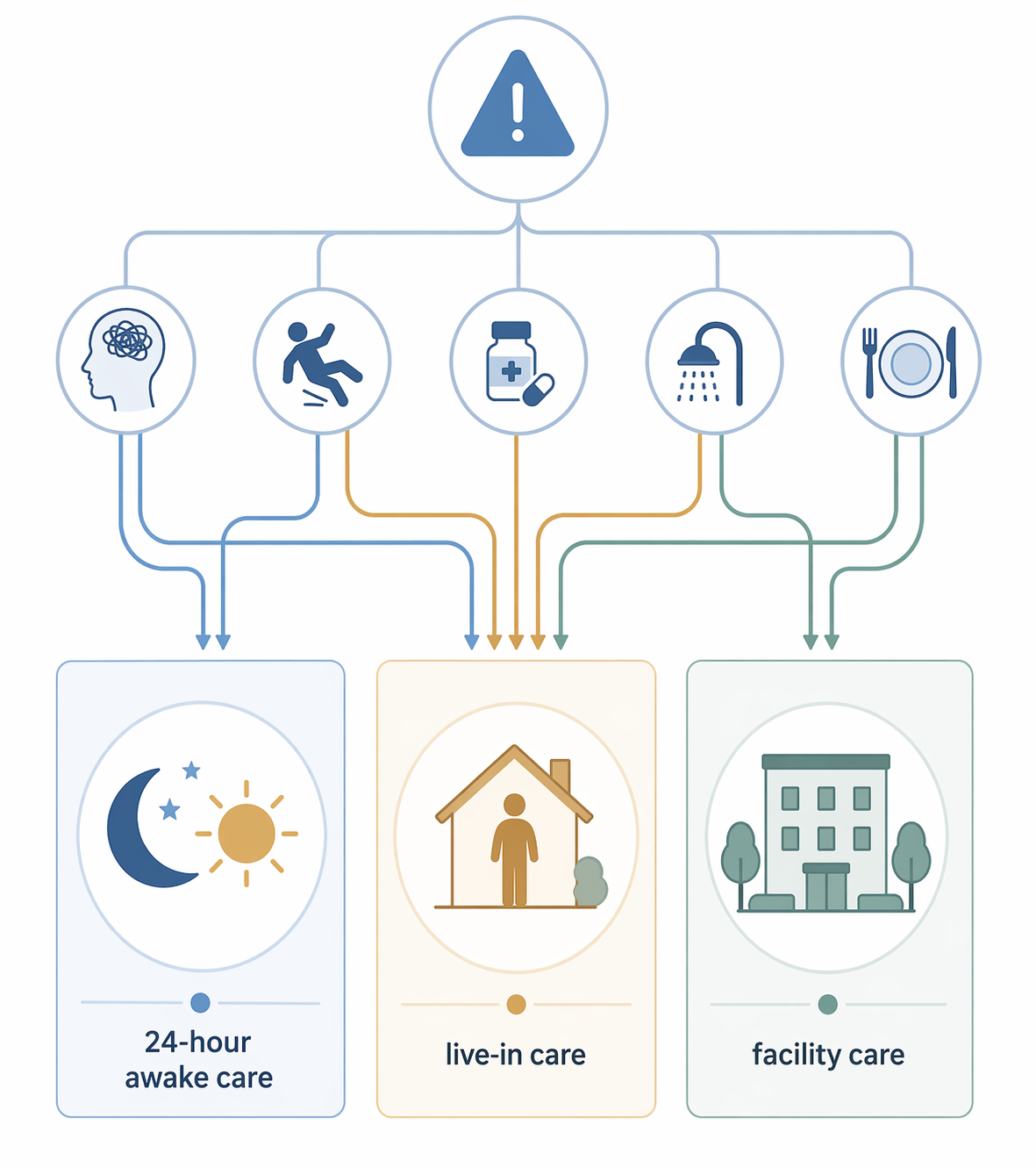
This is the most useful piece in the article — it gives you a concrete filter, not a vague “it depends.” Each sign maps to a specific care model. Use this table:
| Signs that point to… | Care model | Key rule |
|---|---|---|
| Frequent falls, wandering, post-hospital high risk, sundowning, severe mobility decline | 24‑hour awake care (rotating shifts) | Someone is always awake. Two or three caregivers cover the day and night in 8‑ to 12‑hour shifts. |
| Stable but needs constant supervision during waking hours; manageable nights (e.g., sleeps through without help) | Live‑in care (one caregiver with 8‑hour sleep break) | One caregiver lives in, gets 8 hours of uninterrupted sleep plus daytime breaks. Cheaper, but not for overnight needs. |
| Advanced dementia with aggression, bedbound, unsafe home environment, skilled nursing needs | Facility (nursing home or memory care) | When the home can’t be made safe or the level of care exceeds what a single family can coordinate. |
How Much This Costs (Real Numbers)
You need a number, not a vague range. Here’s what I’ve found across sources:
- 24‑hour awake care: $15,000 – $25,000/month. The wide range comes from geographic differences and agency overhead. A Place for Mom’s 2026 report says $24,733/month at $34/hour; Genworth’s survey puts it at $19,656/month at $27/hour. The discrepancy is real — different survey timing and methods. Use the range.
- Live‑in care: $8,000 – $12,000/month. Much cheaper, but it only works if your parent can be left alone for 8 hours of sleep.
- A private room in a nursing home averages $9,034/month; assisted living averages $5,419/month. For some families, a facility is actually cheaper than 24‑hour home care.
For a deeper cost comparison, read our guide to the cost crossover point between home care and assisted living.
Start a Log Right Now
Before you call anyone, start a simple log. A notebook or a note on your phone. For the next three days, write down:
- Any fall or near-fall (where, when, what caused it).
- Any wandering or confusion (time of day, what happened).
- Medication errors (missed dose, double dose, wrong pill).
- Weight — weigh your parent once, then again in a week.
- How many times they used the bathroom at night.
- Your own sleep hours and stress level (honestly).
This log is your evidence. You’ll need it for the doctor, for the Area Agency on Aging assessment, and for any agency you interview. Without it, you’ll get vague answers. With it, you can say “she fell four times in two weeks, and here’s when and why.”
Your Next Steps — In Order
You have the signs. You have a sense of the model. Now here’s the exact sequence. I’ve seen families get stuck on step 2 because step 1 wasn’t done right. Do them in order.
- Call the Eldercare Locator at 1-800-677-1116. This connects you to your local Area Agency on Aging (AAA). Ask for a free in-home assessment. Some AAAs can schedule one within 48 hours; others have a wait. Be persistent. Do this today — within 24 hours.
- Make a doctor’s appointment. Bring your log. Ask for a referral to home health services if your parent qualifies (recent hospitalization, skilled need). The doctor can also document the need for 24‑hour care, which helps with insurance and agency assessments. Do this within the first week.
- Request an in-home safety evaluation. Many home care agencies offer this for free. An occupational therapist can do a more formal one. They’ll identify fall hazards, suggest grab bars, and recommend equipment. Our guide for seniors living alone includes a room-by-room checklist you can start now. Do this within the first week.
- Interview at least two home care agencies. Ask: How do you handle caregiver back-up for call-offs? What training do caregivers have for dementia? Do you use 12‑hour or 8‑hour shifts for 24/7 care? What is the cost per hour and what does it include? Do not sign a contract until you’ve compared. This can happen within two weeks.
Within one month: Agency contract signed (if going with home care). Funding lined up (private pay, long-term care insurance claim started, or Medicaid application submitted — note that Medicaid approval can take months). Caregiver starts. True 24/7 staffing often takes 1–2 weeks for the agency to arrange, so plan ahead.
One more thing: if your parent is resisting help, that’s normal. Our roadmap for when a parent refuses help can guide that conversation. But resistance is not a reason to wait. You can take steps on your own — the call to the Eldercare Locator, the doctor’s appointment, the home safety evaluation — before your parent agrees to anything.
Start with one call. 1-800-677-1116. You’ll feel better knowing there’s a plan.
Questions to bring to a clinician or OT
This is not medical, legal, or a family's final decision — only a framework. Bring these questions to a clinician, occupational therapist, or your local Area Agency on Aging.
Find Local HelpRelated reading
Noticed something outdated or inaccurate on this page? Flag a correction. We review every report against CDC, NIA, and AARP HomeFit guidance before updating a page.