
Caregiver decision guide
24-Hour Care for Elderly: A Family Decision Framework for 2026
A decision framework for adult children evaluating whether 24/7 home care is the right choice for a parent after a fall, hospitalization, or mobility decline. Combines 2026 national cost data ($24,733/month median), the live-in care middle path (~$8K–$12K/month), and clinical need criteria to help families make an informed, financially sound decision.
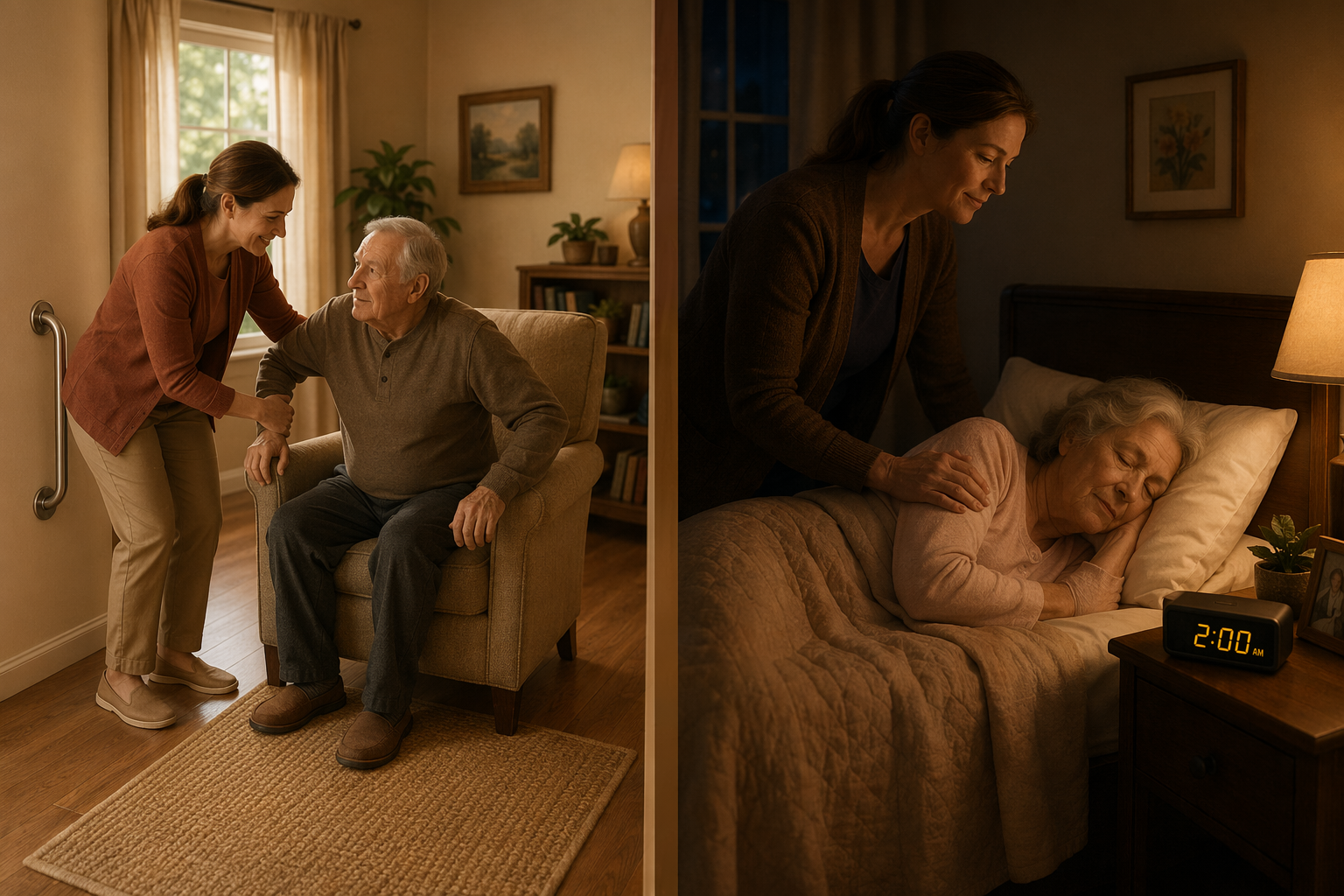
What 24-Hour Care Actually Means: Two Models, One Goal
When families say they need "24-hour care," they often imagine a single caregiver living in the home and being available at all times. The reality is more structured — and the structure directly determines the cost. There are two distinct models, and choosing between them is the first financial decision you will face.
Model 1: Rotating Shift Care (24/7 Awake Coverage)
In this model, two or three caregivers work staggered shifts — typically two 12-hour shifts or three 8-hour shifts — so that at least one caregiver is awake and actively monitoring at all times. No sleeping quarters are provided because the caregiver on duty is expected to remain awake throughout the shift. This model is the standard for seniors who need active nighttime supervision: those with dementia-related sundowning, frequent nighttime wandering, or a high fall risk that requires immediate response during the night.
Because you are paying for multiple caregivers per day, rotating shift care is the most expensive option. At the 2026 national median rate of $34 per hour, a full week of 24/7 awake coverage costs approximately $5,712 per week, or roughly $24,733 per month.
Model 2: Live-In Care (One Caregiver, Scheduled Breaks)
Live-in care uses a single primary caregiver who lives in the home. The caregiver is provided with a private sleeping area and is entitled to an 8-hour uninterrupted sleep break each night, plus additional meal and rest breaks during the day. If the caregiver is woken during the night to assist the senior, that time is typically paid and may count against their break period depending on the agency's policy.
This model costs significantly less — roughly $8,000 to $12,000 per month — because you are paying for one caregiver rather than two or three. The trade-off is that live-in care is only appropriate when the senior does not require awake overnight supervision. If your parent can sleep through the night safely but needs help with morning routines, meals, and mobility during the day, live-in care may be the ideal middle path.
The Real Cost of 24/7 Home Care in 2026: National and State-by-State
The national median cost of 24/7 non-medical home care in 2026 is approximately $24,733 per month, based on the A Place for Mom 2026 Cost Report which cites a national median hourly rate of $34. However, this national average masks enormous variation by state. The Genworth Cost of Care Survey, a widely cited industry benchmark, provides state-level data that shows costs ranging from roughly $13,650 per month in the least expensive states to over $26,000 per month in the most expensive.
The table below shows the range of 24/7 home care costs across states, alongside the median costs for live-in care and assisted living for comparison.
| Care Option | National Median Monthly Cost (2026) | Lowest State Cost | Highest State Cost |
|---|---|---|---|
| 24/7 Rotating Shift Care | $24,733 | $13,650 (West Virginia) | $26,390 (Minnesota) |
| Live-In Care | $8,000 – $12,000 | Varies by region | Varies by region |
| Assisted Living | $5,419 | Varies by region | Varies by region |
The state-level variation is critical for your decision. If you live in Minnesota, where 24/7 care costs $26,390 per month, the financial calculus is very different than if you live in West Virginia, where the same level of care costs $13,650 per month. Your local market rates should be the starting point for any budget analysis, not the national average.
The Breakeven Rule: When Assisted Living Becomes More Cost-Effective
A well-known rule in senior care is that once a family needs more than 40 hours per week of paid home care, assisted living becomes the more cost-effective option. At 40 hours per week of home care at $34/hour, the monthly cost is approximately $5,893 — already above the 2026 assisted living median of $5,419 per month.
When you scale up to 24/7 care — 168 hours per week — the cost gap becomes enormous. At $24,733 per month for 24/7 shift care versus $5,419 per month for assisted living, you are paying roughly 4.5 times more for home care. For most families, this is not sustainable as a long-term arrangement.
| Care Scenario | Weekly Hours | Monthly Cost (National Median) | Cost vs. Assisted Living |
|---|---|---|---|
| 24/7 Rotating Shift Care | 168 hours | $24,733 | 4.6x more expensive |
| Live-In Care | 24/7 coverage (with breaks) | $8,000 – $12,000 | 1.5x – 2.2x more expensive |
| Assisted Living | 24/7 (facility staff) | $5,419 | Baseline |
However, the live-in care middle path changes this equation significantly. At $8,000 to $12,000 per month, live-in care is more expensive than assisted living but far less expensive than rotating shift care. For families whose parent does not need awake overnight supervision, live-in care can be a financially viable alternative that allows the senior to remain at home.
When 24/7 Home Care Still Makes Financial Sense
Despite the high cost, there are specific clinical and situational profiles where 24/7 home care is not only justified but is the most appropriate — and sometimes the only viable — option. The decision should be driven by clinical need, not by a general preference for home care.
Short-Term Post-Hospital Recovery
As Vicki Demirozu of Giving Care with Grace notes, what families often call "24/7 care" after a hospitalization frequently refers to just 2 to 3 days of continuous supervision while the senior stabilizes. In this context, paying the premium for 24/7 shift care for a few days is far more cost-effective than a hospital readmission or an unnecessary move to assisted living. If your parent has just had hip replacement surgery, a stroke, or a serious fall, a short burst of 24/7 care may be exactly what is needed — and it is a finite expense.
Dementia with Sundowning or Nighttime Wandering
For seniors with Alzheimer's disease or other dementias who experience sundowning — increased confusion, agitation, and restlessness in the late afternoon and evening — or who wander at night, 24/7 awake shift care is often the safest option. Assisted living facilities may not have the staffing ratios to provide the one-on-one supervision these behaviors require, and the risk of a fall or elopement during the night is too high for live-in care with an 8-hour caregiver sleep break. In these cases, the higher cost of rotating shift care is a direct investment in safety.
Frequent Falls Requiring Immediate Response
If your parent has already fallen multiple times — especially at night — the calculus shifts. A single fall that results in a hip fracture can cost $30,000 to $50,000 in medical bills and rehabilitation, not to mention the emotional and functional toll. Paying $24,733 per month for 24/7 care may be less expensive than one fall-related hospitalization. The key is to assess the fall risk honestly using the CDC's STEADI framework and to act before the next fall occurs.
Strong Home Equity and a Preference to Age in Place
For seniors who own their home outright and have significant home equity, the cost of 24/7 home care may be offset by the value of remaining at home. Selling the home to pay for assisted living may not be desirable if the senior has strong emotional ties to the home or if the local real estate market is depressed. In these cases, a home equity line of credit or a reverse mortgage can fund 24/7 care for the typical engagement duration.
How Mobility Decline Drives Care Level Escalation
The path from independent living to 24/7 care almost always runs through mobility decline. Falls are the leading cause of injury for adults aged 65 and older. According to the CDC, over 14 million older adults — 1 in 4 — report falling each year. Of those who fall, about 37% sustain an injury that requires medical treatment or restricts activity for at least one day, resulting in approximately 9 million fall injuries annually.
The trend is worsening. The age-adjusted fall death rate increased 21% from 2018 to 2024, rising from 64.7 per 100,000 to 78.4 per 100,000. As mobility declines — whether from arthritis, neuropathy, muscle weakness, or balance disorders — the risk of falling at night increases disproportionately. A senior who can safely use a walker during the day may be unable to get to the bathroom safely at 2:00 AM without assistance.
This is the mechanism that pushes families from part-time care to 24/7 coverage. The progression often looks like this:
- Stage 1: The senior is independent but has noticeable balance issues or uses a cane occasionally. No paid care is needed.
- Stage 2: After a minor fall, the family hires a caregiver for 10–20 hours per week to assist with bathing, meals, and transportation.
- Stage 3: A second fall or a hospitalization occurs. The family increases care to 30–40 hours per week, often including evening coverage.
- Stage 4: Nighttime mobility becomes unsafe. The family faces the decision: 24/7 awake shift care, live-in care, or assisted living.
Understanding this progression is critical because it means the decision for 24/7 care is rarely sudden. It is the culmination of a series of smaller decisions. The earlier you recognize the pattern, the more time you have to plan financially and explore all options — including home modifications and mobility aids that might slow the progression.
Your Decision Framework: 7 Questions to Ask Before Committing to 24/7 Care
Use the following questions as a structured decision framework. Each question is designed to move you from a general sense of "we need more help" to a specific, actionable care plan with a clear budget and timeline.
| Question | What to Evaluate | Decision Implication |
|---|---|---|
| 1. Does my parent need awake overnight supervision or just someone present? | Assess nighttime behavior: Does your parent wake frequently? Do they try to get out of bed unassisted? Do they wander or become confused at night? | If awake overnight supervision is needed → 24/7 rotating shift care ($24,733/month). If not → live-in care ($8K–$12K/month) may suffice. |
| 2. How many hours of paid care do we actually need per week? | Track care hours for one week. Include all ADL assistance (bathing, dressing, toileting, eating, transferring) and supervision time. | If under 40 hours/week → part-time home care is likely more cost-effective than assisted living. If 168 hours/week → 24/7 care is the only option. |
| 3. What is our monthly budget, and does 24/7 care fit? | Calculate total monthly income (Social Security, pensions, retirement withdrawals) and assets available for care. Be realistic about how long assets will last. | If budget is under $8,000/month → 24/7 care is likely unaffordable. Explore assisted living or Medicaid options. If $8K–$12K/month → live-in care is viable. If over $24,733/month → 24/7 shift care is possible. |
| 4. Does my parent have dementia with wandering or sundowning? | Consult with the diagnosing physician. Ask specifically about nighttime behavior patterns and safety risks. | If yes → 24/7 awake shift care is strongly recommended for safety. Live-in care is not appropriate if the senior needs active nighttime supervision. |
| 5. Is this a short-term post-hospital need or a long-term situation? | Ask the hospital discharge planner for a realistic recovery timeline. Most post-hospital 24/7 needs last 2–3 days, not weeks or months. | If short-term (2–3 days) → 24/7 shift care is a finite, justifiable expense. If long-term → explore live-in care or assisted living for sustainability. |
| 6. Have we explored the live-in care middle path? | Ask home care agencies if they offer a live-in model. Compare the cost difference between live-in and rotating shift care in your area. | If live-in care is available and appropriate → it can save $12,000–$16,000 per month compared to 24/7 shift care. |
| 7. What are the hidden costs of 24/7 home care? | Factor in: home modifications (grab bars, ramps, stair lifts), increased utilities, caregiver meals, and the cost of family caregiver burnout (lost work, health impacts). | The true cost of 24/7 home care is higher than the hourly rate alone. Budget an additional 10–20% for hidden expenses. |
Paying for 24/7 Care: What Insurance Covers and What It Doesn't
One of the most common — and costly — misconceptions families have is that Medicare or their health insurance will pay for 24/7 home care. The reality is stark: Medicare does not cover 24/7 custodial care. It only covers intermittent skilled nursing care (such as wound care or physical therapy) for a limited time after a hospitalization, and only if the care is ordered by a physician. The day-to-day assistance with bathing, dressing, eating, and mobility — which is the bulk of what 24/7 care provides — is classified as custodial care and is not covered.
Here is a summary of the most common payment sources and what they cover:
| Payment Source | Covers 24/7 Custodial Care? | Key Details |
|---|---|---|
| Medicare (Parts A & B) | No | Only covers intermittent skilled nursing and therapy. Does not cover personal care, companion care, or 24/7 supervision. |
| Medicaid (HCBS Waivers) | Varies by state | Home and Community-Based Services (HCBS) waivers may cover in-home care, but availability and coverage levels vary significantly by state. Waitlists are common. |
| PACE Programs | Varies by state | Programs of All-Inclusive Care for the Elderly (PACE) cover both medical and non-medical services, including in-home care. Not available in all states. |
| VA Aid & Attendance | May cover live-in or 24/7 care | Veterans and surviving spouses may qualify for Aid & Attendance benefits, which can be used to pay for in-home care. Amount depends on need and service record. |
| Long-Term Care Insurance | Depends on policy | Some policies cover in-home care, including live-in or 24/7 care. Review the policy carefully for daily benefit limits, elimination periods, and covered services. |
| Private Pay (Out-of-Pocket) | Yes | The most common route. Families pay directly from savings, retirement accounts, home equity, or family contributions. |
For most families, private pay is the only realistic option for 24/7 home care. This means the decision must be grounded in a clear understanding of your financial resources and how long they will last. If your parent has a long-term care insurance policy, review it carefully with the insurance company to understand exactly what is covered and what the daily benefit limits are. If your parent is a veteran, apply for VA Aid & Attendance benefits as early as possible, as the application process can take several months.
For a detailed comparison of hiring through an agency versus hiring a private caregiver — including the liability, tax, and insurance implications — see our guide: Live-In Caregiver Agency vs. Private Hire: The True Cost and Risk Comparison for 2026.

Questions to bring to a clinician or OT
This is not medical, legal, or a family's final decision — only a framework. Bring these questions to a clinician, occupational therapist, or your local Area Agency on Aging.
Find Local HelpRelated reading
Noticed something outdated or inaccurate on this page? Flag a correction. We review every report against CDC, NIA, and AARP HomeFit guidance before updating a page.