
Caregiver decision guide
24-Hour Care vs. Live-In Care: How to Choose the Right Model for Your Parent
Adult children often confuse 24-hour shift care with live-in care, but these two models have very different costs, staffing structures, and suitability for nighttime needs. This guide provides a clear decision framework to help you choose the right option for your parent's safety and your family's budget.

Two Models, One Confusing Name: What Families Need to Know
When a parent can no longer be left alone overnight, families hear two phrases thrown around interchangeably: "24-hour care" and "live-in care." They sound like the same thing. They are not. Choosing the wrong model can mean a parent with dementia wandering unsupervised at night, or paying thousands of dollars more per month than necessary for a parent who simply needs someone present during the day.
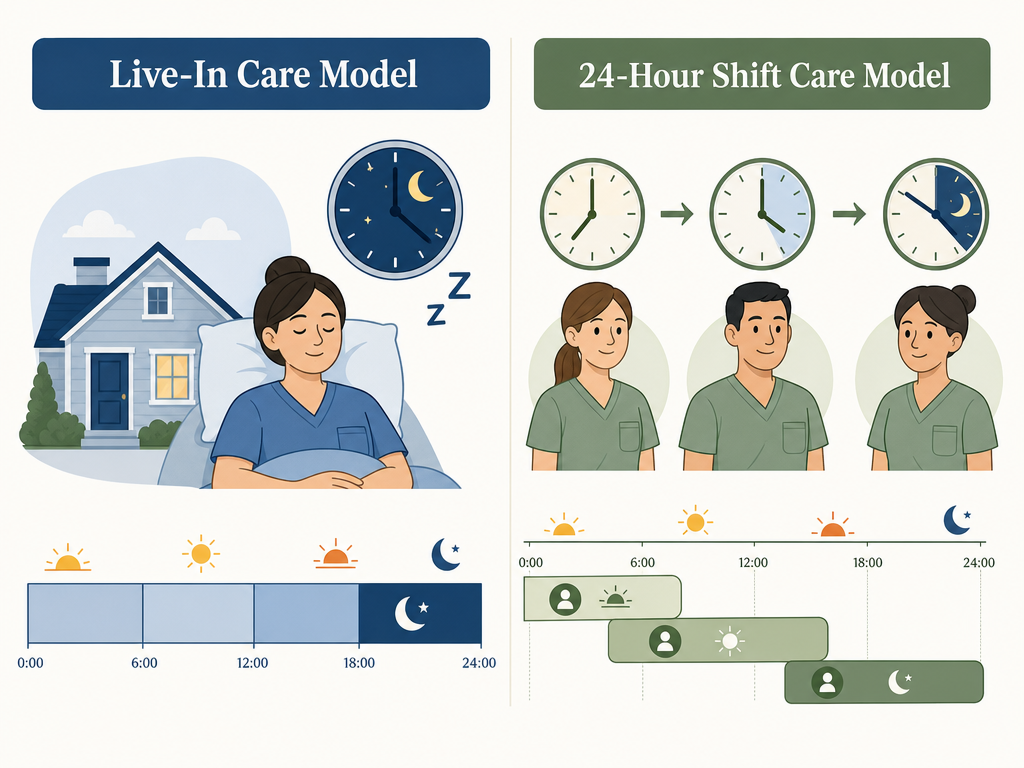
The core difference is simple but critical: 24-hour shift care uses two or three caregivers who work rotating awake shifts, meaning someone is alert and on duty every minute of the day and night. Live-in care uses one caregiver who resides in the home but is legally entitled to eight hours of uninterrupted sleep plus meal breaks — during which the senior has no direct supervision.
This guide provides a decision framework to help you match your parent's specific nighttime needs, safety risks, and budget to the right model. We will cover how each model works, what they cost, the legal rules that govern live-in workers, and a practical matrix to help you decide.
How 24-Hour Shift Care Works: Awake Coverage Around the Clock
In the 24-hour shift care model, a home care agency assigns two or three caregivers to cover a full day in rotating shifts. A typical structure might be:
- Day shift (7:00 a.m. – 3:00 p.m.)
- Evening shift (3:00 p.m. – 11:00 p.m.)
- Night shift (11:00 p.m. – 7:00 a.m.)
Some agencies use 12-hour shifts instead, with two caregivers splitting the day. Regardless of the shift length, the defining feature is that the caregiver on duty is awake and actively working throughout their entire shift. If your parent needs help toileting at 2:00 a.m., wanders at 3:00 a.m., or sundowns at 5:00 p.m., a caregiver is alert and available to respond immediately.
Because multiple caregivers are paid for every hour of the day, this model is significantly more expensive. According to A Place for Mom's 2026 Cost of Long-Term Care and Senior Living Report, the national median cost of 24/7 nonmedical home care is approximately $24,733 per month (based on $34 per hour). AgingCare, citing Genworth survey data, reports a median of roughly $19,656 per month (based on $27 per hour, which may reflect older data). The range across sources reflects different survey methodologies and timing, but the takeaway is clear: 24-hour shift care is a major financial commitment.
How Live-In Care Works: One Caregiver, Overnight Sleep
Live-in care places a single caregiver in the senior's home. The caregiver provides care during the day and evening, but is legally entitled to an eight-hour sleep period and meal breaks. During that sleep period, the senior is unsupervised unless they actively wake the caregiver.
Key requirements for the live-in model include:
- The family must provide a private sleeping space (a bedroom with a door).
- The caregiver is entitled to at least eight hours of uninterrupted sleep per night.
- The caregiver also receives meal breaks and at least two full days off per week.
- If the senior's needs interrupt the caregiver's sleep repeatedly, the arrangement may violate labor laws and should be converted to 24-hour shift care.
Because only one caregiver is paid per 24-hour period (rather than two or three), live-in care costs roughly half as much. AgingCare, citing proprietary data from A Place for Mom, reports a median live-in care cost of approximately $10,646 per month. This makes it an attractive option for families whose parent sleeps through the night with minimal assistance.
24-Hour Care vs. Live-In Care: Side-by-Side Comparison
The table below summarizes the key differences between the two models. Use it as a quick reference when discussing options with agencies or family members.
| Dimension | 24-Hour Shift Care | Live-In Care |
|---|---|---|
| Monthly cost (national median) | $19,656–$24,733 | ~$10,646 |
| Number of caregivers per day | 2–3 (rotating shifts) | 1 (with scheduled breaks) |
| Caregiver awake overnight? | Yes — always alert and on duty | No — entitled to 8 hours of sleep |
| Caregiver consistency | Lower — multiple caregivers rotate | Higher — same caregiver daily |
| Suitable for wandering/dementia? | Yes — awake supervision at all times | No — unsupervised during sleep period |
| Suitable for stable overnight sleepers? | Yes, but may be overkill | Yes — ideal for minimal nighttime needs |
| Typical agency availability | Widely available | Varies by state and agency |
Pros and Cons of Each Model
Beyond the numbers, each model has distinct tradeoffs that affect your parent's safety, your family's peace of mind, and the caregiver's working conditions.
24-Hour Shift Care
- Pros: Full overnight supervision; suitable for dementia, wandering, sundowning, and frequent nighttime toileting; no risk of caregiver fatigue compromising care; caregiver is always awake and responsive.
- Cons: Significantly higher cost ($19,656–$24,733/mo); multiple caregivers rotate, which can be disorienting for a senior with dementia; less consistency in the caregiver relationship; more people in the home.
Live-In Care
- Pros: Lower cost (~$10,646/mo); consistent caregiver relationship, which builds trust and familiarity; fewer people in the home; feels more like a natural living arrangement.
- Cons: No overnight supervision during the caregiver's sleep period; not suitable for seniors who wander, have dementia-related nighttime agitation, or need help toileting at night; potential for caregiver fatigue if the senior's needs interrupt sleep; may be harder to find through agencies depending on your state.
Legal Considerations: FLSA Rules for Live-In Caregivers
The Fair Labor Standards Act (FLSA) sets specific rules for live-in domestic workers. If you hire a live-in caregiver through an agency, the agency is responsible for FLSA compliance. If you hire independently, you need to understand these rules to avoid legal exposure.
Under the FLSA, a live-in caregiver is entitled to:
- At least eight hours of uninterrupted sleep per night.
- Meal breaks during the day.
- At least two full days off per week (24 consecutive hours each).
- A private sleeping space (a bedroom with a door).
- Minimum wage and overtime pay for all hours worked.
If your parent's needs regularly interrupt the caregiver's sleep — for example, if they need help toileting three times a night or wander and need redirection — the live-in arrangement may no longer be legally viable. In that case, you should transition to 24-hour shift care, where awake caregivers are on duty overnight.
Which Model Is Right for Your Parent? A Decision Matrix
The most important factor in choosing between 24-hour and live-in care is your parent's nighttime needs. The decision matrix below matches common senior profiles to the appropriate model.
| Senior Profile | Recommended Model | Why |
|---|---|---|
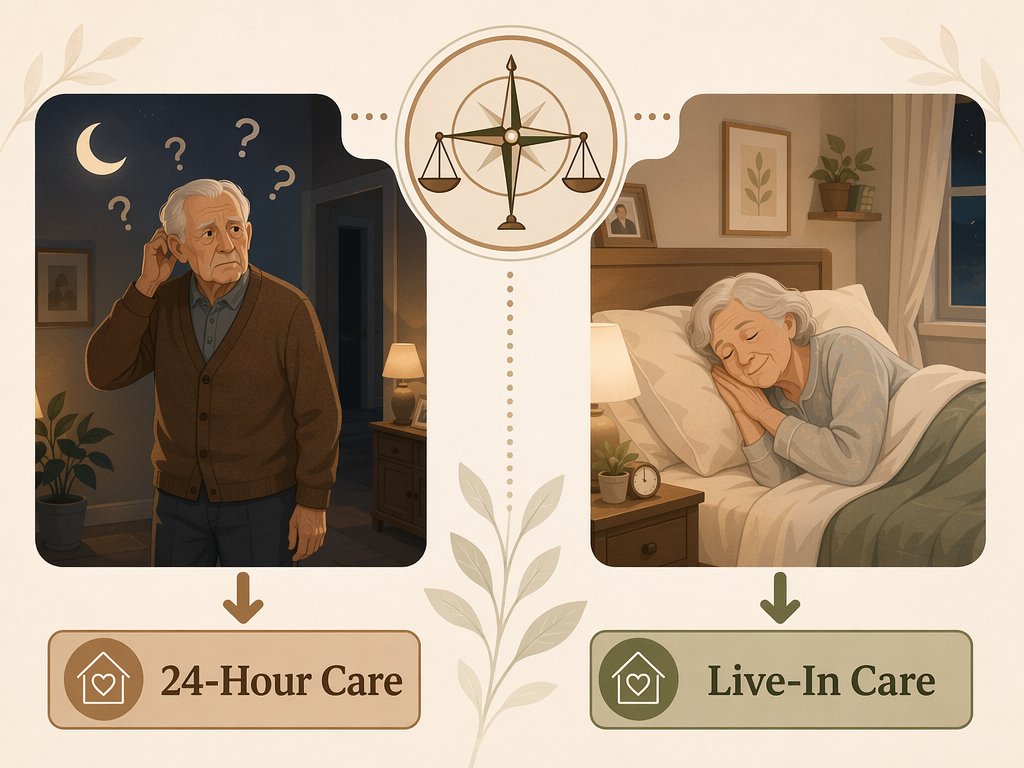
| Wanders at night or has dementia-related sundowning | 24-hour shift care | Requires awake supervision to prevent falls, injuries, or leaving the home |
| Needs help toileting 2+ times per night | 24-hour shift care | Frequent interruptions make live-in sleep periods legally and practically unworkable |
| Has a history of nighttime falls | 24-hour shift care | Immediate response needed; a sleeping caregiver cannot prevent a fall |
| Sleeps through the night with minimal assistance | Live-in care | Lower cost, consistent caregiver, no need for awake overnight coverage |
| Needs occasional nighttime reassurance (e.g., once per night) | Live-in care (with caveats) | May work if the caregiver can return to sleep; discuss with agency and caregiver |
| Post-hospitalization with nighttime monitoring needs | 24-hour shift care | Medical instability or medication schedules may require awake overnight observation |
Visiting Angels, a national home care provider, recommends live-in care for seniors who "sleep through the night with minimal assistance and do not wander" and 24-hour care for seniors who "wander, pose safety risks, are frequently awake at night, or have sundown syndrome." This aligns with the clinical guidance from the NIA and Alzheimer's Association on dementia-related sleep disturbances.
How to Work with Home Care Agencies on Shift Structures
Once you have identified which model fits your parent's needs, the next step is finding an agency that can deliver it. Not all agencies offer live-in care, and those that do may have specific policies about shift structures, backup coverage, and FLSA compliance.
When interviewing agencies, ask these questions:
- Do you offer live-in care, 24-hour shift care, or both? Some agencies only provide one model.
- What is the shift structure for 24-hour care? Do you use 8-hour or 12-hour shifts? How many caregivers will be involved?
- How do you handle shift changes? Is there overlap for handoff communication, or does one caregiver leave before the next arrives?
- What is your backup coverage policy? If a caregiver calls in sick, how quickly can you provide a replacement?
- For live-in care: do you handle FLSA compliance, including sleep periods, meal breaks, and days off? Do you provide a written agreement specifying these terms?
- Can we meet the caregivers before they start? Consistency of caregiver assignment is especially important for seniors with dementia.
If you are considering 12-hour shifts as an alternative to the full 24-hour model, our guide on Live-In Caregiver vs. 12-Hour Shifts: A Cost-and-Care Decision Framework provides a deeper comparison of that specific tradeoff.
For a more detailed breakdown of live-in care pricing by state, including how costs vary across the country, see our state-by-state guide: Live-In Caregiver Cost in 2026: What Families Actually Pay, State by State.
Questions to bring to a clinician or OT
This is not medical, legal, or a family's final decision — only a framework. Bring these questions to a clinician, occupational therapist, or your local Area Agency on Aging.
Find Local HelpRelated reading
- Live-In Caregiver Agency vs. Private Hire: The True Cost and Risk Comparison for 2026
- Is Overnight Care Enough? How to Decide Between Overnight Care, 24/7 Home Care, and Facility Placement After a Nighttime Crisis
- When Is It Time for 24-Hour Home Care? 10 Warning Signs and a Decision Framework for Families
Noticed something outdated or inaccurate on this page? Flag a correction. We review every report against CDC, NIA, and AARP HomeFit guidance before updating a page.