
Caregiver decision guide
The Hidden Costs of Elderly Home Care: 6 Expenses Families Overlook and How to Budget for Them
The $34–$35 national median hourly rate for home care is just the starting point. This guide reveals six hidden costs — from medical supplies and home modifications to caregiver overtime and lost family income — that can derail a care budget, and provides a practical worksheet to build a realistic total-cost plan.
The Base Cost Trap: Why Hourly Rates Alone Mislead Families
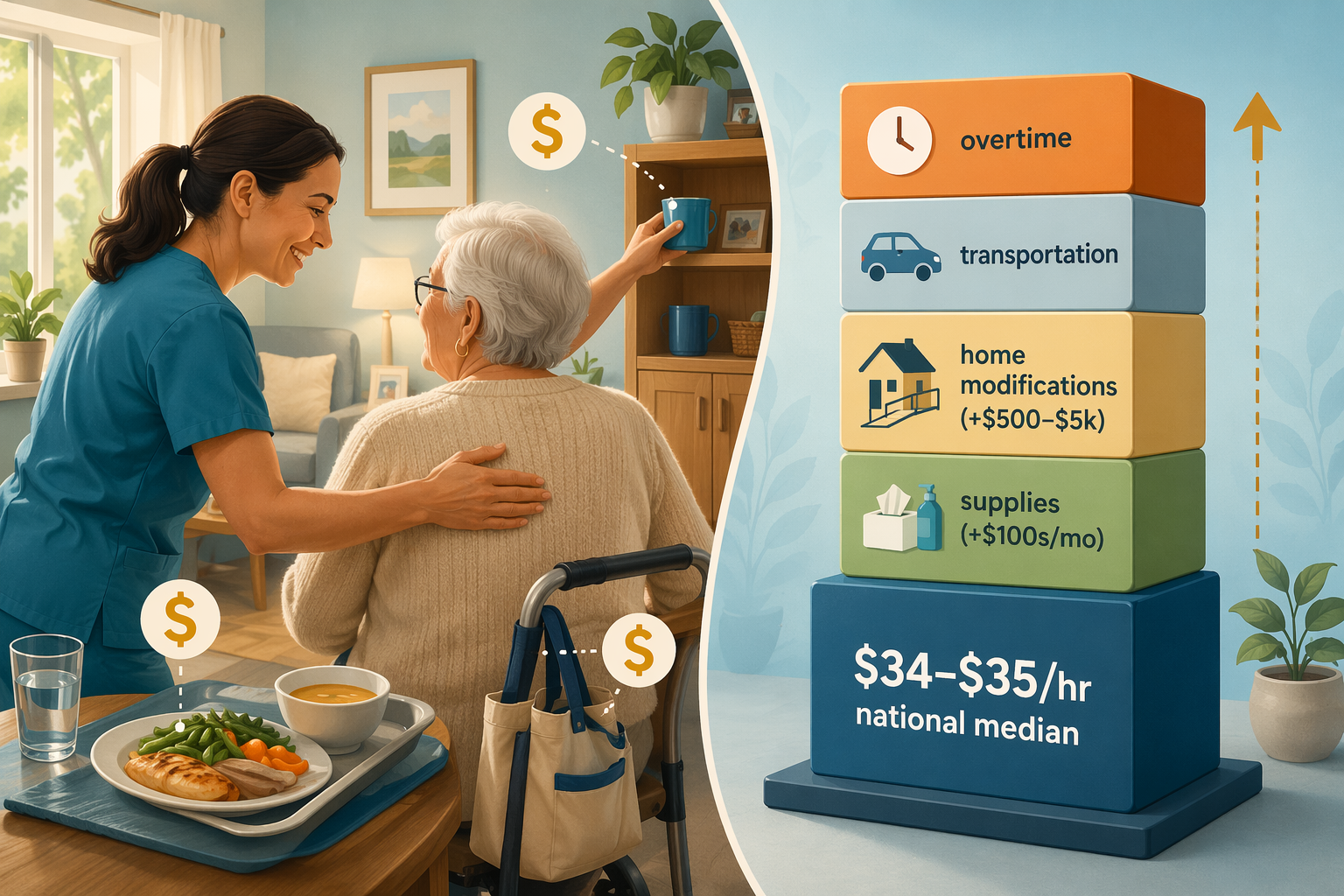
When you first search for home care costs, the number that appears most often is the national median hourly rate — roughly $34 to $35 per hour in 2026. That figure comes from private industry surveys, and it is a useful benchmark for comparing one region to another or one type of care to another. But it is also dangerously incomplete.
Families who build a budget around that single number — multiplying it by the hours of care they think they need — almost always discover within the first month that their actual spending is 20 to 40 percent higher. The gap is not caused by the agency inflating its rate. It is caused by expenses that never appear on a timesheet: medical supplies that Medicare will not cover, one-time home modifications that safety demands, transportation costs that add up ride by ride, overtime premiums that kick in on holidays, recurring technology subscriptions, and the invisible but very real cost of the family member who spends hours every week coordinating it all.
The sections that follow walk through six specific hidden costs that families routinely overlook. Each one is grounded in the real-world experience of family caregivers and the documented gaps in public and private coverage. At the end, you will find a worksheet you can use to build a total-cost budget before you sign a care agreement — so the number on paper matches the number you actually pay.
Hidden Cost #1: Medical Supplies and Incontinence Products
The first surprise many families encounter is the steady monthly expense of medical and personal care supplies. Gloves, disposable underpads, adult briefs, wound dressings, catheter supplies, nutritional shakes, and over-the-counter medications are not included in a caregiver's hourly rate. They are the responsibility of the family, and they add up quickly.
According to Care.com, these supplies can add hundreds of dollars per month to a family's care budget. A single box of adult incontinence briefs can cost $40 to $80 and may last only two to three weeks depending on the level of need. Gloves, underpads, and barrier creams add another $30 to $60 per month. For a senior with a chronic wound or a catheter, the monthly supply cost can easily exceed $200.
The most common supplies families forget to budget for include:
- Adult incontinence briefs and disposable underpads
- Nitrile or latex gloves for the caregiver
- Wound care supplies (gauze, tape, antiseptic, bandages)
- Barrier creams and skin protectants
- Catheter and ostomy supplies
- Nutritional supplements (Ensure, Boost, or similar)
- Over-the-counter medications (pain relievers, laxatives, antacids)
If your parent has a condition that requires ongoing supplies — a healing surgical wound, a catheter, or advanced incontinence — ask the agency or a home health nurse for a written list of what you will need each month. Then price those items at a medical supply store or online pharmacy before you finalize your care budget. A realistic estimate for supplies alone is $100 to $300 per month for moderate needs, and higher for complex cases.
For a deeper look at what Medicare does and does not cover for non-medical care, see our guide: Does Medicare Cover Companion Care? A Family Guide to Paying for Elder Companion Services.
Hidden Cost #2: Home Safety Modifications
When a family decides to bring care into the home, they rarely consider whether the home itself is ready to receive that care. The bathroom that has worked fine for decades may now be a fall hazard. The front steps may be impassable for someone using a walker. The bedroom may lack a clear path for a wheelchair or a bedside commode.
Home safety modifications are a one-time cost, but they can be substantial. According to Care.com, these renovations typically range from $500 to more than $5,000, depending on the scope of work. The most common modifications include:
- Grab bars in the shower, next to the toilet, and near the bed ($50–$200 per bar, plus installation)
- Improved lighting in hallways, stairwells, and the bathroom ($100–$500)
- Non-slip flooring or mats in the bathroom and kitchen ($50–$300)
- Ramps for entryways with steps ($200–$2,000, depending on length and materials)
- Bathroom modifications such as a walk-in shower, raised toilet seat, or shower chair ($500–$5,000)
- Stair lifts for multi-level homes ($2,000–$5,000)
- Widened doorways for wheelchair access ($500–$1,500 per doorway)

The key is to conduct a home safety assessment before care begins, not after a fall happens. An occupational therapist can perform a professional assessment and recommend specific modifications. Some agencies offer a basic safety checklist as part of their intake process. If you are working with a private caregiver, you will need to arrange this yourself.
For a detailed cost comparison between home modifications and facility care, see our analysis: CAPS Home Modifications vs. Assisted Living: The $64,000 Annual Cost Comparison.
Hidden Cost #3: Caregiver Transportation and Mileage
If your parent needs a caregiver to drive them to medical appointments, the pharmacy, the grocery store, or social activities, that transportation is rarely included in the base hourly rate. Some agencies charge a separate transportation fee. Others bill the caregiver's time spent driving at the same hourly rate, but do not include the mileage itself. Private caregivers may expect mileage reimbursement at the federal rate or a negotiated per-mile fee.
The cost breaks down into three components:
- The caregiver's time spent driving to and from appointments (billed at the hourly rate)
- Mileage reimbursement (typically the IRS standard mileage rate, which was $0.67 per mile in 2024 and is adjusted annually)
- Fuel and vehicle wear-and-tear (often bundled into the mileage rate)
A single round trip to a specialist appointment 20 miles away, with a one-hour appointment and 30 minutes of driving each way, can cost: 2 hours of caregiver time at $35/hour ($70) plus 40 miles at $0.67/mile ($26.80) for a total of $96.80 — just for that one trip. If your parent has three appointments per week, that is nearly $300 per week in transportation-related costs alone.
Before you hire a caregiver, ask the agency or the individual caregiver these specific questions:
- Is transportation included in the hourly rate, or is it billed separately?
- Do you charge for driving time at the same hourly rate?
- What is the mileage reimbursement rate?
- Is there a minimum number of hours for a transportation-only visit?
Hidden Cost #4: Overtime, Holiday Pay, and Annual Rate Increases
The hourly rate you are quoted assumes a standard workweek. But caregiving rarely fits neatly into a 40-hour schedule. If your parent needs care on weekends, holidays, or beyond 40 hours in a single week, overtime and holiday premiums can inflate your weekly cost significantly.
According to Care.com, in most states, caregivers must be paid time-and-a-half for hours worked over 40 per week and for work performed on major holidays. This is not optional — it is a legal requirement under the Fair Labor Standards Act for most home care workers, though some states have additional protections. An agency will pass this cost through to you. A private caregiver may negotiate a flat overtime rate, but the expectation of premium pay on holidays is nearly universal.
Consider this example:
| Scenario | Hours per week | Base rate | Overtime hours | Overtime rate | Weekly cost |
|---|---|---|---|---|---|
| Standard week | 40 | $35/hr | 0 | N/A | $1,400 |
| Week with holiday (8 hrs) | 48 | $35/hr | 8 | $52.50/hr | $1,820 |
| Week with 10 hrs overtime | 50 | $35/hr | 10 | $52.50/hr | $1,925 |
In addition to overtime, families should budget for annual rate increases. Care.com notes that agencies typically raise their rates each year to account for inflation and cost-of-living adjustments — usually 3 to 5 percent annually. A $35/hour rate in 2026 could become $36.75 to $38.50 per hour by 2027. Over a multi-year caregiving journey, these increments compound.
Hidden Cost #5: Technology and Monitoring Systems
Many families turn to monitoring technology as a way to stretch their care budget — and it can work. A medical alert system, passive home sensors, or a GPS tracker can reduce the number of hours a paid caregiver needs to be present. But these technologies come with their own recurring costs that families often fail to include in their initial budget.
According to Care.com, technology and monitoring costs are a hidden expense that families rarely anticipate. The most common categories include:
- Medical alert systems (PERS): $20–$45 per month for the monitoring service, plus a one-time equipment fee of $50–$200 for the base unit and pendant
- Passive home sensors (motion, door, stove, temperature): $150–$400 for a starter kit, plus $10–$30 per month for monitoring and data access
- GPS trackers for seniors who wander: $100–$300 for the device, plus $20–$50 per month for cellular service and location tracking
- Security cameras for home monitoring: $50–$200 per camera, plus $10–$30 per month for cloud storage and remote access
- Wearable health monitors (heart rate, fall detection, activity tracking): $100–$300 upfront, with optional subscription fees

The total monthly cost for a basic technology package — a medical alert system plus a few passive sensors — is typically $40 to $80 per month. That is not a large number on its own, but it is an ongoing expense that does not appear on a caregiver's invoice. Over the course of a year, it adds $480 to $960 to your total care spending.
For a detailed cost-benefit analysis of how monitoring technology can reduce overall care expenses, see our guide: How Monitoring Technology Can Reduce In-Home Senior Care Costs: A Cost-Benefit Framework for Families.
Hidden Cost #6: The Family Caregiver's Lost Income and Time
The most invisible cost of home care is the one that never appears on a bill: the time and income lost by the family member who manages the entire operation. Even when a paid caregiver is in the home, someone has to hire that caregiver, train them on the senior's routines and preferences, schedule their shifts, handle payroll or agency paperwork, communicate with doctors, order supplies, and step in when the caregiver calls in sick.
According to Care.com, families often overlook the cost of time spent by family caregivers on hiring, training, and coordination, which can mean missed work and lost income. This is not a theoretical concern — it is a direct financial impact. A 2023 AARP report estimated that family caregivers lose an average of $7,000 to $12,000 per year in lost wages and retirement savings due to caregiving responsibilities. For adult children in their 40s and 50s who are still in their peak earning years, the impact can be even greater.
The tasks that consume this time include:
- Interviewing and vetting agencies or private caregivers (5–15 hours initially)
- Onboarding and training new caregivers on the senior's routine, medications, and preferences (3–10 hours per new hire)
- Weekly scheduling and shift management (1–3 hours per week)
- Coordinating medical appointments and communicating with healthcare providers (1–2 hours per week)
- Ordering and managing medical supplies and equipment (30 minutes to 1 hour per week)
- Handling payroll, taxes, or agency billing (1–2 hours per month)
- Stepping in as backup care when the regular caregiver is unavailable (varies widely)
If you are the family member handling these tasks, your time has real economic value. If you are taking time off work, reducing your hours, or using paid leave to manage care coordination, that lost income should be included in your total cost of care. It may not appear on a spreadsheet from the agency, but it is a real cost to your household.
For a guide to financial assistance programs that can help offset some of these costs, see: Financial Help for Family Caregivers: A Practical Guide to Finding Money to Care for Aging Parents.
How to Build a Realistic Total-Cost Budget: A Worksheet Approach
The best time to build a total-cost budget is before you sign a care agreement. Use the worksheet below to estimate your monthly and annual costs across all seven categories — the base hourly rate plus the six hidden costs covered in this guide.
| Expense category | How to estimate | Typical monthly range |
|---|---|---|
| Base hourly care (e.g., 30 hrs/wk at $35/hr) | Multiply weekly hours by hourly rate, then by 4.33 | $4,200–$4,800 |
| Medical supplies and incontinence products | List all supplies needed; price at medical supply store | $100–$300 |
| Home safety modifications (amortized monthly) | Total one-time cost divided by 12 or 24 months | $40–$200 |
| Transportation and mileage | Estimate weekly trips; multiply by time + mileage rate | $100–$400 |
| Overtime and holiday pay | Estimate 2–4 overtime hours per week at 1.5x rate | $100–$300 |
| Technology and monitoring subscriptions | Add monthly fees for all devices and services | $40–$80 |
| Family caregiver lost income (if applicable) | Estimate hours spent on coordination × your hourly wage | $500–$1,500 |
To use this worksheet:
- Start with your base hourly care cost. Multiply the number of hours you expect to need per week by the hourly rate, then multiply by 4.33 to get a monthly figure.
- Add each hidden cost category. For one-time expenses like home modifications, divide the total by 12 or 24 to get a monthly amortized cost.
- Add a 5% buffer for annual rate increases and unexpected expenses.
- Multiply the monthly total by 12 to get your estimated annual cost.
- Compare this total to your available funding sources — savings, long-term care insurance, VA benefits, Medicaid waivers, or other programs.
Building a total-cost budget before you commit to a care arrangement is the single most effective step you can take to avoid financial surprises. The hourly rate is just the starting point. The full picture — supplies, modifications, transportation, overtime, technology, and your own time — is the number that matters.
Questions to bring to a clinician or OT
This is not medical, legal, or a family's final decision — only a framework. Bring these questions to a clinician, occupational therapist, or your local Area Agency on Aging.
Find Local HelpRelated reading
Noticed something outdated or inaccurate on this page? Flag a correction. We review every report against CDC, NIA, and AARP HomeFit guidance before updating a page.