
Caregiver decision guide
Good Morning Messages That Check In on Elderly Parents
Warm, reply-friendly good-morning messages for an aging parent, paired with a simple daily check-in routine that treats the parent's reply as a low-key safety signal — so a flat or missing response is noticed early without making the parent feel monitored.
A good morning text to an aging parent has to do a little more than sparkle. “Good morning, hope your day is blessed” is sweet enough, but it does not tell you whether Dad slept, whether Mom made it to the kitchen comfortably, or whether either of them sounds like themselves today.
The best good morning messages to send to elderly parents are warm enough to feel like love and specific enough to invite a real answer. A reply about coffee, the weather, church, the garden, a sore knee, a neighbor’s visit, or last night’s sleep is not just a reply. Over time, it becomes a gentle signal of how the morning is starting.

Ready-to-send good morning messages that invite a reply
Use these as starting points, not scripts to send forever unchanged. The small detail is what makes the message feel personal: the oatmeal she likes, the blue mug he always uses, the bird feeder, the crossword, the porch, the old dog, the way Sunday mornings used to smell like bacon. If your parent usually answers in one line, ask one easy question. If they like to talk, give them a little doorway.
Short and sweet
- Good morning, Mom. Did you sleep okay, or was it one of those up-and-down nights?
- Morning, Dad. Coffee made yet, or are you still easing into the day?
- Good morning. Just wanted your first hello of the day. What’s the weather doing over there?
- Morning! I hope the house feels peaceful today. What’s on your list after breakfast?
- Good morning, love you. Are you starting with tea, coffee, or something stronger called patience?
Heartfelt without being heavy
- Good morning, Mom. I woke up grateful that I can still text you first thing. What are you looking forward to today?
- Morning, Dad. I was thinking about how steady you’ve always been for us. How’s your morning starting?
- Good morning. I hope today gives you one easy thing and one pretty thing. Tell me if you spot either.
- Morning, my dear. I wish I could sit at the table with you for ten minutes. What would we be having?
- Good morning. You are loved before you do a single useful thing today. Did you get some decent rest?
Funny, but kind
- Good morning, Dad. Has the newspaper disappointed you yet, or are we giving it a few more minutes?
- Morning, Mom. Is today a “get things done” morning or a “robe has seniority” morning?
- Good morning. I hope your coffee is strong and your joints are negotiating in good faith. How are you feeling?
- Morning! Please confirm that breakfast has not been replaced by cookies. Or at least tell me what kind.
- Good morning. I’m checking whether the family’s most important person is awake and ruling the kingdom yet.
Appreciative
- Good morning, Mom. I used one of your old kitchen tricks yesterday and thought of you. What are you making today?
- Morning, Dad. I caught myself saying something you always say. What’s your first project this morning?
- Good morning. Thank you for all the ordinary mornings you made safe for us. How does your morning feel today?
- Morning. I’m grateful for your voice in my life. Send me one sentence about how you’re doing when you can.
- Good morning. I still measure a good breakfast against yours. What did you end up eating today?
Faith-based, if that is already part of your relationship
- Good morning, Mom. Praying your day starts gently. Are you watching service, going in person, or taking a quiet morning?
- Morning, Dad. May God give you strength for today’s little things. How are you feeling after breakfast?
- Good morning. I’m thanking God for you today. Is there anything you want me to pray about?
- Morning. I hope the day brings peace to your house. Did you sleep well enough to feel rested?
- Good morning, love you. I hope your coffee is warm and your spirit feels steady. What’s the first thing on your mind?
Memory prompts
- Good morning. I remembered those Saturday pancakes you used to make. Did you ever use a recipe, or was it all instinct?
- Morning, Dad. I saw an old truck like the one you had. What color was yours again?
- Good morning, Mom. The flowers outside reminded me of your old garden. What did you always plant first?
- Morning. I was thinking about our old kitchen table. Where did that table come from?
- Good morning. If you could bring back one breakfast from years ago, what would it be?
For Mom
- Good morning, Mom. Did you have your first cup yet, or should nobody ask you important questions?
- Morning, Mom. How are your knees feeling before you get moving today?
- Good morning. I hope the birds are putting on a show for you. Have you looked outside yet?
- Morning, Mom. I love you. Are you staying home today or heading out for anything?
- Good morning, beautiful. What sounds best this morning: a quiet day, a phone call, or a little fresh air?
For Dad
- Good morning, Dad. Are you up and moving, or still giving the day a careful inspection?
- Morning, Dad. What’s first today: breakfast, the paper, the porch, or fixing something that was not broken?
- Good morning. How did your back feel when you got out of bed?
- Morning, Dad. I hope the coffee is good. Any plans to drive anywhere today?
- Good morning. I was thinking of you and your old radio voice. What’s the news from your kitchen?
For both parents
- Good morning, you two. Who made the coffee, and who is taking credit for it?
- Morning, Mom and Dad. What’s the plan today: errands, porch sitting, or pretending to rest while doing chores?
- Good morning. I hope the house is warm and the morning is calm. Did you both sleep all right?
- Morning, both of you. Send me one word each for how the day is starting.
- Good morning. I love knowing you’re starting the day together. What’s for breakfast?
From a daughter or son
- Good morning, Mom. Your daughter is requesting the morning report: sleep, breakfast, and whether the world is behaving.
- Morning, Dad. Your son is checking in before the day gets away from us. How are you moving this morning?
- Good morning. It’s your daughter, sending love and asking the official question: did you eat something real yet?
- Morning. It’s your son, hoping your day starts easy. Anything you need before I get tied up later?
- Good morning from your child who still needs your advice. What would you do with a free morning?
Why “specific” beats a generic sunrise
A glowing sunrise picture can be nice once in a while. The trouble is that it asks almost nothing of the relationship. Your parent can tap a heart, send “same to you,” and disappear into the day. That may be perfectly fine on a busy morning, but it does not create much contact.

The better version sounds like it could only have come from you to them: “Did the cardinals come back to the feeder?” “Is your hip calmer after yesterday?” “Are you still going to the 10 o’clock service?” “Did you make the oatmeal with raisins or the good brown sugar?”
One ethnographic study of care-related image sharing among older adults in Taiwan is useful here, with a caution: it should not be treated as a map of every U.S. family. Its relevant lesson is narrower and still valuable. Care is felt more strongly when exchange is reciprocal, not when one person simply forwards an image and leaves the other person as a passive receiver.[1]
That is the reason every message above gives your parent something easy to answer. The question is not a test. It is a hand extended across the morning.
The daily check-in routine behind the message
The message matters, but the habit around it matters more. If you text at random times, a late reply is hard to interpret. If you usually text around the same time and your parent usually answers in a familiar way, a change becomes easier to notice without turning the whole relationship into a monitoring system.
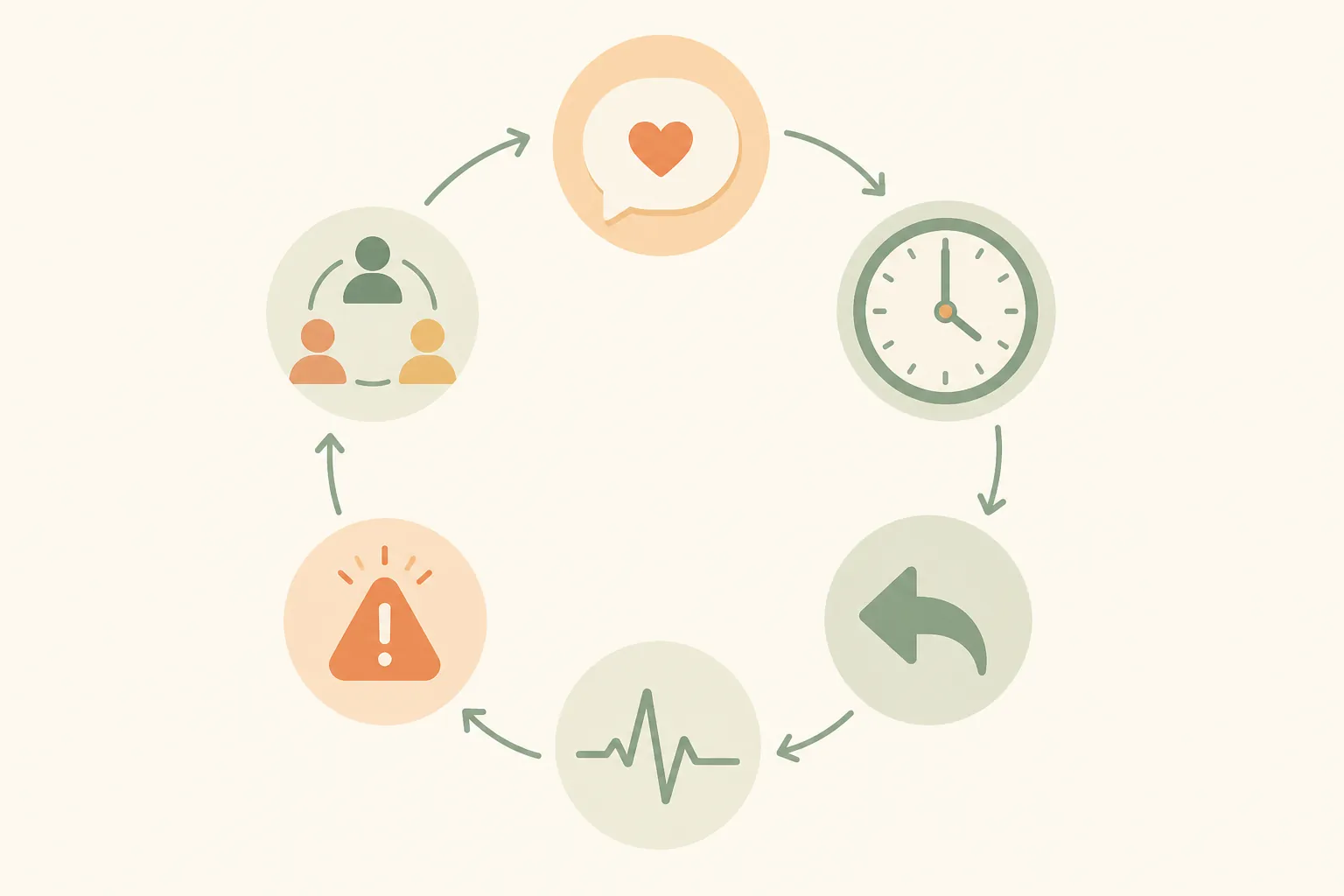
| Part of the routine | What it looks like in real life |
|---|---|
| Choose a consistent time | Send the message after the parent is usually awake, not at a time that pressures them to jump for the phone. |
| Send something warm and answerable | Ask about one concrete thing: sleep, breakfast, weather, plans, pain, church, the garden, or a memory. |
| Learn the normal reply pattern | Notice whether they usually answer in 5 minutes, 45 minutes, after breakfast, or after the morning news. |
| Watch timing, tone, and wording | A missing reply is one signal. So is a reply that sounds unusually flat, confused, vague, or unlike them. |
| Follow up calmly | Call or send a second message that sounds caring, not accusatory. |
| Use a pre-agreed care circle | If the reply stays missing or sounds concerning, contact the people your parent already agreed may help. |
Some documented family check-in patterns use a daily text, a defined reply window such as an hour, a reminder, and then a pre-selected circle of relatives, neighbors, or friends if there is still no answer. That is a useful shape, but it should be adapted to the family and agreed on ahead of time, not sprung on a parent as a rule they never accepted.[2][3]
Step 1: Pick a time that respects the parent’s morning
A good check-in time is not simply early. It is predictable and humane. If your father wakes at 6:00 but does not want to talk until he has coffee, 8:15 may be kinder than 6:10. If your mother goes to morning Mass, the routine may work better after she usually returns. If your parent’s sleep is irregular, the time window may need to be looser.
Say what you are doing in ordinary language: “I like saying good morning to you before my day gets busy. If I don’t hear back after a while, I may call, just so I’m not wondering.” That lands very differently from “I need you to verify that you’re okay every morning.”
Step 2: Let the reply be the signal
The point is not to interrogate. The point is to make room for a normal answer. “Did you sleep?” “What did you eat?” “Are you heading out?” “How’s the back today?” These are ordinary family questions. Against a regular routine, they also help you notice when something sounds off.
| A normal reply might sound like | A reply worth a closer look might sound like |
|---|---|
| “Morning. Slept okay. Making toast.” | “I don’t know. Not sure yet.” |
| “Coffee first, then I’ll water the tomatoes.” | “Can’t get going today.” |
| “Knee is stiff but same as usual.” | “Very dizzy when I stood up.” |
| “Going to the store around 10.” | “I think I fell but I’m fine.” |
| “Phone was charging. I’m up now.” | A message with odd wording, unusual confusion, or a tone that does not sound like them. |
None of this diagnoses anything. A flat answer may mean bad sleep. A vague answer may mean the phone is annoying. A missing answer may mean the battery died. But when the reply is very different from the parent’s usual rhythm, it deserves attention.
Step 3: Know your parent’s ordinary pattern before you worry
One parent replies with a thumbs-up and considers that affectionate. Another writes three paragraphs before breakfast. One never uses punctuation. Another suddenly using no punctuation may mean nothing at all. “Normal” belongs to that parent, not to a chart.
For a week or two, simply notice the pattern: when they tend to answer, whether they answer before or after eating, whether they mention pain freely, whether they avoid complaints, whether they prefer texting, calling, or voice messages. You are learning their morning language.
Step 4: Follow up without sounding like a supervisor
If the usual window passes, the next message should still sound like family. Try: “Just checking again because I didn’t see your reply. No rush if you’re busy — send me a word when you can.” Or: “I’m going to call in a few minutes so I can stop wondering.”
If they answer with irritation, take the information and lower the heat. “Fair enough. I don’t want to hover. Let’s pick a time that doesn’t make you feel watched.” The routine only works if the parent can live with it.
Step 5: Agree on the care circle before anyone needs it
The care circle might be a sibling, a neighbor with a key, a nearby cousin, a church friend, a building manager, or a trusted friend who can knock on the door. The important part is consent and clarity. Your parent should know who may be contacted, in what order, and under what circumstances.
A family might agree, for example, that if there is no reply after the usual window, you send one follow-up and call. If there is still no answer after a reasonable second window, you call the neighbor your parent chose. If the reply mentions a fall, chest pain, severe shortness of breath, sudden confusion, or immediate danger, you treat that differently and seek urgent help. The exact timing is not a universal medical standard; it is a family safety routine.
Messages for common morning situations
The same parent may need different messages on different mornings. A quiet Monday, a stormy day, a doctor-appointment morning, and the first holiday after a spouse’s death should not all get the same cheery line.
| Situation | Reply-friendly message |
|---|---|
| After a rough night | Good morning. Did you manage to get any solid sleep, or was it a restless one? |
| Before a doctor visit | Morning. What time do you need to leave today, and do you have your questions written down? |
| Bad weather | Good morning. Is everything calm at the house with the weather, and do you still have power? |
| Very hot day | Morning. It looks like a hot one. Are you keeping the house cool enough so far? |
| After a recent fall or near-fall | Good morning. How did you feel getting out of bed today — steady, stiff, or unsure? |
| Grief anniversary | Good morning. I know today may feel tender. Do you want company by phone later, or a quiet check-in? |
| When they hate being fussed over | Morning. I’m not hovering, just saying hello. What’s one thing on your agenda today? |
| When they love details | Good morning. Give me the full breakfast report when you’re ready: food, coffee, weather, and mood. |
| When they often forget to charge the phone | Morning. If your battery is low, just send me one word now and charge it after breakfast. |
| When you are traveling | Good morning from the road. I’ll be slower to answer today, but I still want to know how your morning started. |
Why daily contact is worth taking seriously
Daily contact should not be sold as medicine. A text message does not prevent dementia, heart disease, stroke, falls, or death. It can, however, help keep a relationship active and make a meaningful change harder to miss.
The broader context is sobering. The CDC reports that about 1 in 3 U.S. adults feel lonely and about 1 in 4 lack social and emotional support.[4] The National Academies reported in 2020 that approximately 24% of community-dwelling Americans age 65 and older are socially isolated.[5]
The same National Academies summary describes social isolation as associated with about a 50% increased risk of dementia, a 29% increased risk of coronary heart disease, and a 32% increased risk of stroke.[5] Those are associations, not proof that one family habit prevents those outcomes. They are still enough to justify taking ordinary connection seriously.
There are already many good morning message lists online, including collections focused on dads, general morning greetings, and messages for moms.[6][7][8] The missing piece is usually not another pretty sentence. It is the reply: the small, human answer that tells you Mom is making tea, Dad is grumbling at the paper, or something about this morning is not quite right.
When the morning reply points to something bigger
Most replies need nothing more than an answer back. “Toast and coffee” can get a heart. “The roses finally bloomed” deserves enthusiasm. But sometimes the message reveals a problem that a warmer text cannot solve.
- “I got dizzy when I stood up.”
- “I almost fell going to the bathroom.”
- “The power is out and it’s getting dark in the hallway.”
- “It’s too hot in here, but I don’t want to bother anyone.”
- “The water is off, so I’m trying not to drink too much.”
- “My back hurts too much to sit at the counter.”
Those answers shift the job. The morning message has done its work by bringing the issue into view. The next step may be a call, a neighbor visit, a same-day appointment, or a home-safety fix.
If the issue is a power outage, especially after severe weather, use a fall-prevention lens rather than treating it as only an inconvenience. Dark rooms, cords, portable lights, spoiled food decisions, and rushing all change the risk picture. Start with the Post-Tornado Power Outage Fall Prevention Checklist.
If the reply mentions heat, smoke, evacuation stress, or a house that will not cool down, move from texting into a heat-safety plan. The guide on wildfire safety for older adults during a heat dome is a better place to handle those decisions.
If the morning text reveals a water shutoff, dehydration worry, slippery cleanup, or a parent rationing fluids to avoid bathroom trips, treat it as a fall-risk situation too. See why a water crisis is a fall emergency for older adults.
And if your parent’s answer keeps circling back to pain while sitting, trouble getting up from the counter, or avoiding meals because a chair is uncomfortable, the issue may be less about the message and more about the setup of the room. For one narrow but common example, review how to choose counter stools for elderly people with back pain.
A morning text is not surveillance. It is not prevention medicine. It is a familiar voice at a familiar time, with enough room for the parent to answer as a person — and enough consistency for the family to notice when the answer changes.
References
- Memes of Care, Taylor & Francis Online.
- How to check on an elderly parent living alone without being intrusive, CheckinBee.
- Quick Check-in on Your Parents, Parenting Aging Parents.
- Risk Factors for Social Isolation and Loneliness, Centers for Disease Control and Prevention.
- Social Isolation and Loneliness in Older Adults: Opportunities for the Health Care System, National Academies of Sciences, Engineering, and Medicine, 2020.
- 155+ Good Morning Dad Messages, wikiHow.
- 120 Good Morning Messages, Prevention.
- 100 Positive and Heartwarming Good Morning Messages for Mom, Tootris.
Questions to bring to a clinician or OT
This is not medical, legal, or a family's final decision — only a framework. Bring these questions to a clinician, occupational therapist, or your local Area Agency on Aging.
Find Local HelpRelated reading
Noticed something outdated or inaccurate on this page? Flag a correction. We review every report against CDC, NIA, and AARP HomeFit guidance before updating a page.