
Caregiver decision guide
Are Robot Vacuum Benefits for Elderly Parents Real?
A robot vacuum can ease the physical strain of vacuuming for an aging parent and keep floors cleaner more often, but the payoff depends on setup, self-emptying features, and home prep — and it can't replace hands-on cleaning. Weigh the genuine benefits against the limits to decide whether one is worth the investment.
Vacuuming looks like a simple chore until an older parent has to do every part of it: pull the machine out of a closet, carry or drag it to the room, bend for the cord, find an outlet, push and pull the weight over carpet, get under the bed, work around chair legs, unplug, move to the next room, then empty the bin or bag. If balance, grip strength, back pain, arthritis, shortness of breath, or stamina has changed, that ordinary job can become the chore that quietly stops getting done.
So are robot vacuum benefits for elderly parents real? Yes, when the benefit is defined narrowly and practically. A robot vacuum can reduce the pushing, pulling, bending, plugging, and carrying that make floor cleaning hard on an aging body. It can also run often enough that dust, crumbs, hair, and grit do not wait for the next family visit. AARP’s 2025 reporting frames robotic vacuuming as one way to off-load a physically demanding task for older adults, especially those with chronic conditions or functional impairment, while also noting the ordinary complications: cords, rugs, smartphone setup, price, and the need for touch-up cleaning.[1]
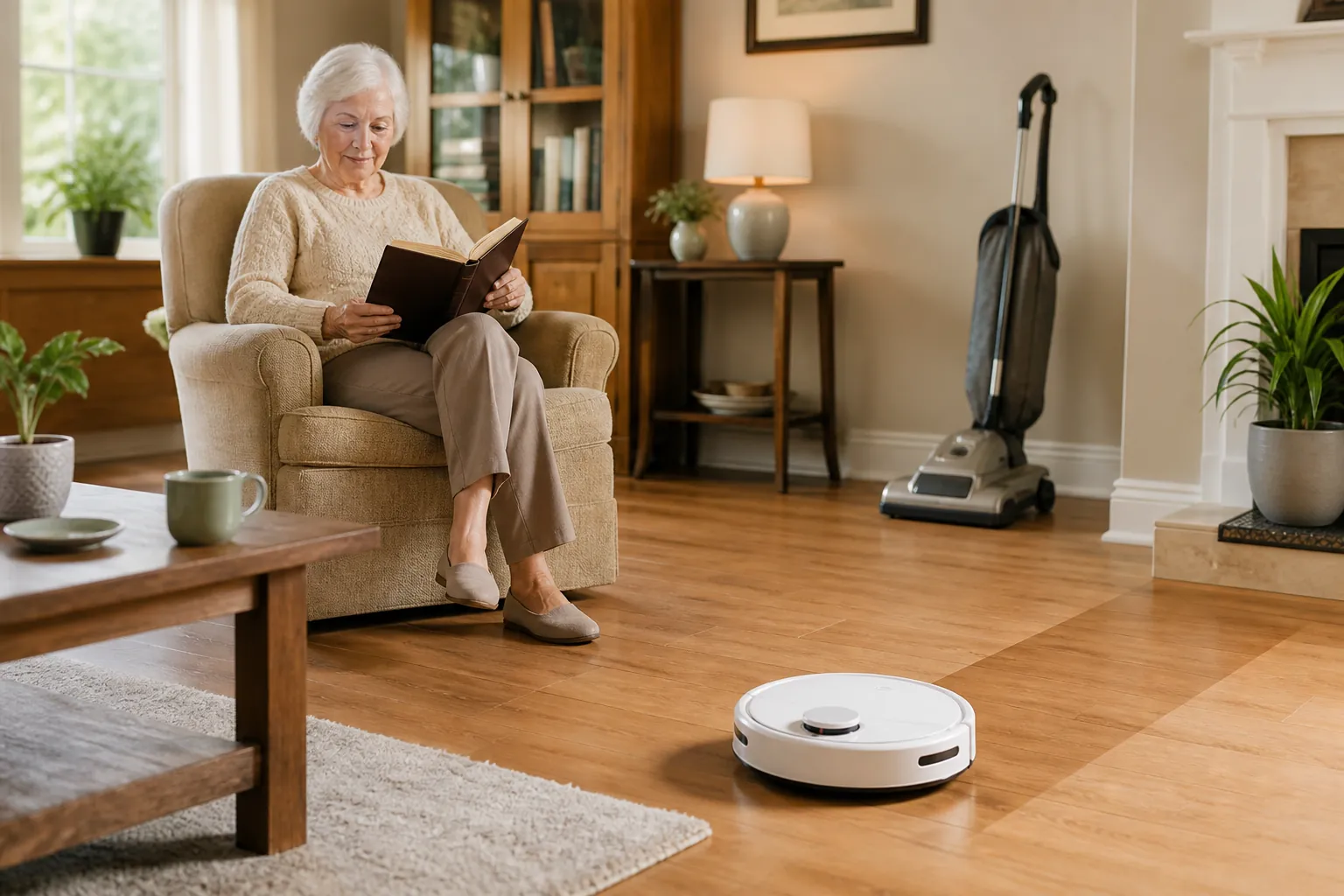
The catch is that the robot is not the whole solution. Someone still has to make the floor safe for it, place the dock where it will not become a new obstacle, set up the app, choose a realistic schedule, and handle maintenance. In many homes, the robot helps only after an adult child does the unglamorous work that makes the machine boring.
What the robot actually takes off your parent’s body
The strongest case for a robot vacuum is not that it is “smart.” It is that it removes repeated movements that can become punishing: leaning over, reaching under furniture, managing cords, and pushing a machine through a whole room. Reviewed’s aging-in-place robot vacuum guide makes the same practical point: robot vacuums reduce the need for pushing and pulling a full-size vacuum and can clean under furniture without the person bending or contorting their body.[2]
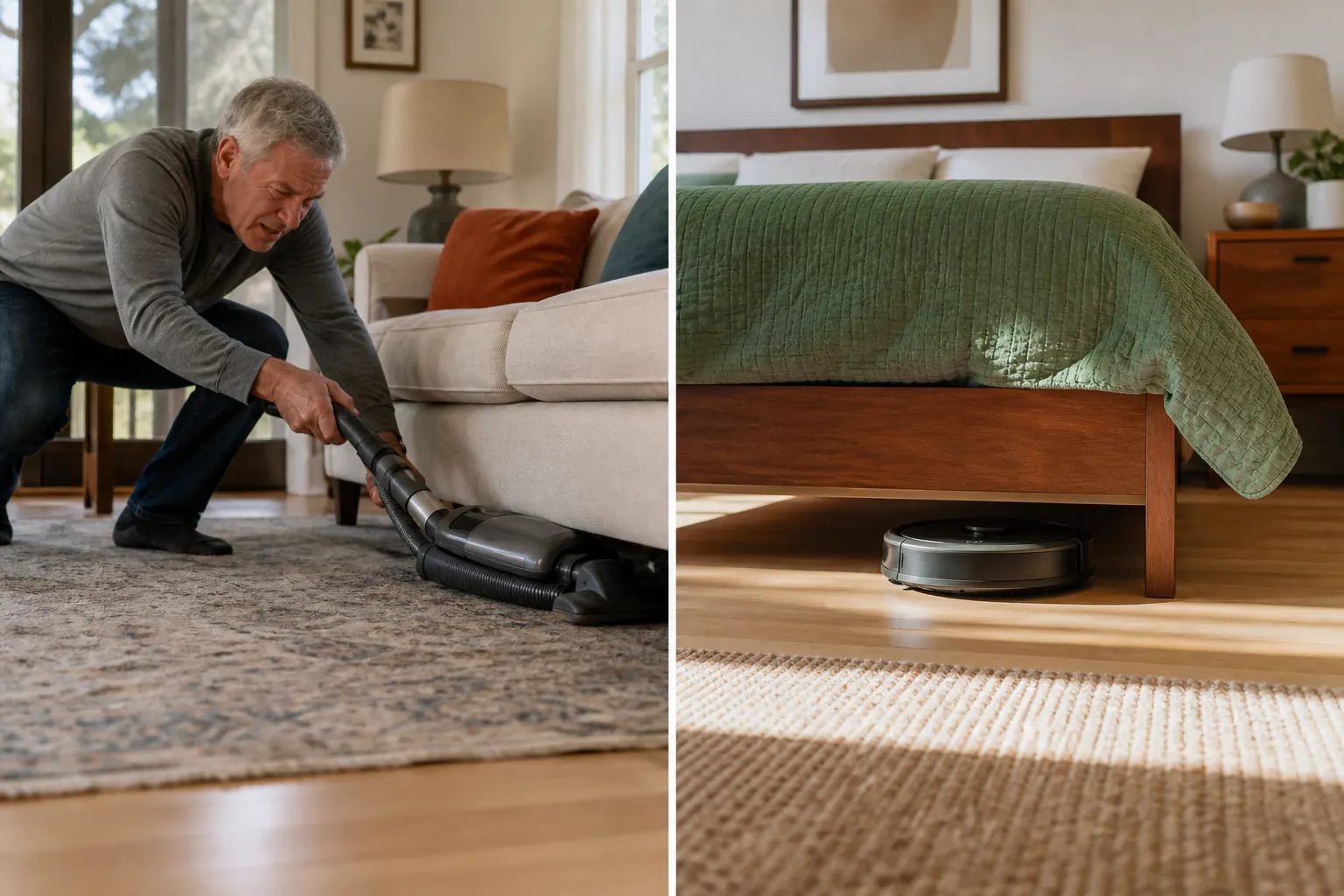
That matters most for parents who are still managing their homes but have started rationing effort. They may vacuum the visible middle of the room and skip the edges. They may leave the bedroom for another day. They may avoid moving the vacuum between floors. The house still looks respectable, but the chore has already been edited down around pain, fatigue, or fear of losing balance.
A robot vacuum can take over the flat, open, repetitive part of the job. It can run in the living room after breakfast, make a pass under the bed, or pick up the daily trail of crumbs near a favorite chair. That is meaningful relief. It is also not the same as no cleaning. Stairs, baseboards, upholstery, high corners, thick rug edges, and tight spots around clutter still need hands-on attention. AARP notes that a hand vacuum may still be needed for touch-ups.[1]
| What gets easier | What still needs a person |
|---|---|
| Routine passes across open floors | Stairs and landings |
| Cleaning under beds and some sofas | Baseboards, corners, and narrow gaps |
| Reducing how often a heavy vacuum comes out | Deep cleaning rugs and carpet |
| Frequent pickup of crumbs, dust, and pet hair | Clearing cords, socks, rug fringe, and small objects first |
| Less bending to empty the bin if the model self-empties | Replacing bags, washing filters, untangling brushes, and fixing errors |
Cleaner more often is a real benefit, but it is not deep cleaning
A robot vacuum’s quiet advantage is frequency. A full-size vacuum often waits for energy, time, and a clear afternoon. A robot can be scheduled for short, regular runs, which helps keep everyday debris from building up between visits from family, a house cleaner, or a more thorough manual cleaning.
That frequency has a modest indoor-cleanliness benefit. The Asthma and Allergy Foundation of America advises vacuuming once or twice a week to help keep indoor allergens low, while warning that poor-quality vacuums can put dust back into the air.[3] A robot vacuum should not be treated as an allergy treatment, and model filtration varies, but more regular floor maintenance can help keep visible dust, hair, pollen tracked indoors, and crumbs from sitting around as long.
Dust itself is not imaginary housekeeping shame. The American Lung Association notes in a dust briefing, produced in partnership with Swiffer, that people in the U.S. spend up to 90% of their time indoors and that household dust can include skin cells and dust mite matter.[4] The partnership caveat matters; this is not an independent robot-vacuum study. Still, the basic point is useful for caregivers: floors that are cleaned more consistently are easier to keep ahead of than floors that wait until the job becomes large.
The limit is suction, coverage, and judgment. A robot may miss a strip beside a chair leg, avoid a dark rug, struggle with fringe, or fill its bin faster than expected during shedding season. It cannot decide that spilled flour needs a different tool or that a damp mess should not be smeared across the kitchen. The benefit is maintenance cleaning, not replacing every pass of a good vacuum in every room.
Self-emptying is where the value changes for many older adults
A basic robot vacuum still asks someone to bend down, pull out a small dustbin, carry it to the trash, open it without spilling debris, tap out dust, snap it back in, and remember to do that often enough that the vacuum can keep working. For a younger buyer, that may be a minor annoyance. For an older parent with hand weakness, back pain, tremor, or low stamina, that small bin can become the part that makes the whole device stop helping.
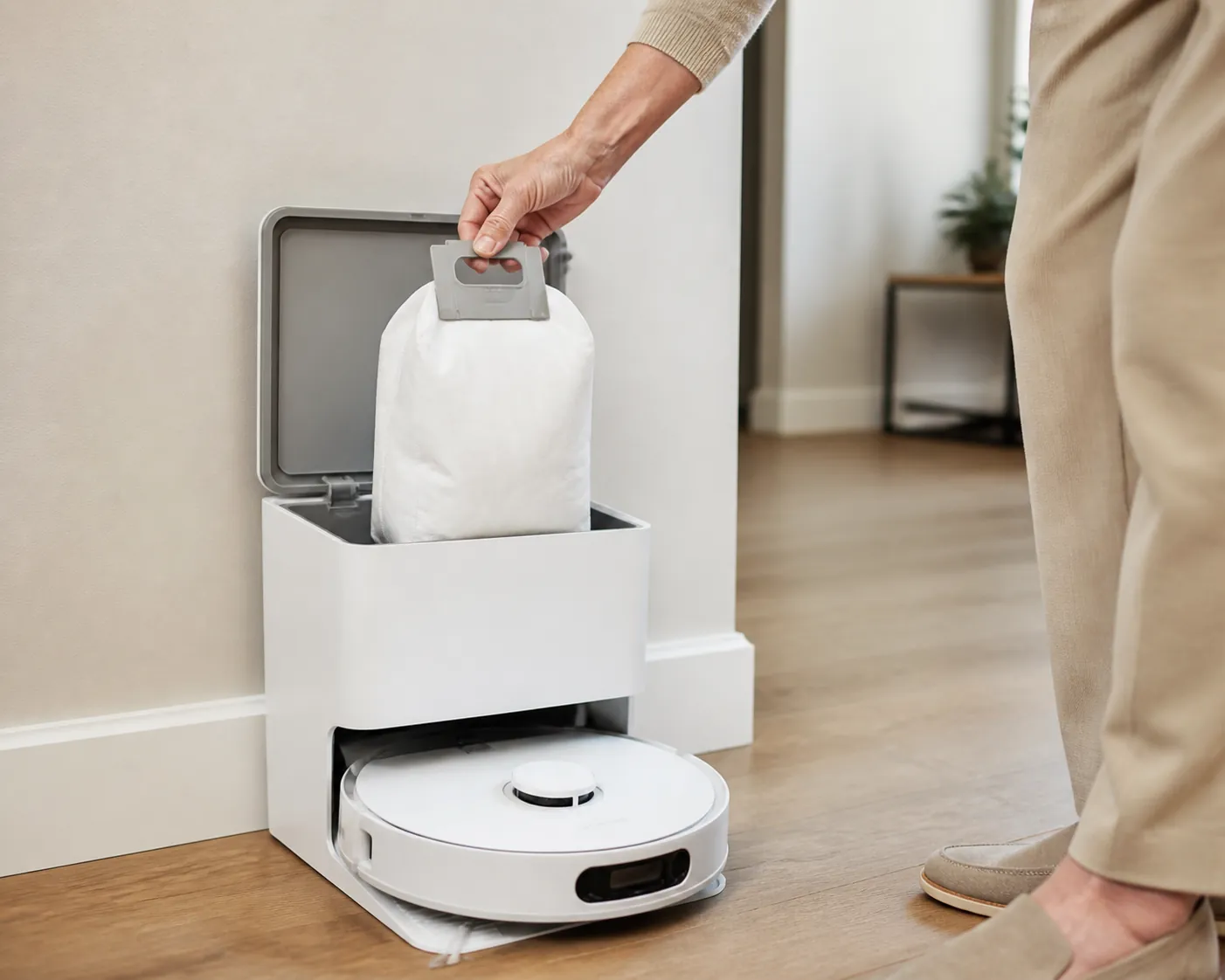
Self-emptying models reduce that burden by sending debris from the robot into a larger dock bag or container. Reviewed reported that some self-emptying models hold about 30 to 60 days of debris in self-sealing bags, though that 2021 figure should be treated as illustrative rather than a guarantee for every home.[2] Ecovacs, a manufacturer, similarly frames self-emptying models as reducing emptying to about once every 1 to 2 months, but that is a manufacturer claim and will depend on the model, household debris, pets, and run schedule.[5]
This is one of the few upgrades that can be worth more than a flashy navigation feature for an aging-in-place home. If the parent can leave the robot alone for several weeks and an adult child can replace the dock bag during a regular visit, the machine is more likely to keep doing its job. If the parent must kneel every two days to clear the bin, the purchase may simply trade one tiring task for another.
Self-emptying does not mean maintenance-free. Bags run out. Filters need attention. Hair wraps around brushes. A sock can jam the roller. The dock takes up floor space and usually makes a louder burst of noise when it empties the robot. If your parent is startled by sudden sounds or likely to unplug a noisy appliance, schedule the emptying cycle for a time when someone can explain what is happening.
The home has to be prepared before the robot is safe or useful
The same floor hazards that make a home risky for a parent can also defeat a robot vacuum. Loose cords wrap in brushes. Small throw rugs bunch up. Rug fringe tangles. Shoes, bags, pet toys, tissue boxes, and oxygen tubing can stop a cleaning run or create a mess. AARP specifically warns that cords can tangle brushes and that loose throw rugs are slip and trip hazards, recommending that owners put cords away and remove small rugs.[1]
This is also where fall-prevention language needs to stay honest. The CDC reports that more than 1 in 4 adults age 65 and older falls each year, and it flags throw rugs and clutter as home hazards.[6] Clearing cords and loose rugs can reduce specific hazards in the walking path. That does not prove a robot vacuum prevents falls, and the evidence here does not support that claim. The safer statement is the more useful one: the robot works best in the same cleared floor environment that is already better for walking.
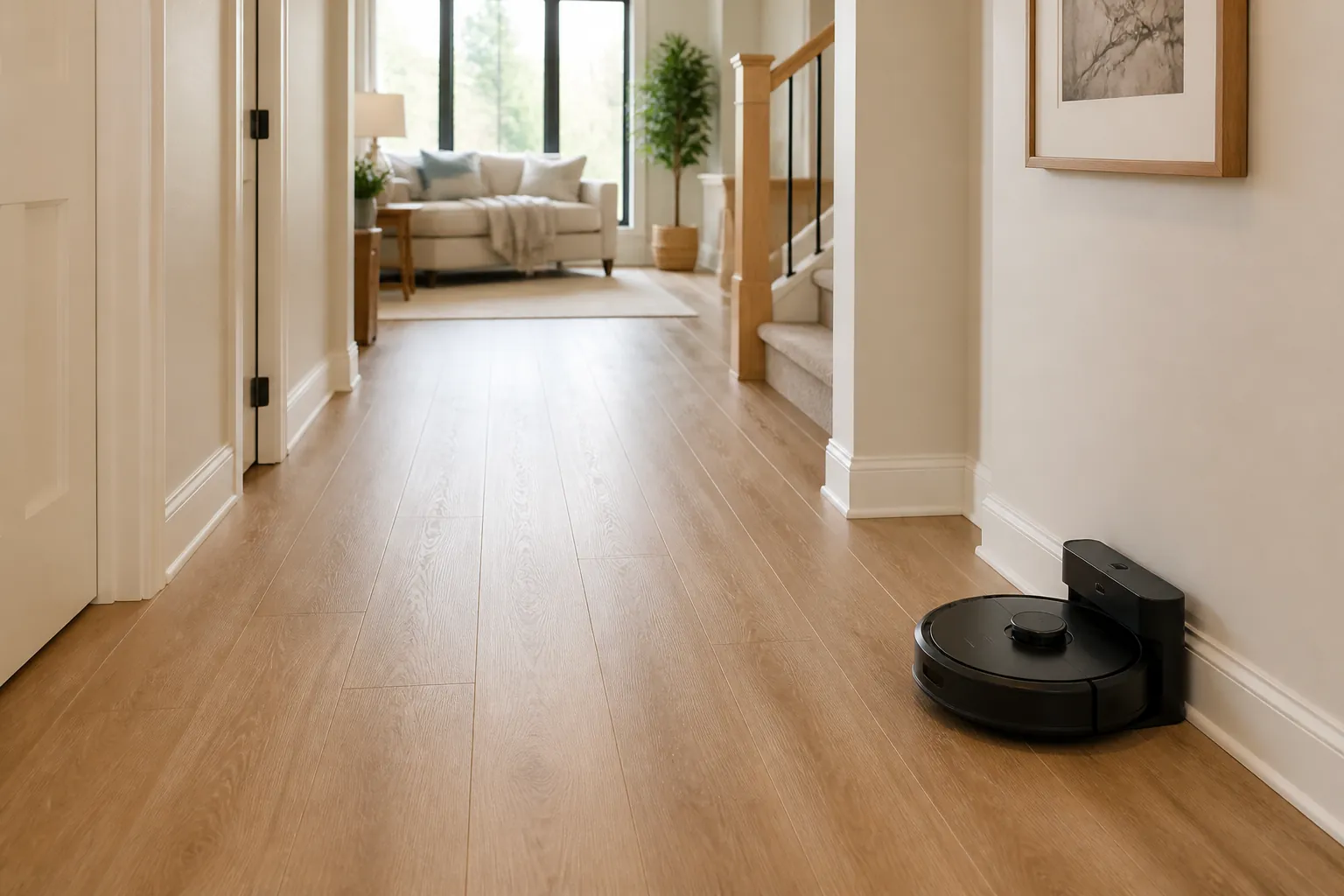
Before buying, look at the house from the robot’s height and from your parent’s feet. The dock should sit against a wall, not in a narrow hallway or beside the bed where someone may step into it at night. Reviewed notes that dock-return features and boundary tools can help reduce the chance that the robot itself becomes a tripping hazard, especially if it is kept out of hallways and bedrooms at night.[2]
- Tuck lamp, charger, and extension cords along the wall or behind furniture before the first run.
- Remove loose throw rugs that slide, curl, or bunch. If a rug is important, test whether the robot handles it without folding the edge.
- Keep the dock out of the main walking path and away from places your parent crosses in the dark.
- Use app boundaries, physical boundary strips, or closed doors to block stairs, fragile areas, pet bowls, and rooms that are not ready.
- Do a supervised first week. Watch where the robot gets stuck, what it drags, and which alerts your parent ignores or worries about.
The first run is not a test of the robot as much as a test of the house. If it eats a phone cord, bumps a walker basket, or parks itself where your parent walks to the bathroom, the fix may be moving the dock or clearing the room, not buying a different machine.
App setup can be a caregiver task, not a parent task
Many modern robot vacuums expect a smartphone app for setup, mapping, schedules, room selection, updates, and troubleshooting; AARP calls out smartphone setup as part of the current robot-vacuum experience.[1] That does not mean a parent has to become the household robot manager. In a better setup, the adult child handles the app, creates a simple schedule, names the rooms clearly, and teaches the parent only what they actually need.
That teaching should be short. Show where the robot starts. Show the one button to pause or send it home, if the model has a physical button. Explain what noises are normal. Decide together whether notifications go to the parent, the caregiver, or both. If your parent already dislikes app-controlled appliances, do not make the vacuum another device that demands attention every day.
The schedule should fit the person, not the product demo. A robot that runs while your parent is carrying coffee, using a walker, or heading to the bathroom in the evening is badly scheduled. Daytime runs, after the main walking paths are clear and lights are on, are usually easier to supervise and less likely to surprise someone.
Price is a decision range, not proof of usefulness
AARP reported a broad robot-vacuum price range of about $180 to $1,400 in January 2025.[1] Prices shift, but the spread is still a useful reminder: “robot vacuum” can mean a basic bump-and-clean device or a higher-end model with mapping, object avoidance, mopping, self-emptying, and app controls.
For an elderly parent, the most useful spending question is not which model has the most impressive spec sheet. It is which feature removes a real point of friction in this specific home. If bending to empty the bin is the problem, self-emptying may matter more than premium suction. If the house has many cords or chair legs, obstacle handling and reliable mapping may matter more than a mop pad. If Wi-Fi is unreliable or no one will manage the app, an expensive connected model may be worse than a simpler cleaning plan.
Model comparisons, suction ratings, and brand-by-brand tradeoffs belong in a buying guide. At this stage, decide whether the home is a good candidate at all. If it is, then move to a model-selection resource such as robot vacuums for seniors with mobility issues or a more detailed list of the best robot vacuums for seniors with mobility issues.
When a robot vacuum is worth considering
A robot vacuum is most likely to help when the parent’s main problem is the physical burden of routine floor cleaning. The home has mostly one-level living areas, open floor space, manageable rugs, and a caregiver who can handle setup and occasional rescue. In that situation, the robot can reduce heavy vacuuming sessions and keep floors from sliding into “I’ll get to it later” territory.
It is less promising when the home is dominated by stairs, thick rugs, cluttered rooms, tangled cords, thresholds the robot may not cross, or frequent messes that require judgment. It is also less promising when no one is available to set up the app, replace bags, clean filters, untangle brushes, or adjust the schedule after the first week. A robot vacuum may be automatic during a cleaning run, but it is not an automatically successful household system.
There is also a middle ground. The robot may be useful for the main living area even if it cannot handle the whole house. It may run in the kitchen and den while a family member or cleaner still handles bedrooms, stairs, and deep carpet cleaning. That partial use can still be worth it if it removes the chore your parent finds most tiring.
The fall-risk question deserves a separate lens
Robot vacuums sit awkwardly in fall-risk conversations. On one hand, vacuuming can involve cords, bending, carrying, and awkward reaching. On the other hand, the robot itself is a moving object on the floor, and a poorly placed dock can become one more thing near the walking path.
The sensible approach is to treat the robot as one tool inside a broader floor-safety plan. If you are specifically evaluating hazards, stairs, cords, dock placement, and nighttime movement, use a dedicated fall-risk guide such as Can a Robot Vacuum Cut Fall Risk for Seniors Aging in Place? and compare vacuum types in safest vacuum to prevent falls. The benefit discussion here should not be stretched into a medical or clinical claim.
A practical decision threshold
Consider a robot vacuum when your parent still wants to keep the home tidy but struggles with the body mechanics of vacuuming: pushing, pulling, bending, plugging, carrying, and reaching. Give extra weight to self-emptying if grip, stamina, or bending is part of the problem. Plan on doing the first setup yourself, clearing cords and loose rugs, choosing a dock location outside the walking path, and checking the first few cleaning runs.
Hold off, or buy much more cautiously, when the home’s main problems are stairs, clutter, rug edges, app dependence, or cleaning tasks the robot cannot reach. In those homes, a lighter manual vacuum, a safer cleaning routine, paid help, or broader home modifications may solve more than a robot will. For the wider role of household robotics beyond floors, see robots that help seniors live at home.
References
- Should a Robovac Be Your Next Appliance? — AARP, Jan. 2025
- These are 10 great robot vacuums for people who are aging in place — Reviewed
- Control Indoor Allergens — Asthma and Allergy Foundation of America
- Dust Briefing — American Lung Association
- Self-Empty Robot Vacuum: The Best Gift for Elderly — Ecovacs
- Facts About Falls — Centers for Disease Control and Prevention
Questions to bring to a clinician or OT
This is not medical, legal, or a family's final decision — only a framework. Bring these questions to a clinician, occupational therapist, or your local Area Agency on Aging.
Find Local HelpRelated reading
Noticed something outdated or inaccurate on this page? Flag a correction. We review every report against CDC, NIA, and AARP HomeFit guidance before updating a page.