
Caregiver decision guide
The 72-Hour Caregiver Checklist: What to Do Immediately After a Parent's Crisis
When a parent falls, is hospitalized, or suddenly declines, most caregiving checklists assume you have weeks to plan. This guide is organized by time urgency — hours, days, and weeks — so you can stabilize the situation, secure medical and legal authority, and build a sustainable care plan without missing critical steps.
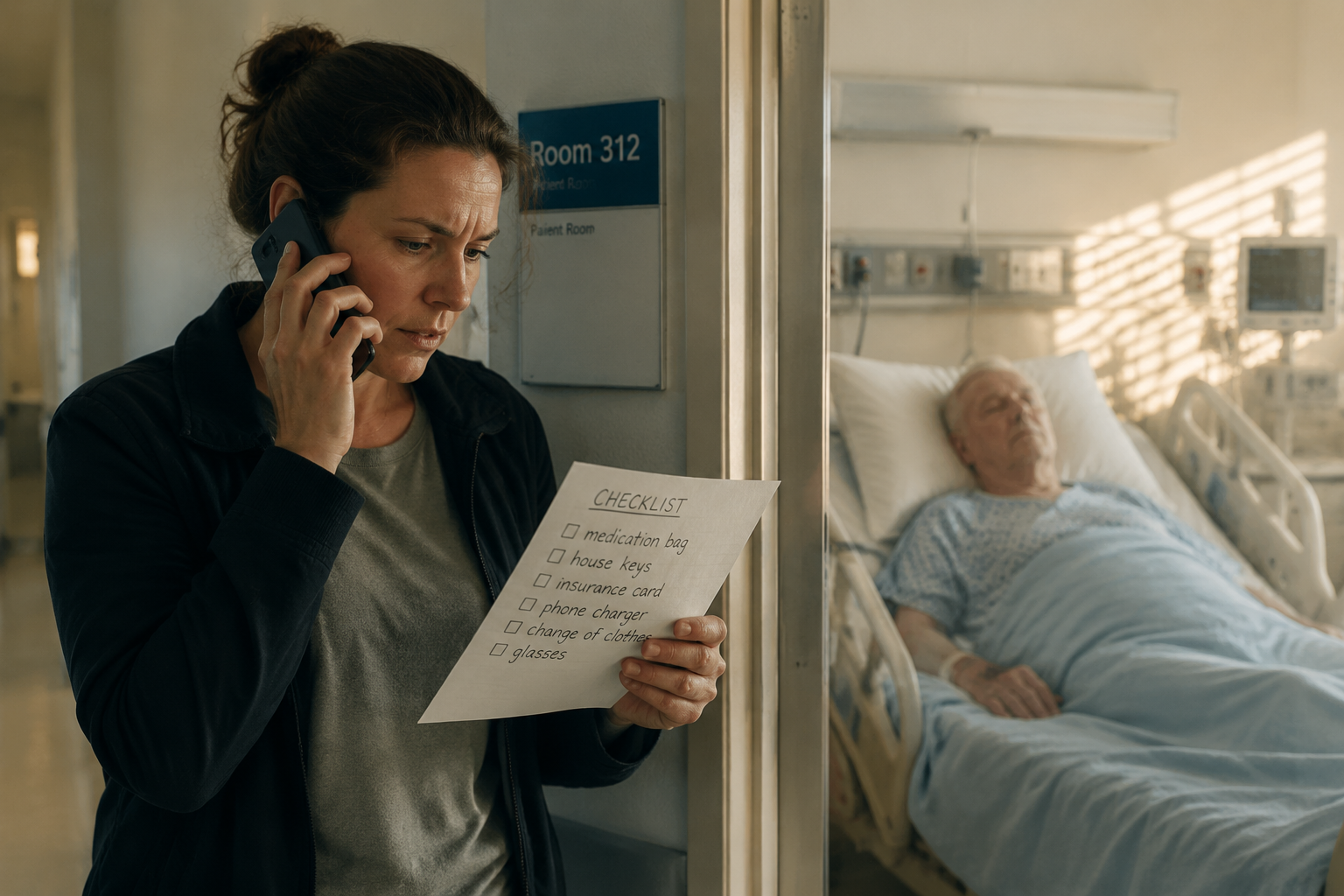
The call usually starts with one plain sentence: your mother fell, your father is in the emergency department, or a nurse says discharge may happen tomorrow. You may still be at work, in another state, or trying to hear the caller while a child is asking for dinner. This is when a normal checklist for caring for elderly parents can feel too slow. You do not need a five-year plan first. You need to know where your parent is, who is responsible for care right now, what permission you have to receive information, and whether home will be safe if the hospital sends them back there.
If you feel behind, that is not a personal failure. Falls alone are a common doorway into crisis care: the CDC reports that one in four older adults falls each year, with about 3 million emergency department visits and 1 million fall-related hospitalizations annually among older adults.[1] Most families are not calmly prepared when caregiving begins. In A Place for Mom's 2026 caregiver statistics, only one in four caregivers said they felt completely prepared when caregiving started; 24% entered caregiving because of an immediate need, and 25% began within 30 days.[2]
So the order matters. This checklist is sorted by urgency: hours 0-24, days 1-14, and weeks 2-8. It is meant to keep the first handoff from becoming a blur of missed phone calls, missing medication bottles, and family members repeating different versions of the same story.
The First Pass: What Needs Control Now
| Time frame | Main job | What you are trying to prevent |
|---|---|---|
| Hours 0-24 | Locate your parent, secure medical communication, gather essentials, and name one family contact. | A discharge or treatment decision happening while the family has no information, no permission, or no medication history. |
| Days 1-14 | Prepare follow-up care, scan the home, clarify legal authority, and build a communication routine. | Missed appointments, unsafe return home, duplicate family calls, unpaid urgent bills, and confusion about who can sign or decide. |
| Weeks 2-8 | Assemble documents, assess lasting support needs, consider technology or home help, and check caregiver strain. | A short crisis turning into an unstable care arrangement that depends on one exhausted person remembering everything. |
Hours 0-24: Stabilize Access, Information, and Belongings
Start with location, not interpretation. Write down the hospital, emergency department, rehab center, or clinic name; the unit or room number if there is one; the main phone number; and the name and role of the person who called. If you are speaking with a neighbor, police officer, facility aide, or distant relative, ask where your parent physically is now and whether anyone is with them. Then confirm whether your parent is awake, able to speak, and able to understand what is being discussed.
The next call should establish who is medically responsible. In a hospital, ask for the bedside nurse and the attending physician's service. In the emergency department, ask who is currently managing the case and when the next update is expected. Do not rely on “someone will call you.” Ask for the correct number to call back, the best time to call, and whether there is a case manager or social worker assigned.
- Parent's full legal name, date of birth, and current location
- Primary diagnosis or reason for evaluation, if the staff can share it
- Current status: admitted, under observation, waiting for tests, being discharged, or transferred
- Name of the nurse, physician, case manager, or social worker you spoke with
- Direct callback number and expected time of next update
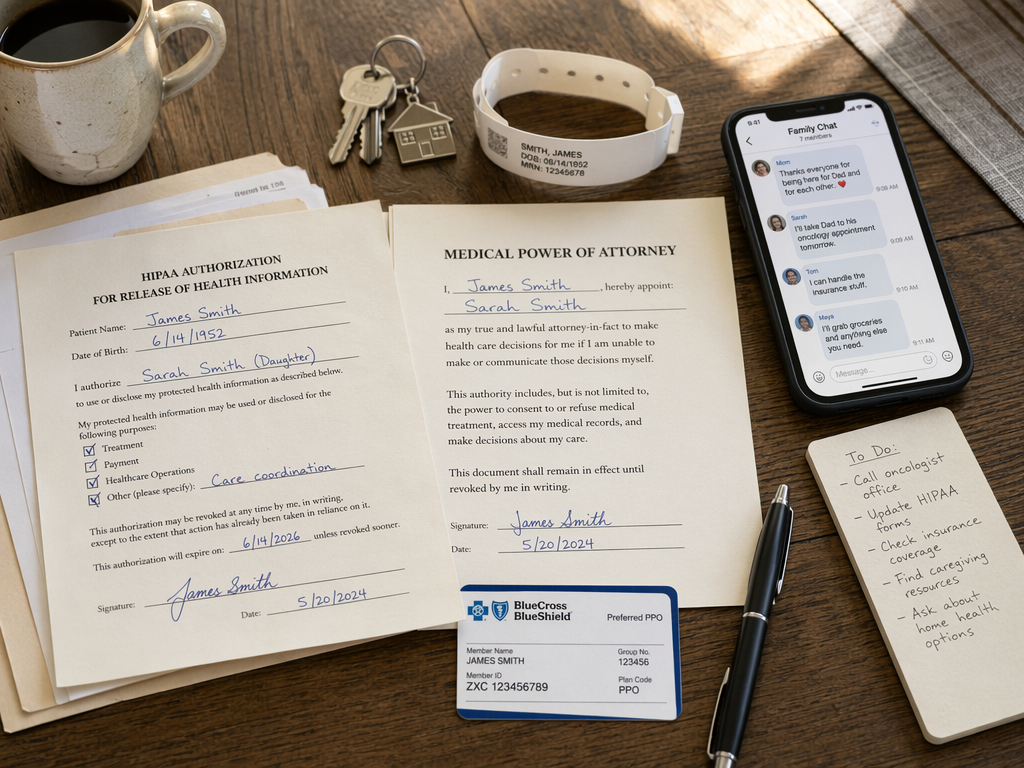
Then ask the locked-door question early: “What authorization do you need in order to speak with me?” HIPAA does not automatically let an adult child receive medical details just because the situation is frightening. AARP's legal checklist for family caregivers points families toward documents and permissions such as HIPAA authorization, health care power of attorney, financial power of attorney, advance directives, wills, and related legal records because these are the papers that determine who can receive information or act when a parent cannot.[3]
If your parent is alert and agrees to involve you, ask staff how your parent can add you to the permitted-contact list for this visit. If your parent is not able to consent, ask what the facility needs from you and whether an existing health care proxy, medical power of attorney, or advance directive is on file. If nobody knows, that is not the moment to argue with the unit clerk. Ask for the social worker or case manager and write down exactly what document is missing.
Find the Small Things That Carry the Case
A parent can be surrounded by professionals and still have the wrong medication list in the chart. Before you start calling every sibling, find the medication bag. If you are near the home, collect prescription bottles, over-the-counter medications, supplements, eye drops, inhalers, insulin supplies, and any written medication list. If you are not nearby, ask a neighbor, sibling, or trusted friend to take photos of labels rather than guessing names over the phone.
- Medication bottles, pill organizer, and pharmacy name
- Insurance card, Medicare or Medicare Advantage card, and photo ID
- Glasses, hearing aids, dentures, cane, walker, phone, charger, and house keys
- Names and numbers for primary care doctor, specialists, pharmacy, home health agency, and regular caregivers
- Recent discharge papers, lab reports, or appointment summaries if they are easy to find
Do one family update after you have the first facts. Not six half-updates. Choose one person to send a short message: where your parent is, what is known, what is not known, who is calling next, and what help is needed. If there is a difficult sibling, give them the same facts in writing. It is harder for family drama to eat the day when everyone can see the same timestamped information.
Also check the house before you forget the house exists. Is the stove off? Are pets fed? Is the front door locked? Is there food spoiling, mail piling up, oxygen equipment running, or a space heater left on? These are not side issues. They are the difference between managing one crisis and discovering a second one.
Days 1-14: Turn the Emergency Into a Working Care System
Once the first calls are made, the work changes. You are still reacting, but you now have to make the next handoff cleaner than the first one. The questions become more specific: What has changed medically? What must happen before discharge? Who is allowed to speak? What will home require tonight, tomorrow, and next week?
Prepare for the First Serious Doctor Conversation
A follow-up visit is not a place to arrive with a vague worry and a tote bag of papers. Harvard Health's guidance on taking an aging parent to the doctor emphasizes preparing questions, bringing medication information, supporting the parent without taking over, and making sure the visit produces clear next steps.[4] In practical terms, that means you arrive with one page.
- What happened: fall, confusion, weakness, medication error, infection concern, stroke-like symptoms, pain, or sudden decline
- What changed from baseline: walking, toileting, eating, memory, speech, sleep, mood, pain, or ability to manage medications
- Current medications and recent changes, including stopped medications
- Discharge instructions you do not understand
- The decision you need from the appointment: therapy referral, home health order, medication review, driving advice, wound plan, cognitive evaluation, or specialist follow-up
If your parent can participate, speak with them before the visit about what they want raised. Then ask their permission to take notes during the appointment. If they minimize symptoms in front of the doctor, do not correct them like a child. State the observable change: “Before Friday, she walked to the mailbox. Since the fall, she needs help standing from the toilet.” That kind of sentence helps a clinician more than a family argument about whether someone is “doing fine.”
Ask Discharge Questions Before the Discharge Hour
Discharge can sound like good news while still being unsafe. Ask these questions before transportation is being arranged:
- Can my parent walk, transfer, toilet, bathe, dress, eat, and take medications safely enough for the proposed setting?
- What level of supervision is required for the next several days?
- Is home health, physical therapy, occupational therapy, speech therapy, wound care, or nursing being ordered?
- What symptoms require a call to the doctor, urgent care, or 911?
- Which medications are new, stopped, changed, or time-sensitive?
- Who schedules follow-up appointments, and by what date?
- If the family believes home is unsafe, who should hear that concern before discharge?
When you do not understand the answer, say so in the room. A discharge packet is not a care plan if nobody knows who will pick up the antibiotic, whether the walker fits through the bathroom door, or whether your parent can get out of bed at 2 a.m.
Scan the Home Before You Trust the Home
The first home scan is not decorating. It is a search for predictable trouble. Walk the route from bed to bathroom, bathroom to kitchen, kitchen to favorite chair, and door to car. Look for loose rugs, low lighting, cords, clutter, slippery bathroom surfaces, unstable furniture, missing handrails, high thresholds, and medications scattered across rooms. For a more systematic room-by-room pass, use a fall prevention checklist once the immediate hazards are cleared.
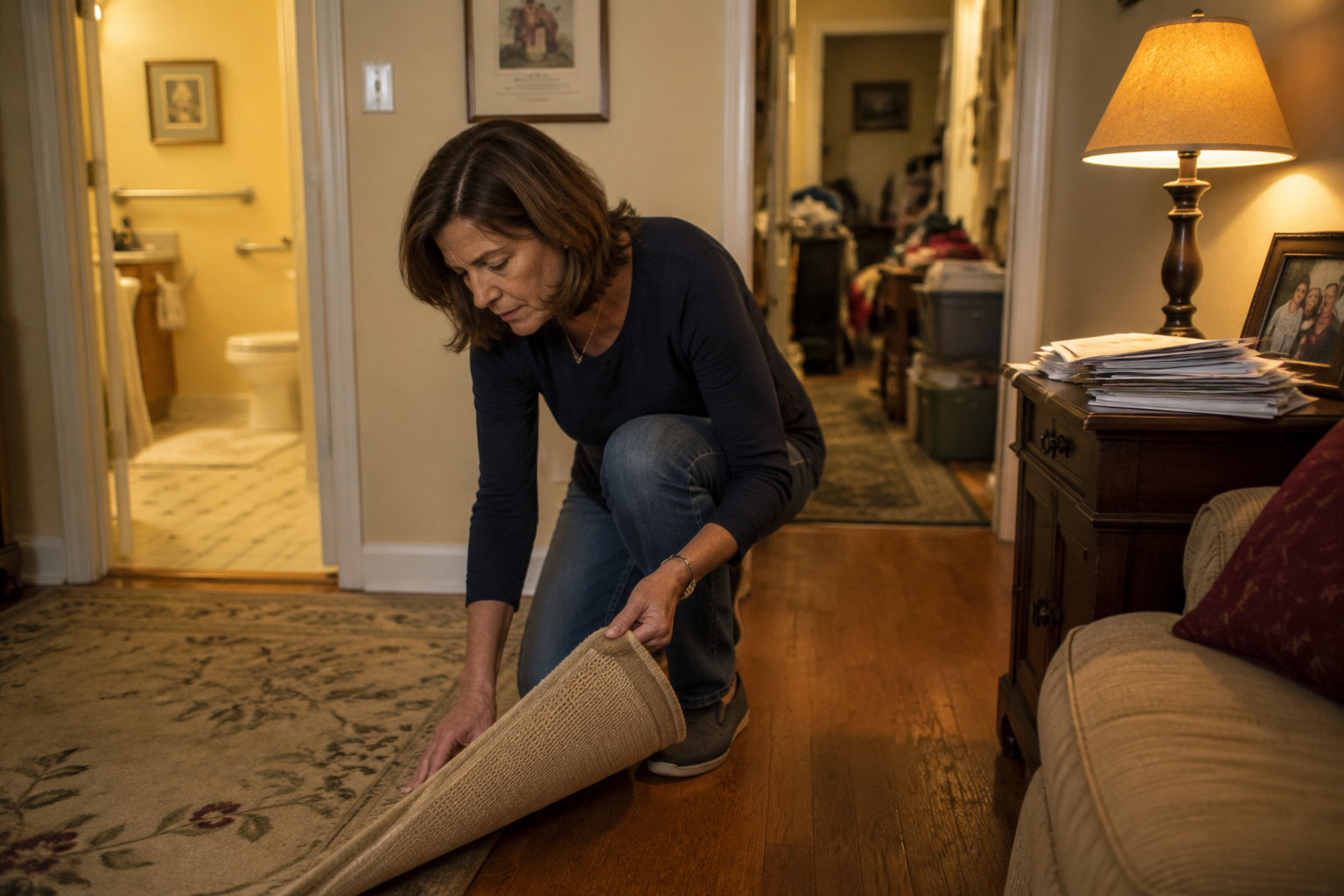
Bathrooms deserve special attention because they combine water, hard surfaces, privacy, and urgency. If your parent is newly weak or dizzy, a towel bar is not a grab bar. A raised toilet seat, shower chair, non-slip surface, handheld shower head, and properly mounted grab bars may be more urgent than any paperwork on your table. When the bathroom is the weak point, a bathroom safety after a fall guide can help you separate immediate fixes from larger renovations.
Clarify Legal Authority While Your Parent Can Still Participate
The best time to find legal documents is before the next crisis. The second-best time is now. Ask where your parent keeps their health care power of attorney, financial power of attorney, advance directive, will, insurance policies, Social Security information, military records if relevant, and banking or bill-pay instructions. AARP's legal checklist highlights these categories because caregiving often requires both medical access and financial authority, and those are not the same thing.[3]
If documents do not exist and your parent has decision-making capacity, contact an elder law attorney or the appropriate legal resource in your state promptly. If your parent does not have capacity and no one has authority, ask the hospital social worker what options exist. Do not assume a bank, hospital, or insurance company will accept “I am the daughter” as legal authority when signatures, records, or money movement are involved.
Check Money Enough to Keep Care Moving
This is not the week to reorganize your parent's financial life unless there is abuse, fraud, or immediate danger. It is the week to make sure the mortgage or rent, utilities, phone, insurance premiums, and essential prescriptions do not lapse. Check whether bills are on autopay, whether mail has piled up, and whether your parent has been responding to notices. If you do not have legal authority, stay inside the line: gather information, preserve documents, and get proper advice before acting on accounts.
Set One Communication Chain
By the second week, the family needs a system that does not depend on one person retelling the day from memory at midnight. Use one shared note, group text, email thread, or care app. Keep it plain: current location, diagnoses or concerns, medication changes, upcoming appointments, who is doing what, and open questions. If one sibling handles medical calls and another handles bills or home tasks, say that explicitly.
The goal is not perfect harmony. The goal is that the nurse, doctor, pharmacist, home health agency, and family are not all working from different versions of the truth.
Weeks 2-8: Decide What the Crisis Has Revealed
After the first two weeks, the question widens. Was this a temporary setback, or did the crisis uncover a permanent change? Age matters here, not because older adults are all the same, but because care needs often rise sharply later in life. Pew Research Center reported in February 2026 that adults ages 75 and older are about twice as likely as adults ages 65 to 74 to have a caregiver, 31% compared with 16%.[5]
That does not tell you what your parent needs. It does tell you not to treat a major fall, hospitalization, or sudden decline as a paperwork nuisance that can be closed once the discharge folder is filed.
Build the Document Folder You Wished You Had
A Place for Mom's 2026 caregiver statistics also found that 54% of caregivers wished they had planned sooner.[2] That regret often has a very ordinary shape: nobody can find the insurance card, the pharmacy list is wrong, the power of attorney is unsigned, or the family does not know whether the parent wanted aggressive treatment if recovery was unlikely.
- Medical: diagnoses, medication list, allergies, doctors, pharmacy, hospital discharge summaries, therapy orders, vaccination record if available
- Legal: health care power of attorney, financial power of attorney, advance directive, HIPAA releases, will, trust documents if any
- Insurance and benefits: Medicare, Medicaid if applicable, supplemental plans, long-term care insurance, veteran benefits if relevant
- Home and daily life: keys, alarm codes, utility providers, landlord or mortgage information, pet care, regular helpers, transportation options
- Contacts: family decision-makers, neighbors, clergy or community contacts if your parent wants them involved, attorney, accountant, financial adviser
Keep copies where they can actually be reached in a crisis. A perfect binder locked in your parent's house does not help when the hospital calls you from three counties away.
Match Supervision to the Real Gaps
Do not start with a product. Start with the gap. Is your parent missing medications, falling at night, leaving the stove on, forgetting appointments, refusing help with bathing, wandering, or unable to transfer safely? Each gap points to a different support: pill packaging, home health, physical therapy, meal support, transportation, personal care aides, family check-ins, or a higher level of care.
Monitoring technology can help when the problem is an information gap between visits, but it is not a substitute for hands-on help when hands are what is needed. If you are comparing options, start with the basic differences among elderly monitoring systems and decide how much privacy your parent is willing to trade for safety information.
If the care gap is personal care, meals, laundry, transportation, medication reminders, or companionship, look at home help for the elderly before the family starts assigning unpaid shifts that nobody can sustain. If the gap is round-the-clock supervision, repeated falls, nighttime wandering, or unsafe transfers, the question may be whether it is time for 24-hour home care or another supervised setting.
When Memory Changes the Rules
If your parent has dementia, suspected dementia, delirium, or new confusion, slow down before accepting a plan that depends on perfect self-management. A person may sound agreeable in the hospital and still be unable to remember medication changes, use a walker consistently, answer the phone, or avoid unsafe cooking at home. Dementia also changes consent, driving, wandering risk, financial vulnerability, and how much weight to give a verbal promise that help is not needed. A guide to how dementia changes senior care can help you sort ordinary recovery from cognitive safety concerns.
Check the Caregiver, Too
Caregiver strain often shows up after the emergency quiets down. A Place for Mom's 2026 burnout statistics report that 78% of caregivers experience feelings of burnout.[6] That number should not be used to scare you. It should be used to justify building relief into the care plan before exhaustion becomes the operating system.
Ask a few blunt questions: Are you missing work repeatedly? Sleeping badly? Snapping at your own family? Avoiding medical calls because you cannot absorb one more task? Paying out of pocket without knowing what your parent can afford? If the answer is yes, use a caregiver burnout self-assessment or a first-month caregiver plan to make the work visible. Invisible work does not become lighter because everyone is grateful.
When the Checklist Is Not Enough
Some findings should push you beyond a family checklist. Call the doctor, hospital social worker, adult protective services, elder law attorney, emergency services, or another appropriate professional if your parent cannot be left alone, lacks food or heat, is being financially exploited, is unsafe with fire or driving, cannot take essential medication, is falling repeatedly, is wandering, or is refusing necessary care while clearly unable to understand the risk.
If you are unsure whether aging in place is still safe, use a structured five-domain safety framework to look at health, cognition, mobility, home environment, and support. The point is not to force a move. The point is to stop pretending that a parent is safe at home if the evidence says the home no longer has enough care around it.
A checklist cannot resolve a medical crisis, replace legal advice, or make an unsafe situation safe by organization alone. It can keep the first 72 hours from becoming a fog of missed permissions, missing medications, and duplicate family calls. In a crisis, the order of care decisions changes: stabilize first, authorize next, coordinate clearly, then plan for what the crisis has revealed.
References
- Facts About Falls, CDC.
- 2026 Caregiver Statistics, A Place for Mom.
- Legal Checklist for Family Caregivers, AARP.
- Taking an aging parent to the doctor? 10 helpful tips, Harvard Health.
- Family Caregiving in an Aging America, Pew Research Center, February 26, 2026.
- 2026 Caregiver Burnout Statistics, A Place for Mom.
Questions to bring to a clinician or OT
This is not medical, legal, or a family's final decision — only a framework. Bring these questions to a clinician, occupational therapist, or your local Area Agency on Aging.
Find Local HelpRelated reading
Noticed something outdated or inaccurate on this page? Flag a correction. We review every report against CDC, NIA, and AARP HomeFit guidance before updating a page.