
Caregiver decision guide
The Complete Guide to Government Help for Elderly and Disabled Adults: 8 Major Programs and How to Access Them
A comprehensive, program-by-program guide for adult children and family caregivers navigating the fragmented landscape of federal and state assistance. Covers SSI, SSDI, Medicare, Medicaid/HCBS, OAA, PACE, VA benefits, and nutrition programs with current 2026 data, eligibility criteria, and concrete next steps.

The Scale of the Need: Why This Guide Exists
If you are reading this, you have likely just crossed a threshold — a parent's fall, a new diagnosis, a phone call from a worried neighbor — and realized that the informal systems you relied on are no longer enough. You are not alone in this moment. According to the CDC's Behavioral Risk Factor Surveillance System (BRFSS), 28.7% of all U.S. adults — roughly 70 million people — report having a functional disability. Among adults aged 65 and older, that figure jumps to 43.9%.
The American Community Survey (ACS) from 2023, which uses a narrower definition, still finds that 13.5% of the population — about 44.68 million people — live with a disability. The most common types among adults are cognitive conditions (13.9%), mobility limitations (12.2%), and challenges with independent living (7.7%).
The challenge for families is not a lack of programs. The federal government alone operates at least eight major programs that can help elderly and disabled adults maintain independence at home. The real problem is fragmentation. Each program has its own eligibility rules, application process, and administering agency. There is no single front door. This guide is designed to be that map — a consolidated, program-by-program overview with current 2026 data, so you can identify which programs apply to your situation and take the next step with confidence.
If you are entirely new to this role, you may also want to read our Getting Started as a Family Caregiver: A Practical Guide for Adult Children for a broader orientation before diving into the program details below.
Cash Assistance Programs: SSI and SSDI
The two primary federal cash assistance programs — Supplemental Security Income (SSI) and Social Security Disability Insurance (SSDI) — serve different populations and have different eligibility paths, but both can provide a critical income floor for elderly and disabled adults.
Supplemental Security Income (SSI)
SSI is a needs-based program funded by general tax revenues, not Social Security taxes. It is designed for individuals who are aged 65 or older, or who are blind or have a disability, and who have limited income and resources. As of February 2026, the average monthly SSI benefit is $735.91. The maximum federal payment is $994 per month for an individual and $1,491 for a couple.
One of the most important features of SSI is that it automatically qualifies recipients for Medicaid in most states. This can be a lifeline for families who are struggling with healthcare costs. SSI recipients may also be eligible for SNAP (food stamps) without a separate application in many states.
Social Security Disability Insurance (SSDI)
SSDI is an insurance program funded through payroll taxes. Eligibility is based on work history — the individual must have earned enough work credits — and a disability that prevents them from working. As of February 2026, the average monthly SSDI benefit is $1,492.61, with a maximum of $4,152.
A key difference from SSI: SSDI recipients become eligible for Medicare after receiving benefits for 24 months. This waiting period is a significant consideration for families who need immediate health coverage. SSDI benefits automatically convert to full retirement benefits when the recipient reaches retirement age.
It is possible to receive both SSI and SSDI simultaneously if the SSDI benefit is low enough that the individual still meets SSI's income and resource limits.
| Feature | SSI | SSDI |
|---|---|---|
| Funding source | General tax revenues | Payroll taxes (FICA) |
| Eligibility basis | Age 65+ or disability + limited income/resources | Disability + sufficient work credits |
| Average monthly benefit (Feb 2026) | $735.91 | $1,492.61 |
| Maximum monthly benefit (Feb 2026) | $994 (individual) / $1,491 (couple) | $4,152 |
| Health coverage | Auto-qualifies for Medicaid in most states | Medicare after 24 months of benefits |
| Application timeline | 3–5 months | 3–5 months |
| Can receive both? | Yes, if SSDI benefit is low enough | Yes, if SSDI benefit is low enough |
Health Coverage: Medicare and Medicare Savings Programs
Medicare is the federal health insurance program for people aged 65 and older, and for younger people with certain disabilities. It is divided into several parts, each covering different services.
Medicare Parts A, B, and D
Part A covers hospital stays, skilled nursing facility care, hospice, and some home health care. Most people do not pay a premium for Part A if they or their spouse paid Medicare taxes while working. Part B covers doctor visits, outpatient care, medical supplies, and preventive services. It requires a monthly premium. Part D covers prescription drugs and is offered through private insurance plans approved by Medicare.
It is critical to understand what Medicare does not cover. Medicare home health coverage is limited to short-term, medically necessary services provided by a certified home health agency. It does not cover long-term custodial care, such as help with bathing, dressing, or eating for an extended period. This is a common and costly misconception.
Medicare Savings Programs (MSPs) and Extra Help
For beneficiaries with limited income and resources, Medicare Savings Programs can help pay for Part A and Part B premiums, deductibles, and coinsurance. There are four types of MSPs, each with different income limits. Additionally, the Extra Help program helps pay for Part D prescription drug costs, including premiums, deductibles, and copayments.
| Program | What It Covers | Who It Helps |
|---|---|---|
| Medicare Part A | Hospital stays, skilled nursing, hospice, some home health | Most people 65+ (premium-free for most) |
| Medicare Part B | Doctor visits, outpatient care, medical supplies, preventive services | All Medicare beneficiaries (monthly premium required) |
| Medicare Part D | Prescription drugs | All Medicare beneficiaries (through private plans) |
| Medicare Savings Programs (MSPs) | Part A/B premiums, deductibles, coinsurance | Low-income Medicare beneficiaries |
| Extra Help | Part D premiums, deductibles, copayments | Low-income Medicare beneficiaries |
Long-Term Services and Supports: Medicaid and HCBS Waivers
Medicaid is the primary payer for long-term care in the United States, covering both nursing home care and home and community-based services (HCBS). Unlike Medicare, Medicaid can pay for custodial care — the kind of daily assistance that most elderly and disabled adults need to remain at home.
The key mechanism for home-based care is the HCBS waiver program. These waivers allow states to provide services — such as personal care, homemaker services, respite care, and home modifications — to people who would otherwise need nursing home care. However, HCBS waivers are state-specific. Eligibility criteria, covered services, and the number of available slots vary dramatically from one state to another.
Some states offer consumer-directed personal assistance programs through Medicaid, which allow the individual to hire and manage their own caregivers — including family members. This can be a way for family caregivers to receive payment for the care they are already providing.
For a deeper dive into the specific services and payment options available through these programs, see our companion guide: How to Pay for Senior Home Care: A Family's Guide to Financial Assistance Programs, Insurance Coverage, and Hidden Benefits.
Community-Based Support: The Older Americans Act (OAA)
The Older Americans Act (OAA) is the primary federal investment in community-based services for older adults. It is not a single program but a framework that funds a wide range of services delivered through a national network of Area Agencies on Aging (AAAs). In FY2023, OAA programs served over 12 million individuals — roughly one in six older adults in the United States.
The scale of OAA services is substantial. In FY2023 alone, OAA-funded programs provided 181 million home-delivered meals and 13.1 million one-way transportation trips. The total funding for FY2024 was $2.37 billion.
Key OAA Title III Programs
- Home-Delivered and Congregate Meals: Meals on Wheels and senior center meals provide nutritious food and social contact.
- Transportation: Non-emergency medical and essential trip transportation for older adults who cannot drive.
- Caregiver Support: The National Family Caregiver Support Program provides counseling, respite, and training.
- Elder Abuse Prevention: Programs to detect, prevent, and respond to elder abuse, neglect, and exploitation.
- Long-Term Care Ombudsman: Advocates for residents of nursing homes and assisted living facilities.
- Legal Assistance: Free or low-cost legal help for older adults on issues like benefits, housing, and advance directives.
To access OAA services, contact your local Area Agency on Aging. The Eldercare Locator (800-677-1116) can connect you to the right AAA.
Comprehensive Care: The PACE Program
The Program of All-Inclusive Care for the Elderly (PACE) is a unique model that integrates Medicare and Medicaid financing to provide comprehensive medical and social services to older adults who need nursing-home-level care but can live safely in the community.
To qualify for PACE, an individual must be at least 55 years old, live in a PACE service area, and be certified by their state as needing nursing home care. PACE organizations provide all Medicare and Medicaid-covered services, plus additional services like adult day care, meals, transportation, and home care. The goal is to keep participants healthy and living in their own homes for as long as possible.
PACE is not available everywhere. It requires a local PACE organization to administer the program. You can find out if PACE is available in your area through the Eldercare Locator or by visiting the National PACE Association website.
Veterans Benefits: Aid & Attendance, PCAFC, and SAH Grants
For veterans and their surviving spouses, the Department of Veterans Affairs (VA) offers several programs that can provide significant financial and caregiving support. These benefits require proof of military service (DD Form 214) and eligibility varies by service-connected status.
Aid & Attendance (A&A)
Aid & Attendance is a monthly pension increase for veterans or surviving spouses who need help with activities of daily living, are bedridden, are in a nursing home, or have significantly reduced eyesight. It is added to the basic VA pension and can make a substantial difference in a family's ability to afford care.
Program of Comprehensive Assistance for Family Caregivers (PCAFC)
PCAFC provides a stipend, training, and support to family caregivers of eligible veterans who were seriously injured in the line of duty. The program recognizes the critical role family caregivers play and provides financial compensation for their work.
Specially Adapted Housing (SAH) Grants
For veterans with service-connected disabilities, the SAH grant provides funding to modify a home to make it accessible. For FY2026, the maximum grant amount is $126,526. This is one of the highest-value single sources of home modification funding available. The grant can be used for ramps, widened doorways, roll-in showers, and other structural changes.
| VA Program | What It Provides | Eligibility Basis |
|---|---|---|
| Aid & Attendance | Monthly pension increase for help with ADLs | Veteran or surviving spouse; needs-based |
| PCAFC | Stipend, training, and support for family caregivers | Veteran seriously injured in line of duty |
| SAH Grant (FY2026) | Up to $126,526 for home modifications | Veteran with service-connected disability |
Nutrition and Daily Needs: SNAP, Meals on Wheels, and Congregate Meals
Food insecurity is a serious concern for many elderly and disabled adults living on fixed incomes. Two main federal nutrition programs can help.
Supplemental Nutrition Assistance Program (SNAP)
SNAP provides monthly benefits that can be used to purchase food at grocery stores and farmers markets. Eligibility is based on income and resources. SSI recipients are often automatically eligible for SNAP, and in many states, the application process is streamlined. SNAP benefits can be used alongside other nutrition programs.
OAA Nutrition Programs: Meals on Wheels and Congregate Meals
The OAA funds two types of meal programs. Home-delivered meals (commonly known as Meals on Wheels) are for homebound seniors who cannot prepare their own meals. Congregate meals are served at senior centers and other community locations, providing both nutrition and social interaction. These meals may be no-cost or fee-based depending on local funding and the individual's ability to pay.
- SNAP: Food purchasing assistance for low-income individuals and families.
- Meals on Wheels: Home-delivered meals for homebound seniors (OAA-funded).
- Congregate Meals: Group meals at senior centers (OAA-funded).
These programs can be used together. For example, a senior might receive SNAP benefits for groceries and also get Meals on Wheels deliveries for daily nutrition.
Where to Start: Your Action Plan
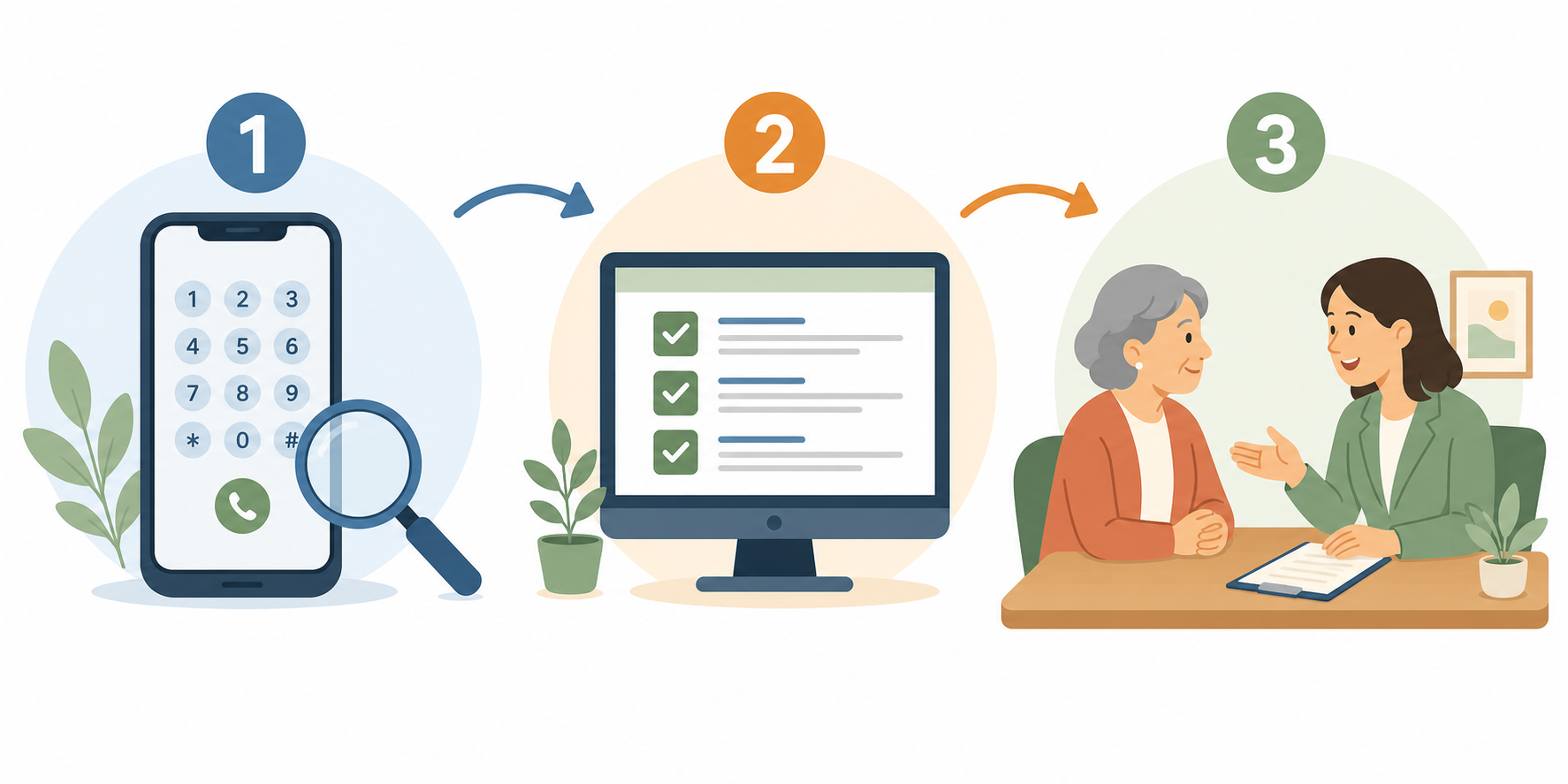
The information above can feel overwhelming. Here is a concrete, three-step action plan to get started today.
- Call the Eldercare Locator at 800-677-1116. This free, nationwide service connects you to your local Area Agency on Aging (AAA) and Aging and Disability Resource Center (ADRC). These are your primary entry points for OAA services, Medicaid HCBS waiver information, and local support programs.
- Use an online benefits screening tool. The National Council on Aging's BenefitsCheckUp (BenefitsCheckUp.org) and Benefits.gov allow you to answer a single set of questions and see which federal and state programs you may be eligible for. This is the fastest way to identify all potential programs at once.
- Contact your local ADRC for state-specific information. Your ADRC can tell you exactly what Medicaid HCBS waivers are available in your state, what the eligibility criteria are, and how to apply. They can also help with applications for other state and local programs.
Quick-Reference Program Comparison Table
Use the table below as a scannable reference to quickly identify which programs might apply to your situation. Print it out, keep it with your caregiving binder, and refer back to it as you work through applications.
| Program | Administering Agency | Eligibility Basis | Key Benefit (2026 Data) | How to Apply |
|---|---|---|---|---|
| SSI | Social Security Administration (SSA) | Age 65+ or disability + limited income/resources | Avg $735.91/mo; max $994/$1,491; auto-Medicaid | SSA office or ssa.gov; use BEST tool first |
| SSDI | Social Security Administration (SSA) | Disability + sufficient work credits | Avg $1,492.61/mo; max $4,152; Medicare after 24 mo | SSA office or ssa.gov; use BEST tool first |
| Medicare | Centers for Medicare & Medicaid Services (CMS) | Age 65+ or certain disabilities | Parts A, B, D; MSPs and Extra Help available | Social Security Administration; Medicare.gov |
| Medicaid / HCBS Waivers | State Medicaid agencies | Low income; state-specific criteria | Long-term care; home/community-based services | State ADRC or Medicaid office |
| Older Americans Act (OAA) | ACL/ACFC (via AAAs) | Age 60+ (no income test for most services) | Meals, transportation, caregiver support, legal aid | Eldercare Locator (800-677-1116) |
| PACE | State Medicaid agencies + CMS | Age 55+; need nursing-home level of care | Comprehensive medical and social services | Eldercare Locator or National PACE Association |
| VA Aid & Attendance | Department of Veterans Affairs (VA) | Veteran or surviving spouse; needs-based | Monthly pension increase for ADL help | VA regional office or va.gov |
| VA SAH Grant | Department of Veterans Affairs (VA) | Veteran with service-connected disability | Up to $126,526 for home modifications (FY2026) | VA regional office or va.gov |
| SNAP | USDA (via state agencies) | Low income and resources | Monthly food purchasing assistance | State SNAP office or Benefits.gov |
| Meals on Wheels / Congregate Meals | ACL/ACFC (via AAAs) | Age 60+; homebound for home-delivered | Nutritious meals; social contact | Eldercare Locator (800-677-1116) |
This guide is a starting point, not a substitute for professional advice. Eligibility rules, benefit amounts, and program availability change. Always verify current information with the administering agency or a qualified benefits counselor. For a broader perspective on why having a care plan matters, read The Planning Gap in Aging at Home: Why 90% of Seniors Want to Stay Put but Fewer Than 15% Have a Real Care Plan.
Questions to bring to a clinician or OT
This is not medical, legal, or a family's final decision — only a framework. Bring these questions to a clinician, occupational therapist, or your local Area Agency on Aging.
Find Local HelpRelated reading
- How to Pay for Senior Health Care Services: A Family Guide to Medicare, Medicaid, Private Pay, and Everything in Between
- The Overlooked Middle: Affordable Senior Housing Options for Seniors Who Don't Qualify for Medicaid but Can't Afford Private Assisted Living
- The Complete Guide to Home Helps for the Elderly: Services, Modifications, Technology, and Funding
Noticed something outdated or inaccurate on this page? Flag a correction. We review every report against CDC, NIA, and AARP HomeFit guidance before updating a page.