
Caregiver decision guide
Aging in Place vs. Assisted Living After a Fall: A Decision Guide for Adult Children
After a parent's fall, the decision between staying home and moving to assisted living is urgent and complex. This guide helps adult children match their parent's care needs to the right level of support, weighing safety, hidden costs, and caregiver capacity against the strong desire to age in place.
The Gap Between Wanting to Stay Home and Being Able To
The numbers are stark. According to a February 2026 Pew Research Center survey, 93% of U.S. adults aged 65 and older live in their own home or apartment. Among those living at home without a caregiver, 60% say they would want to stay in their home with someone caring for them if the need arose. Only 18% would prefer assisted living, and 11% would move in with family.
But here is where the gap opens: of those who prefer to stay home with care, only 37% say this outcome is extremely or very likely to happen. The desire to age in place is nearly universal. The confidence that it will actually work is not.
A parent's fall is the event that most often forces this gap into the open. Before the fall, aging in place was an abstract hope. After the fall, it becomes a concrete question of safety, logistics, and money — and the answer is rarely as simple as "we'll make the house safer."
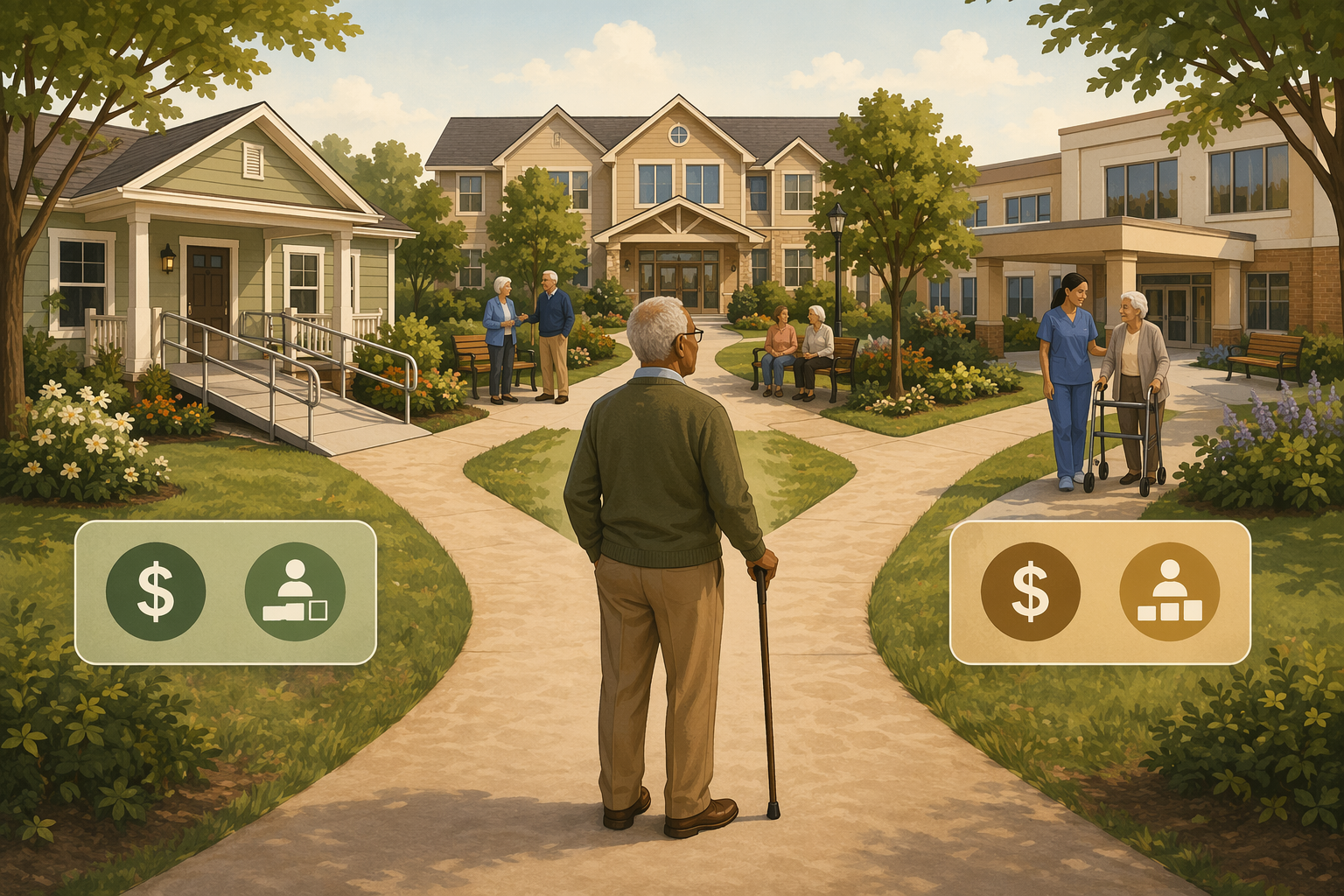
Why a Fall Changes Everything: The New Risk Reality
A single fall is not an isolated event. It is a signal. The CDC reports that more than 1 in 4 older adults falls each year. Falling once doubles the chances of falling again. Each year, falls among older adults result in approximately 3 million emergency department visits, 1 million hospitalizations, and 319,000 hip fractures. About 37% of those who fall report an injury requiring medical treatment or restricting activity for at least one day.
These numbers change the decision calculus. Before the fall, the question was "Can Mom stay home?" After the fall, the question becomes "Is it safe for Mom to stay home alone?" The difference is not semantic. It is the difference between a preference and a risk assessment.
- A fall is the most common reason older adults lose independent living status. The hospitalization itself often causes deconditioning that accelerates functional decline.
- Living alone after a fall is especially dangerous. If your parent cannot get up after a fall, hours or days on the floor can lead to dehydration, pressure injuries, and rhabdomyolysis — a serious condition that can cause kidney damage.
- The fear of falling again often leads to reduced activity, which weakens muscles and worsens balance, creating a downward spiral that increases fall risk further.
For readers who want immediate action steps, the Home Fall Prevention Checklist for Older Adults provides a room-by-room guide to reducing environmental hazards. But reducing hazards is only one part of the equation. The deeper question is whether the home environment can be made safe enough for a senior with declining mobility and increasing care needs — and at what cost.
Matching Care Needs to the Right Level of Support
The core decision framework is simple in concept but difficult in practice: the right choice depends on matching your parent's daily care needs to what each option can actually deliver. A senior who needs help with two or more activities of daily living (ADLs) — bathing, dressing, toileting, transferring, continence, feeding — and lives alone is in a fundamentally different risk category than a senior who is fully independent but unsteady on their feet.
Here is how the two options compare across the dimensions that matter most after a fall:
| Dimension | Aging in Place (with support) | Assisted Living |
|---|---|---|
| ADL assistance | Hourly home care ($34/hr national median, 2025 APFM data) or live-in care; coverage gaps when caregiver is unavailable | 24-hour staff availability; assistance with up to 2 ADLs included in base cost; additional fees for higher care levels |
| Fall detection and response | Depends on PERS device or family check-ins; response time varies; no guarantee someone can reach the senior quickly | Built-in alert systems; staff can respond within minutes; emergency protocols in place |
| Social engagement | Isolation risk, especially for seniors living alone; depends on family visits, community programs, or hired companionship | Structured activities, communal dining, and peer interaction built into daily life |
| Medication management | Family caregiver or hired aide manages; risk of missed doses or errors when caregiver is unavailable | Staff-managed medication administration; oversight by licensed nurses in most states |
| Meal preparation and nutrition | Meal delivery services, family cooking, or hired help; risk of skipped meals or poor nutrition when support is inconsistent | Three meals daily in communal dining; dietary accommodations available |
| Safety monitoring | Family or technology-based; no continuous professional oversight | 24-hour staff presence; security systems; wander prevention in memory care units |
| Cost (national median) | Home care $34/hr (APFM 2025); 20 hrs/week ~$2,944/month; plus modifications, utilities, and missed work wages | $5,419/month (APFM 2025); $70,800/year (Argentum 2026); includes housing, meals, activities, and basic care |
For a senior living alone with 2+ ADL deficits, assisted living's 24-hour staff and built-in safety features often provide a better match than aging in place with piecemeal support. The key word is "match." A senior who needs help with bathing and dressing but is otherwise independent may do well with 2-3 hours of home care per day. A senior who needs help with toileting, cannot reliably use a fall alert button, and lives alone faces risks that home care alone cannot fully address.
For a deeper look at facility types and what each offers, see the Senior Residential Homes: A Complete Decision Framework for Family Caregivers. That article covers the full spectrum of options. This guide focuses on the specific binary choice that families face after a fall.
The Hidden Costs of Staying Home That Families Don't See Coming
When families compare the cost of aging in place versus assisted living, they typically compare the obvious numbers: the monthly rent at a facility versus the cost of a few hours of home care per week. This comparison almost always makes aging in place look cheaper. But it misses the hidden costs that accumulate quietly and often exceed the assisted living price tag.
- Missed work wages. The average family caregiver spends $7,200+ per year in out-of-pocket costs, according to AARP research. For adult children who reduce work hours or leave jobs entirely, the lost income can be far higher — tens of thousands of dollars per year in foregone wages, retirement contributions, and career advancement.
- Piecemeal home modifications. Grab bars, ramps, stair lifts, walk-in tubs, widened doorways, and lighting upgrades are rarely done in one project. Families add modifications one at a time as needs change, and the cumulative cost can easily reach $10,000–$50,000 or more. The Complete Cost Guide to Aging-in-Place Remodeling breaks down specific costs for each modification type.
- Caregiver health impacts. Spousal caregivers and adult children who provide unpaid care experience higher rates of depression, anxiety, and chronic health conditions. The financial cost of treating these conditions — and the lost productivity they cause — is rarely counted in the aging-in-place budget.
- Uncoordinated services. Home care agencies, meal delivery, transportation services, medication management, and medical appointments each operate independently. Coordinating them falls on the family caregiver, who effectively works a second job managing logistics. The cost of that labor is invisible on a spreadsheet.
- Utility and maintenance costs. The senior's home still requires heating, cooling, electricity, water, property taxes, insurance, and maintenance. These costs continue regardless of whether the senior is fully independent or needs 24-hour care.
| Cost Category | Aging in Place (Monthly Estimate) | Assisted Living (Monthly Estimate) |
|---|---|---|
| Housing (rent/mortgage, taxes, insurance, utilities) | $1,200–$2,500 (varies widely by region) | Included in $5,419/month median (APFM 2025) |
| Home care (20 hrs/week at $34/hr) | $2,944 (APFM 2025 median) | Included in base cost for up to 2 ADLs |
| Home modifications (amortized over 5 years) | $200–$800 | Not applicable (facility already accessible) |
| Missed work wages / caregiver costs | $600–$3,000+ (varies by caregiver employment) | Not applicable |
| Meals and transportation | $500–$1,000 | Included |
| Medication management | $100–$300 (coordination cost) | Included |
| Total estimated monthly | $5,544–$10,544+ | $5,419 (median) |
For a deeper dive into the specific costs of aging in place, see What Does Aging in Place Actually Cost in 2026?. For live-in caregiver costs specifically, the How Much Does a Live-In Caregiver Cost in 2026? guide provides a full pricing breakdown.
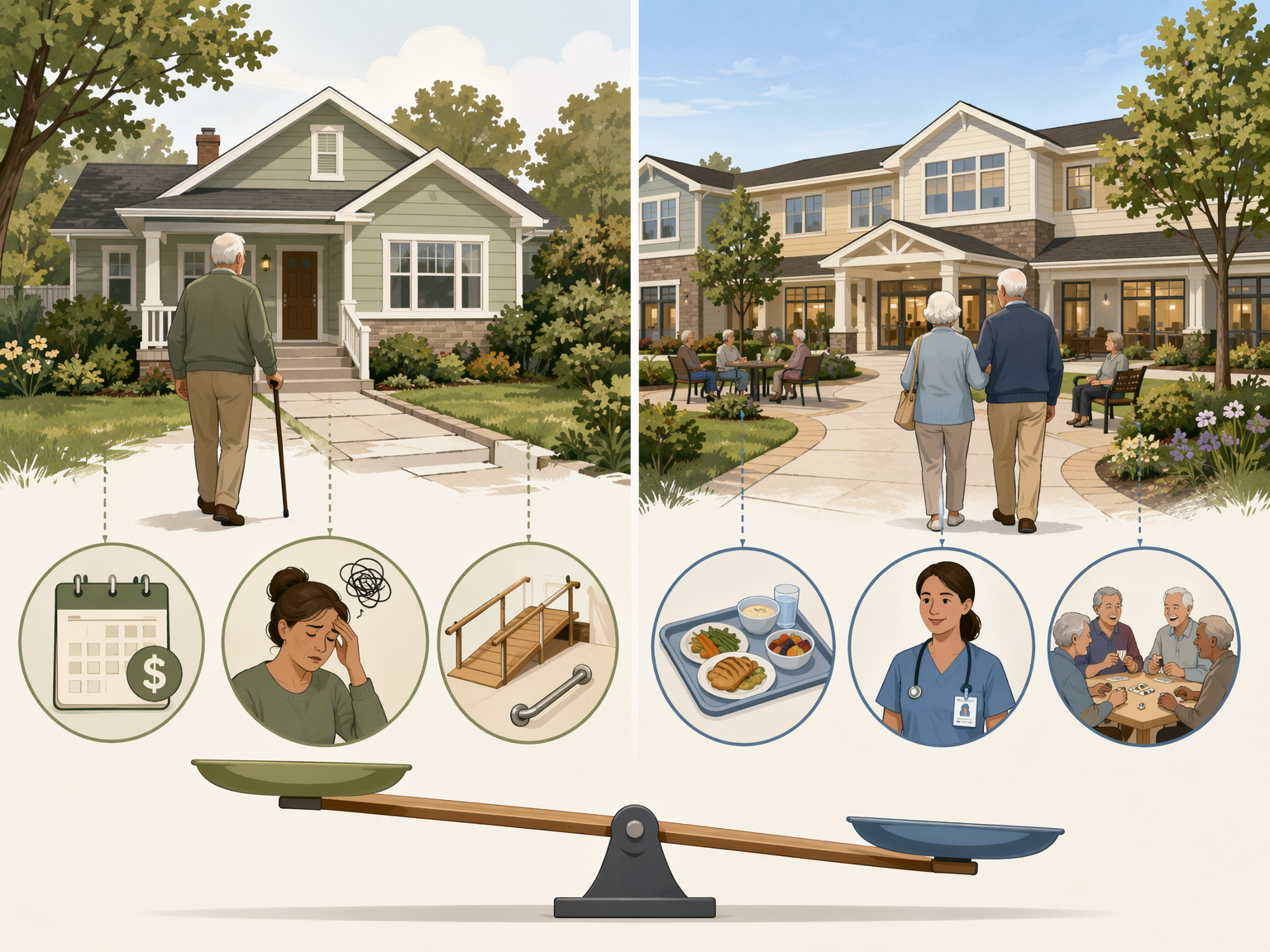
When Assisted Living Becomes the Safer — and More Cost-Effective — Choice
There are specific threshold conditions that tip the balance decisively toward assisted living. These are not preferences or lifestyle choices. They are safety and feasibility thresholds that, when crossed, make aging in place with home care alone a higher-risk proposition than most families should accept.
- The senior lives alone and has 2+ ADL deficits. Living alone compounds every risk. A senior who needs help with bathing and dressing but lives alone faces hours of unmet need each day, even with a few hours of home care. The gap between when the home care aide leaves and when the next person checks in is a window of vulnerability.
- The senior cannot reliably activate a fall alert system. If your parent cannot or will not wear a PERS button, cannot use a voice-activated device, or cannot reach a phone after a fall, the response time to a fall becomes unpredictable. In assisted living, staff respond within minutes.
- The primary family caregiver is experiencing burnout. The First 30 Days as a Family Caregiver guide covers the early stages, but caregiver burnout typically sets in after months or years of sustained effort. If the primary caregiver — often an adult child with their own job and family — is showing signs of exhaustion, resentment, or declining health, the current setup is not sustainable.
- The senior needs supervision that exceeds what home care can provide. Home care is typically scheduled in blocks of 2-8 hours. It does not provide overnight supervision, 24-hour monitoring, or immediate response to emergencies. A senior who wanders, is at high fall risk during the night, or needs frequent toileting assistance may need the continuous coverage that only a residential setting can provide.
- The cumulative cost of aging in place approaches or exceeds assisted living. When you add up home care hours, modifications, missed work wages, and caregiver health costs, the monthly total may equal or exceed the $5,419/month median for assisted living. At that point, the cost argument for staying home collapses.
According to Argentum's 2026 Value of Assisted Living report, nearly 1.4 million Americans live in more than 31,000 assisted living communities, with an average annual cost of $70,800. Every day, more than 10,000 Americans turn 65, and nearly 70% will need some form of long-term care, with one in five requiring professional care for five or more years. Assisted living is described by Argentum as the most cost-effective long-term care option for many seniors.
For families exploring home care funding options, the guide How to Pay for In-Home Care in 2026: 7 Funding Sources Families Need to Know covers the major funding sources, including Medicaid waivers, VA benefits, and long-term care insurance.
Your 30-to-60-Day Action Plan After a Fall
The weeks immediately after a fall are a critical window. Your parent may still be recovering in a hospital or rehabilitation facility, which gives you time to assess, plan, and visit options before a discharge decision is forced on you. Use this window deliberately.
- Assess ADL deficits (Days 1-7). Use a standardized ADL assessment tool or work with the hospital's occupational therapist to determine how many activities of daily living your parent needs help with. Be honest about what they can and cannot do alone. This assessment is the single most important input to the decision.
- Calculate the true monthly cost of the current setup (Days 7-14). Include home care hours, modifications already made or planned, utility and maintenance costs, transportation, and your own missed work wages. Compare this total to the all-inclusive monthly cost of assisted living in your area.
- Tour 2-3 assisted living communities (Days 14-21). Visit during meal times and activity hours, not just during scheduled tours. Observe the staff-to-resident ratio, the condition of common areas, and how residents interact. Ask about their fall prevention protocols, emergency response times, and policies for residents who need more than 2 ADLs of assistance.
- Consult with an elder law attorney (Days 14-30). An elder law attorney can help you understand Medicaid eligibility, VA benefits, and asset protection strategies. This is especially important if your parent may need to spend down assets to qualify for Medicaid coverage of long-term care.
- Involve your parent in the decision (Ongoing). The goal is not to make the decision for your parent but to arrive at a shared understanding of what safe aging looks like. Use the conversation guide in the next section to navigate this difficult discussion.
For a comprehensive onboarding guide for new caregivers, see The First 30 Days as a Family Caregiver: A Step-by-Step Onboarding Guide. That guide covers the practical steps of setting up care coordination, medication management, and communication systems — all of which apply whether your parent stays home or moves to assisted living.
Making the Decision Together: A Conversation Guide
The goal of this conversation is not to "win" an argument. It is to arrive at a shared understanding of what safe aging looks like and to make a decision together that respects your parent's autonomy while honestly addressing the risks.
- Start with their values, not the logistics. Ask: "What matters most to you about where you live?" Listen to the answer without immediately countering with safety concerns. Your parent may value privacy, routine, or proximity to friends. Understanding these values helps you frame the assisted living option in terms that resonate.
- Use data, not emotion. Instead of saying "I'm worried about you falling again," say "The CDC reports that more than 1 in 4 older adults falls each year, and falling once doubles the risk of falling again. Let's look at what that means for your safety here at home." Data is less confrontational than emotion.
- Frame assisted living as a solution, not a surrender. Instead of "You can't stay here alone," try "What if there was a place where you'd have help when you need it, meals prepared, and people to talk to — and you could still decorate your own room and come and go as you please?"
- Acknowledge the loss. Moving from a home of 30+ years to a single room is a genuine loss, even if the new setting is safer and more social. Say: "I know this is hard. You've built a life here, and leaving it feels like losing a part of yourself. I'm not asking you to stop being independent. I'm asking you to let us find a way for you to be safe and independent at the same time."
- Take the decision in stages. You do not need to decide everything in one conversation. Start with a tour. Then discuss. Then visit again. The decision to move to assisted living can take weeks or months. Rushing it creates resistance.
Ultimately, the decision between aging in place and assisted living after a fall is not about which option is better in the abstract. It is about which option is safer, more sustainable, and more aligned with your parent's actual daily needs. The data is clear: most older adults want to stay home, but many cannot do so safely without a level of support that exceeds what most families can provide. The courage to have the honest conversation — and to act on what it reveals — is the most important thing you can do for your parent's safety and your own wellbeing.
Questions to bring to a clinician or OT
This is not medical, legal, or a family's final decision — only a framework. Bring these questions to a clinician, occupational therapist, or your local Area Agency on Aging.
Find Local HelpRelated reading
Noticed something outdated or inaccurate on this page? Flag a correction. We review every report against CDC, NIA, and AARP HomeFit guidance before updating a page.