
Caregiver decision guide
How to Evaluate a Restaurant for Senior Accessibility
A practical 10-point framework helps family caregivers assess any restaurant's suitability for an older adult with mobility, sensory, or cognitive needs, and a brief phone-screening script can eliminate most unsuitable venues before a visit.
Search results for accessible restaurants for seniors review are often too cheerful for the job they are supposed to do. A listing may say “wheelchair accessible,” a reviewer may give five stars, and the restaurant may still be a poor choice for an older adult who uses a walker, hears best in a quiet room, needs a readable menu, or becomes disoriented when the restroom is hidden behind a crowded bar.
The better starting point is not a restaurant list. It is a repeatable way to judge any restaurant before the outing turns into a test of everyone’s patience. ADA measurements help because they give caregivers something concrete to ask about: table height, knee clearance, clear floor space, and accessible seating. But a meal can meet a legal threshold and still fail the person sitting there. The useful question is simpler: can your parent arrive, sit, order, converse, use the restroom, and leave without the restaurant making each step harder than it needs to be?
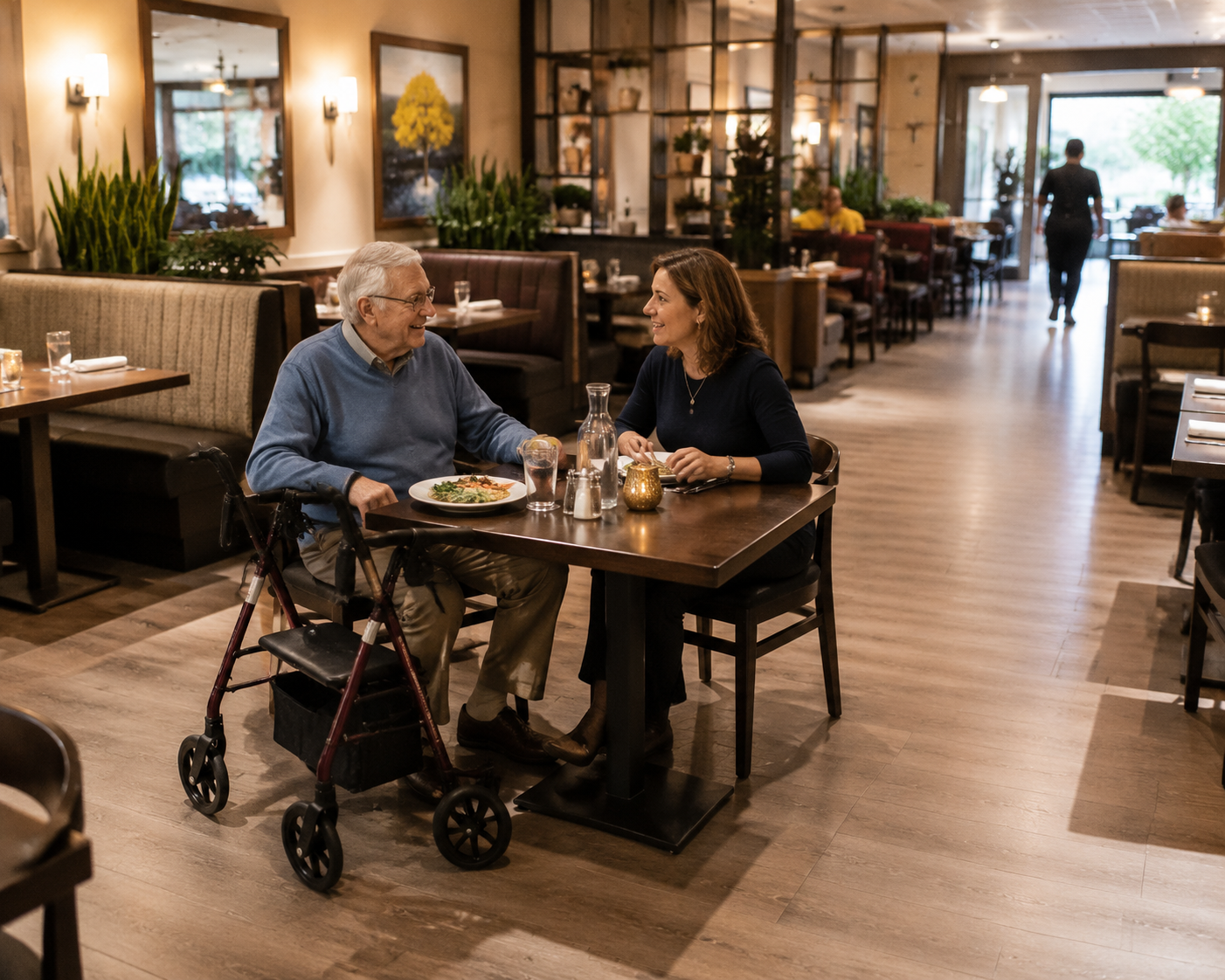
Use this five-question phone screen before you drive
A short call does not need to be awkward. The goal is not to interrogate the host; it is to find out whether the restaurant can support the visit in real time. Call during a quieter part of the day if possible, not in the middle of dinner rush.
- “Is there any step, raised threshold, or heavy door between the parking/drop-off area and the dining room?”
- “Can you seat us at a table where a walker or wheelchair can get through without squeezing between chairs?”
- “Do you have a table with enough space underneath for knees or wheelchair footrests, not just a booth?”
- “Is the restroom on the same level, and is the route to it clear during service?”
- “Can we reserve a quieter, well-lit table and get a large-print menu or have the menu read aloud if needed?”
Listen less for perfect wording and more for practical competence. “Yes, we can remove a chair before you arrive” is more useful than “we’re accessible.” “Our restroom is technically accessible, but the hallway gets tight after 6:30” is not a failure; it is information you can plan around. Vague reassurance is the answer that should make you cautious.
Why the usual accessibility clues are not enough
Digital tools can help narrow the field. ROLLIN, for example, reports more than 100,000 venues across 16 states and scores places on a 0–100 scale using factors such as wheelchair entry, level entry, accessible restrooms, wide aisles, parking, and lighting. Its limits matter too: it is iOS-only and not nationwide, so it is useful where available but cannot be the whole plan.[1]
Ordinary review sites are even patchier. Many reviewers notice food, price, and service speed; fewer describe the slope of the entry, the weight of the door, the distance from the table to the restroom, or whether the room is so loud that an older adult with hearing loss gives up on conversation. That missing detail is exactly where a caregiver’s day can fall apart.
This is not a niche concern. ADA.gov cites an Open Doors Organization study from 2003 reporting that 75% of people with disabilities ate out at least weekly and that disabled diners spent $35 billion annually in restaurants. The figures are dated, and restaurant spending has changed since then, so they should not be treated as current market sizing. They still make one point plainly: accessible dining is not a rare special request. ADA.gov also notes that almost 42% of adults 65 and older have one or more disabilities, and that the U.S. population age 65 and older was projected to reach 69 million by 2030.[2]
The 10-point restaurant accessibility review
Review the restaurant in the order your parent will experience it. That keeps the focus on the outing itself, not on an abstract compliance label.
| Check | What to look for | Caregiver question |
|---|---|---|
| 1. Parking and drop-off | Close accessible parking, curb cuts, safe drop-off, even pavement | Can my parent get from car to entrance without rushing or crossing a risky path? |
| 2. Entrance | Ramp or level entry, no surprise step, manageable slope, visible signage | Is the entrance truly usable, or only technically reachable? |
| 3. Door and threshold | Wide doorway, low or flush threshold, door that is not too heavy | Can we get through without needing a stranger to rescue us? |
| 4. Interior pathway | Clear route through host stand, bar area, aisles, and chair backs | Can a walker move through when the restaurant is actually busy? |
| 5. Table and seating fit | Table height, knee clearance, removable chair, non-isolated seating | Can my parent sit comfortably with dignity, not tucked away as an afterthought? |
| 6. Restroom access | Same-level restroom, clear route, turning space, grab bars where needed | Can my parent reach and use the restroom without a maze of chairs? |
| 7. Sound | Lower music, softer room, distance from bar or kitchen, ability to hear staff | Can we have a conversation without shouting or guessing? |
| 8. Lighting | Even lighting, low glare, enough brightness to read and walk safely | Can my parent see the menu, floor changes, and faces? |
| 9. Menu readability | Large print, simple layout, online menu that can be enlarged, staff willing to read options | Can my parent choose food without feeling hurried or embarrassed? |
| 10. Staff and timing | Calm response, willingness to reserve the right table, slower service window | Does the restaurant know how to make the meal easier before we arrive? |
1. Parking and drop-off
The review starts before the front door. A restaurant can have an accessible entrance and still be a poor fit if the only parking is across a busy lot, if the curb cut is hard to find, or if the pavement between the car and door is uneven. For an older adult using a walker, those first fifty feet can decide the mood of the whole meal.
When you call, ask about drop-off as well as parking. A safe drop-off near the entrance can matter more than a technically marked accessible space at the far edge of the lot. If your parent tires quickly, the best plan may be to drop them with another family member at the door, park separately, and avoid spending their energy before lunch even begins.
2. Entrance
“There’s a ramp” is only the beginning. Look for whether the ramp route is obvious, whether the surface is smooth, whether there is a handrail if needed, and whether the ramp leads to the same entrance everyone else uses. A side entrance through a service corridor may be better than no access, but it changes the dignity of arrival.
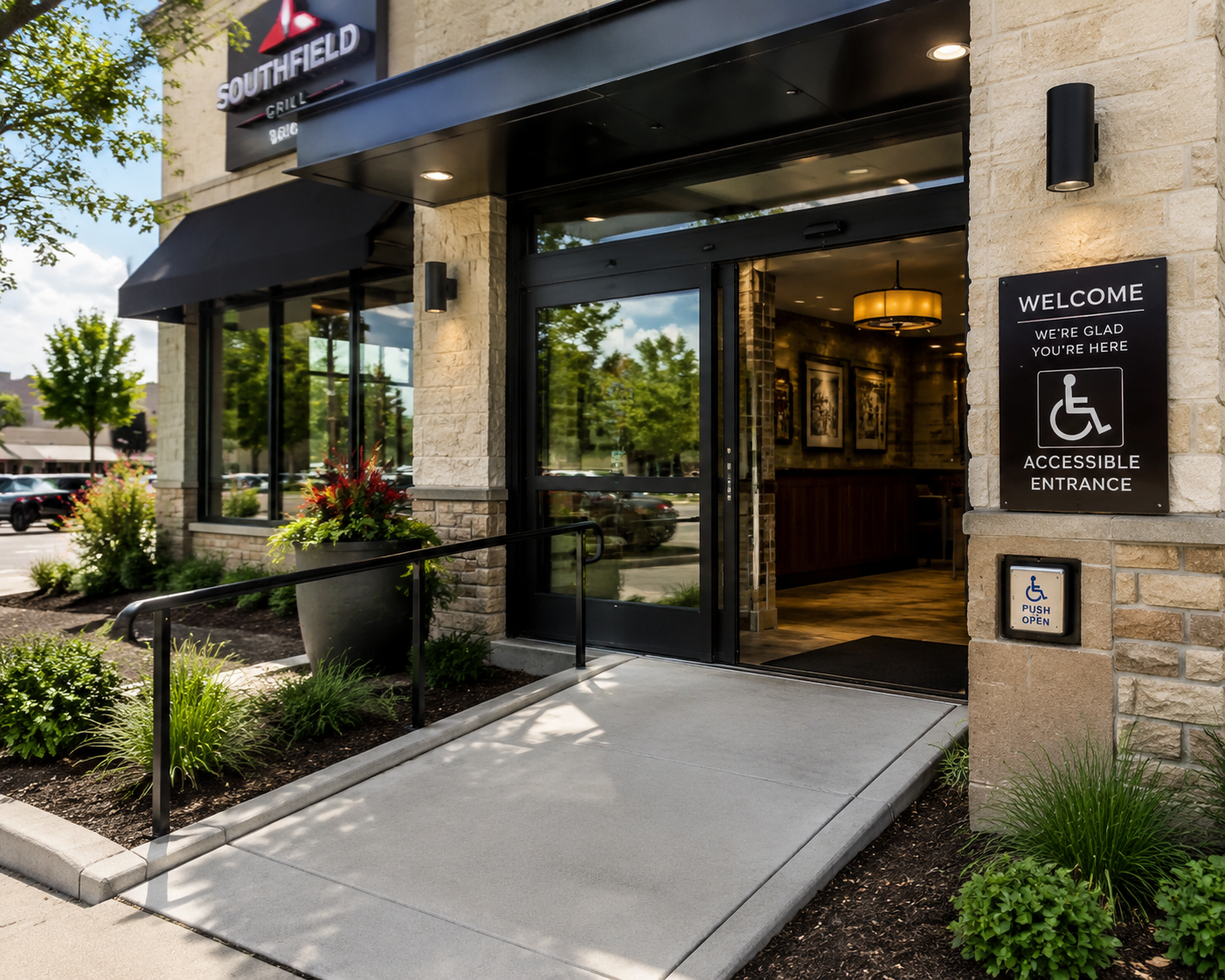
The best entrances are uneventful. No one has to hunt for a staff member. No one has to lift the walker. No one has to announce a disability at the host stand before being allowed in.
3. Door and threshold
A heavy door can undo a good ramp. So can a raised threshold that catches a walker wheel. If your parent uses a wheelchair, scooter, or rollator, ask whether the doorway and threshold are easy to pass through without staff having to lift, tilt, or push the device.
This is where online photos can help. Look closely at entrance pictures on Google Maps or the restaurant’s own site. If you see a step, a narrow vestibule, a tall sill, or a decorative mat bunched at the doorway, call before you commit.
4. Interior pathway
A clear path at 3:00 p.m. may disappear at noon. The host stand, waiting area, bar stools, stroller parking, chair backs, server stations, and coat racks all compete for the same space. The question is not whether a wheelchair could theoretically enter an empty dining room. It is whether your parent can move through the restaurant while people are sitting, eating, and standing up.
The Disabled Foodie’s review system gives this issue the attention it deserves by assessing entrance, bathroom, walkways and aisles, staff treatment, and menu access, including Braille menus. That structure is useful because it follows the actual friction points a diner encounters, rather than stopping at the front door.[3]
5. Table and seating fit
Accessible seating is not just a table near the entrance. ADA guidance for food service includes dining surfaces 28 to 34 inches high, at least 27 inches of knee clearance, clear floor space of 30 by 48 inches, and accessible seating dispersed across the dining area rather than isolated in one inferior spot. At least 5% of seating must be accessible.[4]
Translate those numbers into the moment at the table. Can your parent’s knees fit underneath? Can a wheelchair footrest clear the table base? Can a walker be parked without becoming a trip hazard? Is the chair stable and easy to rise from? A high-top table, a fixed booth, or a pedestal base may look ordinary to everyone else and still make the meal unworkable.
There is also a social piece. A table that is “accessible” only because it is beside the restroom hallway or separated from the rest of the family may solve a measurement problem while creating a dignity problem. When reserving, ask for a regular dining table with a removable chair and enough side clearance.
6. Restroom access
Restroom access is where many outings become stressful because the problem appears after everyone has already ordered. Ask whether the restroom is on the same level as the dining room. Then ask whether the path stays clear during service. A restroom can have grab bars and still be functionally out of reach if the route runs through a tight line of chairs.
For parents with early cognitive changes, the route matters as much as the fixture. Clear signage, a direct path, and staff who can give simple directions reduce confusion. Dementia-friendly restaurant guidance emphasizes clearer signage, patient communication, reduced sensory overload, and staff training; those features also help many older adults who do not have a dementia diagnosis but need a calmer, more legible environment.[5]
7. Sound
Noise is not a small preference when an older adult has hearing loss. Alzheimer Calgary’s dementia-friendly restaurant guide flags noise levels above 70 dB as especially problematic for older adults with hearing loss and as a possible source of confusion and disorientation for people with cognitive decline.[5]
That number gives you a practical rule: avoid the loudest room, the bar side, the open kitchen, the speaker, and peak brunch if conversation is the point of the meal. If you use a phone sound meter app, treat it as a rough clue rather than a medical instrument. You are not trying to publish an acoustic study. You are trying to learn whether your father will still be talking after ten minutes.
8. Lighting
Restaurants often dim lights to create atmosphere. For an older adult with low vision, that atmosphere can turn the menu into a blur and the floor into guesswork. Glare is the other problem: bright windows, polished floors, mirrored walls, and bare bulbs can make it harder to see edges and faces.
Ask for a table with even light, not necessarily the brightest table in the room. If your parent reads lips or depends on facial cues, seat them where faces are visible and backlighting is limited. If they are unsteady, avoid dramatic lighting changes between the dining room and restroom.
9. Menu readability and ordering
A menu can be inaccessible without looking unusual: small gray type, glossy paper, low contrast, QR-only ordering, seasonal inserts, or a server who recites specials too quickly. The practical fix is to reduce pressure at the table.
- Check the online menu at home and enlarge it if needed.
- Ask whether a large-print menu is available.
- Choose two or three likely options before arrival if decision fatigue is an issue.
- Tell the server, simply, “We may need an extra minute with the menu.”
Family caregiving often involves preparing without making the outing feel over-managed. Looking at the menu ahead of time is one of those quiet supports. It preserves choice while taking away the scramble.
10. Staff awareness and timing
Staff do not need to be perfect. They do need to be willing, calm, and specific. A good host understands why a removable chair matters. A good server does not lean over your parent and ask you what they want to eat. A good manager can say which dining period is quieter instead of pretending every time is the same.
A Disability Horizons profile of The Disabled Foodie’s accessible restaurant picks described Boulud Sud in New York City as a strong example of proactive accommodation: staff removed a chair before arrival for wheelchair access, reserved a quieter table, and had a large-print menu ready. Not every restaurant must imitate that exact setup. What matters is that the work happened before the diner had to ask for rescue in the middle of the room.[3]
Timing is part of staff awareness. A restaurant that is difficult at 7:00 p.m. may be very workable at 11:30 a.m. or 4:30 p.m. If your parent moves slowly, hears better in quiet spaces, or needs help reading the menu, an off-peak reservation can be the difference between a pleasant meal and a tense one.
How to combine digital clues, the phone call, and your own review
Start online, but do not end there. Photos may reveal the entrance, table spacing, lighting, flooring, and whether most seating is booths or high-tops. Reviews may mention loud music or crowded aisles even when they are not written as accessibility reviews. Apps such as ROLLIN can add structured accessibility data where they have coverage.[1]
Then call. Use the five questions, and be honest about the need without overexplaining your parent’s medical history. “My father uses a walker and hears best in a quieter area” gives the restaurant enough information to help. If the person on the phone cannot answer, ask when a manager will be available.
After the visit, make your own note while the details are fresh: which entrance worked, where you sat, whether the restroom route was manageable, what time was quiet, and which staff member helped. That note becomes more reliable than a star rating the next time you want lunch to feel like lunch.
Restaurant outings also belong inside a broader care plan, not as a luxury after every “serious” task is handled. If you are already thinking through transportation, home safety, and social connection, this framework fits naturally alongside an aging in place home care plan. If you are hosting an older relative at home and also choosing where to eat out, the same habit applies: remove the avoidable obstacles before the day becomes tiring. The companion guide on hosting an elderly guest takes that same practical view inside the home.
Printable-style checklist for your next reservation
- Parking/drop-off: close, safe, level enough, and not rushed.
- Entrance: no surprise step; ramp or level route is easy to find.
- Door/threshold: wide, smooth, and not dependent on a heavy pull.
- Pathway: walker or wheelchair can move through when the room is occupied.
- Table: 28–34 inches high, at least 27 inches of knee clearance, and enough clear space to sit without being isolated.[4]
- Restroom: same level if possible, clearly signed, and reachable through an uncluttered route.
- Sound: quiet enough for conversation; avoid rooms likely to exceed a comfortable level for hearing or cognition.[5]
- Lighting: bright enough to read and walk, without harsh glare.
- Menu: readable format, online preview, large print, or patient staff support.
- Staff/timing: specific answers, willingness to reserve the right table, and an off-peak option if needed.
The best restaurant is not always the one that looks most compliant in a search filter. It is the one where the practical pieces line up: arrival, seating, ordering, conversation, restroom access, and departure. A structured review will not make every outing perfect, but it can keep a hopeful lunch from becoming hidden work no one warned you about.
References
- ROLLIN app, ROLLIN.
- Expanding Your Market: Customers with Disabilities Mean Business, ADA.gov.
- The Disabled Foodie's Top 5 NYC Accessible Restaurants, Disability Horizons, 2025.
- Food Service: Accommodating Diners with Disabilities, ADATA.org.
- A Guide to Dementia-Friendly Restaurants and Public Spaces, Alzheimer Calgary.
Questions to bring to a clinician or OT
This is not medical, legal, or a family's final decision — only a framework. Bring these questions to a clinician, occupational therapist, or your local Area Agency on Aging.
Find Local HelpRelated reading
Noticed something outdated or inaccurate on this page? Flag a correction. We review every report against CDC, NIA, and AARP HomeFit guidance before updating a page.