
Caregiver decision guide
Home Care vs. Assisted Living vs. Nursing Home: A 2026 Cost Comparison and Decision Guide for Families
This guide helps adult children compare the true costs of home care, assisted living, and nursing homes in 2026. It provides a state-by-state cost breakdown, explains what each option covers, and offers a decision matrix to match your parent's needs to the right level of care.

The Three-Care Pathway Decision: Home Care, Assisted Living, or Nursing Home
When an older adult can no longer manage independently, families typically face three structured options: bring paid help into the home, move to an assisted living community, or transition to a nursing home. Each pathway serves a different level of need, and the cost relationship between them is not what most people assume.
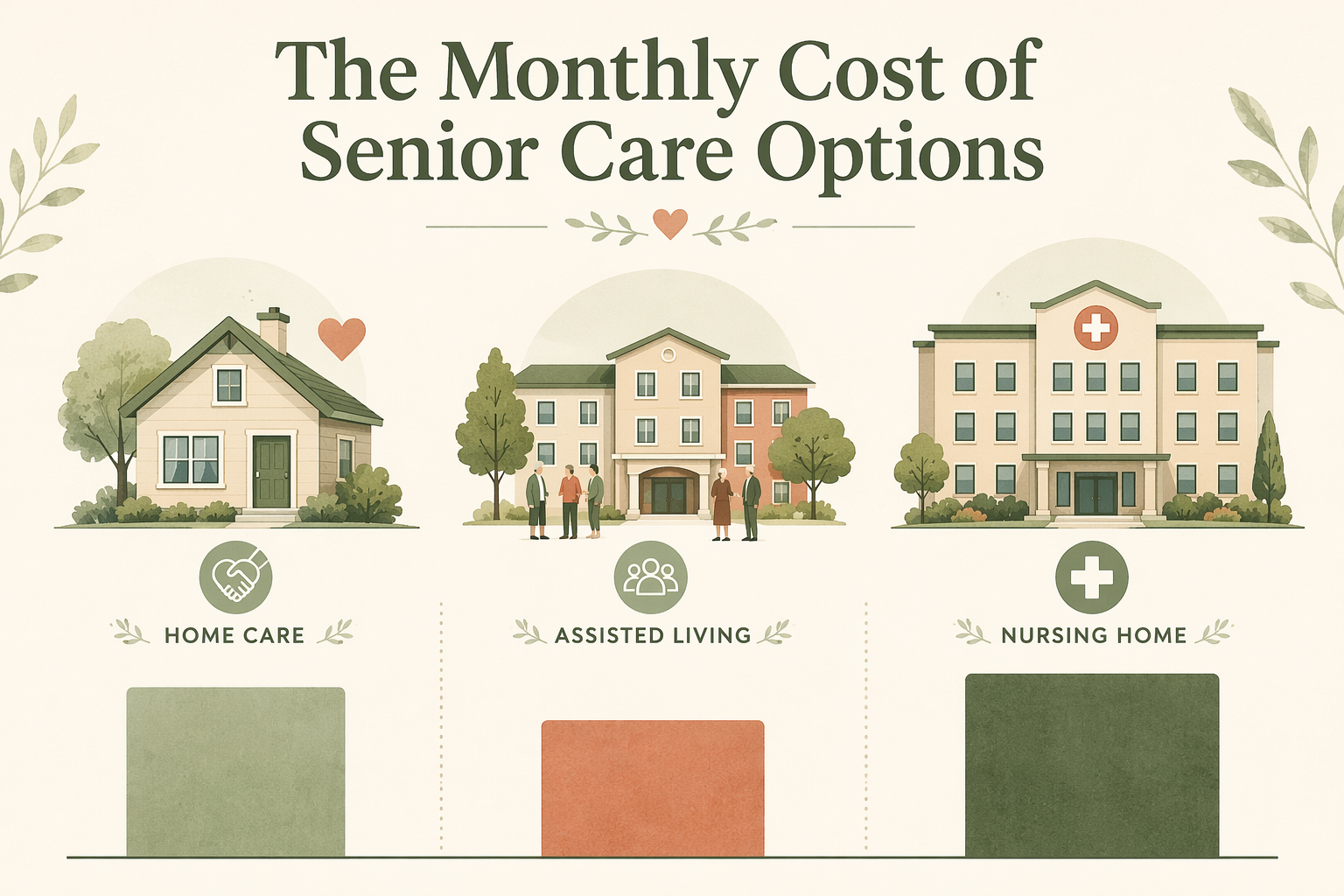
The common intuition is that home care is the cheapest option because it avoids facility overhead. The 2026 data tells a different story. Full-time home care — defined as roughly 44 hours per week of non-medical personal assistance — carries a national median cost of $6,478 per month, according to A Place for Mom citing Genworth 2025 data. That is higher than the median for assisted living, which SeniorLiving.org reports at $6,313 per month in 2026. Nursing homes remain the most expensive by a wide margin, with a private room costing $11,294 per month nationally.
This guide is built around that cost differential — not because money is the only factor, but because the financial picture is often the first thing families get wrong. Once you understand the true monthly range, you can weigh it against the services each option provides, the medical care it can deliver, and the trade-offs in independence, safety, and social connection that matter most to your parent.
2026 Cost Comparison: National Median Monthly Rates
The table below presents the national median monthly costs for each care pathway, drawn from the most current 2026 survey data available. These are national medians — actual costs in your area may be significantly higher or lower, particularly for nursing homes, where state-level variation is extreme.
| Care Option | Monthly Cost (Median) | Annual Cost (Median) | Data Source & Year |
|---|---|---|---|
| Home Care (44 hrs/wk) | $6,478 | $77,736 | A Place for Mom / Genworth 2025 |
| Assisted Living | $6,313 | $75,756 | SeniorLiving.org May 2026 |
| Assisted Living (alternate source) | $5,190 | $62,280 | A Place for Mom proprietary 2025 |
| Nursing Home, Semiprivate Room | $9,842 | $118,104 | SeniorLiving.org May 2026 |
| Nursing Home, Private Room | $11,294 | $135,528 | SeniorLiving.org May 2026 |
Several patterns stand out. First, full-time home care is not the budget option — it costs slightly more than assisted living at the national median, and significantly more than the lower-end assisted living estimate from A Place for Mom ($5,190/month). Second, the gap between a semiprivate and private nursing home room is roughly $1,450 per month, or about $17,400 annually. Third, nursing home costs are rising 7–9% annually nationwide, according to SeniorLiving.org, which means the gap between facility-based care and home-based care is widening each year.
For a broader comparison that includes additional dimensions like quality of life, location convenience, and family satisfaction, see our full side-by-side comparison of home care, assisted living, and nursing homes.
State-by-State Cost Ranges for Nursing Homes
National medians obscure enormous geographic variation. Nursing home costs in particular vary by a factor of more than five across states, driven by differences in labor costs, real estate, Medicaid reimbursement rates, and state regulatory requirements.
| State | Semiprivate Room (Monthly) | Private Room (Monthly) |
|---|---|---|
| Texas | $5,808 | $6,750 |
| Missouri | $6,200 | $7,100 |
| Ohio | $7,500 | $8,400 |
| Florida | $8,900 | $10,200 |
| California | $10,500 | $12,800 |
| New York | $12,800 | $14,500 |
| Alaska | $32,220 | $35,000 |
The range is striking: a semiprivate room in Texas costs $5,808 per month, while the same level of care in Alaska runs $32,220 per month — a difference of over $26,000 per month. Most states fall between $7,000 and $13,000 for a semiprivate room, but families in high-cost states like New York, California, and Massachusetts should expect to pay well above the national median.
State-level cost data for assisted living and home care is less standardized and not available from the same survey sources. Assisted living costs tend to vary less dramatically than nursing homes — typically ranging from $3,500 to $8,000 per month depending on the state and level of care — but the absence of a centralized federal reporting system makes apples-to-apples comparisons difficult. For local cost data, consult your state's department of health or aging services, or use the cost calculator tools available on SeniorLiving.org and A Place for Mom.
What Each Option Covers: Services, Staffing, and Medical Care
Cost only tells part of the story. The services, staffing ratios, and medical capabilities embedded in that monthly fee differ substantially across the three pathways. Understanding what you are — and are not — paying for is essential to making a fair comparison.
| Dimension | Home Care | Assisted Living | Nursing Home |
|---|---|---|---|
| Typical services | Personal care (bathing, dressing, toileting), meal prep, light housekeeping, medication reminders, companionship | Private or semi-private apartment, meals, personal care, medication management, social activities, 24-hour supervision | Private or semi-private room, all meals, skilled nursing care, rehabilitation therapy, medication administration, 24-hour medical monitoring |
| Staffing standard | No federal standard; caregiver training varies by state and agency | State-regulated; no federal staffing standard; requirements vary widely by state | Federally regulated by CMS; minimum ~3.5 hours of nursing care per resident per day (CMS 2024 rule) |
| Medical care | Non-medical only; cannot provide skilled nursing, wound care, or IV medications | Limited; medication management and coordination with outside providers; no 24/7 skilled nursing on-site typically | Full skilled nursing care, physician oversight, rehabilitation (PT/OT/speech), wound care, IV therapy |
| Physician recommendation required? | No | No | Yes — a physician must certify the need for skilled nursing care |
| Typical length of stay | Ongoing; can last years with increasing hours | Ongoing; average stay ~22 months | Short-term rehab (weeks to months) or long-term custodial care (years) |
The key takeaway: home care provides personal assistance but no medical care. Assisted living bridges the gap with supervision and medication management but typically lacks on-site skilled nursing. Nursing homes are the only option equipped to handle complex medical needs, post-hospital rehabilitation, and around-the-clock monitoring. If your parent has a chronic condition requiring regular nursing interventions — diabetes management, wound care, feeding tube support — a nursing home may be the only appropriate setting regardless of cost.
Who Pays? Understanding Your Payment Options
How you pay for care depends heavily on which pathway you choose. The payment landscape is fragmented, and assuming that Medicare or private insurance will cover long-term care is one of the most common — and costly — mistakes families make.
- Medicare: Medicare Part A covers short-term skilled nursing facility (SNF) stays only after a qualifying inpatient hospital stay of at least three days. In 2026, days 1–20 are covered at $0 after the $1,736 Part A deductible; days 21–100 require a $217/day copay; after 100 days, all costs are the patient's responsibility. Medicare does not cover long-term custodial care in a nursing home, and it does not cover assisted living at all. It also does not cover non-medical home care, though it may cover home health services (skilled nursing, physical therapy) on a part-time, intermittent basis.
- Medicaid: Medicaid is the primary payer for long-term nursing home care in the United States. Nationally, Medicaid paid for an average of 82 cents per dollar spent on nursing home care, according to AHCA/NCAL data cited by SeniorLiving.org. Eligibility is based on income and assets, and thresholds vary significantly by state. For assisted living, Medicaid coverage varies by state — some states offer Medicaid waivers that cover assisted living costs for eligible individuals, while others do not. Home care may be covered through state-specific Medicaid home and community-based services (HCBS) waivers, but availability and waitlists vary.
- Long-Term Care Insurance: Policies vary widely in what they cover, daily benefit amounts, elimination periods, and inflation protection. Most policies cover nursing home care, assisted living, and home care, but the specific terms depend on the policy. If your parent has a policy, review it carefully with a geriatric care manager or elder law attorney to understand the benefit triggers and caps.
- Private Pay: The majority of assisted living residents and home care recipients pay out of pocket. Private pay is also common for the first months or years of nursing home care before Medicaid eligibility is established. Families often use a combination of savings, Social Security income, pension income, and proceeds from the sale of a home.
- VA Benefits: Veterans and surviving spouses may qualify for the VA Aid and Attendance benefit, which provides a monthly pension supplement that can be used toward home care, assisted living, or nursing home costs. The VA also operates its own nursing homes (Community Living Centers) and offers contracts with community nursing homes and assisted living facilities through the Veterans Directed Care program.
For a deeper dive into each payment source, including state-specific Medicaid eligibility thresholds and VA Aid and Attendance application steps, see our complete 2026 guide to paying for senior care.
The Trade-Off Framework: Beyond the Dollar Sign

A cost comparison alone cannot tell you which option is right for your family. The decision requires weighing several non-financial factors that are equally important — and often more emotionally charged.
- Independence vs. Safety: A 2022 University of Michigan poll cited by AARP found that 88% of adults ages 50–80 want to live in their own homes as long as possible. Yet only 15% had given a lot of consideration to the home modifications needed to make that safe, and just 19% were confident they could afford to hire help. Home care preserves independence and familiarity but may not provide the safety net that a 24-hour supervised setting offers — especially for someone at high risk of falls or wandering.
- Socialization vs. Familiarity: Assisted living communities offer built-in social engagement — group meals, activities, and peer interaction — that can combat isolation and depression. Staying at home, even with paid caregivers, can be lonely. On the other hand, moving to a facility means leaving behind a neighborhood, a church community, and decades of memories. For some older adults, the social benefits of assisted living outweigh the emotional cost of relocation. For others, the opposite is true.
- Caregiver Strain vs. Professional Care: Home care shifts the physical burden from family members to paid professionals, but it does not eliminate the managerial burden. Families still coordinate schedules, supervise care quality, manage payroll (if hiring privately), and handle emergencies. Assisted living and nursing homes transfer both the physical and managerial burden to the facility, but at the cost of reduced family control over day-to-day care.
- Cost vs. Care Intensity: A parent who needs only 10–15 hours of help per week may be far cheaper at home than in any facility. But a parent who needs 24-hour supervision, has complex medical needs, or is at high risk for falls may find that home care costs exceed assisted living — and that neither provides the medical capability of a nursing home. The breakeven point between aging in place and moving to a facility depends on hours of care needed, local labor costs, and the parent's medical complexity.
If you are trying to determine whether staying home is financially sustainable, our breakeven analysis for aging in place vs. assisted living walks through the specific calculations, including home modification costs, utility increases, and the hidden expenses of coordinating care.
Decision Matrix: Choose Home Care If…, Choose Assisted Living If…, Choose a Nursing Home If…
The following matrix translates the cost data, service comparisons, and trade-off framework into actionable guidance. Use it to match your parent's specific circumstances to the most appropriate care pathway.
| Choose This Option If… | Home Care | Assisted Living | Nursing Home |
|---|---|---|---|
| Level of care needed | Help with 2–3 ADLs (bathing, dressing, meal prep) but no skilled nursing needs | Help with 3–4 ADLs plus medication management and 24-hour supervision, but no daily skilled nursing | Complex medical needs: post-hospital rehab, wound care, IV therapy, feeding tube, or 24/7 skilled nursing monitoring |
| Monthly budget | Under $6,500/month for part-time care (under 44 hrs/wk); may exceed $6,500 for full-time care | $5,200–$6,300/month median; may be lower than full-time home care in many markets | $9,800–$11,300/month median; Medicaid may cover costs for eligible individuals |
| Safety concerns | Low fall risk; home is already modified or can be modified affordably; no wandering risk | Moderate fall risk; needs 24-hour supervision but not skilled nursing; wandering is a concern but facility can manage with locked units | High fall risk, advanced dementia with wandering, or medical instability requiring immediate nursing response |
| Social engagement | Parent prefers solitude or has strong local social network (family, friends, church); may become isolated without structured activities | Parent is lonely at home and would benefit from group meals, activities, and peer interaction | Social engagement is secondary to medical needs; facility may offer activities but medical care is the primary function |
| Family involvement | Family lives nearby and can supervise care, handle coordination, and provide backup | Family lives at a distance or cannot provide daily oversight; facility handles coordination | Family cannot provide any care and parent needs 24/7 skilled monitoring |
| Cognitive status | Mild cognitive impairment or early-stage dementia; can be left alone safely for periods | Moderate dementia; needs supervision but not yet at the stage of frequent wandering or aggression | Advanced dementia, frequent wandering, aggression, or other behavioral symptoms requiring a secured unit and skilled staff |
How to Start: Your First Steps Toward a Decision
Making a decision among these three pathways is overwhelming, especially when you are also managing the emotional weight of a parent's decline. The following steps will help you move from confusion to a clear plan of action.
- Assess your parent's functional needs using the ADL/IADL framework. Activities of Daily Living (ADLs) include bathing, dressing, toileting, transferring, and eating. Instrumental Activities of Daily Living (IADLs) include medication management, meal preparation, transportation, housekeeping, and managing finances. The number of ADLs and IADLs your parent needs help with — and how often — is the single best predictor of which care pathway is appropriate. Our functional trajectory guide can help you determine whether your parent's needs are likely short-term (post-hospital rehab) or long-term (progressive decline).
- Have the family conversation. Include your parent in the discussion as much as their cognitive status allows. Discuss preferences, fears, and non-negotiables. Use the trade-off framework above to structure the conversation: what does your parent value most — staying home, being around people, having medical security? Document the answers.
- Tour facilities and interview home care agencies. Visit at least three assisted living communities and three nursing homes in your area. Ask about staff-to-resident ratios, turnover rates, medication management protocols, and what happens in a medical emergency. For home care agencies, ask about caregiver training, background checks, backup coverage, and how they handle scheduling changes. Request a detailed cost estimate in writing.
- Consult with a financial planner or elder law attorney. A professional can help you understand Medicaid eligibility in your state, evaluate long-term care insurance policies, structure assets to preserve eligibility, and estimate the total cost of each pathway over a multi-year horizon. This is especially important if your parent may need Medicaid to cover nursing home costs in the future.
- Model the costs for your specific situation. Use the national medians in this guide as a starting point, then adjust for your local market. For home care, calculate the exact number of hours per week your parent needs and multiply by the local hourly rate (typically $20–$35/hour for non-medical care). For assisted living and nursing homes, call facilities directly for their current rates. Do not rely on published medians alone — your actual costs may be 20–40% higher or lower.
For a detailed breakdown of home care costs including hourly rates, agency fees, and the hidden expenses that families often overlook, see our in-depth guide to the true cost of in-home senior care in 2026.
Questions to bring to a clinician or OT
This is not medical, legal, or a family's final decision — only a framework. Bring these questions to a clinician, occupational therapist, or your local Area Agency on Aging.
Find Local HelpRelated reading
Noticed something outdated or inaccurate on this page? Flag a correction. We review every report against CDC, NIA, and AARP HomeFit guidance before updating a page.