
Caregiver decision guide
Short-Term vs. Long-Term Senior Care: How to Know Which Your Parent Actually Needs
After a hospitalization, it's easy to mistake temporary recovery needs for permanent decline — or vice versa. This guide provides a functional trajectory framework, a 4-question clinical screen, and a trial stay strategy to help adult children make the right call between short-term rehab and long-term care.

Why Families Confuse Short-Term and Long-Term Care
You are standing in a hospital discharge planning office. The social worker hands you a list of five facilities. Every single one of them is called something like "Oakwood Rehabilitation and Nursing Center." The same building houses both a short-term skilled nursing facility (SNF) and a long-term nursing home. They share an entrance, a cafeteria, and sometimes even a name. It is nearly impossible to tell, from the outside, which part of the building your parent needs.
This structural ambiguity is the first reason families make the wrong call. The second is emotional. You have just watched your parent survive a fall, a stroke, or a major surgery. In that state of heightened anxiety, it is easy to assume one of two extremes: either this is a temporary setback that will resolve in two weeks, or this is the beginning of the end and they will never come home. Both assumptions can be wrong, and both lead to poor decisions.
The data confirms how rarely families have time for deliberate planning. According to a 2025 caregiver survey by A Place for Mom (n=1,029), only 24% of caregivers who found senior care in the past year said their need was immediate — meaning the other 76% had some warning. Yet 30% of all caregivers surveyed felt mostly or completely unprepared when caregiving began, and 25% of those who found senior care needed it within 30 days. The gap between having warning and feeling prepared is where the confusion lives.
The solution is not to memorize Medicare rules or tour every facility on the list. The solution is to step back and ask a single, more fundamental question: Is my parent on a recovery trajectory or a progressive decline trajectory? The answer to that question determines everything that follows — the type of facility, the payment source, the length of stay, and the family's role.
If you are feeling overwhelmed and unsure where to begin, you are not alone. The stage-based guide for new caregivers was written for exactly this moment — when a health crisis has thrown you into a role you did not expect and you need a structured way to move from confusion to action.
The Functional Trajectory Framework: Recovery vs. Progressive Decline
The critical differentiator between short-term and long-term care is not your parent's age. It is not their diagnosis. It is their functional trajectory — whether they are expected to regain independence in activities of daily living (ADLs) with skilled therapy.
A recovery trajectory means the medical team expects improvement. The patient had a discrete event — a hip replacement, a pneumonia hospitalization, a deconditioning episode after surgery — and with physical therapy, occupational therapy, and skilled nursing, they are likely to return to their prior level of function. This is the domain of short-term care.
A progressive decline trajectory means the underlying condition is chronic and worsening. This includes advanced dementia, end-stage Parkinson's, congestive heart failure that no longer responds to medication adjustments, or general frailty with no reversible cause. In this trajectory, the goal is not recovery but safety, comfort, and quality of life. This is the domain of long-term custodial care.
The confusion arises because the two trajectories can look identical in the first week after a hospitalization. A patient with advanced dementia who falls and breaks a hip may appear to be on a recovery trajectory (they need rehab for the hip) while actually being on a progressive decline trajectory (the dementia will continue to worsen regardless of the hip). A patient with severe deconditioning after a long ICU stay may appear to be on a decline trajectory (they cannot walk, they are confused) while actually being on a recovery trajectory (with aggressive therapy, they may regain function over weeks).
- Expected recovery trajectory: Short-term rehab, 15–30 days typical, focus on PT/OT/ST, goal is return home.
- Progressive decline trajectory: Long-term custodial care, indefinite duration, focus on ADL support and safety, goal is quality of life.
The framework is simple in concept but difficult in practice because the hospital discharge team is incentivized to move the patient out quickly, and the family is emotionally exhausted. That is why you need a structured tool — not a gut feeling — to make the call.
Short-Term Rehab vs. Long-Term Custodial Care: Side-by-Side Comparison
Once you have identified the trajectory, the next step is understanding what each care model actually provides. The table below maps the key differences across the dimensions that matter most for decision-making.
| Dimension | Short-Term Rehab (SNF) | Long-Term Custodial Care |
|---|---|---|
| Primary goal | Restore function; return home | Safety, comfort, quality of life |
| Clinical focus | Skilled nursing, PT, OT, speech therapy | ADL assistance (bathing, dressing, eating, toileting) |
| Typical length of stay | 15–30 days (up to 100 days with Medicare) | Indefinite (months to years) |
| Staffing model | 24-hour skilled nursing supervision; daily therapy | Custodial care; RN on-site but not 24-hour skilled |
| Primary payment source | Medicare Part A (up to 100 days with conditions) | Private pay, long-term care insurance, or Medicaid |
| Cost (national median, 2026) | $327/day semi-private (SNF) | $9,277/month semi-private (~$119,340/year) |
| Discharge expectation | Planned discharge to home or lower level of care | Resident remains unless condition changes significantly |
The most important row in that table for most families is the payment row. Medicare covers short-term SNF care — but only under strict conditions and only for a limited time. Understanding the Medicare timeline is essential because it creates a hard deadline for decision-making.
The Medicare Cliff: What It Costs and When
Medicare Part A covers skilled nursing facility care only after a qualifying three-day inpatient hospital stay (the day of discharge does not count). The patient must enter a Medicare-certified SNF within 30 days of discharge and need daily skilled nursing or therapy services. These rules are non-negotiable.
Once in a covered SNF stay, the cost structure for 2026 is:
- Days 1–20: $0 after the $1,736 Part A deductible.
- Days 21–100: $217 per day coinsurance.
- Day 101 and beyond: All costs out-of-pocket. Medicare pays nothing.
This is what families call the "Medicare cliff." At day 101, the cost shifts from a manageable daily copay to the full private-pay rate — roughly $327 per day for a semi-private room. A family that has not planned for this transition can face a sudden financial crisis.
For a deeper look at what Medicare covers for care at home, see our complete breakdown of the Medicare Home Health Benefit in 2026. But for the decision at hand — short-term vs. long-term — the key takeaway is that Medicare creates a 100-day window for recovery, and that window is both an opportunity and a deadline.
The 4-Question Functional Screen: Is Your Parent a Short-Term Candidate?
Before you agree to any placement, run this four-question screen. It is designed to be used at the hospital bedside or during the discharge planning meeting. Each question maps to a specific predictor of whether a recovery trajectory is realistic.
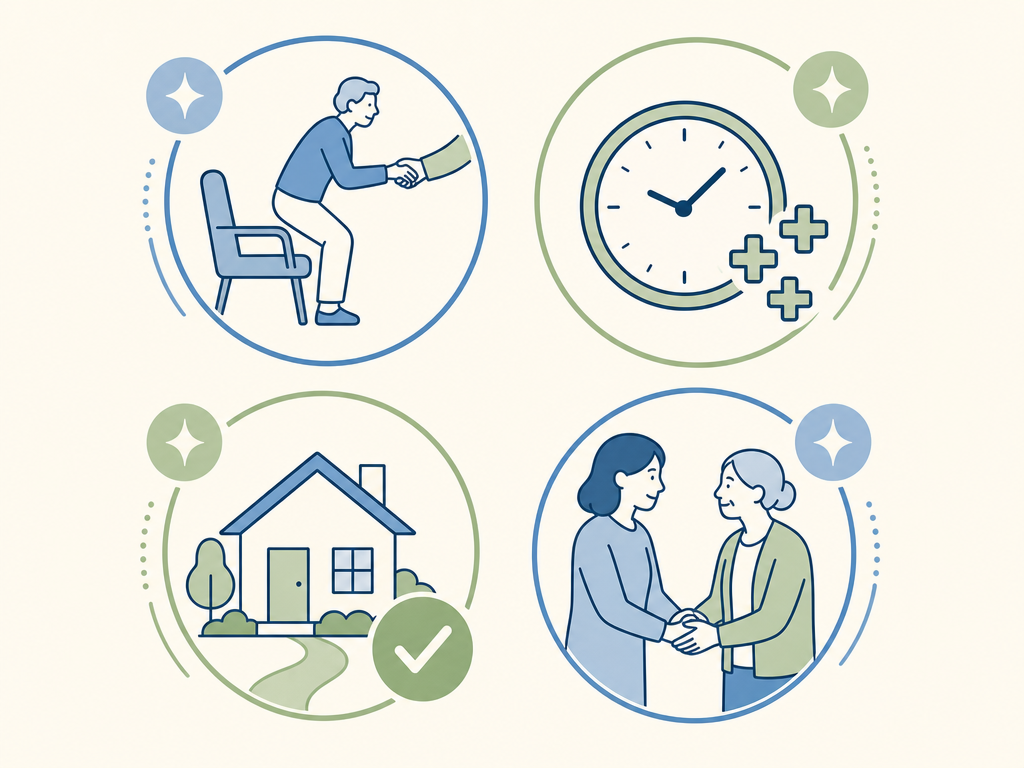
- Can they transfer with one person assisting? Transfer ability — moving from bed to chair, chair to toilet — is the single strongest predictor of whether a patient can return home. If your parent requires two people or a mechanical lift to transfer, the home environment will need significant modification and a much higher level of caregiver support.
- Do they have three or more hours per day of therapy tolerance? Short-term rehab is intensive. Patients are expected to participate in physical therapy, occupational therapy, and possibly speech therapy for several hours daily. If your parent is too weak, too confused, or too fatigued to engage in therapy, the SNF stay will not produce the expected recovery.
- Is the home environment safe for discharge? This means: can a wheelchair or walker navigate the doorways? Is there a bedroom and bathroom on the first floor? Are there grab bars in the shower? Is the lighting adequate? A patient who can transfer with one assist but lives in a three-story walkup is not a safe discharge candidate without home modifications.
- Is there a willing and available caregiver? Short-term rehab is designed to discharge patients to a home where someone — a family caregiver or paid aide — can provide ongoing support. If the primary caregiver is a spouse who is also frail, or an adult child who works full-time and lives 45 minutes away, the discharge plan needs to account for that gap.
If the answer to all four questions is yes, your parent is a strong candidate for short-term rehab with a realistic path home. If the answer to two or more is no, you need to have a serious conversation with the discharge planner about whether short-term care is appropriate — or whether you are looking at a long-term placement.
For a more detailed assessment framework that connects these questions to specific ADL and IADL evaluations, see our guide to assessing your parent's daily living needs and matching them to the right senior housing.
The Trial Stay Strategy: Using Short-Term Care as a Diagnostic Period
Sometimes you cannot know the trajectory until you see how the patient responds to therapy. That is where the trial stay strategy comes in.
A trial stay means using a short-term SNF stay — or, in some cases, a short-term respite stay in an assisted living facility — as a diagnostic observation period. You are not committing to long-term placement. You are buying time to see whether the recovery trajectory materializes.
This strategy works because short-term care is, by definition, temporary. According to Care.com, short-term care typically lasts about two to three weeks, though it can extend longer as needed. Medicare's 100-day benefit period gives you a defined observation window. The key is to use that window actively — not passively.
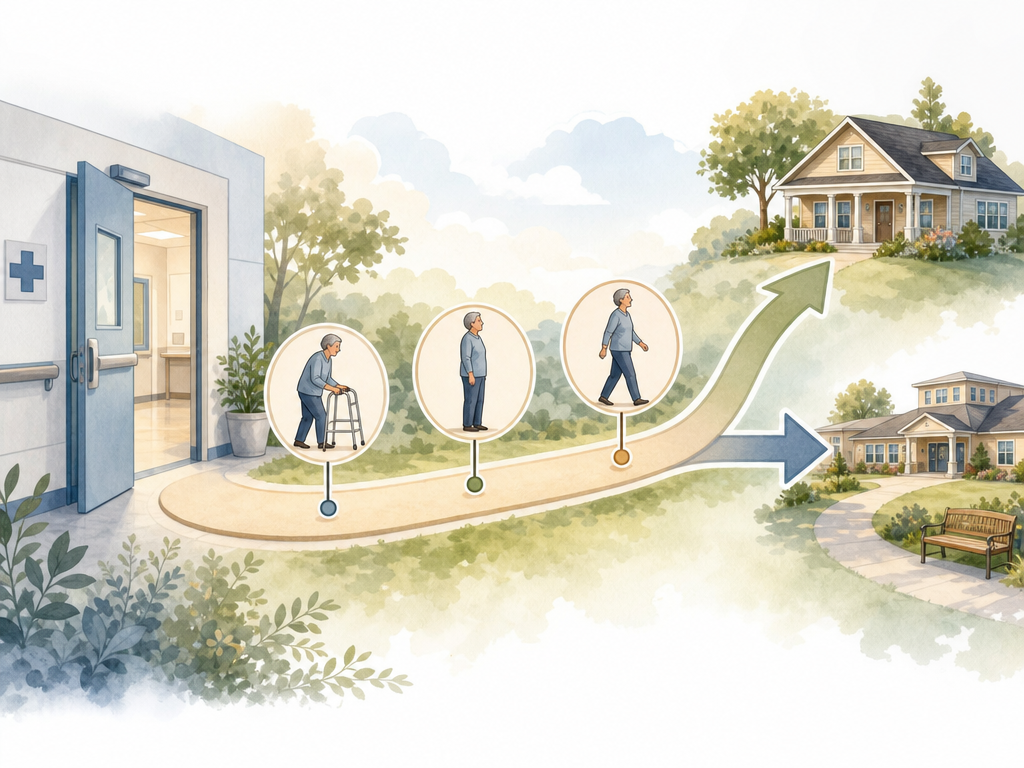
Here is what to watch for during the first 30 days:
- Therapy progress: Is your parent improving week over week? Are they tolerating more minutes of therapy? Are they progressing from bed exercises to standing exercises to walking with a walker?
- ADL independence: Can they now transfer with less assistance? Are they eating independently? Are they continent more often? These are the functional markers that predict whether home discharge is realistic.
- Stamina and engagement: Is your parent more alert than they were at hospital discharge? Do they have the energy to participate in daily activities? A patient who remains lethargic and withdrawn after two weeks of therapy may be on a different trajectory.
- Discharge planning activity: Is the SNF's social worker actively discussing discharge dates and home setup? If the team is not talking about discharge by day 14, that is a red flag.
The trial stay strategy is especially valuable for families who are uncertain about the trajectory. It gives you data — real, observed data about your parent's response to therapy — rather than forcing you to make a permanent decision based on a hospital discharge summary.
What Happens When Improvement Plateaus but Your Parent Can't Go Home
This is the scenario every family fears: your parent has been in the SNF for 60 days. They have made some progress — they can transfer with one assist, they are eating independently — but they are not safe to go home. The home has stairs. The spouse is exhausted. The adult child lives three states away. And Medicare's 100-day clock is ticking.
- Therapy notes show plateaued progress — the same functional level for two consecutive weeks.
- No discharge plan has been discussed, or the plan is vague ("we'll see how it goes").
- The home environment has not been assessed or modified.
- The family caregiver is showing signs of burnout or has explicitly said they cannot manage.
When you see these signs, you have a narrow window to act. The options are:
- Transition to Medicaid if your parent qualifies financially. Medicaid may pay 100% of nursing home costs for eligible individuals, but the rules are state-specific and the application process can take weeks or months. Do not wait until day 90 to start.
- Transition to long-term placement in the same facility or a different one. If the SNF has a long-term custodial wing, your parent may be able to stay in the same building — but the payment source changes from Medicare to private pay or Medicaid.
- Explore a different care model, such as assisted living with a higher level of care, or a group home setting that provides ADL support at a lower cost than a nursing home.
- Bring in paid home care services if the home environment can be made safe with modifications and a caregiver schedule.
This is the moment when having a staged plan matters most. Our senior care assistance triage guide provides a time-horizon framework for exactly this situation — what to do now, what to do next week, and what to do next month when the recovery trajectory is uncertain.
The most important thing to remember is that a plateau does not mean you failed. It means the initial assumption — that your parent was on a recovery trajectory — turned out to be incorrect. That is not a failure of care; it is a signal to shift from a short-term mindset to a long-term planning mindset. The functional trajectory framework is not about getting the answer right on day one. It is about having a system for recognizing when the answer changes.
For a broader view of how to match specific care services to your parent's actual situation — whether short-term or long-term — see our guide to senior health services by care need.
Questions to bring to a clinician or OT
This is not medical, legal, or a family's final decision — only a framework. Bring these questions to a clinician, occupational therapist, or your local Area Agency on Aging.
Find Local HelpRelated reading
Noticed something outdated or inaccurate on this page? Flag a correction. We review every report against CDC, NIA, and AARP HomeFit guidance before updating a page.