
Caregiver decision guide
Home Care vs. Assisted Living vs. Nursing Home: A Side-by-Side Comparison for Family Decision-Makers
This guide helps family caregivers compare home care, assisted living, and nursing homes across five key decision axes: cost trajectory, medical oversight, social engagement, caregiver burden relief, and autonomy. It includes a cost deep-dive, the 40-hour tipping point where home care costs exceed assisted living, hidden expenses, Medicare/Medicaid differences, and scenario-based walkthroughs to match care to your parent's specific needs.
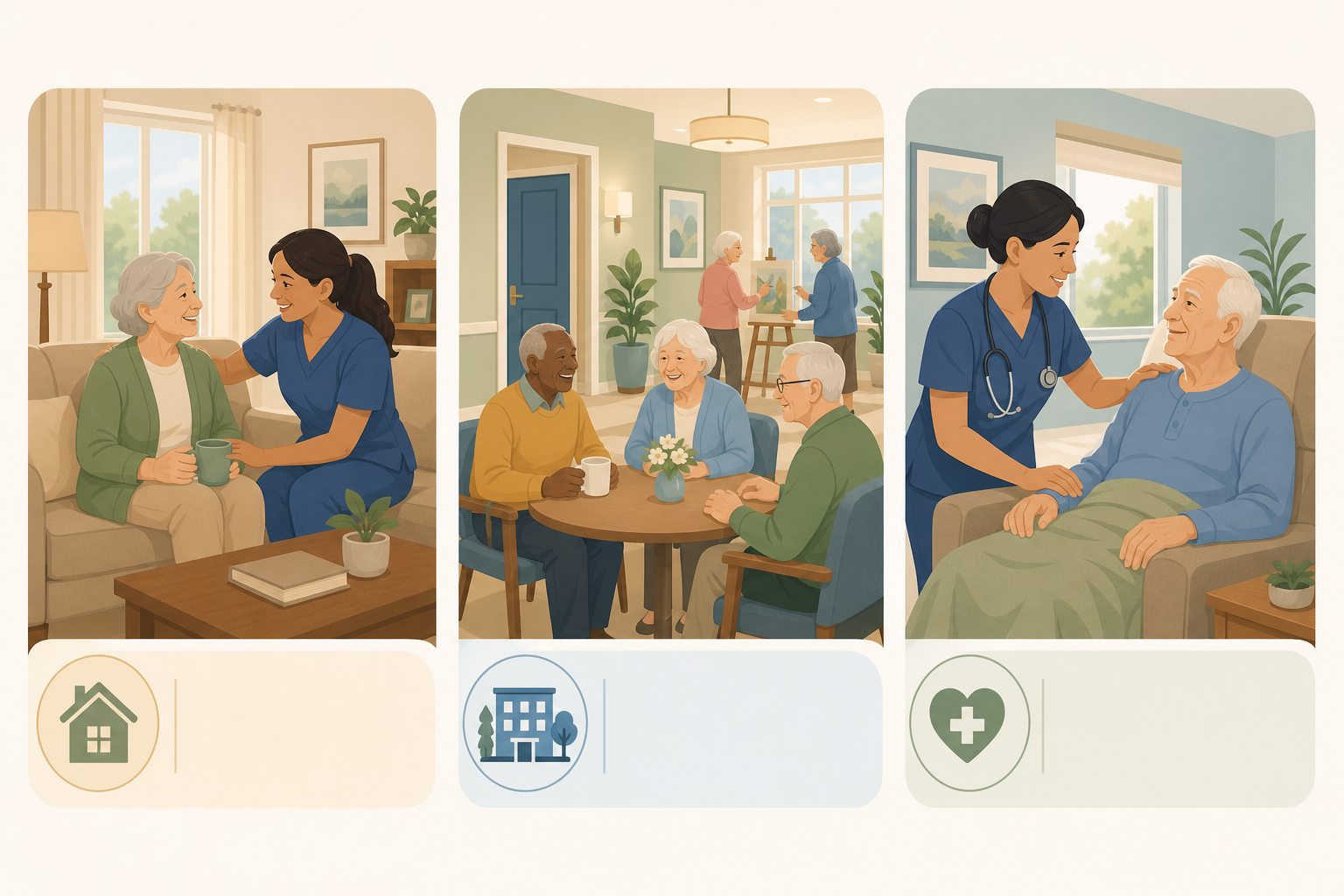
The Three-Option Landscape: When Each Type of Care Applies
If you are reading this, you are likely past the point of wondering whether your parent needs help. A hospital discharge, a fall, a missed dose of insulin, or a gradual decline you could no longer ignore has made the question concrete: What comes next? The answer usually narrows to three options, each with a distinct purpose and a different set of trade-offs.
Home Care (Non-Medical and Home Health Aide)
Home care is the broadest category. It includes non-medical personal care — bathing, dressing, meal preparation, light housekeeping — provided by a home care aide, as well as skilled home health care (wound care, physical therapy, medication management) provided by licensed professionals. The key distinction: non-medical home care is paid entirely out of pocket or through long-term care insurance, while Medicare covers limited, short-term home health care for people who are homebound and under a doctor's care.
Home care works best when a senior needs help with a few activities of daily living (ADLs) but is otherwise safe at home, when a family caregiver needs relief during work hours, or when the senior is adamant about staying in a familiar environment and the home is reasonably safe and accessible.
Assisted Living
Assisted living communities provide housing, meals, 24-hour supervision, and personal care assistance in a residential setting. They are designed for seniors who need help with daily activities but do not require the round-the-clock skilled nursing care that a nursing home provides. The average assisted living resident is 87 years old, and most residents move in between the ages of 75 and 84.
Assisted living is the right fit when a senior can no longer manage safely at home even with paid help, when social isolation has become a health concern, or when the family caregiver's own health or work is suffering under the load.
Nursing Homes (Skilled Nursing Facilities)
Nursing homes provide the highest level of care outside of a hospital. They offer 24-hour skilled nursing care, rehabilitation services, and medical monitoring for people with complex or unstable health conditions. Nursing homes are appropriate when a senior has advanced dementia, requires permanent IV medications, has multiple wounds that need daily professional care, or needs around-the-clock monitoring that assisted living cannot provide.
Despite the common fear that a move to a nursing home is inevitable, only about 5% of older Americans live in nursing homes at any given time. The vast majority of seniors — over 90% — prefer to age in place, and most will never need a nursing home level of care.
Five-Axis Comparison: How the Options Differ on What Matters Most
Most comparison articles focus on monthly cost and stop there. But the real decision involves five distinct dimensions, and each option scores differently on each one. The table below maps home care, assisted living, and nursing homes across these five axes so you can see the full landscape at a glance.
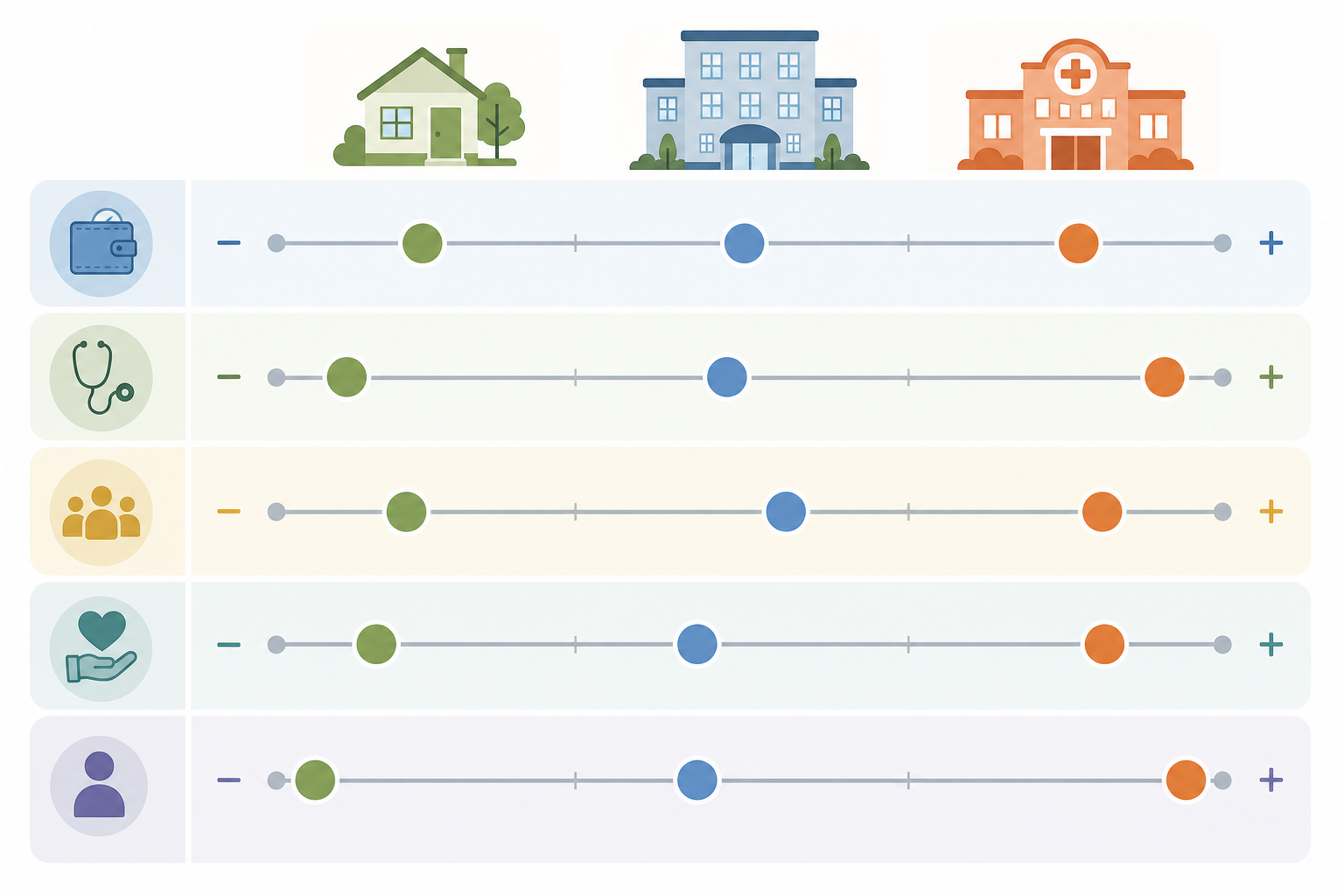
| Decision Axis | Home Care | Assisted Living | Nursing Home |
|---|---|---|---|
| Cost Trajectory | Variable; rises with hours. Full-time (44 hrs/wk) ~$80K/yr. Can exceed assisted living at ~40+ hrs/wk. | Fixed monthly fee (~$74K/yr median). Predictable but subject to level-of-care add-ons. | Highest fixed cost (~$115K/yr semi-private). Often covered by Medicaid after spend-down. |
| Medical Oversight | Low to moderate. Non-medical aides cannot administer meds or provide skilled care. Home health is short-term only. | Moderate. Staff can supervise meds and coordinate care, but cannot provide 24/7 skilled nursing. | High. 24-hour skilled nursing, rehabilitation, and medical monitoring on-site. |
| Social Engagement | Low unless intentionally structured. Senior is at home; socialization depends on family, friends, or paid companions. | Moderate to high. Communal dining, activities, outings. Built-in social structure. | Low to moderate. Social activities exist but are often limited by residents' health status. |
| Caregiver Burden Relief | Partial. Paid aides cover specific hours; family still manages coordination, transportation, and off-hours needs. | High. Facility handles all daily care, meals, and supervision. Family shifts to a visiting role. | Complete. Facility manages all medical and personal care. Family role is advocacy and companionship. |
| Senior Autonomy | Highest. Senior remains in familiar environment with their own routines and schedule. | Moderate. Community rules, meal times, and shared spaces. Private apartment but less control than home. | Lowest. Regimented schedule, shared rooms (often), and clinical environment. |
The table reveals a pattern that monthly-cost-only comparisons miss: home care offers the most autonomy and the least caregiver relief, while nursing homes offer the most medical oversight and the least autonomy. Assisted living sits in the middle on most axes, which is why it is often the "Goldilocks" option for families whose parent needs more than a few hours of help per day but does not require skilled nursing.
Cost Deep-Dive: What You'll Actually Pay in 2026
Cost is the first question most families ask, and for good reason. The numbers are sobering, and they vary depending on which source you consult. Below are the most recent national medians from CareScout's 2025 Cost of Care Survey (as reported by U.S. News) and from Genworth (as reported by SeniorLiving.org), along with A Place for Mom's 2026 assisted living figure for comparison.
| Care Type | CareScout 2025 (U.S. News) | Genworth (SeniorLiving.org) | A Place for Mom 2026 |
|---|---|---|---|
| Home Care (Non-Medical) | $35/hr; $80,080/yr at 44 hrs/wk | $220/day; $6,677/mo; $80,126/yr | $33/hr; $6,292/mo at 44 hrs/wk |
| Assisted Living | $6,200/mo; $74,400/yr | $200/day; $6,077/mo; $72,924/yr | $5,419/mo (based on 24,000+ residents) |
| Nursing Home (Semi-Private) | $9,581/mo; $114,972/yr | $314/day; $9,555/mo; $114,665/yr | $9,277–$10,646/mo (CareScout) |
| Nursing Home (Private) | $10,798/mo; $129,576/yr | $361/day; $10,965/mo; $131,583/yr | Not provided |
A critical insight that many families miss: staying at home with paid care is often the most expensive option over time. Senior care consultant Jacqui Clark put it plainly in an interview with U.S. News:
Staying at home with care is the most expensive option. It's a big myth that it's cheaper to stay at home with care.
This is because home care costs are variable and escalate as the senior needs more hours, while assisted living and nursing home costs are largely fixed. The point at which home care becomes more expensive than assisted living is the focus of the next section.
For a more detailed financial breakdown, including state-by-state variations and long-term projections, see our companion article: The True Cost of Assisted Care: A Financial Roadmap for Families Comparing Home Care, Assisted Living, and Nursing Homes in 2026.
The 40-Hour Tipping Point: When Home Care Costs More Than Assisted Living
One of the most powerful insights for families weighing home care against assisted living is the 40-hour tipping point. Here is the math using the CareScout median rate of $35 per hour for non-medical home care:
- 20 hours per week (roughly 3 hours/day): $700/week = $3,033/month — well below assisted living.
- 30 hours per week (roughly 4.3 hours/day): $1,050/week = $4,550/month — still below assisted living.
- 40 hours per week (roughly 5.7 hours/day): $1,400/week = $6,067/month — approaching or exceeding the assisted living median of $6,200/month.
- 44 hours per week (full-time, per CareScout): $1,540/week = $6,673/month — above the assisted living median.
The tipping point occurs at approximately 40 hours per week of paid home care. Below that threshold, home care is typically cheaper than assisted living. Above it, the fixed monthly fee of assisted living — which includes housing, meals, utilities, and 24-hour supervision — becomes the more cost-effective option.

For a deeper dive into this specific cost threshold, including state-by-state variations and a decision framework for families at the tipping point, see our dedicated articles: Home Care vs. Assisted Living: A Data-Driven Decision Framework for Families at the Tipping Point and Home Care vs. Assisted Living: The 40-Hour Cost Threshold Families Need to Know.
Hidden Costs: What the Monthly Rate Doesn't Tell You
The monthly rates in the cost table above are just the starting point. Each option comes with hidden costs that can significantly change the total financial picture. Here is what to watch for with each option.
Hidden Costs of Home Care
- Home modifications: Grab bars, ramps, stair lifts, walk-in tubs, widened doorways, and lighting upgrades can cost $10,000 to $100,000 depending on the scope of work.
- Utilities, groceries, and maintenance: These costs continue and may increase if the senior is home all day.
- Family caregiver unpaid labor: 20% of Americans are family caregivers, providing an estimated $873 billion of free labor per year. Caregivers living with the care recipient spend over 37 hours per week on care duties — essentially a second full-time job.
- Monitoring technology: Medical alert systems, passive sensors, and GPS trackers add $30–$100 per month.
Hidden Costs of Assisted Living
- Community fee: A one-time, non-refundable fee of $1,000–$5,000 or more to reserve an apartment.
- Level-of-care add-ons: The base rate covers a certain number of ADL assists. If your parent needs help with bathing, dressing, medication management, and toileting, the monthly cost can increase by $500–$2,000 or more.
- Rate increases: Assisted living communities typically raise rates 3–6% annually.
- Second-person fee: If a couple lives together, the second person typically pays an additional fee (median $1,200/month).
Hidden Costs of Nursing Homes
- Medicare coverage limits: Medicare covers skilled nursing care only after a qualifying 3-day hospital stay, for up to 100 days. After day 100, all costs are the patient's responsibility.
- Out-of-pocket costs before Medicaid: If the senior does not qualify for Medicaid immediately, the family must pay out of pocket until assets are spent down to the state's Medicaid threshold.
- Private room premium: A private room costs roughly $1,200/month more than a semi-private room.
For a full breakdown of home care costs including hidden expenses, see The True Cost of In-Home Senior Care in 2026: Hourly Rates, Monthly Projections, and Hidden Expenses. For a comparison of facility pricing structures and hidden fees, see Senior Residential Homes Cost 2026: Breaking Down Prices, Payment Models, and Hidden Fees.
Medicare and Medicaid: What Each Option Covers (and What It Doesn't)
Understanding what Medicare and Medicaid cover — and, more importantly, what they do not cover — is essential to making a financially sound decision. The table below summarizes the key differences.
| Care Type | Medicare Coverage | Medicaid Coverage |
|---|---|---|
| Home Care (Non-Medical) | Does NOT cover custodial care (bathing, dressing, meals). Limited home health coverage for skilled care only, if homebound and under a doctor's care. | Varies by state. Some states offer home and community-based services (HCBS) waivers that cover personal care. Eligibility and services differ significantly. |
| Home Care (Home Health Aide) | Covers short-term skilled nursing, physical therapy, occupational therapy if homebound. Must be from a Medicare-certified agency. No coverage for 24/7 care. | Same as above. Some states cover home health aide services through HCBS waivers. |
| Assisted Living | Does NOT cover room and board. Does NOT cover personal care services. May cover some skilled services (e.g., physical therapy) on a short-term basis. | Varies by state. Some states cover assisted living through HCBS waivers or state-funded programs. Coverage is limited and often has waiting lists. |
| Nursing Home (Skilled Nursing) | Covers up to 100 days after a qualifying 3-day hospital stay. Days 1–20: full coverage. Days 21–100: co-pay ($200+/day in 2026). After day 100: no coverage. | Covers 100% of nursing home costs for qualifying beneficiaries. Requires meeting state income and asset limits (spend-down may be necessary). |
For a more comprehensive guide to payment sources, including long-term care insurance, VA benefits, and reverse mortgages, see How to Pay for Senior Care in 2026: A Guide to Medicare, Medicaid, and Other Funding Sources.
Scenario-Based Walkthroughs: Matching Care to Real-Life Situations
The five-axis framework and cost data are useful abstractions, but the real test is how they apply to your specific situation. Below are three common scenarios that illustrate how the decision process works in practice.
Scenario 1: Mom Needs Help with Bathing but Cooks Her Own Meals
Your mother, 82, lives alone. She is cognitively sharp, manages her own medications, and still enjoys cooking. But she has arthritis in her hips and has become afraid of falling in the shower. She needs help with bathing three times a week and someone to check in on her daily.
- Home care assessment: At 6 hours per week (3 baths × 2 hours each), the cost is roughly $210/week or $910/month — well below the assisted living median. Home care is the clear winner on cost and autonomy.
- Assisted living assessment: Moving her to assisted living would cost $6,200/month for services she does not yet need. She would lose her kitchen, her garden, and her independence. The social benefits do not justify the cost and autonomy loss at this stage.
- Verdict: Home care, with a plan to reassess every 3–6 months as her mobility changes.
Scenario 2: Dad Has Diabetes and Forgets His Insulin
Your father, 78, has type 2 diabetes and early-stage dementia. He can still dress himself and feed himself, but he frequently forgets to take his insulin or takes it twice. He has been to the ER twice in the past six months for hypoglycemic episodes. He lives with your mother, who is 76 and has her own health issues.
- Home care assessment: He needs someone to be present at every meal to supervise insulin administration — that is 3+ hours of supervision per day, plus overnight monitoring if his blood sugar drops. At 25+ hours per week, the cost is roughly $875/week or $3,792/month. But even with paid care, the risk of a missed dose or a nighttime emergency remains.
- Assisted living assessment: Assisted living staff can supervise medications and coordinate with his doctor. The monthly cost of $6,200/month is higher than home care, but it includes 24-hour supervision, meals, and social engagement. More importantly, it relieves your mother of the burden of being the primary monitor.
- Nursing home assessment: If his dementia progresses to the point where he needs skilled nursing for insulin management or wound care, a nursing home may become necessary. But at this stage, assisted living is sufficient.
- Verdict: Assisted living. The medical oversight and caregiver relief axes tip the balance, even though the cost is higher than home care.
Scenario 3: Mom Lives Alone and Is Becoming Isolated
Your mother, 85, is physically healthy — she walks without assistance, manages her own medications, and cooks for herself. But she has become increasingly isolated since her friends moved away or passed on. She spends most days watching television alone. She has lost weight because she does not feel like cooking for one.
- Home care assessment: A home care aide could help with meal preparation and provide companionship for a few hours a day. At 10–15 hours per week, the cost is $350–$525/week or $1,517–$2,275/month. This addresses the immediate concerns but does not solve the underlying social isolation.
- Assisted living assessment: Assisted living offers built-in social engagement — communal dining, activities, and a community of peers. The cost of $6,200/month is significantly higher than home care, but it addresses the root cause of her decline: isolation. Many families find that the improvement in mood, appetite, and cognitive engagement justifies the cost.
- Verdict: Start with home care for meal support and companionship, but plan a visit to an assisted living community to see if the social environment appeals to her. If she responds positively, the social engagement axis may make assisted living the better long-term choice.
For additional guidance on matching care types to specific needs, see Independent Living vs. Assisted Living vs. Nursing Home: How to Match Your Parent's Needs to the Right Level of Care.
Transition Management: How to Trial Home Care Before Committing to a Facility
For many families, the decision between home care and a facility move feels binary and irreversible. But it does not have to be. A phased approach — starting with home care and monitoring for the tipping point — can give you time to make a confident decision without rushing into a facility move that may not be necessary.
Step 1: Start Small and Scale Up
Begin with 6–10 hours of home care per week, focused on the specific tasks that are most challenging — bathing, meal preparation, medication reminders. This gives you a baseline cost and lets you assess how well the senior adapts to having a caregiver in the home.
Step 2: Monitor for the Tipping Point
Track the number of hours of paid care per week. If the senior's needs escalate to 30+ hours per week, you are approaching the 40-hour tipping point. At this stage, begin touring assisted living communities and gathering cost information so you are prepared to make a move if needed.
Step 3: Use Respite Care to Trial a Facility
Many assisted living communities offer short-term respite stays (a few days to a few weeks). This allows the senior to experience the facility without a permanent commitment. It also gives the family caregiver a break and a chance to observe how the senior responds to the environment.
Step 4: Watch for the Non-Financial Tipping Points
Cost is not the only tipping point. Watch for these non-financial signals that home care is no longer sufficient:
- The senior is falling despite home care assistance.
- The family caregiver's health is deteriorating (burnout, missed work, sleep deprivation).
- The senior is becoming increasingly isolated or depressed at home.
- Medication errors are occurring despite supervision (medication errors send over 600,000 older adults to the ER annually, according to the CDC).
- The senior needs care during overnight hours that home care cannot reliably cover.
For families who have just experienced a hospital discharge and need immediate post-discharge payment planning, see How to Pay for Elderly Home Care in 2026: A Financial Roadmap for Families After a Hospital Discharge.
Questions to bring to a clinician or OT
This is not medical, legal, or a family's final decision — only a framework. Bring these questions to a clinician, occupational therapist, or your local Area Agency on Aging.
Find Local HelpRelated reading
Noticed something outdated or inaccurate on this page? Flag a correction. We review every report against CDC, NIA, and AARP HomeFit guidance before updating a page.