
Room checklist
When Staying Home Costs More: The Breakeven Point for Aging in Place vs. Assisted Living
Many families assume aging in place is the cheaper option, but there is a specific calculable point — typically when in-home care reaches 20-40 hours per week — where the total monthly cost of staying home exceeds assisted living. This guide provides the breakeven framework, real cost data, and a decision matrix to help adult children make a financially informed choice.
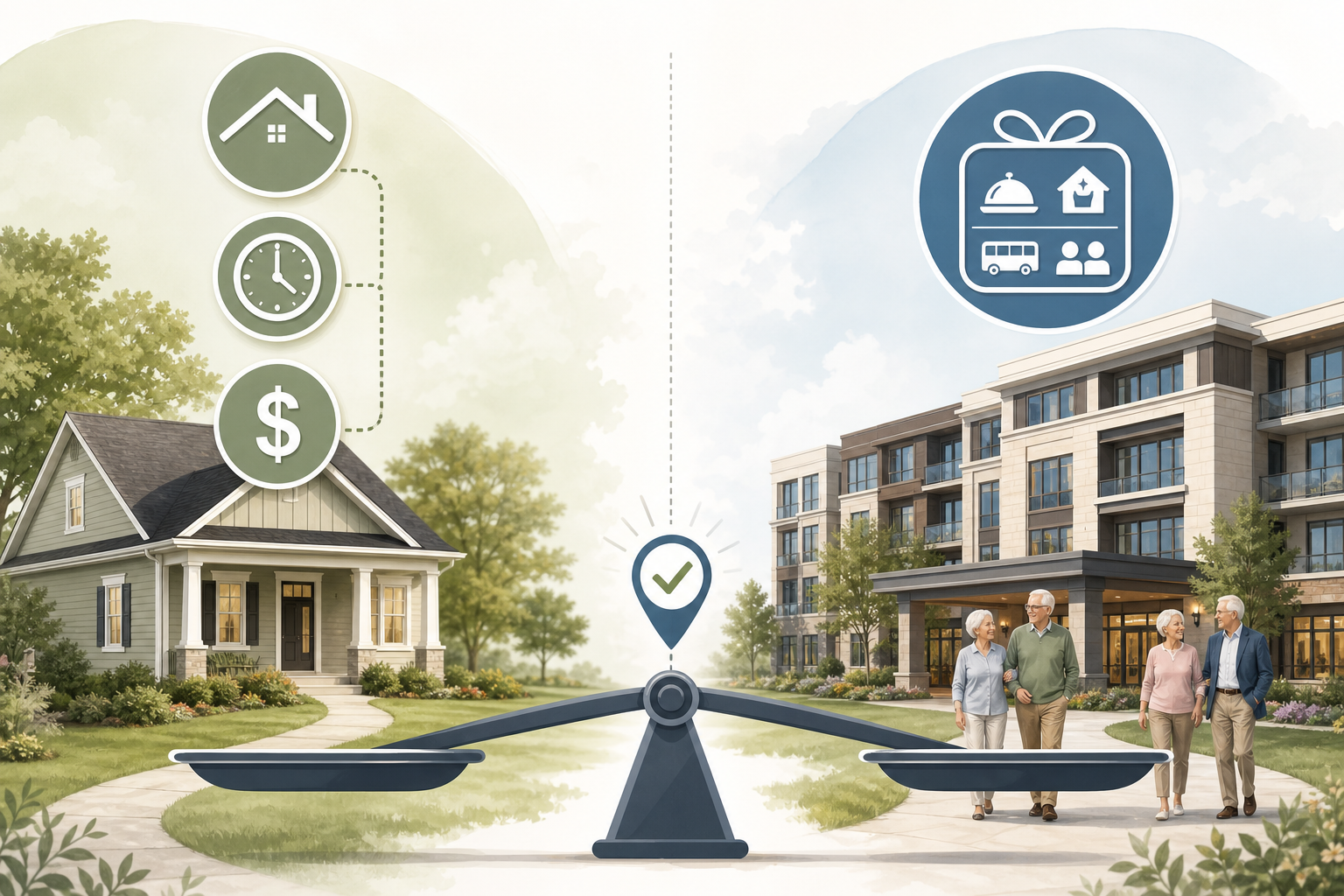
The Anchoring Bias: Why Most Families Assume Home Is Cheaper
When an older parent begins to struggle at home, the default assumption for most adult children is clear: staying in the family home is the less expensive path. This instinct is reinforced by a powerful emotional anchor — the house represents independence, memory, and autonomy. According to an AARP survey cited by Benchmark Senior Living, 77% of Americans aged 50 and older wish to age in place. That statistic alone explains why the conversation about moving to assisted living so often begins with resistance.
But the emotional case for staying home often masks a financial reality that many families never fully calculate. The assumption that home is cheaper rests on comparing only two numbers: the monthly rent or fee of a senior living community against the cost of a few hours of home care per week. That comparison misses the full picture. A 2024 survey by U.S. News and 360 Reviews found that 49% of seniors report that cost-of-living increases make it difficult for them to age in place, suggesting that the financial strain of staying home is more widespread than most families realize.
This article provides a different framework — one that does not ask you to choose between emotion and finance, but instead gives you a specific, calculable breakeven point based on weekly in-home care hours. No existing guide on this site translates the decision into a care-hours-per-week metric. If you have been comparing remodeling costs to assisted living fees, you may want to read our Aging in Place Remodel Cost vs. Assisted Living guide for that angle. Here, we focus on the ongoing monthly math — and the threshold where staying home stops being the cheaper option.
The True Monthly Cost of Aging in Place: Three Layers
To find the breakeven point, you first need to understand the three cost layers that make up the total monthly expense of staying home. Most families consider only one or two of these layers, which is why the true cost so often surprises them.
Layer 1: Homeownership Costs
The American Seniors Housing Association (ASHA), in a report cited by both Benchmark Senior Living and HumanGood, estimates that maintaining a median-priced $400,000 home — including property taxes, utilities, insurance, and routine maintenance — costs an average of $3,725 per month. This figure does not include a mortgage; it is the cost of simply owning and operating the home. For families whose home is valued higher, or whose property taxes are above the median, this number can be significantly larger.
Layer 2: Home Modification Amortization
Most homes need at least some modifications to be safe for an aging resident — grab bars, stair lifts, walk-in showers, widened doorways, or ramps. According to HIT Consultant, as cited by HumanGood, these modifications typically cost between $3,000 and $15,000 in total. A full retrofit from a design-build firm may run higher, but the HIT Consultant range is a reliable national benchmark.
Because these are one-time costs, they should be amortized over the expected time the senior will remain in the home. A reasonable amortization period is five years. At that rate, a $10,000 modification adds about $167 per month to the monthly cost. A $15,000 modification adds approximately $250 per month. For a detailed breakdown of specific modification costs and how to fund them, see our guide on how to pay for aging in place home modifications.
Layer 3: In-Home Care
This is the variable that changes everything. The national median cost of a home health aide is $34 to $35 per hour, according to both HumanGood (citing CareScout) and U.S. News (citing Genworth and CareScout's 2025 Cost of Care survey). Unlike the fixed costs of homeownership and modifications, this expense scales directly with the number of care hours needed each week.
The table below shows how these three layers stack at different levels of weekly care. The homeownership cost is held constant at the $3,725 median. The modification amortization is shown at $200 per month (a mid-range estimate). The care cost is calculated at $34.50 per hour.
| Weekly Care Hours | Monthly Care Cost | Homeownership Cost | Modification Amortization | Total Monthly Cost |
|---|---|---|---|---|
| 10 hours | $1,495 | $3,725 | $200 | $5,420 |
| 20 hours | $2,990 | $3,725 | $200 | $6,915 |
| 30 hours | $4,485 | $3,725 | $200 | $8,410 |
| 40 hours | $5,980 | $3,725 | $200 | $9,905 |
| 44 hours | $6,578 | $3,725 | $200 | $10,503 |
Related reading
Need a professional assessment?
Find a CAPS-credentialed professional or local aging services through our outbound resource list — we never name or rank individual contractors.
Find Local HelpNoticed something outdated or inaccurate on this page? Flag a correction. We review every report against CDC, NIA, and AARP HomeFit guidance before updating a page.