
Caregiver decision guide
Is Hiring a CAPS Worth It? A Cost-Benefit Analysis for Family Caregivers
Weigh the upfront cost of a Certified Aging-in-Place Specialist (CAPS) assessment against the long-term financial and safety risks of going without one. This guide helps family caregivers and older adults on fixed incomes decide whether a CAPS-guided remodel is the smarter investment.
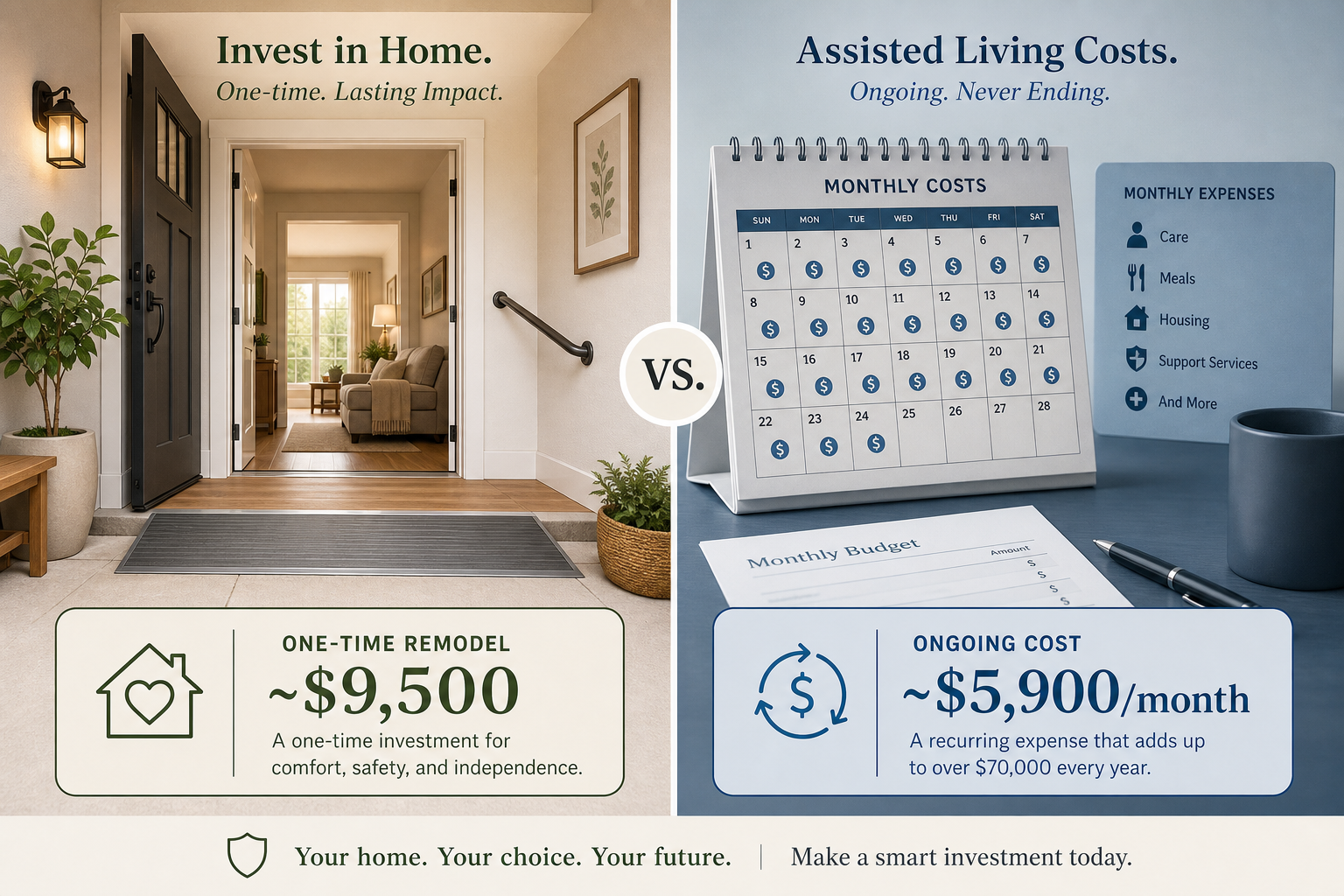
The Real Cost Gap: Assisted Living vs. a One-Time Remodel
The most expensive decision a family can make about aging in place is often the one they make in a hurry — after a fall, a diagnosis, or a sudden functional decline. In that moment, the path of least resistance looks like a move to assisted living. But the numbers tell a different story.
The median monthly cost of assisted living in the United States is approximately $5,900, according to industry data cited by RubyHome. That works out to roughly $70,800 per year — and those costs have been climbing steadily. By contrast, the national average cost of a comprehensive aging-in-place remodel is approximately $9,500 (NAHB data via RubyHome). That is a one-time expense, not a recurring monthly obligation.
The gap becomes even starker when you consider that only 21% of adults aged 65 and older have long-term care insurance (Pew 2025, via RubyHome). For the other 79%, assisted living costs come directly out of savings, retirement accounts, or family contributions. Meanwhile, a University of Michigan National Poll on Healthy Aging (2,277 adults ages 50–80) found that 43% are not confident they could afford long-term care services if needed.
For a deeper look at the full financial comparison between remodeling and relocating, see our article Does an Aging-in-Place Remodel Pay for Itself?.
What a CAPS Assessment Costs — and What You Actually Get
A Certified Aging-in-Place Specialist (CAPS) is a building professional who has completed formal training through the National Association of Home Builders (NAHB), developed in collaboration with AARP. The credential requires completing three courses covering marketing and communication, design concepts, and technical solutions, plus annual continuing education (4 hours per year) to maintain certification.
The upfront cost of engaging a CAPS breaks down into two main categories: the initial home safety assessment and the hourly consultation rate.
| Service | Typical Cost Range | What You Receive |
|---|---|---|
| Home safety assessment | $300 – $1,000 | Personalized walk-through evaluation of the entire home, identifying hazards and opportunities for modification |
| Hourly consultation | $75 – $200 per hour | Professional guidance on modification priorities, product selection, contractor coordination, and funding options |
| Full assessment with written report | $500 (reported by Gina Knight, CAPS) | Detailed, prioritized plan with cost estimates and recommended next steps |
Questions to bring to a clinician or OT
This is not medical, legal, or a family's final decision — only a framework. Bring these questions to a clinician, occupational therapist, or your local Area Agency on Aging.
Find Local HelpRelated reading
Noticed something outdated or inaccurate on this page? Flag a correction. We review every report against CDC, NIA, and AARP HomeFit guidance before updating a page.