
Room checklist
Does an Aging-in-Place Remodel Pay for Itself? The Financial Case for Modifying Your Home vs. Moving to Assisted Living
For adult children comparing costs, this guide breaks down the financial decision between remodeling a parent's home and moving to assisted living — with data on one-time remodel costs vs. recurring facility fees, resale ROI, avoided healthcare expenses, and funding sources that improve net cost.
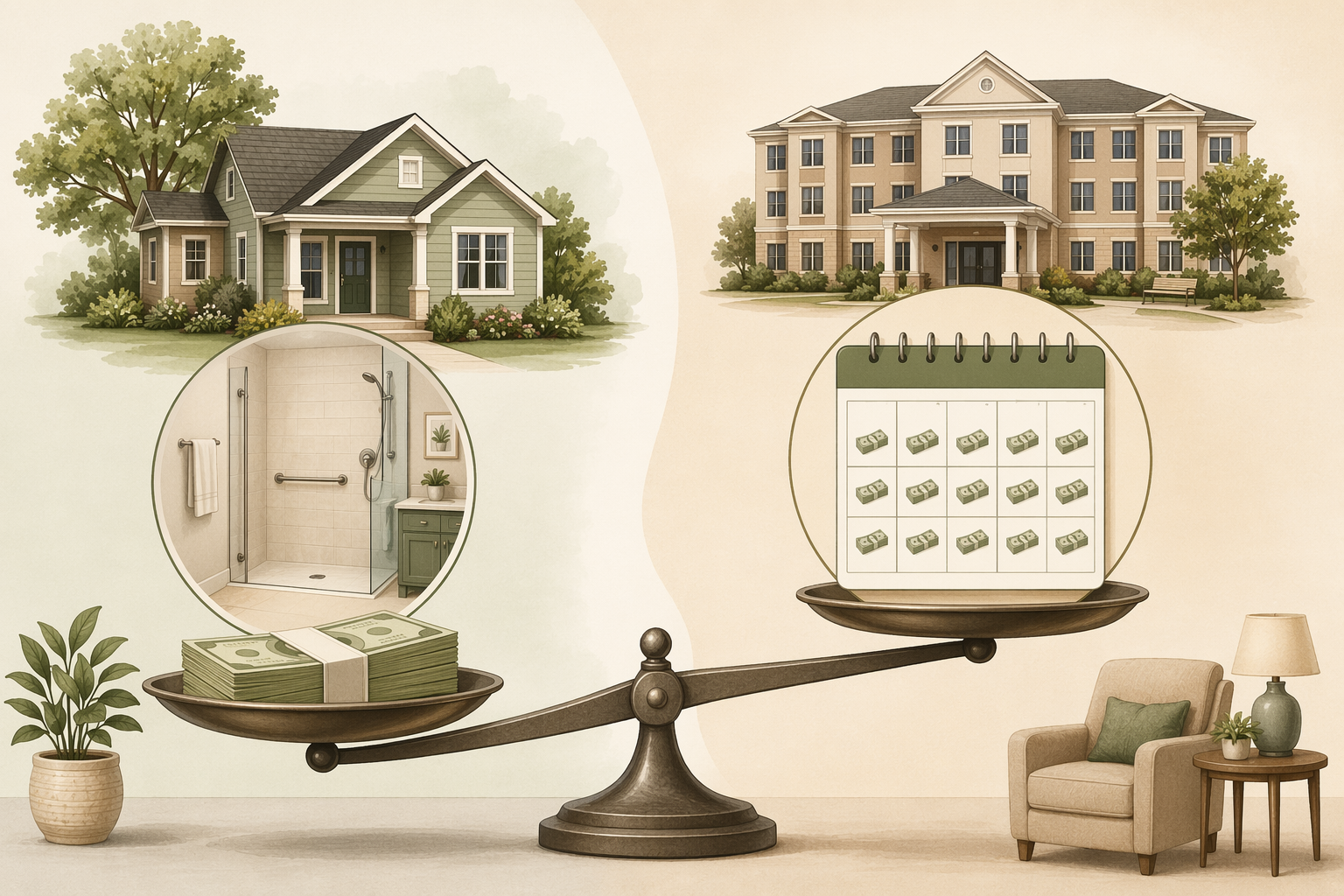
The Core Financial Question: One-Time Remodel Cost vs. Recurring Facility Fees
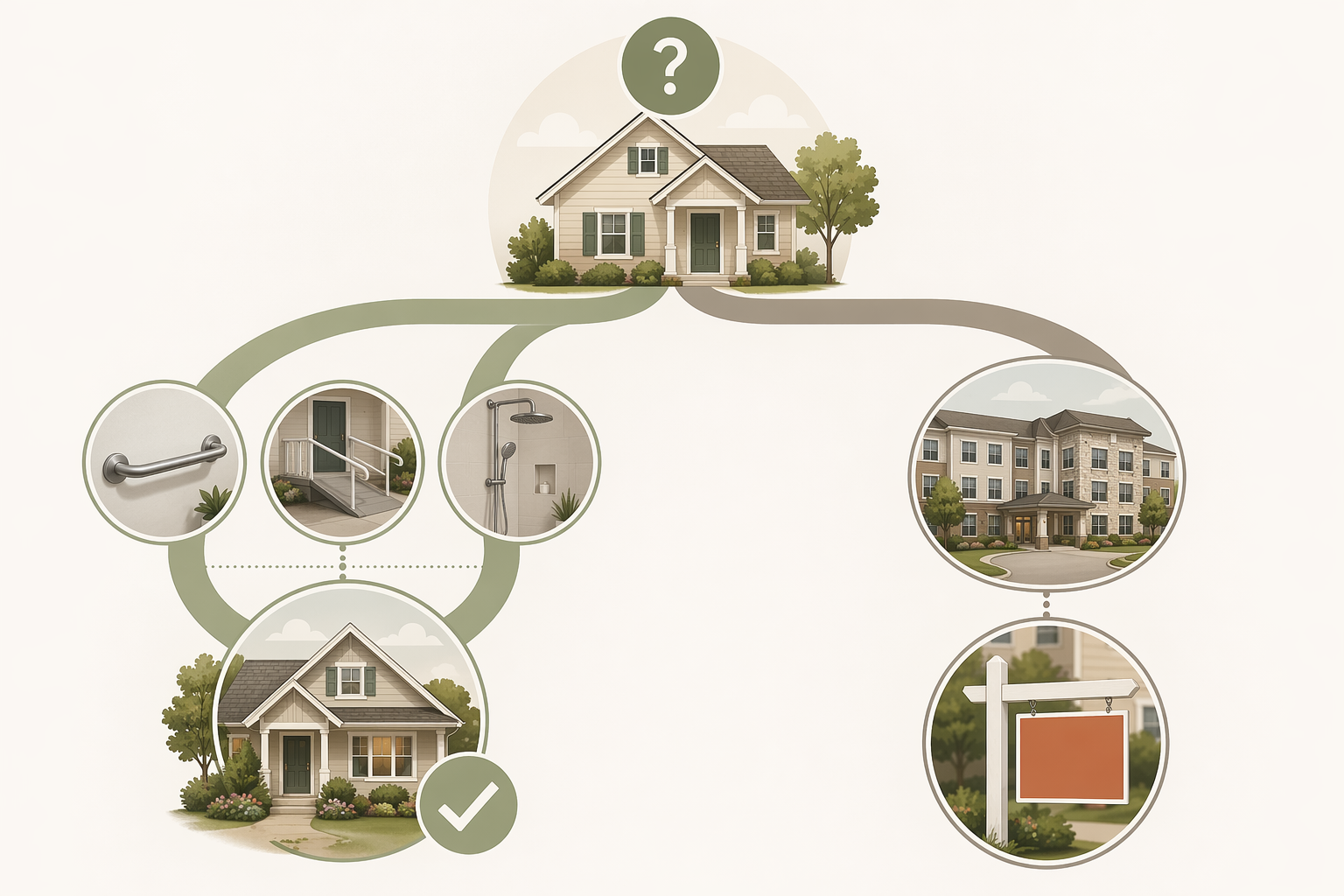
When a parent can no longer manage stairs or step into a standard bathtub safely, families face a fork in the road: modify the home they already own, or move to a facility that provides the needed support. The instinct is often to assume assisted living is the simpler path. But the numbers tell a different story.
A comprehensive aging-in-place remodel — the kind that addresses the bathroom, entryway, and main-floor accessibility — typically runs between $18,000 and $75,000, according to 2026 national data from Cost to Renovate. A single full accessible bathroom remodel averages $8,000 to $25,000. Compare that to the recurring cost of facility care: assisted living averages $4,500 to $5,000 per month nationally, while a semi-private nursing home room runs about $7,900 per month, and a private room exceeds $9,000 per month, per Retirement Living data updated April 2026.
| Option | Typical One-Time or Annual Cost | Notes |
|---|---|---|
| Full accessible bathroom remodel | $8,000 – $25,000 | One-time cost; includes curbless shower, grab bars, comfort-height toilet |
| Whole-home AIP retrofit | $18,000 – $75,000 | One-time cost; addresses bathroom, entry, stairs, lighting, and doorways |
| Stair lift (straight) | $2,200 – $8,500 | One-time cost; allows multi-level home access without moving |
| Assisted living (1 year) | $54,000 – $84,000 | Recurring; national average $4,500–$7,000/month |
| Nursing home semi-private (1 year) | ~$94,800 | Recurring; $7,900/month average |
| Nursing home private (1 year) | ~$108,000+ | Recurring; $9,000+/month average |
The math is stark: a $25,000 bathroom remodel pays for itself in roughly five to six months of avoided assisted living costs. Even a whole-home retrofit at $75,000 is less than a single year in a nursing home. For families who expect their parent to remain in the home for three to five years or more, the financial case for remodeling is difficult to ignore.
Resale Value Recoup: How Universal Design Boosts Home Value
One of the most overlooked aspects of the remodel-versus-move calculation is that remodeling adds value to the home. A universal design bathroom — one with a curbless shower, grab bars, comfort-height toilet, and slip-resistant flooring — yields an average return on investment of 68 to 70 percent at resale, according to the annual Cost vs. Value Report cited by Aging in Place Resources. A midrange standard bathroom remodel returns roughly 80 percent, but it lacks the accessibility features that a growing segment of homebuyers now seek.
The gap between these two ROI figures is narrower than many assume. A $25,000 universal design bathroom retains roughly $17,000 to $17,500 in home value. The remaining $7,500 to $8,000 is the true net cost of the accessibility upgrade — not the full $25,000. When that net cost is compared against even three months of assisted living ($13,500 to $21,000), the remodel remains the cheaper option.
| Remodel Type | Average ROI | Net Cost After Resale (on $25K project) |
|---|---|---|
| Universal design bathroom | 68–70% | $7,500 – $8,000 |
| Standard midrange bathroom | ~80% | $5,000 |
| Universal design bathroom (Bay Area) | ~61% | $9,750 |
The broader market trend supports this investment. The aging-in-place renovation market was valued at $74 billion in 2024 and is projected to exceed $113 billion by 2033. Homeowners aged 65 and older have doubled their share of remodeling spending from 14 percent to 27 percent, according to Harvard JCHS data cited by Custom Home. This is not a niche concern — it is a mainstream shift in how homes are being updated.
The Hidden Cost of Doing Nothing: Fall-Related Medical Expenses
The financial case for remodeling is not just about comparing remodel costs to facility costs. It is also about the cost of not modifying the home. Falls cost the U.S. healthcare system over $50 billion annually, according to CDC data cited by Senioridy and Aging in Place Resources. A single fall resulting in a hip fracture carries average medical costs exceeding $30,000 — more than the cost of a full bathroom remodel.
More than one in four people aged 65 and older fall each year, per the National Institute on Aging. The bathroom is a particularly high-risk zone: a CDC study found that nearly 28 percent of bathroom injuries in people 65 and older were toilet-related. Yet the interventions that prevent these injuries are remarkably inexpensive.
A study published in Human Factors (Levine et al., 2021) found that people using grab bars in their bathrooms were almost 76 percent more likely to recover their balance than those who had no grab bars. A grab bar installed costs $100 to $350 per bar. A three-bar bathroom package runs $400 to $900. Motion-activated night lights along the bedroom-to-bathroom path cost $15 to $60 each. Threshold ramps, which eliminate the tripping hazards that every expert interviewed by Wirecutter identified as significant, cost $50 to $200.
When you factor in avoided medical costs, the effective net cost of many modifications drops to near zero. A $400 grab bar package that prevents a $30,000 hip fracture hospitalization has an implied return that no investment portfolio can match.
Funding Sources That Improve Net Cost
Few families pay the full cost of a remodel out of pocket. Several funding programs can reduce the net expense significantly, and some can cover the entire project for qualifying individuals.
- Medicare Advantage supplemental benefits: Approximately 33 percent of Medicare Advantage plans offer home modification benefits as of 2025, according to KFF data cited by Senioridy. These benefits vary widely by plan and state but can cover grab bars, ramps, and bathroom modifications. Check your parent's specific plan — many beneficiaries are unaware this benefit exists.
- VA SAH and HISA grants: Veterans may qualify for the Special Adaptive Housing (SAH) grant or the Home Improvements and Structural Alterations (HISA) grant. These can fund ramps, grab bars, widened doorways, and bathroom modifications. Eligibility depends on service-connected disability status.
- USDA Section 504 loans and grants: Low-income rural seniors may qualify for USDA Section 504 loans (up to $20,000) and grants (up to $10,000) specifically for home repairs and modifications that remove health and safety hazards. These are available to homeowners aged 62 and older who cannot afford credit elsewhere.
- Medicaid HCBS waivers: Home and Community-Based Services (HCBS) waivers, available in most states, can cover home modifications that allow a beneficiary to remain at home rather than enter a nursing facility. Coverage varies significantly by state and waiver type.
- State tax credits and deductions: Some states offer tax credits for accessibility modifications. Additionally, if a physician prescribes a modification (such as a ramp or grab bar), the cost may qualify as a medical expense deduction on federal taxes.
- Nonprofit programs: Organizations like Habitat for Humanity and local Area Agencies on Aging offer low-cost or sliding-scale home repair programs for seniors. These are particularly valuable for families with limited savings.
When Remodeling Doesn't Make Financial Sense
A balanced financial analysis must acknowledge the scenarios where moving is the better decision. Remodeling is not always the right call, and pretending otherwise would undermine the trust this guide aims to build.
- Home value is too low to recoup investment: If the home is in a market where resale values are depressed, a $25,000 bathroom remodel may never be recovered at sale. In such cases, the net cost of remodeling is the full project cost, not the cost minus resale value.
- Planned sale within five years: If the family plans to sell the home within five years, the breakeven point for a major remodel may not be reached. The avoided facility costs need enough time to accumulate to offset the upfront investment.
- Home structurally unsuitable: Some homes — particularly older homes with narrow hallways, load-bearing walls that cannot be moved, or foundations that cannot support a ramp — are prohibitively expensive to modify. A CAPS assessment can identify these issues before you commit to a plan.
- Care needs exceed what modifications can address: If the senior requires 24-hour skilled nursing care, daily assistance with multiple activities of daily living, or has advanced dementia that makes home safety impossible, no amount of remodeling will substitute for the level of care a facility provides.
- The senior is unwilling to accept modifications: If the older adult refuses to use grab bars, a walk-in shower, or other modifications, the investment will not deliver the safety benefits it is designed to provide. The emotional and relational cost of forcing changes must be weighed against the financial math.
Decision Framework: A Simple Remodel vs. Move Calculator Approach
To help your family run the numbers, here is a practical framework. Gather these five inputs, then compare the total cost of remodeling against the total cost of facility care over the expected time horizon.
- Estimated remodel cost: Get a quote from a CAPS-certified contractor or an occupational therapist who specializes in home assessments. For a detailed room-by-room breakdown, see our Aging in Place Home Modifications Cost Guide.
- Estimated annual facility cost: Research assisted living and nursing home costs in your specific area. Use Genworth's Cost of Care Survey or your state's Department of Aging website for local data.
- Expected years in home: Be realistic about how long the senior is likely to remain in the home given their health trajectory. Three to five years is a reasonable minimum for a major remodel to break even.
- Available funding offsets: Check Medicare Advantage benefits, VA grants, USDA loans, Medicaid HCBS waivers, and state tax credits. Subtract these from the remodel cost.
- Projected medical cost avoidance: Factor in the reduced fall risk from modifications. While you cannot predict a specific fall, the CDC data shows that one in four seniors falls each year, and the average hip fracture costs over $30,000.
| Input | Your Estimate | Notes |
|---|---|---|
| Total remodel cost | $______ | Get a CAPS contractor quote |
| Minus funding offsets | – $______ | VA, Medicare Advantage, USDA, state credits |
| Minus resale value recoup (68–70% of remodel cost) | – $______ | Only if home will be sold |
| Equals net remodel cost | = $______ | True cost of staying |
| Annual facility cost | $______ | Assisted living or nursing home, local rate |
| Multiplied by expected years in home | × ______ years | 3–5 year minimum for breakeven |
| Equals total facility cost over time horizon | = $______ | Cost of moving |
For families building a comprehensive long-term care plan that may include both home modifications and paid caregiving services, our Building an Aging in Place Services Plan guide provides a staged decision framework that integrates remodeling with other care options.
Next Steps: Making the Decision With Confidence
The financial case for an aging-in-place remodel is stronger than most families realize. A one-time investment of $8,000 to $25,000 for a bathroom remodel — or $18,000 to $75,000 for a whole-home retrofit — compares favorably against $54,000 to $108,000 per year in facility costs. When you add resale value recoup, avoided medical expenses, and available funding sources, the net cost of remodeling often drops to a fraction of the sticker price.
Here are the concrete next steps to move forward:
- Get a CAPS assessment: A Certified Aging-in-Place Specialist can evaluate the home and provide a detailed scope of work and cost estimate. Understanding the difference between a CAPS professional and a general contractor is critical — see our guide on CAPS vs. General Contractor vs. Occupational Therapist for a full comparison.
- Check Medicare Advantage benefits: Call your parent's plan and ask specifically about home modification benefits. Many beneficiaries do not know these exist.
- Explore VA and USDA funding: If your parent is a veteran or lives in a rural area, these programs can cover a significant portion of the cost.
- Consult a financial advisor: A professional who understands elder care costs can help you run the numbers for your specific situation, including tax implications and long-term care planning.
- Start with the highest-ROI changes: Grab bars, night lights, and threshold ramps cost under $500 combined and address the most common fall hazards. These can be installed immediately while you plan larger structural changes.
For families who have experienced a fall or emergency and need to act quickly, our guide on why CAPS certification matters after a parent's fall provides the practical steps for hiring the right professional under time pressure.
Related reading
- Does an Aging-in-Place Remodel Pay Off? ROI Data, Cost Avoidance, and the Case for Investing Now
- Funding Sources for Home Modifications: A Complete Guide to VA, Medicaid, Grants, and More
- The Evidence for Aging-in-Place Home Modifications: What Research Says About Fall Prevention, Independence, and Cost Savings
Need a professional assessment?
Find a CAPS-credentialed professional or local aging services through our outbound resource list — we never name or rank individual contractors.
Find Local HelpNoticed something outdated or inaccurate on this page? Flag a correction. We review every report against CDC, NIA, and AARP HomeFit guidance before updating a page.