
Room checklist
How to Hire a CAPS-Certified Aging-in-Place Specialist: A Complete Guide for Family Caregivers
A step-by-step guide for adult children navigating home modifications after a parent's fall or mobility decline. Learn what a CAPS specialist does, when to hire one, what modifications cost, and how to fund the project — from evaluation to final walkthrough.
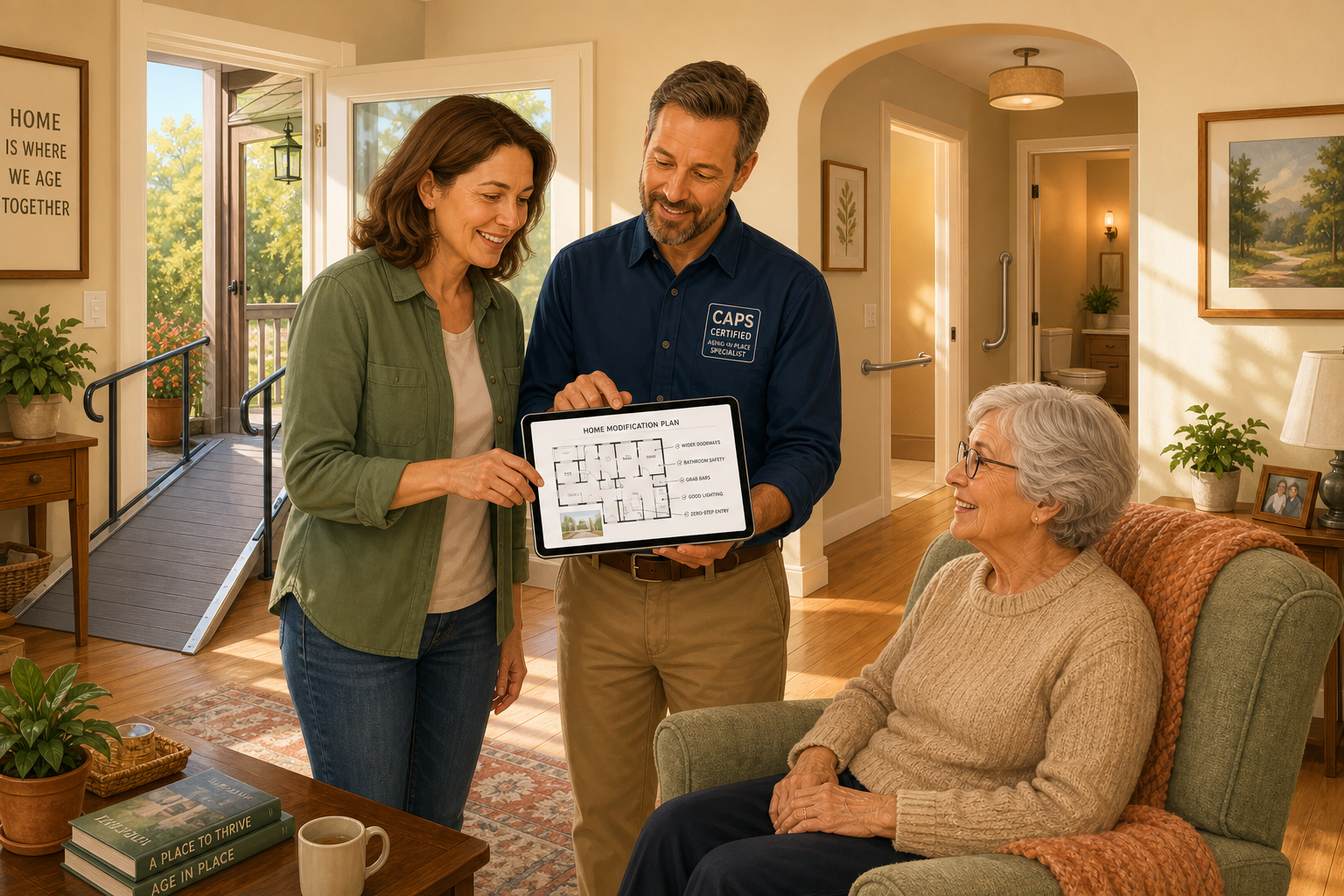
What Is a CAPS-Certified Aging-in-Place Specialist and Why Does the Certification Matter?
A Certified Aging-in-Place Specialist (CAPS) is a professional who has completed a rigorous training program developed jointly by the National Association of Home Builders (NAHB) and AARP in 2002. The credential was created to address a specific gap in the housing market: most contractors know how to build and renovate, but few understand how a home must adapt as a person's mobility, vision, balance, and strength change over time.
To earn the CAPS designation, candidates complete three courses: CAPS I covers marketing and communicating with the aging-in-place client; CAPS II focuses on design concepts and methods for livable homes; CAPS III provides technical details and solutions for accessible living spaces. The curriculum teaches universal design principles, building code compliance, project estimation, and how to collaborate with occupational therapists and other allied professionals. After completing the coursework, candidates must sign a code of ethics pledge and, for contractors, provide proof of liability insurance, workers' compensation insurance, and a valid business license.
Why does this matter for your family? According to a University of Michigan National Poll on Healthy Aging, 88% of adults aged 50 and older prefer to remain in their homes for as long as possible. Yet Census Bureau data indicates that only about 10% of homes in the United States are "aging ready" to accommodate an older adult's needs. A CAPS specialist bridges that gap — they are trained to see what a general contractor might miss: the doorway that will need to be 32 inches wide for a future wheelchair, the bathroom layout that could accommodate a roll-in shower, or the lighting placement that reduces shadow and glare for aging eyes.
The core thesis is simple: a CAPS is more than a contractor. They are a trained specialist who reduces costly mistakes, plans for future needs, and often knows about funding sources that most contractors do not. For a family caregiver navigating home modifications for the first time, that combination of skills can mean the difference between a renovation that works for years and one that needs to be redone in eighteen months.
When to Hire a CAPS vs. a General Contractor
Not every home project requires a CAPS-certified professional. A general contractor can handle a straightforward bathroom refresh or a new kitchen backsplash. But when the project involves adapting a home for an older adult's changing needs — especially after a fall, a dementia diagnosis, or a decline in mobility — the stakes are higher, and the margin for error is smaller.
Consider hiring a CAPS when any of the following apply to your situation:
- The project involves multiple rooms or the entire home. A CAPS is trained to think holistically about how a person moves through their home over the course of a day — from the bedroom to the bathroom to the kitchen to the front door.
- You expect your parent's needs to change over the next 3–5 years. A CAPS designs for the future self, not just the current condition. That means wider doorways, blocking in walls for future grab bars, and zero-threshold showers that work today and accommodate a wheelchair tomorrow.
- You want to avoid costly rework. Installing a standard tub now and replacing it with a walk-in shower in two years costs far more than doing it right the first time.
- You need help navigating funding options. CAPS professionals are more likely to be familiar with VA grants, USDA Section 504 loans, and nonprofit programs that can offset costs.
For a deeper comparison of when each type of professional is the right choice, see our guide on CAPS-certified vs. general contractor.
How CAPS Differs from an Occupational Therapist, CEAC, or SHSS Professional
As you research home modification professionals, you will encounter several credentials. Understanding the difference between them helps you assemble the right team for your parent's situation.
| Credential | Primary Focus | Who Holds It | When You Need This Professional |
|---|---|---|---|
| CAPS (Certified Aging-in-Place Specialist) | Structural home modifications, universal design, building codes, project management | Contractors, remodelers, architects, interior designers, some OTs | When you need construction work done — widening doorways, building ramps, remodeling bathrooms or kitchens |
| OT (Occupational Therapist) | Functional assessment, daily activity adaptation, safety recommendations | Licensed healthcare professionals | When you need a clinical assessment of what your parent can and cannot do safely; OTs recommend modifications but do not build them |
| CEAC (Certified Environmental Access Consultant) | Home safety assessment, product recommendations (DME, accessibility equipment) | Home medical equipment providers, OTs, discharge planners | When you need a detailed home safety evaluation focused on equipment and product solutions rather than structural changes |
| SHSS (Senior Home Safety Specialist) | Home safety assessment, fall prevention, non-structural modifications | Aging services professionals, care managers, some contractors | When you want a comprehensive safety audit that covers behavioral and environmental changes, not just construction |
In practice, these roles often overlap. Many occupational therapists also hold the CAPS credential, giving them the clinical knowledge to assess a person's functional needs and the construction knowledge to recommend specific structural solutions. Similarly, a CAPS contractor may work closely with an OT to ensure that a bathroom remodel addresses both the physical layout and the specific challenges of arthritis, balance disorders, or post-stroke recovery.
For most family caregivers, the ideal sequence is: start with an OT evaluation (which Medicare Part B may cover) to identify the specific functional challenges, then hire a CAPS to design and build the structural solutions the OT recommends.
Finding and Vetting a CAPS Specialist
The NAHB maintains a CAPS directory that allows you to search for certified professionals by location. This is the most reliable starting point because it confirms that the individual has completed the three-course curriculum, signed the code of ethics, and maintains current certification through continuing education.
Once you have a shortlist of candidates, the vetting process involves several steps:
- Verify their CAPS status through the NAHB directory or by asking for their certificate and renewal date.
- Confirm they hold a valid business license and liability insurance — requirements vary by state, but both are non-negotiable.
- Ask for references from past aging-in-place projects, not just general remodeling work.
- Check online reviews on Google, Yelp, and the Better Business Bureau.
- Interview at least three candidates before making a decision.
For a complete 10-question framework and step-by-step directory instructions, read our dedicated guide on how to find and vet a CAPS-certified contractor.
What a CAPS Home Evaluation Looks Like (and What It Costs)
Before any construction begins, a CAPS specialist will conduct a thorough home evaluation. This is fundamentally different from a general contractor's estimate. A contractor typically measures the space and provides a quote for the specific work you have requested. A CAPS evaluation starts with a broader question: "How does your parent actually live in this home, and what will they need in the future?"
According to Gina Knight, CAPS and president of Kastle Keeper, a typical CAPS home evaluation costs around $500. The evaluation produces a detailed report that includes:
- Room-by-room assessments with photographs and annotated visuals
- Prioritized recommendations organized by urgency and budget
- Specific product and material suggestions (grab bar types, flooring options, faucet styles)
- Cost estimates for each recommended modification
- A phased implementation plan so you can spread work across multiple budget cycles
For a deeper breakdown of what drives CAPS evaluation and project costs, see our CAPS specialist cost guide.
Room-by-Room Modification Costs: What to Expect
Home modification costs vary significantly by region, the condition of the existing structure, and the quality of materials selected. The ranges below are representative estimates based on industry data and should be confirmed with local quotes.
| Modification | Typical Cost Range | Notes |
|---|---|---|
| Grab bars (three, installed) | $150 | One of the lowest-cost, highest-impact modifications; blocking in walls during construction adds minimal cost |
| Walk-in shower (tub-to-shower conversion) | $1,500 – $2,000 | Includes demolition, plumbing, waterproofing, and a zero-threshold entry |
| Walk-in tub | $5,000 – $7,000 | Higher cost than a walk-in shower; requires more water and longer fill/drain times |
| Widened doorways (per doorway) | $100 – $250 per foot | Cost depends on whether the wall is load-bearing; 32-inch minimum for wheelchair access |
| Outdoor ramp (per linear foot) | $100 – $250 | Material choice (wood, aluminum, concrete) significantly affects cost |
| Kitchen modifications | $15,000+ | Includes lowered countertops, pull-out shelves, touchless faucets ($150–$275+), and accessible appliances |
| Non-slip flooring (per square foot) | $1 – $4 | Material cost only; installation adds $2–$5 per square foot depending on subfloor condition |
| Full-home accessibility remodel | $10,000 – $100,000 | Depends on scope; typical CAPS projects fall in the $10K–$100K range according to Age Safe America |
For a broader safety perspective that complements these structural modifications, download our home fall prevention checklist for a room-by-room safety audit you can do today.
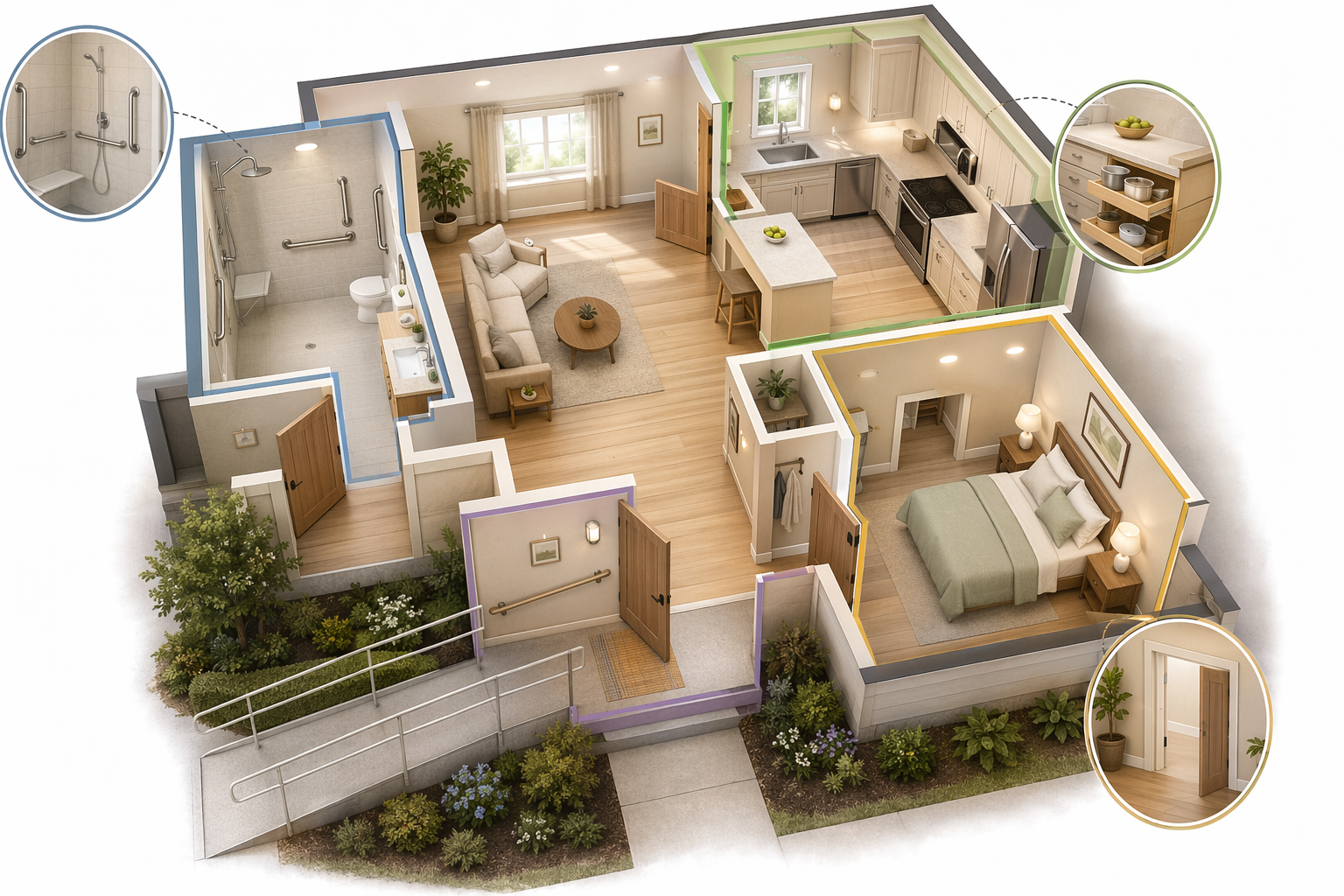
How to Pay for Home Modifications: Financing Options at a Glance
Financing is often the biggest barrier to home modifications. The good news is that several programs exist to help offset costs, though each has specific eligibility requirements.
- Medicare Part B: Covers occupational therapy home evaluations and assistive devices prescribed as medically necessary, but does not pay for structural modifications like grab bar installation, ramp construction, or bathroom remodeling.
- USDA Section 504 Home Repair Program: Offers loans up to $40,000 at 1% interest for low-income homeowners aged 62 and older, plus grants up to $10,000 for removing health and safety hazards.
- VA HISA (Home Improvements and Structural Alterations) Grant: Provides up to $6,800 lifetime for service-connected disabilities to fund ramps, grab bars, widened doorways, and bathroom modifications.
- Rebuilding Together's Safe at Home Program: Provides free home modifications for low-income older adults and veterans through local affiliates.
- Habitat for Humanity Aging in Place Program: Offers low-cost modification services in participating communities.
- Area Agency on Aging: Contact the Eldercare Locator at 1-800-677-1116 to find region-specific programs in your area.
For a detailed comparison of home modification costs versus assisted living expenses, read our aging in place remodel cost vs. assisted living decision guide.
What to Expect During the Renovation Process
Once you have selected a CAPS specialist, secured financing, and finalized the design, the renovation phase begins. Understanding the process helps you prepare your parent — and yourself — for the disruption that comes with construction.
A typical CAPS-guided renovation follows this sequence:
- Design and permitting (1–4 weeks): The CAPS finalizes construction drawings, submits permit applications, and orders materials. Your parent may need to make temporary living arrangements if the work affects the only bathroom or kitchen.
- Demolition and rough-in (1–2 weeks): Walls are opened, plumbing and electrical are relocated, and blocking is installed for future grab bars. This is the noisiest and dustiest phase.
- Construction and finishing (2–6 weeks): New walls go up, flooring is installed, fixtures are mounted, and finishes are applied. The CAPS coordinates subcontractors (plumbers, electricians, tilers) to keep the project on schedule.
- Cleanup and final inspection (1–3 days): The work area is cleaned, debris is removed, and the CAPS performs a final quality check before the walkthrough.
One advantage of working with a CAPS is their training in phased construction. If your budget or timeline cannot accommodate a full remodel at once, a CAPS can sequence the work so that the most critical modifications — bathroom safety, entry access, bedroom accessibility — are completed first, with less urgent upgrades scheduled for later phases.
The Post-Project Walkthrough: Ensuring Safety and Satisfaction
The final walkthrough is your opportunity to verify that every modification meets safety standards, functions as intended, and accommodates your parent's current and anticipated needs. A thorough CAPS will walk through the project with you, but it is your responsibility to ask questions and confirm that nothing was overlooked.
Use this checklist during your walkthrough:
- Grab bars are securely anchored to wall blocking (not just drywall) and can support 250+ pounds of force.
- Doorways measure at least 32 inches wide (or as specified in the plan) for wheelchair or walker clearance.
- Shower entries are flush or have a beveled threshold no higher than 0.5 inches.
- Non-slip flooring is installed in all wet areas and meets the slip-resistance rating specified in the contract.
- Lever-style handles are installed on all doors and faucets — no round doorknobs.
- Lighting is bright, even, and positioned to eliminate shadows and glare, especially in hallways and stairways.
- All electrical outlets and switches are reachable from a seated position (15–48 inches from the floor).
- The turning radius in bathrooms and kitchens is at least 5 feet for wheelchair maneuverability.
- Your parent can safely and comfortably use every modified space — test it together.
If something is not right, address it with the CAPS before making the final payment. Most reputable specialists will correct issues promptly — their reputation depends on the safety and satisfaction of the families they serve.
For a complementary resource on bathroom-specific safety, see our grab bar installation guide and our stair lift cost and funding guide for additional project-specific guidance.
Related reading
Need a professional assessment?
Find a CAPS-credentialed professional or local aging services through our outbound resource list — we never name or rank individual contractors.
Find Local HelpNoticed something outdated or inaccurate on this page? Flag a correction. We review every report against CDC, NIA, and AARP HomeFit guidance before updating a page.