
Room checklist
10 Questions Every Caregiver Should Ask Before Hiring a CAPS Specialist
A practical screening framework for adult children who need to interview and evaluate Certified Aging-in-Place Specialists — including what to listen for in their answers, why the credential alone isn't enough, and red flags that signal it's time to keep looking.
Why Screening a CAPS Matters: Credential vs. Real Experience
Finding a Certified Aging-in-Place Specialist through the NAHB directory is a logical first step. But the credential itself — a designation offered jointly by AARP and NAHB since 2002 — tells you far less than most families assume. The CAPS program requires completing three courses (CAPS I, II, and III), but there are no prerequisites. No industry experience, no education requirement, no licensing, and no certification is needed to enroll. Anyone can take the courses and apply for the credential.
Annual renewal is equally undemanding: 4 hours of continuing education per year, with no documentation submission required, at a cost of $65 for NAHB members or $95 for non-members. That means a CAPS who earned the designation a decade ago and has taken the minimum four hours of CE every year holds the same credential as someone who completed the courses last month and works on aging-in-place projects daily.
This matters because the stakes are high. According to Amy Roberts, a CAPS professional cited in Care.com, less than 4% of U.S. homes are aging-in-place ready. Your parent's home almost certainly needs significant modification. Hiring the wrong specialist means wasted money, delayed timelines, and — worst case — modifications that don't actually meet your parent's needs.
Before you start interviewing, make sure you've identified whether a CAPS is actually needed. Our guide on 11 red-flag signs your parent needs a CAPS specialist can help you decide. Once you're certain, use the following 10 questions as your screening framework.
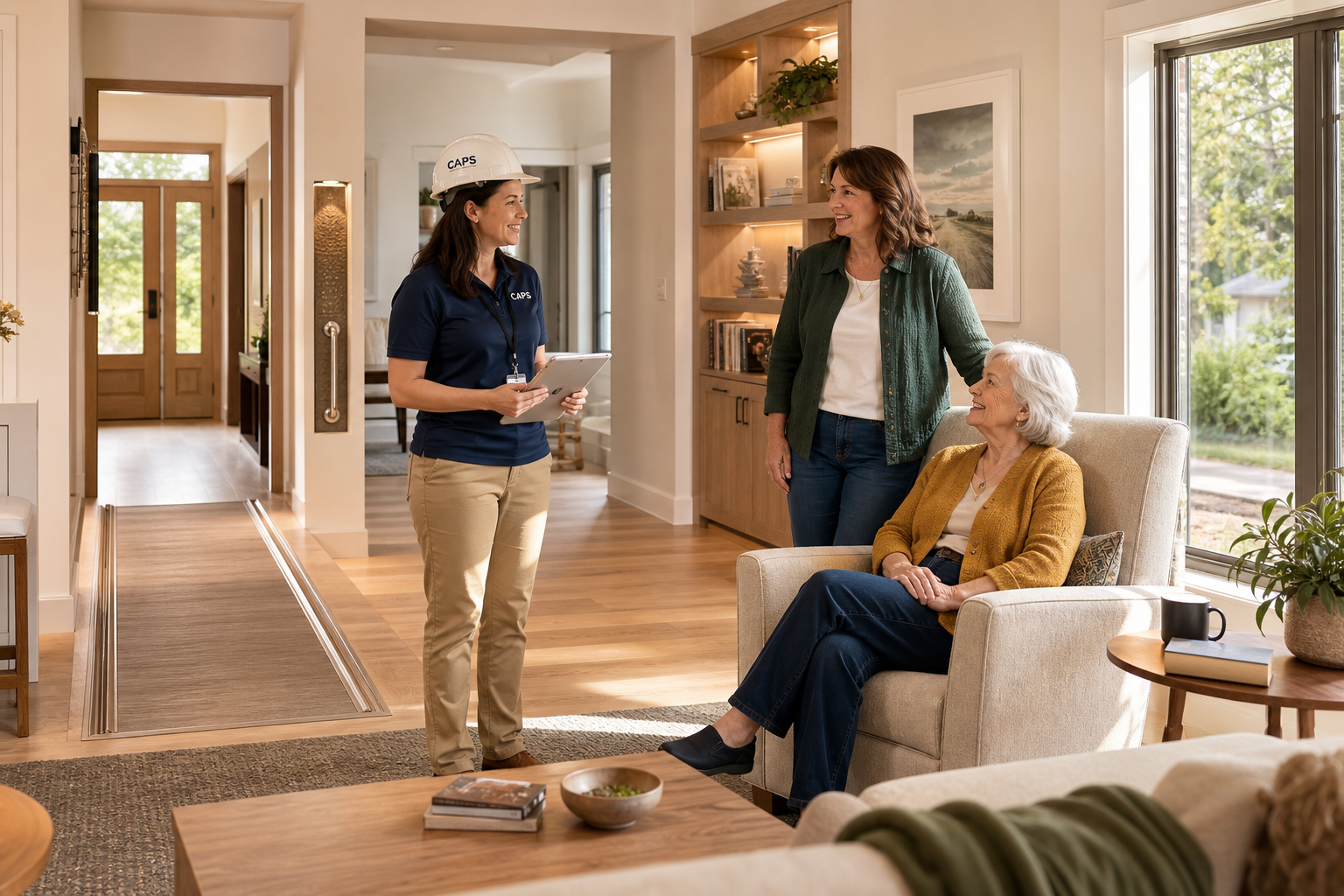
Question 1: What Specific Experience Do You Have With [Parent's Condition]?
A CAPS who has only worked on general aging-in-place projects — grab bars, ramps, wider doorways — may not be equipped to handle the specific challenges your parent faces. Dementia, Parkinson's disease, post-stroke recovery, and progressive mobility limitations each require different design approaches.
A good answer includes concrete examples: "I worked with a family last year whose father had Parkinson's. We installed zero-threshold showers with a built-in seat, added motion-sensor lighting in the hallway for nighttime freezing episodes, and used lever-handle faucets throughout." A vague answer sounds like: "I've done a lot of bathrooms for seniors."
- Ask for the number of projects they've completed for someone with your parent's specific condition.
- Request a description of the most challenging modification they made for that condition.
- Listen for whether they mention collaborating with occupational therapists or physical therapists — a strong signal of condition-aware practice.
Question 2: Do You Have Construction Experience or Do You Subcontract Everything?
This is one of the most important distinctions to understand. CAPS professionals come from diverse backgrounds — construction, healthcare (occupational therapists, physical therapists, nurses), design, real estate, and even nonprofits. A CAPS with a construction background can typically manage the full project: design, permitting, contractor bidding, and oversight. A CAPS without construction experience acts as a consultant — they assess the home, design the modifications, and refer the actual construction work to contractors they know.
Gina Knight, a CAPS interviewed by Care.com, advises looking for someone with construction experience: "You can't just go knocking down walls without the proper knowledge and permit required." Neither model is inherently wrong, but they require different levels of involvement from you.
Question 3: Can You Provide a Phased Plan So We Don't Have to Do Everything at Once?
Most families cannot afford or manage all modifications simultaneously. The average cost for basic modifications to make a single-story home livable is $12,000 to $16,000, and major renovations can range from $10,000 to $50,000 or more. A good CAPS should be willing to prioritize and phase work based on safety urgency and budget.
A well-structured phased plan includes:
- Phase 1: Critical safety modifications (bathroom grab bars, non-slip flooring, improved lighting in high-risk areas)
- Phase 2: Mobility improvements (ramp installation, widened doorways, stair lift if needed)
- Phase 3: Comfort and convenience upgrades (walk-in tub, kitchen modifications, smart-home technology)
- Phase 4: Aesthetic and long-term adjustments (finishing touches, future-proofing for anticipated needs)
If the CAPS cannot or will not break the project into phases with clear cost estimates for each, that's a warning sign. They should understand that your family's financial reality may change over time.
Question 4: Will You Handle Contractor Bidding and Management, or Do We Need To?
The CAPS's role in project management exists on a spectrum. Understanding where a particular specialist falls on that spectrum is essential for setting expectations.
| Service Model | What the CAPS Does | What You Need to Do | Best For |
|---|---|---|---|
| Full-service | Designs, bids, hires, and manages all contractors; single point of contact | Make decisions and approve budgets | Families with limited time or who live far away |
| Co-management | Designs and bids the project; you hire the contractor; CAPS provides oversight | Hire and communicate with the contractor; CAPS handles technical questions | Families who want some control but need expert guidance |
| Consultant-only | Assesses the home and provides a written plan; you find and manage contractors | Source, hire, and manage all contractors independently | Families with construction experience or a trusted contractor already in place |
Be honest with yourself about how much time and energy you can dedicate to project management. If you're a long-distance caregiver working full-time, the full-service model may be worth the higher cost.
Question 5: What Does Your Home Assessment Include — Do You Provide a Written Report With Visuals?
A thorough home assessment is the foundation of every good modification project. A verbal walkthrough is insufficient. A professional CAPS should provide a written report that includes photos, diagrams, or even 3D renderings of proposed changes.
Home safety assessments typically cost between $300 and $1,000, depending on the size of the home and the complexity of the evaluation. A personalized home evaluation with a full report and visuals runs around $500, according to Care.com. What you should expect in that report:
- Room-by-room hazard identification with photographs
- Specific modification recommendations for each identified issue
- Cost estimates for each recommended modification
- A prioritized action plan (which modifications are urgent vs. optional)
- Diagrams or renderings showing how the modifications will look and function
For a detailed walkthrough of what a complete CAPS assessment and renovation process looks like, read our guide on what to expect when you hire a CAPS.
Question 6: Can You Share References From Past Clients With Similar Needs?
References are critical, but not all references are equally useful. A CAPS who has worked primarily on new-construction accessible homes may not be the right fit for a 1950s bungalow that needs retrofitting. Ask specifically for references from clients whose situations are similar to yours — similar home age and layout, similar medical condition, similar budget.
When you call those references, ask these follow-up questions:
- Was the project completed on time and within the original budget?
- How well did the CAPS communicate throughout the process — did they return calls and emails promptly?
- Did the modifications actually solve the safety or mobility problem they were designed for?
- Would you hire this CAPS again if you needed additional work done?
- Is there anything you wish you had known before starting the project?
Question 7: Are You Familiar With Funding Sources Like VA Grants, Medicaid Waivers, or Local Programs?
A CAPS who understands the funding landscape is significantly more valuable than one who only knows how to design and build. With less than 4% of U.S. homes being aging-in-place ready, most families need financial assistance to make their homes safe. A knowledgeable CAPS can help you navigate options like:
- VA Home Improvement and Structural Alterations (HISA) grants — up to $126,526 for eligible veterans (FY2026, subject to annual appropriations)
- Medicaid Home and Community-Based Services (HCBS) waivers — vary by state but can cover home modifications
- USDA Rural Development loans — up to $40,000 for eligible rural homeowners
- Home renovation loans and reverse mortgages
- Local nonprofit programs like Habitat for Humanity's Aging in Place program
A CAPS who can discuss these options knowledgeably — even if they don't handle the paperwork themselves — demonstrates a commitment to helping families afford the care they need. For a complete breakdown of costs and funding, see our guide on how much it costs to hire a CAPS specialist.
Question 8: How Do You Handle Follow-Up After the Project Is Complete?
Aging in place is not a one-time project. Your parent's needs will change over time — a modification that works today may need adjustment in two years as mobility declines or a condition progresses. A good CAPS treats the relationship as ongoing, not one-and-done.
Ask about:
- Warranty on work performed — what is covered and for how long?
- Availability for follow-up questions — do they charge for phone consultations after the project?
- Willingness to return for adjustments — if a grab bar needs to be moved six inches, will they come back?
- Whether they offer periodic reassessments — some CAPS offer annual check-ins to evaluate changing needs
The ideal answer is one that acknowledges the dynamic nature of aging and offers a clear path for future support.
Question 9: What Modifications Do You Recommend We Prioritize First?
This question tests whether the CAPS can think strategically about safety versus convenience versus aesthetics. A good answer prioritizes fall prevention and bathroom safety before cosmetic upgrades. A concerning answer leads with kitchen countertops, new flooring throughout, or other high-cost items that don't address immediate safety risks.
A reasonable priority order from a knowledgeable CAPS:
- Bathroom safety — grab bars, non-slip flooring, shower seat, raised toilet (the bathroom is where most falls occur)
- Entry and exit safety — ramps, handrails, improved lighting at all entrances
- Stair safety — handrails on both sides, improved lighting, stair lift if needed
- Bedroom accessibility — clear pathways, bed transfer aids, night lighting
- Kitchen modifications — pull-out shelves, lever handles, accessible storage
- Aesthetic and convenience upgrades — after all safety needs are addressed
Watch for upselling. If the CAPS immediately recommends a $15,000 walk-in tub before addressing basic grab bar installation, that's a red flag. A walk-in tub may be appropriate, but it should come after the foundational safety modifications are in place.
Question 10: Can You Work With Our Existing Contractors or Do We Need to Use Your Network?
Some CAPS professionals work exclusively with their own network of contractors. Others are happy to collaborate with a contractor the family already knows and trusts. Neither approach is wrong, but you need to know which model you're signing up for before you commit.
If your family has a long-standing relationship with a general contractor, a CAPS who refuses to work with outside contractors may create friction. Conversely, if you don't have a trusted contractor, a CAPS with a vetted network can save you the headache of finding one yourself.
The key is alignment. Ask this question early so there are no surprises when the project starts.

Red Flags to Watch For — and When to Walk Away
Even a CAPS who answers all 10 questions adequately may still not be the right fit. Trust your instincts and watch for these warning signs:
- Vague or evasive answers — if they can't clearly describe their process, experience, or pricing, that's a problem
- Unwillingness to provide references — any legitimate professional should have multiple recent references ready
- Pressure to sign immediately — "This discount is only available if you sign today" is a sales tactic, not a professional approach
- No written report — if they only do a verbal walkthrough and expect you to remember everything, move on
- Dismissiveness about funding — a CAPS who says "just pay for it" without discussing options may not have your family's best interests in mind
- Inability to explain their process clearly — if you don't understand what will happen and when, imagine how confusing it will be mid-project
- Leads with expensive upgrades before basic safety — this suggests they prioritize profit over your parent's safety
Finding the right CAPS takes time, but it's time well spent. The difference between a good specialist and a great one can mean the difference between modifications that merely exist and modifications that actually enable your parent to live safely and independently at home for years to come.
Related reading
Need a professional assessment?
Find a CAPS-credentialed professional or local aging services through our outbound resource list — we never name or rank individual contractors.
Find Local HelpNoticed something outdated or inaccurate on this page? Flag a correction. We review every report against CDC, NIA, and AARP HomeFit guidance before updating a page.