
Caregiver decision guide
Mitch McConnell's Fall: A Caregiver's Guide from ER to Rehab
Using Mitch McConnell's June 2026 fall and hospitalization as a real-world example, this guide walks family caregivers through every stage of post-fall care — from the initial phone call through ER assessment, hospital stay, discharge planning, and rehab transition — with practical checklists and advocacy tips.
The first call rarely arrives with enough information. An older parent has fallen. They may be unconscious, confused, or already on the way to the emergency room. Someone says “possible head injury.” Someone else says “they’re checking his heart.” You are trying to find shoes, a charger, the medication list, and the name of the hospital while also deciding whether you should drive, book a flight, or start calling relatives.
That is the useful part of the Mitch McConnell health update and elderly care story: not the politics around it, but the sequence it made visible. In June 2026, McConnell reportedly fell at home, lost consciousness, was taken by emergency medical services, underwent cardiac evaluation, CT and MRI neuroimaging, and screening for fractures and other serious causes, developed pneumonia during a roughly four-week hospitalization, and was later transferred to a rehabilitation facility.[1][2][3] His care is not a template for every patient. But the path from fall to ER to monitoring to discharge planning to rehab is familiar to many families who suddenly learn that “he fell” is not one event. It is the beginning of a chain.
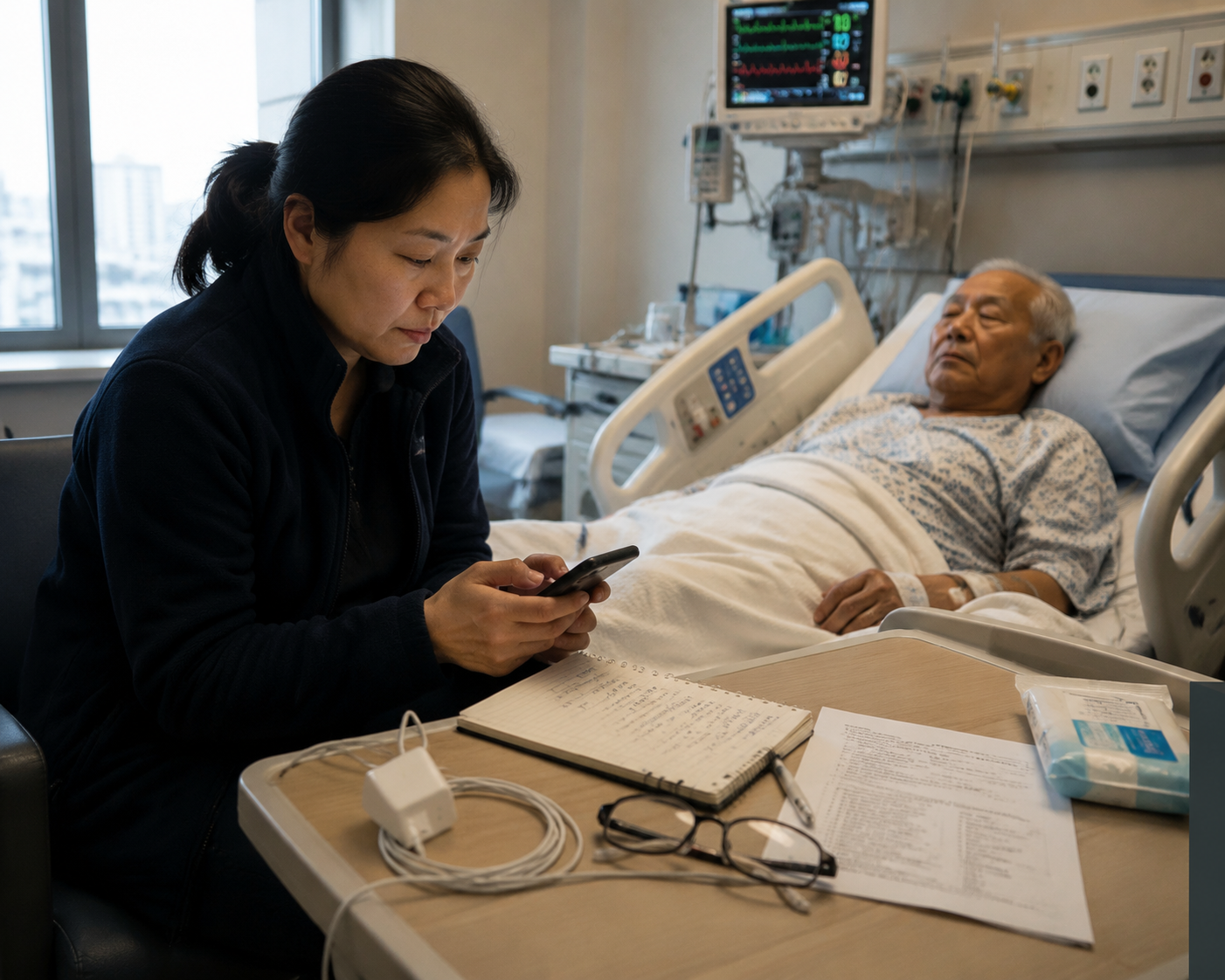
Falls are common enough that no family should treat them as freak accidents. The CDC reports that about 1 in 4 older adults falls each year, and falls are the leading cause of injury death among adults 65 and older, with more than 38,000 deaths annually, 3 million emergency department visits, and 1 million hospitalizations in the most recently cited CDC figures.[4] Those numbers matter because they explain why hospital teams move quickly after a serious fall. The better question for a family is what to do while that machinery is moving.
When You Get the Call
Your first job is not to diagnose the fall. It is to become the person who can supply context the ER may not have. A paramedic or triage nurse can see blood pressure, oxygen level, injuries, and alertness in the moment. They may not know whether your parent normally walks without help, mixes up words at baseline, takes a blood thinner, recently started a new medication, or had been complaining of dizziness for three days.
If you are going to the hospital, bring or send the information that changes decisions:
- Current medication list, including blood thinners, sleep medications, blood pressure drugs, diabetes medications, over-the-counter pills, and supplements.
- Known diagnoses, allergies, recent infections, recent medication changes, and recent hospitalizations.
- Baseline cognition: whether your parent is normally sharp, forgetful, confused at night, or already diagnosed with dementia.
- Baseline mobility: cane, walker, wheelchair, independent walking, recent near-falls, trouble with stairs, or help needed for bathing and toileting.
- What happened before and after the fall: dizziness, chest pain, shortness of breath, fainting, trip hazard, loss of consciousness, head strike, vomiting, weakness, slurred speech, or confusion.
- Emergency contacts, primary care clinician, specialists, pharmacy, advance directive, health care proxy, and insurance information if available.
If you are long-distance, do not wait until you can physically arrive to start helping. Call the ER main number and ask how to provide medication and baseline information. Ask which family member is listed as the contact. If your parent can speak, ask permission to be included. If they cannot, ask how the hospital is handling surrogate decision-making and whether any advance directive is already on file.
Why the First 24 to 48 Hours Can Feel Like Too Much
A serious fall in an older adult often produces a crowded first day. One person asks about the fall. Another asks about chest pain. Someone orders imaging. Someone wants a urine sample. A nurse asks whether your parent normally knows the date. A physical therapist may appear sooner than the family expects. It can feel as if the hospital is looking everywhere except at the obvious injury.
That broader search has a reason. A fall may be caused by a trip, but it may also follow fainting, arrhythmia, stroke symptoms, infection, dehydration, medication side effects, low blood sugar, or weakness from an illness. In McConnell’s reported hospitalization, clinicians evaluated cardiac causes, performed CT and MRI neuroimaging, and screened for fractures, stroke, tumor, and hemorrhage, with reports saying those major findings were ruled out.[1][2][3] That does not mean every older adult gets the same battery of tests. It means families should understand why a post-fall evaluation may look wider than a broken-bone search.
| What the hospital may be checking | Why it matters after a fall | What a caregiver can clarify |
|---|---|---|
| Head injury or neurological event | Confusion, loss of consciousness, weakness, speech changes, or head strike may require urgent evaluation. | Was this confusion new? Did anyone see a head strike? Was there vomiting, severe headache, or one-sided weakness? |
| Heart rhythm or cardiac cause | Some falls begin as fainting or near-fainting rather than a simple trip. | Did your parent report chest pain, palpitations, shortness of breath, or sudden dizziness before falling? |
| Fractures and hidden injuries | Older adults may have serious pain, pelvic injury, hip injury, or spine injury even when the first story sounds minor. | Could they bear weight before EMS arrived? Where is pain new compared with their usual aches? |
| Medication effects | Sedatives, blood pressure drugs, diabetes medications, and multiple prescriptions can contribute to dizziness or confusion. | Which medications were taken that day, and were any recently started, stopped, or changed? |
| Infection or dehydration | Illness can cause weakness, delirium, and poor balance before anyone recognizes a fever or respiratory symptom. | Was there cough, fever, poor eating, urinary symptoms, diarrhea, or unusual sleepiness before the fall? |
The phrase “no fracture” can be a relief and still not mean your parent is safe to go home. A person may have no broken bone but still be weak, dizzy, delirious, unable to transfer from bed to chair, newly incontinent, unable to manage stairs, or unsafe alone overnight. Families sometimes hear one good test result and think the crisis is over. Hospital staff may be thinking about observation, therapy evaluation, oxygen needs, medication changes, or whether a rehabilitation stay is needed.
Watch for Complications That Appear After Admission
McConnell’s hospitalization reportedly included treatment for pneumonia before transfer to rehab.[1][2][3] For families, the lesson is not that pneumonia follows every fall. It is that hospitalization itself can introduce new risks: less walking, disrupted sleep, pain medication, unfamiliar surroundings, swallowing issues, oxygen problems, or infection. An older adult who entered the hospital for a fall may have a second problem emerge while everyone is still focused on the first one.
Delirium deserves the same practical attention. It is not just “acting weird” or “being difficult.” If your parent is suddenly more confused, hallucinating, agitated, sleepy, or unable to follow a conversation, tell the nurse how this differs from baseline. Ask whether pain, infection, dehydration, constipation, oxygen level, medication effects, or sleep disruption are being considered. You do not have to use medical language perfectly. You do have to be specific: “Yesterday she knew where she was; today she thinks she is at home” is useful information.
A notebook helps because the hospital day fragments attention. Write down the date, names, test names, new medications, therapy recommendations, and unresolved questions. If two clinicians give different names for the same next destination—rehab, skilled nursing, post-acute care—ask them to clarify whether they mean the same facility type and what insurance approval is pending.

The Questions to Ask Before Discharge Is Already in Motion
Discharge planning often starts before a family feels ready. That is not automatically negligence; hospitals have to plan for the next level of care as soon as the patient’s medical direction becomes clearer. The problem is that families may hear “stable” and translate it as “back to normal.” In hospital language, stable may only mean the patient no longer needs that level of acute care.
This is where vague advice to “advocate” becomes too soft. Advocacy means asking concrete questions while there is still time to change the plan:
- What do you believe caused the fall, and what remains uncertain?
- Which new diagnoses or complications occurred during the hospital stay?
- Which medications were started, stopped, or changed, and why?
- Can my parent get out of bed, stand, transfer, walk, toilet, and climb stairs at the level required for home?
- Is rehab being recommended, and if so, what type of facility or therapy level is being discussed?
- Who will teach the caregiver wound care, injections, oxygen use, medication timing, mobility assistance, or warning signs if those tasks are expected at home?
The Family Caregiver Alliance emphasizes that discharge planning should identify the help a person will need after leaving the hospital and that family caregivers may need instruction before taking on care tasks. It also notes the CARE Act, which in states that have enacted it generally requires hospitals to record a family caregiver when a patient designates one, notify that caregiver before discharge, and provide instruction for medical or nursing tasks the caregiver will perform at home, though details vary by state.[5]
That state-by-state variation matters. Do not assume the law automatically covers every situation in the same way. Ask the hospital directly: “Does our state have a CARE Act requirement, and am I listed as the caregiver to be notified and trained before discharge?” If the answer is unclear, ask for the discharge planner, case manager, or social worker.
If you are not at the bedside, request a phone or video discharge meeting. A tired spouse in the room may nod through instructions they cannot safely carry out alone. A daughter across the country may be the person who can arrange paid help, move furniture, compare rehab facilities, or catch that the medication list still contains a drug the hospitalist meant to stop.
Rehab Is Not a Waiting Room
After McConnell’s extended hospitalization, reports said he was transferred to a rehabilitation facility.[1][2][3] For families, rehab can sound like a vague place where someone “gets stronger.” It is better to think of it as a time-limited test of what the person can safely do next: sit up, stand, walk, use a walker, manage stairs, transfer to a toilet, conserve energy, swallow safely if that is an issue, and follow instructions closely enough to avoid another fall.
The CDC describes fall-related hospitalizations and recovery in terms that can range from days to about a month depending on injury severity, health status, and function.[4] That range is not a promise. Some people regain their prior level quickly. Others leave rehab needing home health, home care, equipment, or a different living arrangement. What matters is not whether rehab sounds like progress. It is whether the rehab team can tell you what progress is being measured.
- Ask what the therapy goals are: distance walked, transfer ability, stairs, balance, endurance, toileting, dressing, or safe use of equipment.
- Ask what level of help your parent currently needs: independent, supervision, one-person assist, two-person assist, or mechanical lift.
- Ask whether cognition is affecting safety: remembering walker use, calling for help, understanding medications, or following precautions.
- Ask what could block return home: stairs, bathroom access, nighttime toileting, oxygen, wounds, medication complexity, or lack of caregiver support.
- Ask for the expected discharge date as an estimate, not a guarantee, and ask what would change it.
The most useful rehab meetings are plain-spoken. “Can he get from bed to bathroom at 2 a.m. without someone holding him?” may matter more than “Is he improving?” “Can she climb the three steps into the house?” is different from “Can she walk in the therapy gym?” The therapy gym is level, supervised, and designed for success. Home has thresholds, pets, narrow bathrooms, dim hallways, and a favorite chair that may be too low to stand from safely.
The Conversation Most Families Avoid Until Too Late
McConnell said after his hospitalization, “Folks of my generation often hesitate to share the vulnerability that comes with growing older.”[6][7] That line lands because many families recognize it immediately. A parent may minimize dizziness, refuse a walker, insist the fall was a fluke, or reject help from an adult child who still feels, to them, like someone they raised.
The point is not to win an argument about pride. The point is to make safety specific enough that help does not sound like surrender. The National Council on Aging’s falls prevention guidance encourages families to talk about fall risk, health changes, medications, vision, home hazards, and practical prevention steps rather than treating the topic as a single confrontation.[8]
A useful conversation after a hospitalization might begin with what the rehab team observed: “They said you are steady with the walker in therapy but still need someone nearby for bathroom transfers.” Or with a time-limited trial: “Let’s use home health and remove the rugs for the first month, then reassess.” Or with a choice that preserves control: “Would you rather start with a shower chair and grab bar, or have an aide come for bathing twice a week?”
If health secrecy and independence have been long-running family patterns, it may help to read more about why aging parents hide health problems. The hospital crisis may be the first time the pattern becomes visible to everyone else.
Before Rehab Discharge, Make Home Match the New Reality
Rehab discharge can feel like good news with a deadline attached. Families may have a few days to make the home workable. Start with the route your parent will actually use: car to door, door to chair, chair to bathroom, bathroom to bed, bed to kitchen. Clear paths matter more than buying every product marketed for seniors.
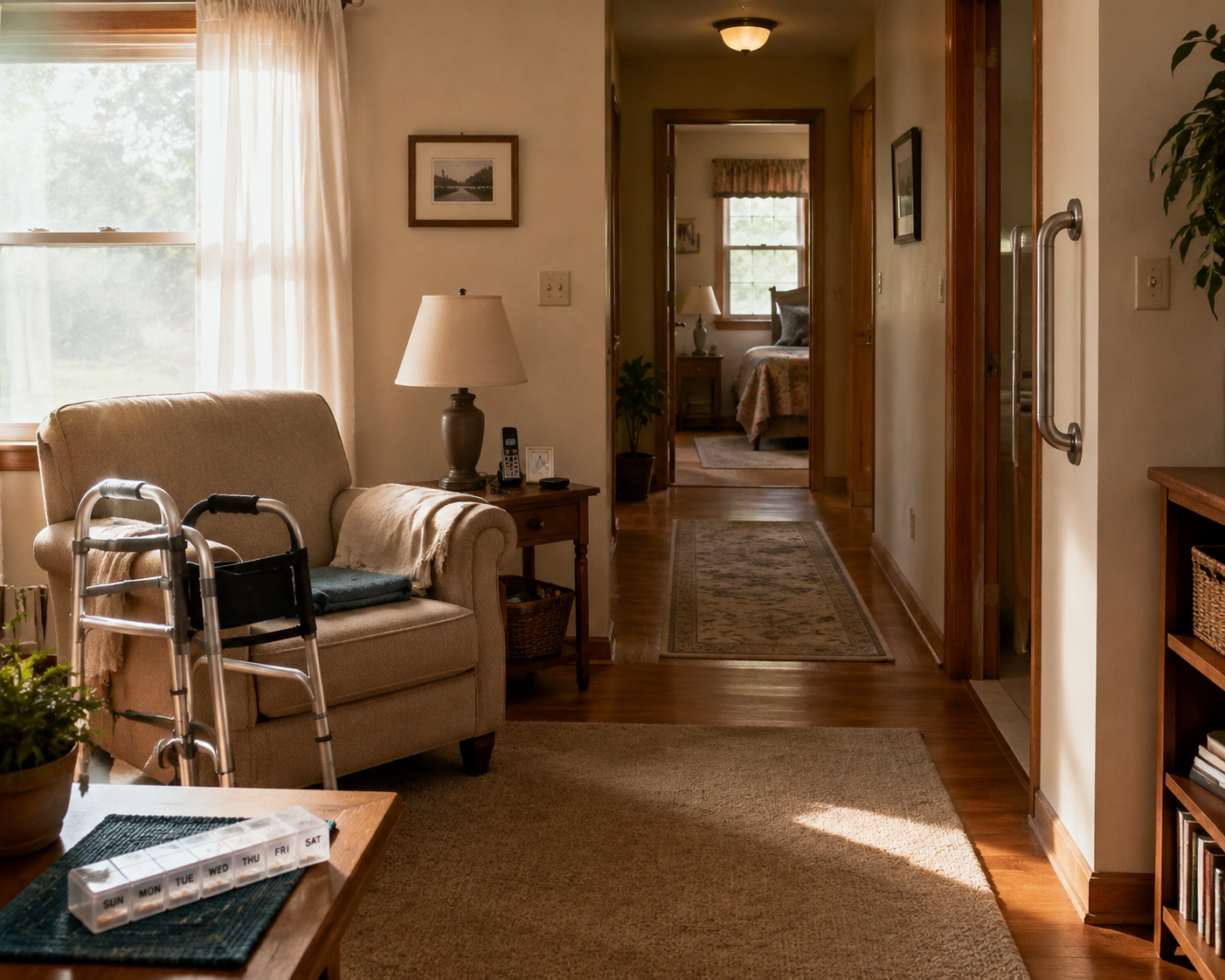
- Remove throw rugs, cords, clutter, low tables, and anything that narrows the walking path.
- Check lighting from bedroom to bathroom, especially for nighttime trips.
- Place the phone, charger, water, glasses, hearing aids, walker, and call button or alert device within reach.
- Ask whether the bed, toilet, shower, and favorite chair are too low or unsafe for transfers.
- Confirm equipment before discharge: walker, wheelchair, commode, shower chair, grab bars, oxygen, wound supplies, or medication organizer.
- Schedule follow-up appointments and know who to call for fever, worsening confusion, shortness of breath, chest pain, new weakness, uncontrolled pain, or another fall.
Also ask what kind of help is being ordered. Skilled home health may include nursing, physical therapy, occupational therapy, or speech therapy when medically indicated. Non-medical home care may help with bathing, meals, supervision, transportation, and household tasks. Families often use the words interchangeably, but the services, payment rules, and purposes differ. If that distinction is new, start with what senior home health care services include and then compare home health versus home care for the decision after discharge.
A fall should also trigger a broader care assessment, not only a cleanup of the spot where it happened. The question is whether the old setup still fits the person coming home. That may involve home modifications, more supervision, medication review, vision care, strength and balance work, or a change in how the family shares responsibility. For a deeper next step, see when a fall signals it is time for help and what aging-in-place modifications cost and save.
McConnell’s case is useful only if it keeps its proper size. It does not predict your parent’s diagnosis, length of stay, rehab outcome, or home needs. It does show the sequence caregivers are often asked to navigate with very little warning: the call, the ER questions, the tests, the complications, the discharge meeting, the rehab goals, and the home that must be ready before the door opens.
References
- AP News report on Mitch McConnell’s June 2026 fall and hospitalization, AP News
- USA Today report on Mitch McConnell’s hospitalization and rehabilitation transfer, USA Today
- BBC report on Mitch McConnell’s fall, testing, pneumonia, and rehab transfer, BBC
- Older Adult Falls Data, Centers for Disease Control and Prevention
- Hospital Discharge Planning: A Guide for Families and Caregivers, Family Caregiver Alliance
- The Guardian report quoting Mitch McConnell on vulnerability and growing older, The Guardian
- NPR report quoting Mitch McConnell on vulnerability and growing older, NPR
- Falls Prevention Conversation Guide for Caregivers, National Council on Aging
Questions to bring to a clinician or OT
This is not medical, legal, or a family's final decision — only a framework. Bring these questions to a clinician, occupational therapist, or your local Area Agency on Aging.
Find Local HelpRelated reading
Noticed something outdated or inaccurate on this page? Flag a correction. We review every report against CDC, NIA, and AARP HomeFit guidance before updating a page.