
Caregiver decision guide
National Night Out activities for seniors by mobility level
The real question behind "National Night Out activities for seniors" is which activities fit an older adult's mobility and energy on a warm August evening. This guide answers it with a graded activity list — seated, light-movement, and observe-and-enjoy options — plus a caregiver planning checklist for heat, hydration, and dusk fall risk.
It is the evening of August 4, 2026: the block party is tonight, the pavement is still warm, the food table is probably farther from the parking than anyone remembers, and an older parent may be very clear about wanting to go. That is the right starting point for choosing National Night Out activities for seniors. The question is less “Is this event for older adults?” and more “Which part of it can be enjoyed without a long stand, a hot wait, or a difficult walk back after dusk?”
National Night Out is generally observed on the first Tuesday in August, with Texas and select areas celebrating on the first Tuesday in October, and its usual shape is familiar: block parties, cookouts, safety demonstrations, and visits from emergency personnel meant to strengthen neighborhood-police partnerships [1]. City and event-planning examples add the details most families recognize — ice cream socials, hot dogs and lemonade, potlucks, movie nights, dancing lessons, thank-you cards for officers, photo booths, cornhole or ladder golf, chalk galleries, scavenger hunts, food-bank collections, and K9 demonstrations [2][3].
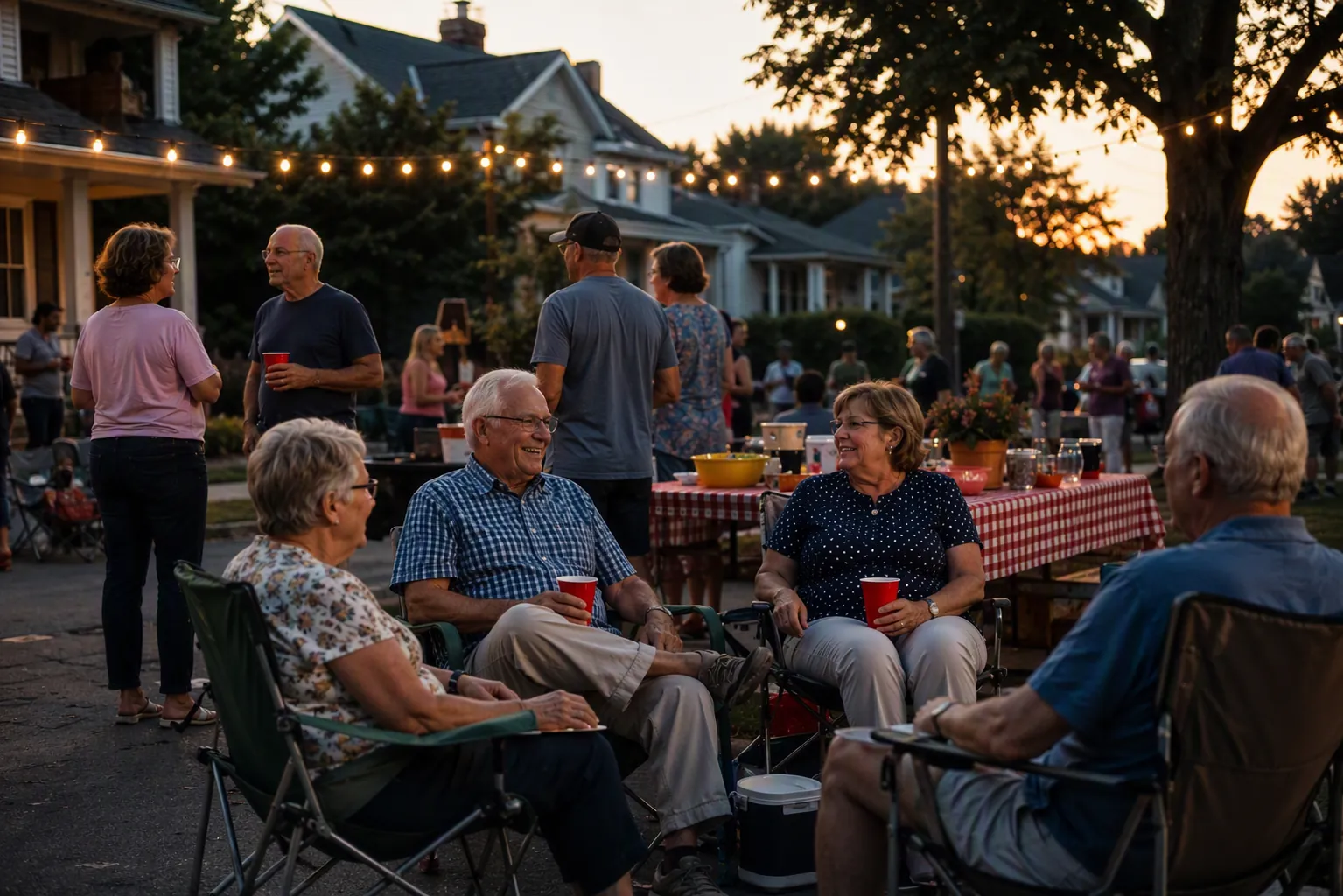
Older adults are not just theoretical guests at these events. Kensington Park Senior Living has promoted an annual National Night Out block party with live music and a police meet-and-greet [4]. Community Action Marin and Vivalon have shown a senior-focused “Seniors in Sync” National Night Out format, though that page reflects a prior event date and should be verified locally before treating it as a current listing [5]. Wikipedia also describes Sycamore Senior Village in Oxnard hosting National Night Out cookouts with live music, dancing, and police, fire, and paramedic visits; because that example is reported through Wikipedia, it is useful as a secondary-source example rather than proof of a current local program [6].
Match the evening to the body that is actually going
A senior-friendly National Night Out activity is not automatically the quietest or most “wholesome” thing on the flyer. It is the activity that has a seat, a short commitment, a clear exit, water within reach, a tolerable noise level, and a way to stop before fatigue turns into a problem. That may still include the fire truck, the hot dog table, the music, and the officer saying hello. It just changes the format.
| Mobility and energy level | Good activity matches | What makes it work |
|---|---|---|
| Seated or low-energy | Ice cream social, cookout meal, lemonade table, photo booth, thank-you-card table, safety-demo viewing, police/fire meet-and-greet from a chair, quiet music listening | Chair placed before the activity starts, shade or indoor cooling nearby, food brought to the table, short visit with an easy exit |
| Light movement | Cornhole, ladder golf, washers, one-song dance lesson, short scavenger-hunt loop, walking between nearby booths | One round instead of a tournament, chair at the waiting spot, level route, shaded rest point, permission to stop early |
| Observe and enjoy | K9 demo, fire truck visit from the edge, live music from a quieter seat, movie night, chalk gallery, people-watching near the main path | View from the side rather than the center, no pressure to stand in a crowd, route back to the car planned before dark |
Seated and low-energy activities deserve first pick
For many older adults, the best hour at National Night Out begins with a chair, not with a lap around the event. A folding chair under a tree, a shaded picnic table, or an indoor community-room seat can turn the same cookout from a test of endurance into a real visit with neighbors. If there is a food line, one person can wait while the older adult stays seated. If the event is spread across a parking lot, choose the seat before choosing the food.
Ice cream socials, lemonade tables, hot dogs, and potluck plates are often the easiest entry point because they already give the evening a purpose. The adaptation is simple: sit first, eat second, wander only if there is still energy. A small plate may be easier to manage than a full tray. A lidded cup or water bottle is safer than balancing an open drink while using a cane, walker, or another person’s arm.
August heat matters most during exactly these “easy” activities, because waiting in one place on asphalt can become harder than walking a short distance. People age 65 and older are more prone to heat-related illness and adjust less well to sudden temperature changes, according to CDC guidance [7]. CDC heat guidance also emphasizes drinking fluids, wearing lightweight and loose-fitting clothing, reducing activity, and using cooler spaces when heat is a concern [8]. For a National Night Out caregiver, that translates into a plain plan: water in hand before the first conversation, shade before the meal, and a cooling break before anyone looks flushed or worn down.
A police, fire, or paramedic meet-and-greet can also be seated. There is no rule that the older adult has to walk over to every vehicle or stand in front of a booth. If firefighters are letting children see the truck, an older guest can sit near the edge and greet them when the crowd thins. If officers are circulating, a caregiver can say, “My mother would love to say hello, but she is staying seated tonight.” That small sentence prevents the event from becoming a slow chase across the lot.
Safety demonstrations work best from the side, not the middle. A chair near the front edge gives a clear view without trapping anyone in the crowd. For someone with hearing loss, the better seat may be closer to the presenter but away from speakers. For someone who tires quickly, the better seat may be farther back, where leaving after ten minutes does not require stepping through children, leashes, strollers, and folding chairs.
Photo booths and thank-you-card tables are underrated for older adults because they create participation without much walking. A seated photo works. Signing a card to thank local officers or firefighters works. A grandparent helping a child choose a sticker or write a note works. These are not filler activities; they are a way to be visible in the neighborhood without making balance, stamina, or speed the price of admission.
Music can be either the highlight or the reason to leave, depending on placement. The senior-compatible version is not necessarily “no music.” It is a seat far enough from the speaker to talk, close enough to enjoy the rhythm, and easy enough to leave if the sound becomes tiring. A cardigan or light layer can help once the sun drops, especially if the event moves from hot pavement to a breezy shaded area.
Light-movement activities can work when they stay short
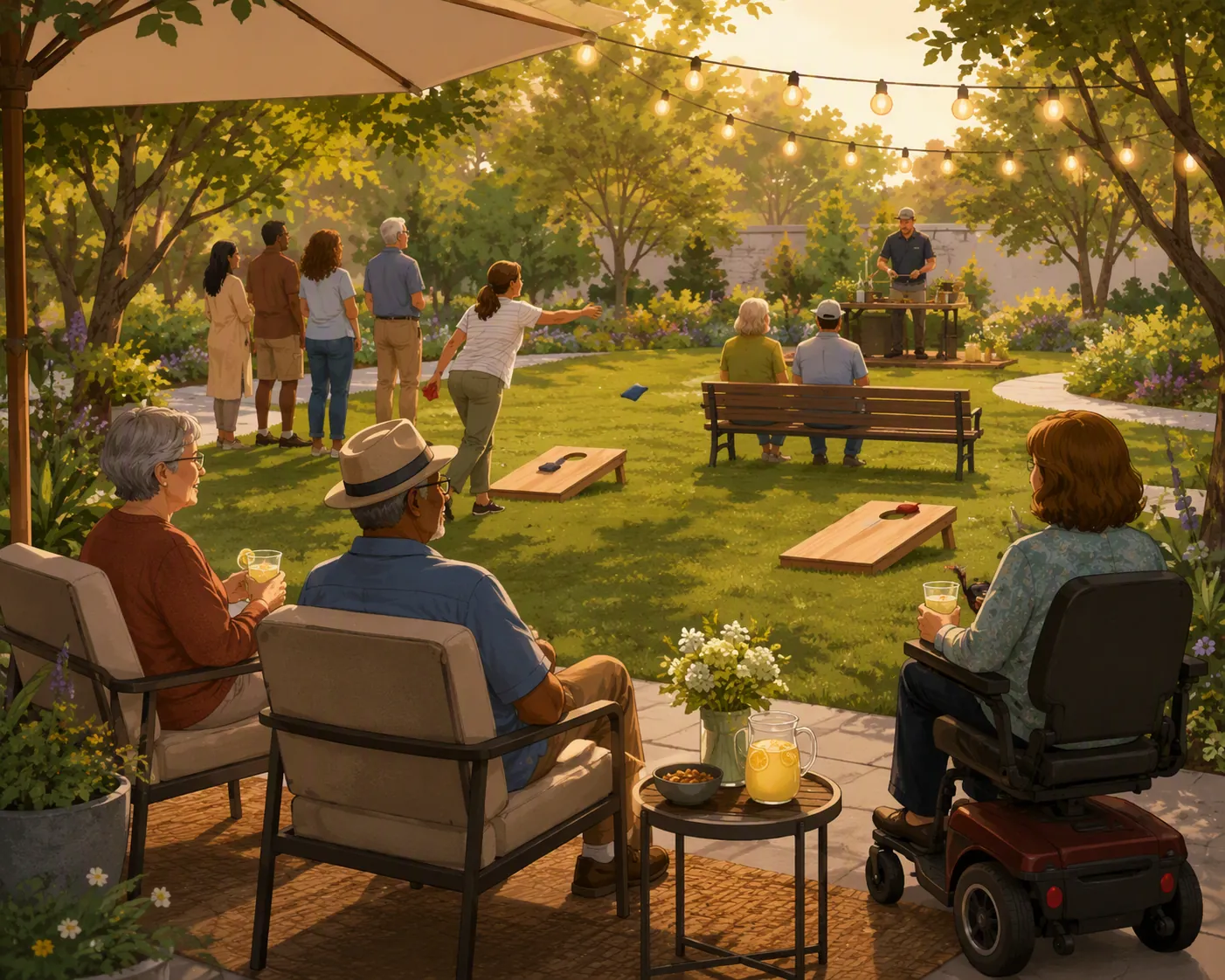
Cornhole, ladder golf, and washers are reasonable National Night Out activities for many seniors if the event does not quietly turn them into a standing tournament. One round is different from twenty minutes of waiting in line. A chair at the game area matters as much as the game itself. So does the surface: a level sidewalk, firm grass, or smooth pavement is far better than a sloped lawn with hidden dips.
- For cornhole: let the older adult throw from a closer line, from a seated position, or only for one turn.
- For ladder golf or washers: skip tournament brackets and play a casual “best of a few throws” round.
- For any lawn game: place a chair at the waiting spot, not twenty feet away after the fatigue has already started.
- For a walker or rollator user: check whether the route to the game crosses grass, gravel, cords, hoses, curbs, or crowded bottlenecks.
If the older adult is debating which aid to bring, it is worth deciding before the event rather than at the trunk of the car. A cane may be enough for a restaurant doorway but not for a long parking-lot crossing; a rollator may provide a seat but may also be awkward if the crowd is packed. Caregivers comparing options can use a walker-vs-rollator balance guide before choosing what goes in the car.
Short scavenger hunts can work if “hunt” means a small loop, not a neighborhood trek. Pick three nearby stops: the fire truck, the lemonade table, and the chalk art; or the officer table, the photo booth, and the shaded music area. The point is not to finish every clue. The point is to give the outing a little motion without letting the farthest booth decide how far everyone has to walk.
Dancing lessons need the same trimming. One seated rhythm exercise, one slow song, or a few steps beside a chair may be enough. A person who once loved dancing may enjoy the music and the memory without needing to prove anything on uneven pavement. If balance is uncertain, the chair stays within reach and the “lesson” ends while it is still fun.
Walking between booths is its own activity. Treat it that way. Instead of saying, “Let’s go see everything,” choose the next visible stop and pause there. The caregiver who knows where the next chair is has a much easier evening than the caregiver who hopes there will be one.
Observe-and-enjoy choices count as participation
Some older adults will enjoy National Night Out most from the edge. That may mean watching a K9 demonstration, listening to live music from the quieter side of the crowd, looking at a chalk gallery, sitting near the fire truck while children climb in and out, or staying for the first half of an outdoor movie. None of those choices is a failure to participate.
The edge seat is often better than the center seat. It offers the same sights with less jostling, a clearer route to the bathroom, and a faster exit if the heat, noise, or crowd becomes too much. It also lets an older adult receive the neighborhood rather than perform stamina for it.
Movie nights require extra judgment because they usually improve socially as they worsen physically: the air cools, more people settle in, and the ground becomes harder to read. If the older adult has low vision, neuropathy, balance problems, or a history of falls, plan the exit before the movie starts. Sit near the route out, keep a small flashlight available if allowed, and leave before the crowd stands up at once.
The caregiver checklist that protects the outing
A little planning should make the evening feel more possible, not more clinical. The goal is to remove the predictable problems before they become the whole memory of the night.
- Check the heat plan before leaving. Bring water, choose lightweight loose clothing, look for shade or indoor cooling, and reduce activity rather than trying to “push through” a hot evening; these align with CDC heat-health guidance [8].
- Consider medications and medical conditions. CDC notes that older adults are more vulnerable to heat-related illness, and that risk can be affected by factors such as chronic medical conditions and certain medicines [7]. If heat sensitivity is likely, choose the seated version of the event from the start.
- Name the stopping signs. If the older adult becomes dizzy, confused, unusually weak, nauseated, faint, or much more tired than expected, the plan is not another booth; it is shade, fluids if appropriate, cooling, and help if symptoms are serious or do not improve [8].
- Park for the exit, not just the entrance. Accessible parking, a curb cut, and a short well-lit route back matter more at 8:30 p.m. than they did on arrival.
- Treat dusk as a fall-risk change. More than one in four older adults falls each year, and CDC emphasizes that falls can be prevented; the same CDC older-adult safety page also notes that night driving raises crash risk [9]. Leave before full dark if walking surfaces, traffic, or vision are concerns.
- Bring the mobility aid that fits the event surface. Smooth sidewalks, grass, gravel, cords, and crowd density all change the answer. If there has been a recent fall or near-fall, use a post-fall aging-in-place checklist before assuming an evening crowd will be manageable.
- Locate the bathroom early. A bathroom that is technically available but across a dark lawn or up a step may not be practical.
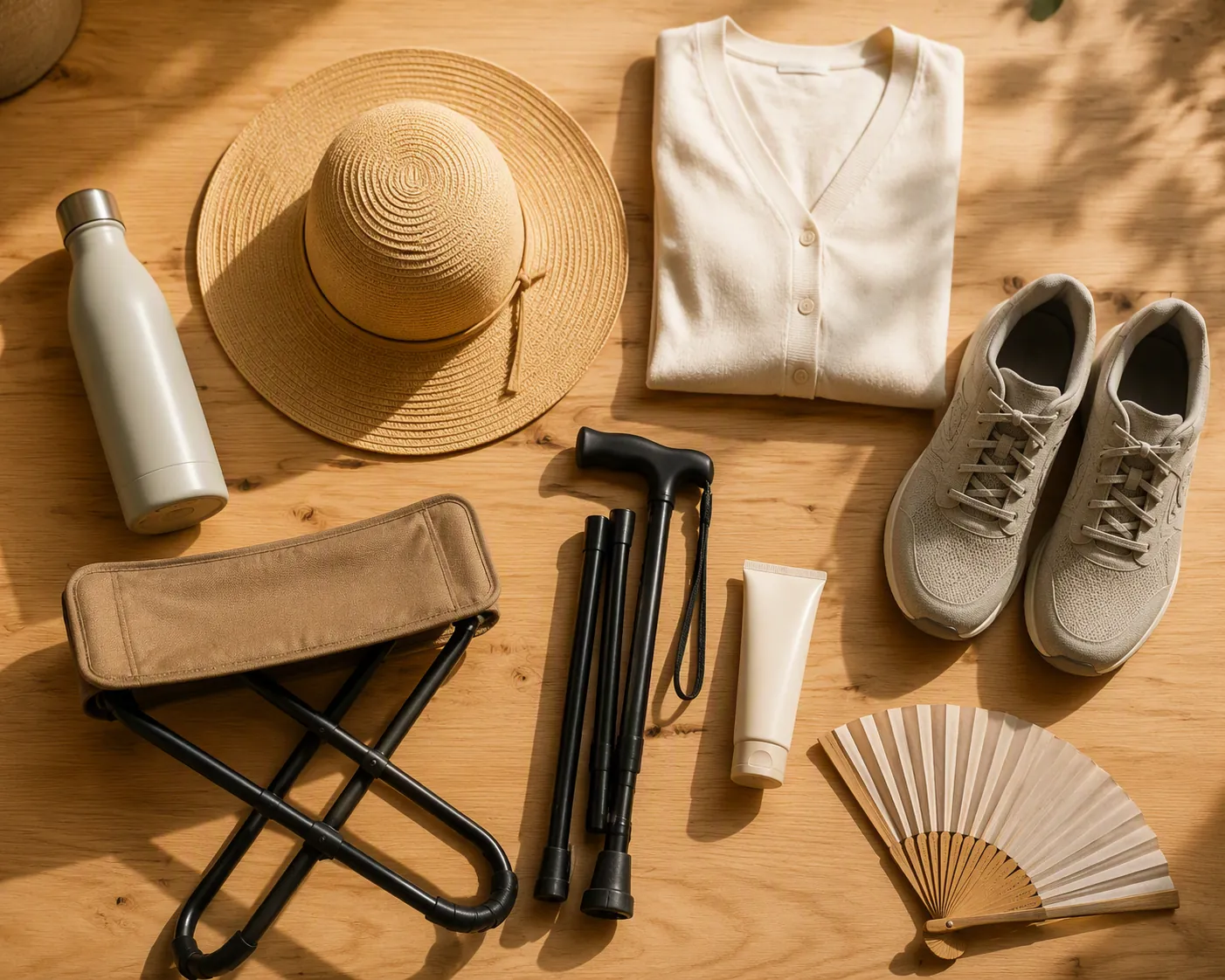
- Carry small comfort items. A hand fan, hat, light layer, water bottle, medication list, phone, and a small snack can prevent a short outing from becoming a long problem.
- Use home as part of the route. Porch lighting, railings, steps, thresholds, and uneven walkway edges still matter after the event. A plan-ahead mobility checklist or an aging-in-place home checklist can help families notice those hazards before the next evening outing.
For most families, the workable plan is modest: arrive early enough to park close, sit in shade, enjoy one food or music activity, greet one or two safety personnel, and leave before the hardest walking conditions begin. National Night Out does not have to be off-limits for an older adult. It needs the right format, the right stopping point, and a simple heat-and-fall plan before anyone leaves home.
References
- About | National Night Out — National Association of Town Watch
- National Night Out | City of Saint Paul Minnesota — City of Saint Paul Minnesota
- 10 National Night Out Activity Ideas to Increase Attendance — PowerDMS
- Annual National Night Out Block Party — Kensington Park Senior Living
- National Night Out – Seniors in Sync — Community Action Marin
- National Night Out — Wikipedia
- Heat and Older Adults (Aged 65+) — CDC
- About Heat and Your Health — CDC
- Still Going Strong: Older Adults — CDC
Questions to bring to a clinician or OT
This is not medical, legal, or a family's final decision — only a framework. Bring these questions to a clinician, occupational therapist, or your local Area Agency on Aging.
Find Local HelpRelated reading
Noticed something outdated or inaccurate on this page? Flag a correction. We review every report against CDC, NIA, and AARP HomeFit guidance before updating a page.