
Caregiver decision guide
Free National Park Day? Mobility-Limited Seniors Need a Pass
For mobility-limited seniors, a federal recreation pass beats waiting for free national park days in 2026: the free lifetime Access Pass and the $20/$80 Senior Pass waive entrance fees on every visit, while fee-free days are fewer, resident-only, and crowded. Readers learn which pass they qualify for, how to get it, and when a fee-free day is still a worthwhile bonus.
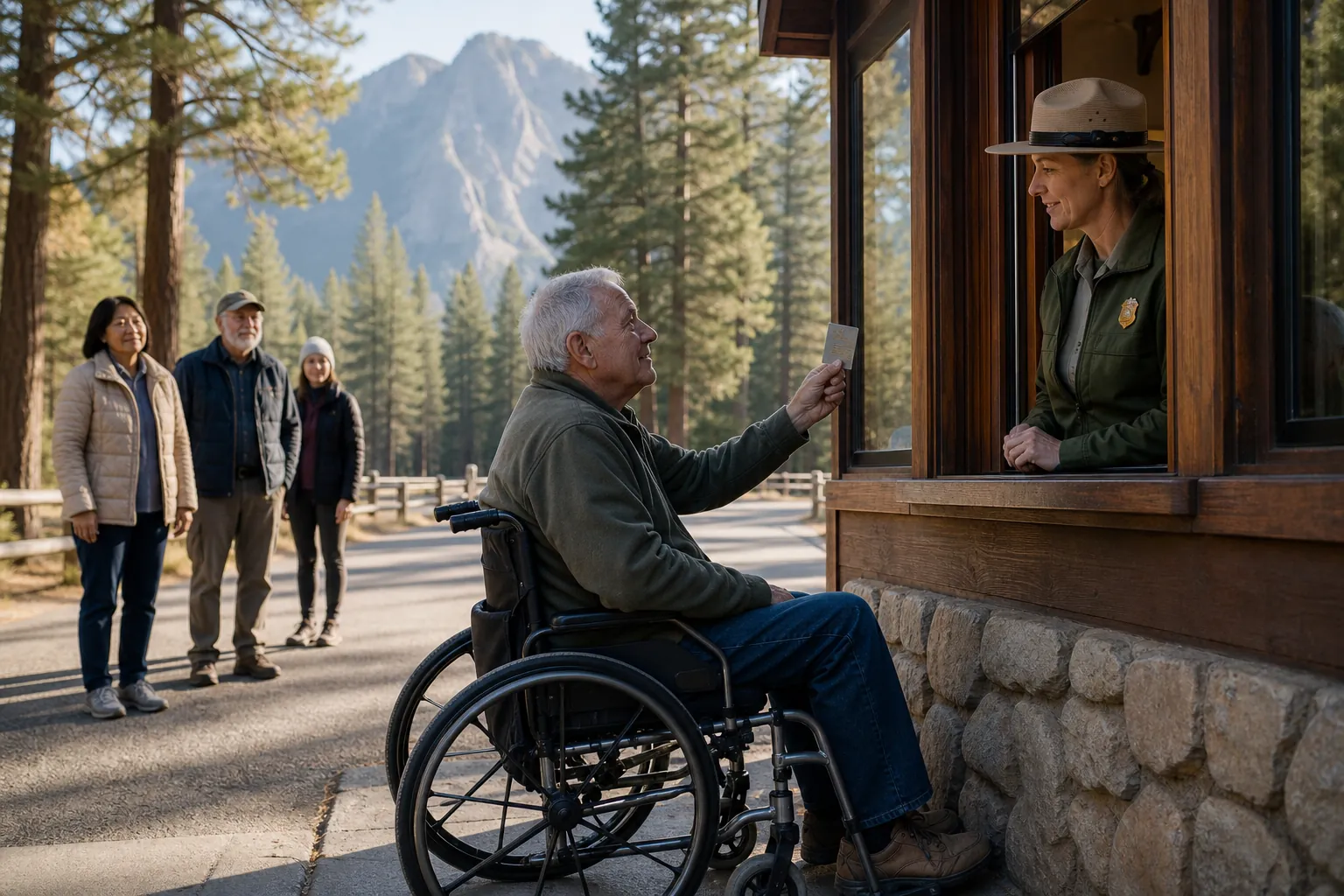
If you are looking up the next free national park day for a senior with mobility issues, pause before you build the outing around that date. The better first question is whether the senior can use a federal recreation pass every time they go. If they have documentation of a permanent disability, the Interagency Access Pass is free, lifetime, and not limited by age; if they do not, the Senior Pass is available to U.S. citizens and permanent residents age 62 and older for $20 annually or $80 for a lifetime pass.[1][2]
That distinction matters more for a mobility-limited visitor than it does for a traveler who can easily improvise. A pass removes the entrance-fee question on ordinary days at more than 2,000 federal recreation sites across six agencies, instead of asking the whole trip to depend on one crowded promotional date, available parking, a tolerable pain day, and a line that moves quickly.[2]
Start with the pass, not the calendar
For most older adults with mobility limitations, the decision is simple enough to sort before anyone checks weather, shuttles, or trail surfaces.
| Situation | Best first option | Why it usually works better |
|---|---|---|
| Senior has documentation of a permanent disability | Access Pass | Free, lifetime, and usable repeatedly instead of only on selected dates |
| Senior is 62+ but does not qualify for the Access Pass | Senior Pass | $20 annual or $80 lifetime; usually more predictable than chasing free-entry days |
| Trip already falls on a 2026 fee-free day | Use the free day as a bonus | Entrance may be waived, but crowds and add-on fees can still complicate the visit |
| The chosen park normally has no entrance fee | Go any suitable day | No need to wait for a fee-free date just to avoid the entrance charge |
This is general information, not medical, legal, or financial advice. Pass eligibility depends on the program rules and the documentation accepted by the issuing agency; when the disability documentation is uncertain, it is worth confirming before making the trip to an issuing site.
The Access Pass is the cleanest answer when a permanent disability is documented
The Access Pass is easy to underestimate because people hear “disability” and assume the bar is higher than it is. The National Park Service describes it as a pass for U.S. citizens or permanent residents with a permanent disability. The disability does not need to be a 100% disability rating, and it is not restricted to wheelchair users.[1][3]
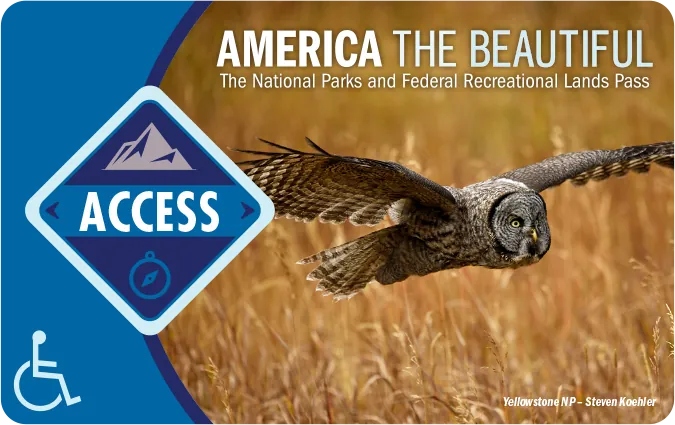
The part to handle carefully is proof. Accepted documentation can come from one of three places: a signed physician statement, a federal agency document such as documentation from the Department of Veterans Affairs or Social Security, or a state agency document such as a vocational rehabilitation agency record.[1]
If using a physician letter, the letter needs to do more than say the person has a diagnosis. It should state that the disability is permanent, that it severely limits one or more major life activities, and the nature of those limitations.[1] That wording is not red tape trivia; it is the difference between arriving prepared and asking an entrance or visitor center employee to interpret a vague note while everyone else is waiting.
For a senior with arthritis, a neurologic condition, vision loss, cardiopulmonary limitations, or another long-term impairment, the practical question is not whether the condition “sounds like a park disability.” The question is whether the person has a permanent disability that meets the program standard and can document it in one of the accepted ways. The pass program is not based on self-attestation.[1]
How to get the Access Pass without adding unnecessary waiting
There are three routes, and the best one depends on whether the senior needs the pass soon and whether an issuing location is convenient.
- In person: The pass can be issued free at more than 1,000 federal recreation sites. This is often the best route when an issuing site is nearby, the documentation is ready, and the senior can tolerate the errand.[1]
- Online or by mail through the USGS Store route: The pass itself is free, but the online or mail process has a processing fee of about $10 and can involve a wait of up to about three weeks.[1][3]
- Digital option through Recreation.gov: In 2026, the Access Pass can be obtained digitally for immediate use, which can matter when a trip is coming up before a physical card would arrive.[1]
For an adult child helping a parent, the most useful preparation is mundane: confirm the parent’s citizenship or permanent-resident status, collect the accepted documentation, check whether the nearest location actually issues passes, and decide whether the in-person visit saves more effort than the online fee and wait. A free lifetime pass is only convenient if the paperwork is complete before the outing.
When the Access Pass does not fit, the Senior Pass is still usually better than waiting
The Senior Pass is not free, and it should not be dressed up as free. But for a 62+ traveler who does not qualify for the Access Pass, $20 for an annual pass or $80 for a lifetime pass is often a small price to remove the entrance-fee calculation from every trip.[2]
The pass covers entrance fees and standard amenity or day-use fees at participating federal recreation sites. It may also provide about a 50% discount on some expanded amenity fees, such as camping, swimming, or boat launch fees, but it generally does not cover special recreation permits or concessioner fees.[2]
That caveat is where a lot of trip budgets go wrong. A pass can waive the entrance fee and still leave a timed-entry reservation, cave tour, boat tour, campground charge, shuttle ticket, or privately operated service outside the pass benefit. The pass is a strong tool for repeated access; it is not an all-inclusive park vacation card.
What changes on a fee-free day, and what does not
A national park fee-free day waives the entrance fee for that date. It does not make every park expense disappear. Timed-entry reservations, tours, and other add-on fees can still apply, and only about 106 National Park Service sites normally charge an entrance fee in the first place.[4]
In 2026, the calendar is also less dependable as a primary plan. The Interior Department announced changes making fee-free entrance days resident-only and reconfiguring the list of dates; reporting on the change noted that several previously familiar dates, including Martin Luther King Jr. Day, the opening day of National Park Week, Juneteenth, the Great American Outdoors Act anniversary, and National Public Lands Day, were no longer on the 2026 NPS fee-free entrance list.[5][6]
As of August 25, 2026, the NPS 110th birthday falls today, and the remaining listed 2026 NPS fee-free entrance dates are Constitution Day on September 17, Theodore Roosevelt’s birthday on October 27, and Veterans Day on November 11.[5] Those dates should still be rechecked before travel, because the whole point is to avoid surprises at the gate.
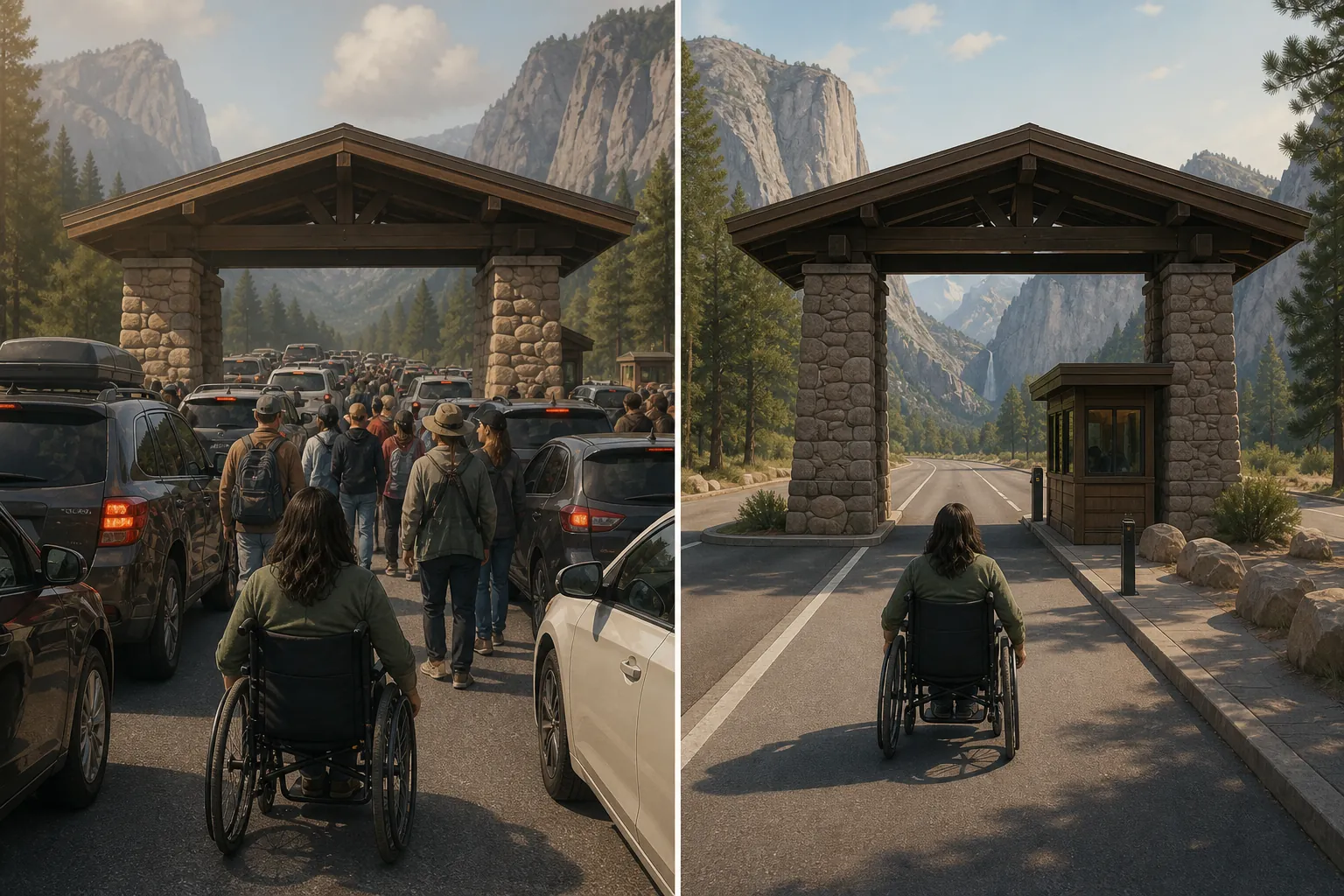
For a mobility-limited senior, the entrance fee is only one part of usability. A crowded fee-free day can mean a longer entrance line, farther parking, more competition for accessible spaces, more people at restrooms and overlooks, and less room to pause without feeling rushed. None of those problems is guaranteed, but they are exactly the kinds of uncertainties that make a “free” outing expensive in energy.
The mobility checks still matter, even with the right pass
A pass solves the entrance-fee problem. It does not tell you whether the shuttle lift is working, whether a trail surface is firm after rain, whether a scenic road is under construction, or whether a loaner wheelchair will be available when you arrive.
The National Park Service states that wheelchairs and manually powered mobility aids may be used in any area open to pedestrian use, and it provides guidance on other power-driven mobility devices.[7] The agency also maintains accessibility information and notes that some parks offer services such as loaner wheelchairs, but availability and details are park-specific.[8]
Before choosing a date, check the specific park’s accessibility page rather than relying on general advice. For a senior with limited walking tolerance, the useful questions are concrete:
- Where are the accessible parking areas, and do they fill early?
- Is there a shuttle, and is it accessible on the route you need?
- Are loaner wheelchairs or beach wheelchairs available, and do they require a reservation?
- Which overlooks, visitor centers, restrooms, and short trails are currently accessible?
- Does the park require timed entry, a tour reservation, or a separate permit even when the entrance fee is waived?
- Are heat, elevation, ice, smoke, or construction likely to turn a short distance into a difficult one?
If the plan includes even a short trail, it is also worth doing a fall-risk reality check before the trip. A pass makes visits easier to repeat; it should not pressure anyone into doing more distance than their balance, stamina, medication effects, or assistive device can support. For a pre-trip screen, see this hiking safety checklist for seniors.
Where always-free parks fit
Some national parks do not charge an entrance fee on any day, so there is no need to wait for a free-entry date. Examples include Great Smoky Mountains, Gateway Arch, Cuyahoga Valley, Congaree, Hot Springs, Mammoth Cave, New River Gorge, and North Cascades.[4][9]
That can be a useful side route when one of those parks is already the right destination. It is not the same as an accessibility guarantee. Great Smoky Mountains may be free to enter, for example, but the visitor still needs to think about traffic, parking, restroom distance, weather, and which stops match their mobility. No-fee does not automatically mean low-friction.
National Public Lands Day is the confusing one in 2026
National Public Lands Day deserves a separate note because people often use “free park day” loosely. In 2026, National Public Lands Day is not an NPS entrance fee-free day under the reconfigured list.[5][6]
That does not mean nothing is happening on National Public Lands Day. The National Environmental Education Foundation still promotes NPLD activities and fee-free coupons for participating federal agency sites.[10] But a coupon at a participating site is not the same thing as a systemwide NPS entrance fee-free day. If a senior’s outing depends on that distinction, verify the exact site, the exact benefit, and the date before leaving home.
A calmer way to plan the visit
For a mobility-limited senior, the strongest plan is usually ordinary and repeatable:
- Check Access Pass eligibility first if there is a documented permanent disability.
- Use the Senior Pass if the person is 62+ and does not qualify for the Access Pass.
- Confirm what the pass covers at the chosen site and what still requires a reservation or separate fee.
- Read the park’s current accessibility page for parking, shuttles, restrooms, trail surfaces, loaner devices, construction, and seasonal conditions.
- Treat fee-free days as a bonus if they already fit the plan, not as the reason the plan exists.
The free-day calendar can still save money for the right visitor on the right day. It is just a fragile foundation for someone who needs fewer variables. If a federal pass can make an ordinary weekday affordable, calmer, and repeatable, that is usually the better access route than waiting for the park’s busiest version of “free.”
References
- Interagency Access Pass, National Park Service, https://www.nps.gov/subjects/accessibility/interagency-access-pass.htm
- Entrance Passes, National Park Service, https://www.nps.gov/planyourvisit/passes.htm
- How to Get a Free Lifetime National Parks Pass, diaTribe, https://diatribe.org/lifestyle/how-get-free-lifetime-national-parks-pass
- Free National Park Days: When to Visit in 2026, NerdWallet, https://www.nerdwallet.com/travel/learn/free-national-park-days
- Department of the Interior Announces Modernized, More Affordable National Park Access, Department of the Interior, November 25, 2025, https://www.doi.gov/pressreleases/department-interior-announces-modernized-more-affordable-national-park-access
- No more free entry? National parks reinstating fees on these days in 2026, The Hill, https://thehill.com/homenews/nexstar_media_wire/5661202-no-more-free-entry-national-parks-reinstating-fees-on-these-days-in-2026/
- Mobility Devices, National Park Service, https://www.nps.gov/subjects/accessibility/mobility-devices.htm
- Accessibility, National Park Service, https://www.nps.gov/aboutus/accessibility.htm
- Free National Park Days, National Park Trips, https://www.nationalparktrips.com/news/free-national-park-days/
- National Public Lands Day, National Environmental Education Foundation, https://www.neefusa.org/national-public-lands-day
Questions to bring to a clinician or OT
This is not medical, legal, or a family's final decision — only a framework. Bring these questions to a clinician, occupational therapist, or your local Area Agency on Aging.
Find Local HelpRelated reading
Noticed something outdated or inaccurate on this page? Flag a correction. We review every report against CDC, NIA, and AARP HomeFit guidance before updating a page.