
STEADI: Screen
Senior Hiking Safety Checklist: Before, During, and After
An older adult's hiking safety checklist in three phases: screen fall risk before the trailhead, work the on-trail essentials, and recover after the hike. Grounded in CDC falls data, NPS Hike Smart guidance, and Mayo Clinic heat precautions — with the 1-in-4 falls statistic framed as a reason to prepare, not to stay home.
A hiking safety checklist for seniors should start before the backpack comes out. The Centers for Disease Control and Prevention reports that about 1 in 4 adults age 65 and older fall each year, roughly 14 million people, and falls are the leading cause of injury death in that age group.[1] That number is not a command to stay home. It is a reason to begin the hike with the same questions that matter in the hallway, on the porch steps, and in the grocery store parking lot: Have I fallen lately? Is my balance different this month? Did a medication change? Can I see the trail clearly? Am I choosing a descent I can manage after I am tired?
Mountain-rescue data point in the same practical direction. A Swiss Alpine Club rescue analysis found that falls accounted for about 45% of 11,220 hiking rescues, with peak ages from 50 to 70 and about two-thirds of injuries involving the lower extremities.[2] That is Swiss mountain-hiking rescue data, not a U.S. trail statistic. For a deeper look at why falls deserve this much attention, see why falls are the biggest hiking risk for older adults. Here, the job is more ordinary and more useful: turn that risk into a before, during, and after routine.
This article is general education, not personal medical advice. If you have had a recent fall, fainting episode, chest pain, new dizziness, a medication change, or a condition that affects balance, vision, hydration, or heat tolerance, check with a qualified clinician before changing your hiking plans.
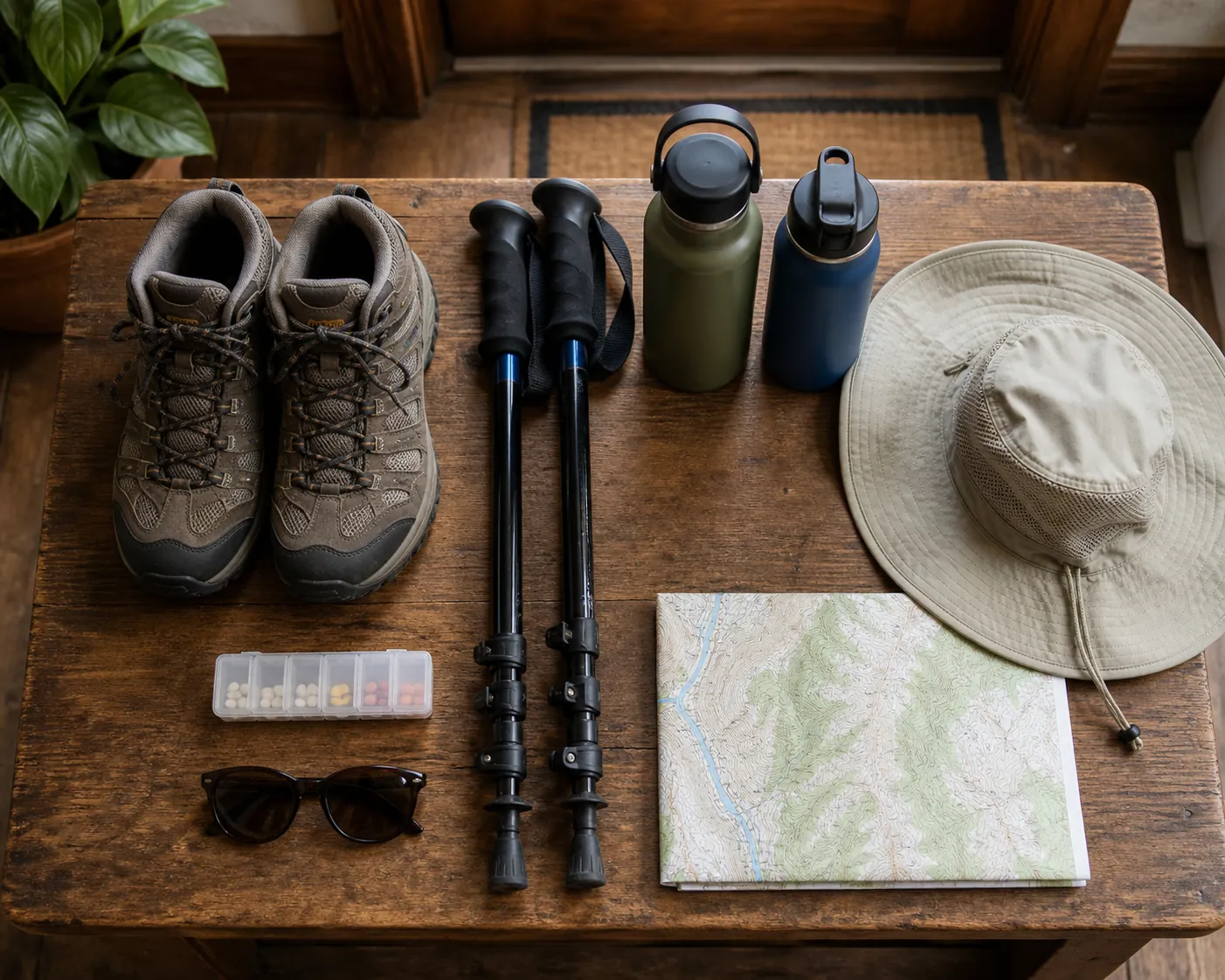
Before the hike: screen the fall risks first
The first decision is not which jacket to wear. It is whether today’s body matches today’s trail. Hiking can support health in older adulthood; CDC describes physical activity for adults 65 and older as beneficial for balance, coordination, bone health, and independent living.[3] That is good permission to keep going. It is not permission to ignore the details that make a fall more likely.
| Check before choosing a trail | What to do with the answer |
|---|---|
| Recent fall, near-fall, or new fear of falling | Choose a shorter, easier route or postpone. If this is new or unexplained, discuss it with a clinician before treating it as just a bad day. |
| Balance feels different than usual | Avoid narrow ledges, loose rock, steep descents, stream crossings, and routes where turning back would be difficult. |
| Medication change or dose change | Check whether dizziness, sleepiness, dehydration, low blood pressure, or heat sensitivity could be side effects. Bring the medication list if hiking with others. |
| Vision change, new glasses, glare sensitivity, or poor depth perception | Pick a trail with predictable footing and good daylight. Sunglasses help with glare, but the trail still needs to be visible underfoot. |
| Foot pain, numbness, sore spots, or unstable shoes | Fix this before the hike. A small foot problem can change gait, and a changed gait is not a small thing on a descent. |
| Heat, humidity, or poor sleep | Lower the ambition. Heat and fatigue make ordinary roots and rocks less forgiving. |
| Lingering soreness from the last hike | Shorten the next hike or add more recovery. Do not use the first mile to find out whether the body has forgiven the last descent. |
For many older hikers, this is also the place to keep doing balance and strength work between hikes. Hiking may be part of an active life, but no source here proves that hiking by itself prevents falls. If balance training is on your to-do list, the home routine matters as much as the trail plan; see posture exercises to help seniors balance and prevent falls.
Choose the hike by its consequences, not its label
A trail marked “moderate” can still be the wrong hike for a 72-year-old who is coming off a poor night’s sleep, wearing new glasses, and facing a loose-rock descent in afternoon heat. A trail marked “easy” can be a good choice or a tedious one; the label alone does not know your knees, your medication list, or how long it takes you to recover.
User-generated trail ratings are useful clues, not verdicts. AllTrails describes its difficulty ratings as user-generated and subjective, which means they can help you notice patterns in reviews but cannot replace your own judgment about distance, elevation, surface, weather, daylight, and current condition.[4]
| Trail detail | Why it matters more with age |
|---|---|
| Total distance | The return miles count. A safe first half does not guarantee a safe walk out. |
| Elevation gain and loss | Descents often ask more of balance, knees, vision, and braking strength than climbs. |
| Surface | Loose gravel, wet leaves, roots, and angled rock all change footing. Smooth does not mean flat; flat does not mean safe. |
| Shade and exposure | A sunny route can become a heat problem even when the distance looks modest. |
| Bailout options | A loop with no shortcut home is a bigger commitment than an out-and-back where you can turn around early. |
| Cell service and remoteness | Do not let a phone plan become the safety plan. Assume batteries fail and signals disappear. |
| Daylight | Older eyes may need more contrast and more time. Plan to finish with daylight to spare. |
If you are returning after illness, a fall, a long inactive spell, or a medication change, the best first hike back may look almost too easy on paper. That is not wasted caution. It gives you information without asking for too much payment.
Make a trip plan before anyone is tired
The National Park Service Ten Essentials list begins with navigation and includes sun protection, insulation, illumination, first aid, fire, repair supplies, nutrition, hydration, and emergency shelter.[5] For an older hiker, those essentials are not a gear-store exercise. They are a way to keep a small mistake from becoming a fall, a heat problem, or a long wait.
- Leave a trip plan with someone who is not on the hike: trail name, starting point, route, expected return time, car description, and when to call for help.
- Set a turn-around time before starting. The clock is often more honest than pride.
- Carry navigation you can use without cell service: a paper map, downloaded map, or both.
- Bring a headlamp even for a day hike. Darkness turns familiar footing into guesswork.
- Carry a first-aid kit that includes blister care, any personal medical items, and a written medication list.
- Pack an insulating or rain layer if weather can change, even if the parking lot feels warm.
- Carry enough food and water to cover delays, not just the planned walking time.
NPS Hike Smart guidance also tells hikers to tell someone where they are going, avoid hiking alone when possible, stay together, and set the pace by the slowest hiker.[6] That last point deserves family attention. If an adult child hikes with a parent, the safer pace is not the younger person’s comfortable pace with pauses added. It is the pace at which the older hiker can still place each foot deliberately, speak normally, and make decisions.
Footwear, poles, and water are fall-prevention tools
Sturdy footwear is not vanity on a trail. NPS recommends sturdy, rubber-soled boots with ankle support and notes that trekking poles or a hiking staff can help with stability.[6] Poles do not make a risky route safe, but they can add points of contact on uneven ground, stream approaches, and descents. They work best when adjusted before the hike and practiced on easier ground, not pulled out for the first time on a steep downhill.
Fit matters. WebMD suggests hiking boots may need to be a half size larger than street shoes because feet can slide forward on descents.[7] Treat that as practical fitting advice, not a universal rule. The real test is whether toes jam, heels slip, soles grip, and the boot remains comfortable after the foot swells a little.
Water belongs in the fall-prevention conversation too. REI’s day-hiking checklist gives about 1 liter of water per person per hour as a starting point.[8] A cool, shaded, easy walk may require less; heat, sun, altitude, medical conditions, and medications may require more. The important habit is to start hydrated and drink before thirst becomes the reminder.
Heat decisions start before the first mile
Heat does not need to be extreme to matter. Mayo Clinic notes that adults 65 and older are at higher risk for heat exhaustion, and that dehydration impairs the body’s ability to sweat and maintain normal temperature. It also lists medication categories that can increase heat risk, including beta blockers, diuretics, antihistamines, and tranquilizers.[9]
Mayo Clinic advises taking precautions when the heat index is 91°F or higher.[9] For an older hiker, that should affect the whole plan: earlier start, shorter route, more shade, more water, lighter pace, and a lower threshold for turning around. A hot forecast is not just a comfort issue. Heat can make footing sloppier, reactions slower, and judgment softer right when the trail asks for care.
For more on hot-weather destinations and fall risk, see summer destinations where heat puts seniors at highest fall risk. Weather judgment also includes storms; if lightning is possible, use lightning safety for senior hikers as a separate planning check. Weather hazards matter, but they do not replace the central rule: protect footing, temperature, hydration, and the ability to make good decisions.
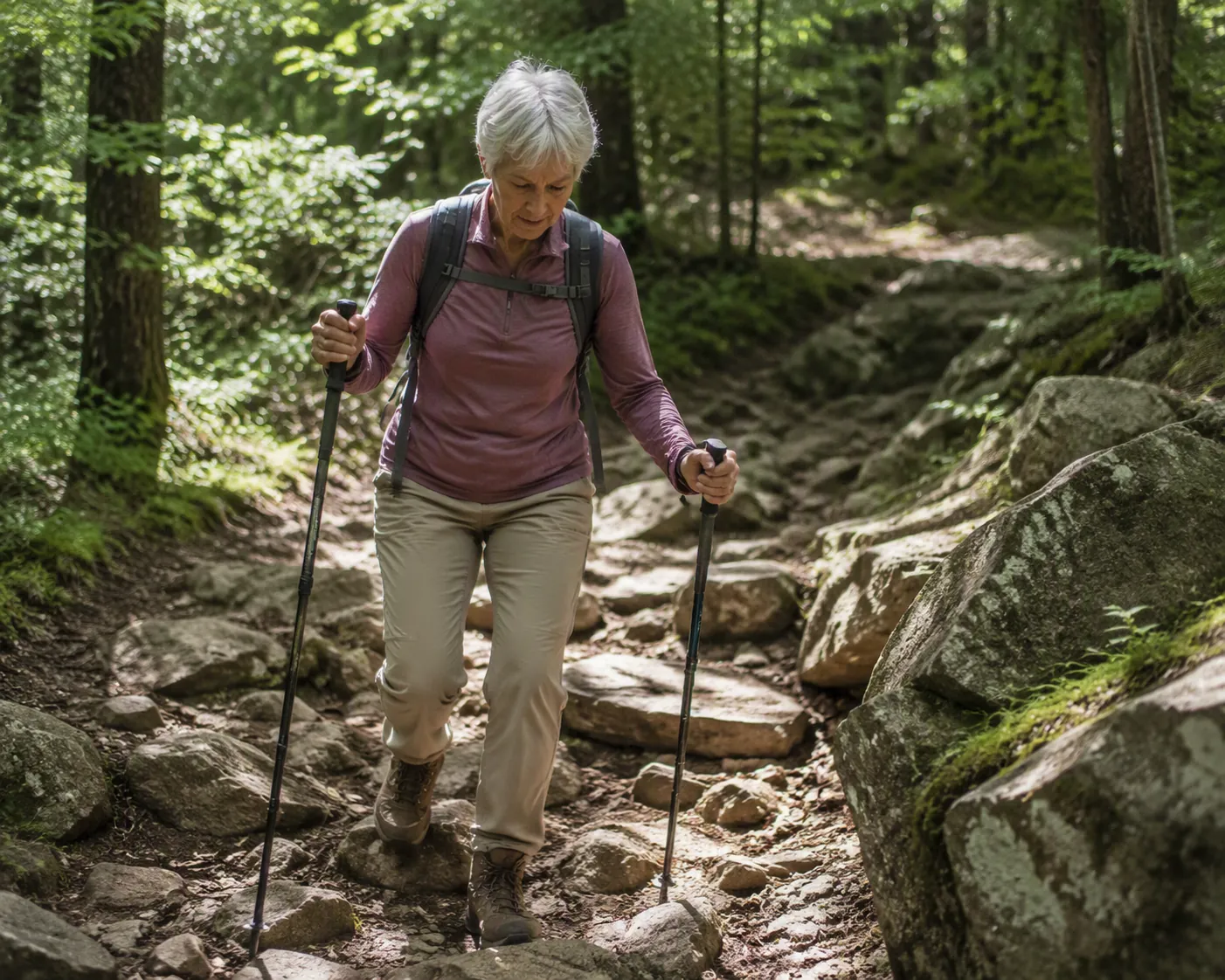
On the trail: let the slowest hiker set the day
Once walking begins, the checklist becomes behavior. NPS Hike Smart guidance says to stay together, set a pace everyone can maintain, let the slowest hiker set the pace, take regular rests, eat before hungry, and drink before thirsty.[6] Those are simple instructions, which is why they are easy to override. Older hikers and their companions should be especially wary of the first mile feeling easy. Early comfort can lead to a later descent that arrives after heat, fatigue, and sore feet have already had their say.
- Use short, steady steps on uneven ground instead of long strides that force sudden corrections.
- Pause before looking at views, phones, maps, or wildlife. Moving feet and wandering eyes are poor partners.
- On descents, slow down before the steep part begins. Braking late is harder on knees and balance.
- Keep enough space between hikers so one stumble does not become two.
- Step around loose rocks and wet roots when possible rather than testing them.
- Adjust layers early. Sweating through clothes, chilling at a rest stop, and then rushing to warm up can all affect steadiness.
Blisters deserve attention while they are still small. NPS Hike Smart specifically mentions moleskin for blisters.[6] A hot spot changes how a person steps; once gait changes, hips, knees, and balance compensate. Stopping for five minutes to protect skin is more sensible than limping politely for an hour.
The turn-around decision is part of the hike
A turn-around time is not a defeat written into the plan. It is how a hiker keeps the return trip from becoming the emergency half of the day. Turn around early if the slowest hiker is stumbling more, using poles differently, getting unusually quiet, becoming confused, complaining of dizziness, falling behind after rest breaks, or showing new foot pain.
Heat signs deserve the same respect. New headache, nausea, weakness, heavy sweating, lightheadedness, or unusual fatigue should change the plan, especially for adults 65 and older or hikers taking medications that raise heat risk.[9] Find shade, rest, cool down, drink if able, and do not continue deeper into the route just because the destination is close.
After the hike: check what changed
The hike is not quite over when the boots come off. Rehydrate, eat something appropriate, and cool down gently rather than dropping straight into a car seat for a long ride. Check feet for blisters or pressure spots. Notice whether soreness is ordinary muscle work or a joint pain that changes walking. Pay attention to dizziness, unusual fatigue, headache, confusion, or a sense that recovery is taking longer than it should.
This is also when the next hike gets safer. If the route was too rocky, choose a smoother one. If the descent was the problem, choose less elevation loss even if the mileage looks easy. If thirst arrived early, pack more water or start earlier. If a medication seemed to make heat or dizziness worse, take that question to a clinician instead of solving it on the trail.
| After-hike note | Change for next time |
|---|---|
| Feet sore or blistered | Change socks, boot fit, lacing, or distance before the next hike. |
| Knees or hips painful after descending | Pick less elevation loss, use poles if appropriate, and shorten the route. |
| Dizzy, overheated, or unusually tired | Choose cooler conditions, more shade, more rest, and consider medical advice if symptoms are new or concerning. |
| Finished later than planned | Start earlier, shorten the route, or set a stricter turn-around time. |
| Needed more help than expected | Do not ignore that information. Adjust the route and companionship plan. |
Hiking remains available to many older adults, and it is worth keeping. The safer version begins before the trailhead, behaves carefully on the trail, and pays attention after the boots are off.
References
- Older Adult Falls Data, CDC
- Half of Emergency Calls in Hikers are Injuries from Falls in 50-70-Year-Olds, German Journal of Sports Medicine, 2019
- Physical Activity Benefits for Adults 65 or Older, CDC
- Difficulty ratings on AllTrails, AllTrails
- Ten Essentials, National Park Service
- Hiking Safety, National Park Service
- What to Know About Hiking After 60, WebMD
- Day Hiking Checklist, REI
- Heat exhaustion - Symptoms and causes, Mayo Clinic
Related reading
Noticed something outdated or inaccurate on this page? Flag a correction. We review every report against CDC, NIA, and AARP HomeFit guidance before updating a page.
Part of the Fall Prevention section.