
Caregiver decision guide
Privacy vs. Safety: Navigating the Ethical Decision of Monitoring an Aging Parent at Home
This guide helps family caregivers navigate the emotional and ethical tension between ensuring an aging parent's safety and respecting their privacy and dignity. It covers privacy concerns by technology type, research on older adults' acceptance, the legal landscape of consent, and a practical framework for collaborative decision-making.
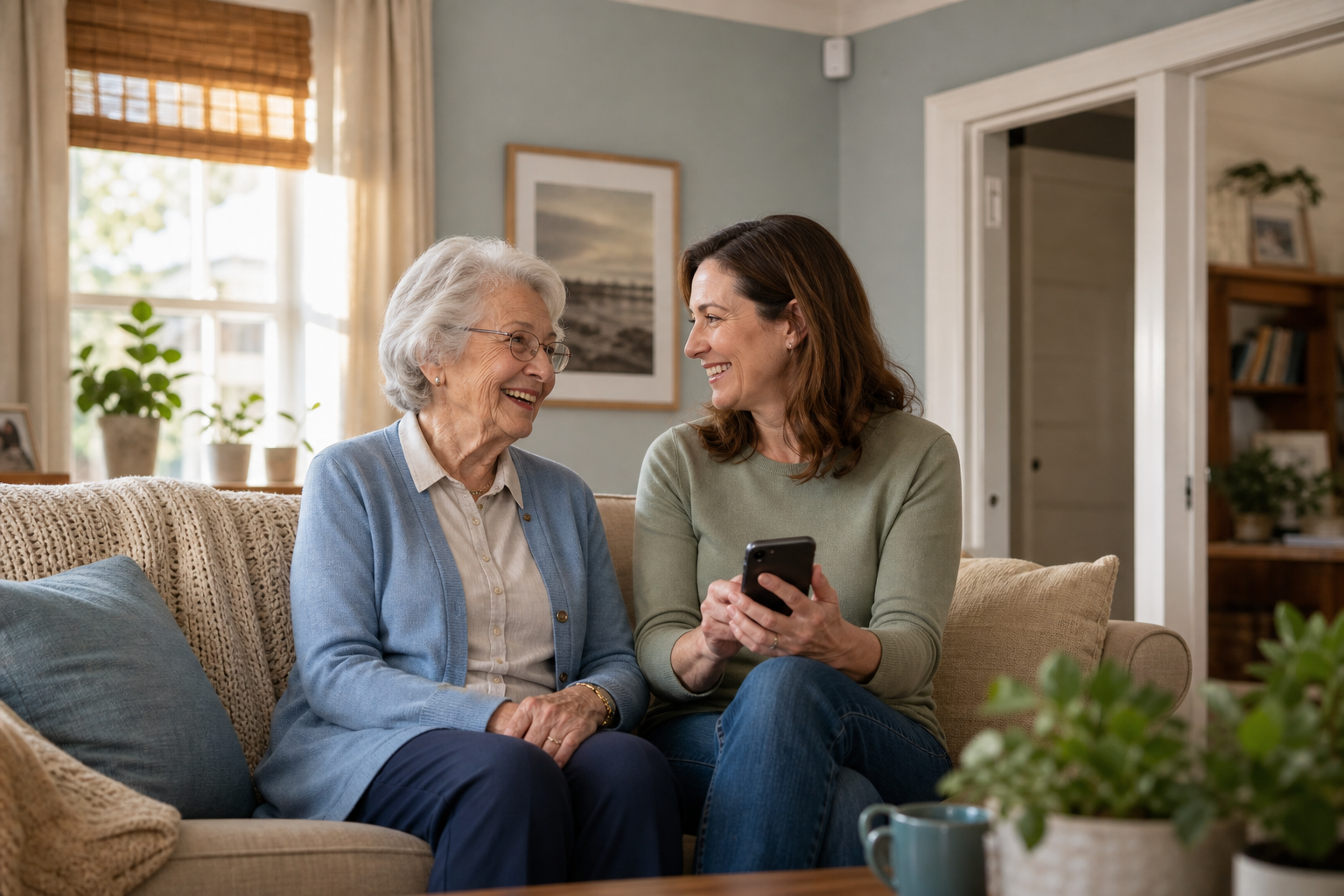
The Caregiver's Dilemma: Safety vs. Privacy
You've just watched your mother struggle to get up from the couch, or you've received a call from a neighbor saying your father seemed confused during his afternoon walk. The thought is immediate: I need to know they're safe. But when you bring up the idea of a camera or a wearable alert button, the response is just as immediate: You're treating me like a child. I'm not a prisoner in my own home.
This is the core tension in elderly monitoring — and it is not a technological problem. It is an ethical and emotional one. The central question is not which device has the best battery life or the fastest response time. It is how to balance a caregiver's need for peace of mind against an older adult's right to privacy, autonomy, and dignity.
The evidence is clear that the most successful monitoring arrangements are made collaboratively, with transparency and explicit consent, not imposed unilaterally. This guide walks through the privacy implications of different technology types, what research tells us about older adults' actual attitudes, the legal landscape you need to understand, and a practical framework for having the conversation — so you can make a decision that protects both safety and the relationship.
Privacy Concerns by Technology Type: A Spectrum of Intrusion
Not all monitoring technologies carry the same privacy weight. Understanding where each category falls on the spectrum of intrusion is the first step toward making a choice that respects your parent's comfort level while still meeting safety needs.
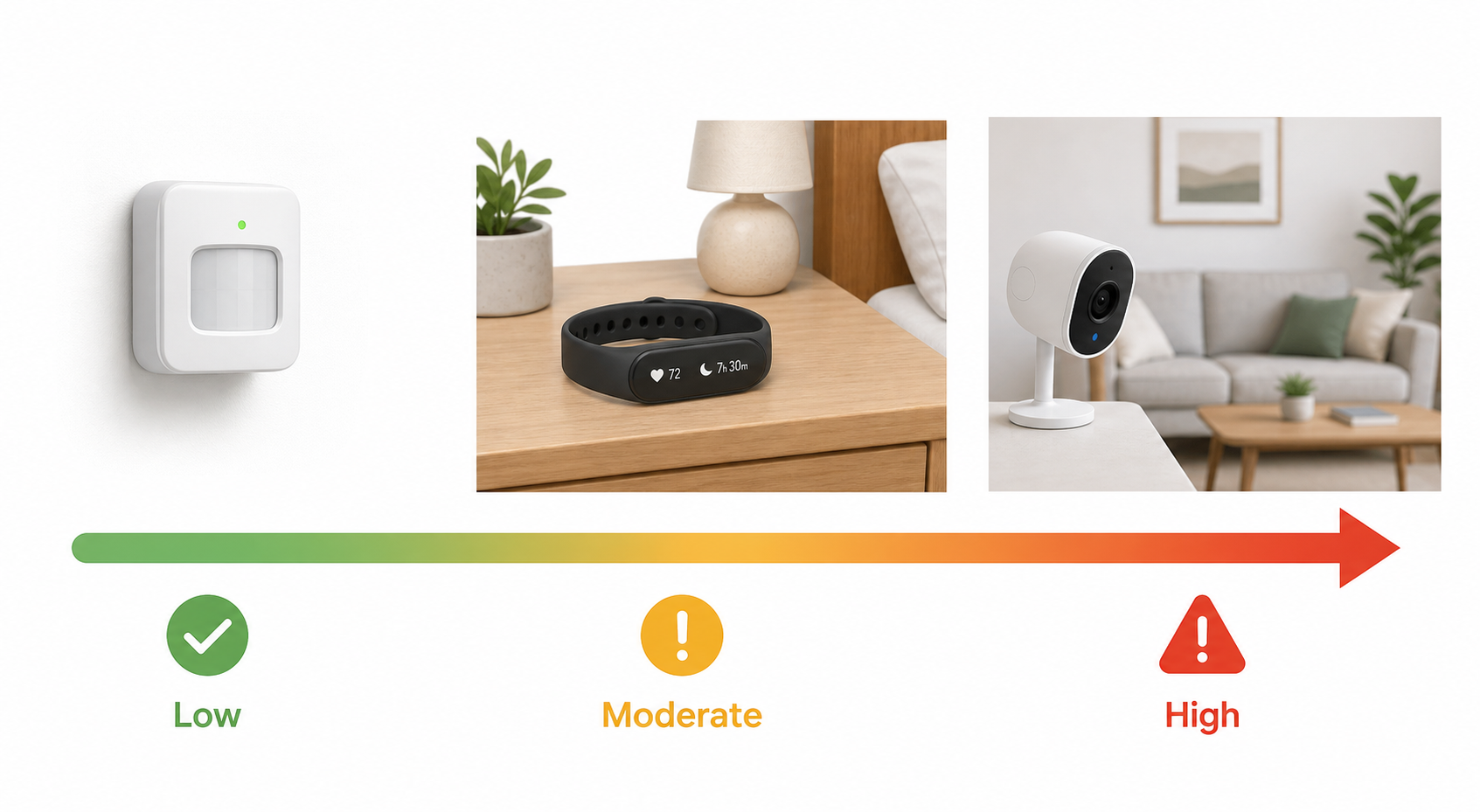
| Technology Category | Privacy Concern Level | Primary Concern | Typical Acceptance Pattern |
|---|---|---|---|
| Passive sensors (motion, door, bed, contact) | Lowest | Data collection and who has access to it | Generally accepted when installed discreetly and explained clearly |
| Wearable devices (pendants, wristbands, smartwatches) | Moderate | Visibility, comfort, and the feeling of being 'tagged' | Varies significantly by individual; some forget they are wearing it, others find it irritating |
| Cameras (video with or without audio) | Highest | Continuous visual surveillance, loss of dignity, recording of intimate moments | Requires explicit consent; often refused for private areas like bedrooms and bathrooms |
A 2022 scoping review published in PMC, which analyzed 30 studies on in-home monitoring technology, confirmed that camera-based monitoring raises the highest privacy concerns among older adults. The review noted that ambient or concealed sensor systems placed above the typical human field of view can help address these concerns. The most common sensor types studied were passive infrared (PIR) motion sensors and contact sensors — technologies that detect movement or door openings without capturing identifiable images or sounds.
The key insight from the research is that how aware individuals are of a sensor being present in their immediate environment varies from one user to another. Some older adults quickly forget about monitoring equipment entirely, while others find sensors irritating and consciously change their behavior or activity routines. This variability means there is no one-size-fits-all answer — the right choice depends heavily on the individual's personality, cognitive state, and living situation.
What Research Tells Us About Older Adults' Acceptance of Monitoring
The PMC scoping review, drawing on the work of Tural et al. (2021), identified four key factors that significantly influence an older adult's attitude toward and intention to use smart home monitoring products: perceived usefulness, ease of use, privacy, and affordability. When these factors are addressed positively, acceptance increases substantially.
Specifically, the research found that older adults' willingness to accept monitoring increases when:
- Sensors are concealed or ambient — placed out of direct line of sight, such as above door frames or in ceiling corners.
- Data stays local — information is stored within the home rather than transmitted to a cloud server or third party.
- Consent is obtained — the older adult is part of the decision-making process from the beginning.
- The purpose is clear — the monitoring is framed as enabling independence and safety, not as surveillance or control.
The research also highlights a critical nuance: acceptance is not static. An older adult who initially resists a wearable pendant may become comfortable with it after understanding how it works and seeing it in action. Conversely, someone who initially agrees to a camera system may later feel its presence is an invasion of privacy. This is why the collaborative framework we discuss below emphasizes revisiting the agreement as needs and comfort levels change.
The Legal Landscape: Consent Laws and Recording Restrictions
Beyond the emotional and relational dimensions, there are legal boundaries that every caregiver should understand before installing monitoring technology — especially systems that include audio or video recording.
Federal law protects conversations where participants have a reasonable expectation of privacy. This means that recording someone in a private space like a bedroom or bathroom, or recording audio without their knowledge, can violate federal wiretapping statutes. The legal stakes are significant: illegal recording can result in hefty fines and even jail time, and any footage obtained illegally may not be admissible as evidence.
State laws add another layer of complexity. Some states are one-party consent states, meaning only one person in a conversation needs to be aware of the recording. Others are all-party consent (or two-party consent) states, meaning every person being recorded must give their permission. If you are considering a system that captures audio — which many camera systems do — you must know which category your state falls into.
| Recording Type | Legal Consideration | Key Action for Caregivers |
|---|---|---|
| Video only (no audio) | Generally lower legal risk in common areas; still requires consent for private spaces | Clearly communicate camera locations; never place in bathrooms or bedrooms without explicit, ongoing consent |
| Audio + video | Highest legal risk; federal and state wiretapping laws apply; all-party consent states require everyone's permission | Verify your state's consent law; obtain written consent from all household members and any in-home caregivers |
| Passive sensor data (motion, door, bed) | Minimal legal risk for data collected within the home; HIPAA may apply if data is shared with healthcare providers | Review the device's privacy policy to understand data storage, sharing, and third-party access |
If you employ in-home caregivers, the legal picture becomes even more nuanced. Caregiver employment contracts may have specific policies about monitoring, and in some states, you may be required to notify and obtain consent from paid caregivers before recording them. The AgingCare article on this topic emphasizes that constant monitoring can undermine trust between caregivers and care receivers and can deprive elders of dignity, especially during intimate care activities like bathing or incontinence care.
A Practical Framework for the Monitoring Conversation
The most common mistake caregivers make is presenting monitoring as a fait accompli — a decision already made, presented as a necessity. This approach almost always triggers resistance, resentment, and a breakdown of trust. The alternative is a collaborative, step-by-step process that treats the older adult as an active participant in the decision.
Here is a framework that research and real-world experience support:
- Start with a transparent conversation about purpose and boundaries. Frame the discussion around your own worry, not their failings. Use "I" statements: "I worry about you when I'm not here, and I'd sleep better knowing you're safe." Ask what they are comfortable with before suggesting any specific technology.
- Agree on excluded areas. The bathroom and bedroom are almost always off-limits for cameras. Even passive sensors in these areas should be discussed explicitly. Respecting these boundaries is non-negotiable for maintaining dignity.
- Begin with the least invasive option. If a simple motion sensor in the hallway can address the core safety concern, start there. You can always add more capability later. Starting with the most intrusive option (a camera) when a simpler solution would work is a common and damaging mistake.
- Walk through the system together. When the device arrives, install it together. Show your parent exactly what it does, what data it collects, who can access that data, and how it is stored. Demystifying the technology reduces fear and builds trust.
- Revisit the agreement as needs change. What works today may not work in six months. Schedule a check-in — every three months is a good cadence — to discuss whether the system is still meeting everyone's needs and whether adjustments are needed.
If your parent is resistant to the idea of monitoring altogether, it may help to understand the underlying psychology. Our guide on why aging parents refuse help explores the common fears — loss of independence, shame, fear of being a burden — that often drive resistance, and offers strategies for addressing them.
Ethical Warning Signs: When Monitoring Replaces vs. Enables Independence
Monitoring technology, used well, is a tool that enables an older adult to remain safely at home longer. Used poorly, it can become a substitute for human connection and a mechanism of control rather than support. Recognizing the difference is essential.
Consider these warning signs that monitoring may be crossing an ethical line:
- Monitoring replaces human contact. If you find yourself checking the app instead of calling or visiting, the technology has become a barrier to connection, not a bridge to safety.
- Monitoring is used to control rather than support. If the primary purpose is to catch mistakes, restrict movement, or enforce compliance, it is undermining autonomy. The goal should be to enable independence, not to supervise every action.
- Monitoring undermines dignity. If the system captures intimate moments — bathing, dressing, toileting — or if the older adult feels constantly watched and judged, the cost to their sense of self is too high.
- Consent was never truly given. If the system was installed without discussion, or if the older adult agreed under pressure or out of fear of being moved to a facility, that is not meaningful consent.
In contrast, monitoring that enables independence looks like this: the older adult can remain at home safely because the system alerts someone when help is needed. They maintain their daily routines and social connections. They feel safer, not more anxious. And the technology is a supplement to, not a replacement for, human care and connection.
The best time to have these conversations is before a crisis forces a decision. Our guide on closing the preparedness gap offers a framework for proactive planning that can help families avoid the rushed, unilateral decisions that so often damage trust.
Making the Choice: A Decision Guide for Camera vs. Passive vs. Wearable
When you have had the conversation, set boundaries, and agreed on the purpose, the next step is choosing the right type of technology. The decision should be driven by the privacy-consent dimension, not by technical specifications. Here is a framework for matching technology type to your specific situation.
| Technology Type | When to Use | When to Avoid | Key Privacy Consideration |
|---|---|---|---|
| Cameras (video, with or without audio) | Shared spaces only (living room, kitchen, hallway); with explicit, ongoing consent from all household members and caregivers | Private spaces (bathroom, bedroom); when any household member objects; when the older adult has cognitive decline that prevents meaningful consent | Highest privacy concern; requires clear boundaries and regular re-consent; audio recording adds significant legal complexity |
| Passive sensors (motion, door, bed, contact) | All areas of the home, including private spaces when discreetly installed; ideal for fall detection, wandering alerts, and activity pattern monitoring | When the older adult finds sensors irritating and changes their behavior as a result; when data is shared with third parties without transparency | Lowest privacy concern; most accepted when installed above eye level and explained clearly; data storage and sharing policies still matter |
| Wearable devices (pendants, wristbands, smartwatches) | Active seniors who are willing to wear the device consistently; when fall detection is the primary concern | When the older adult refuses to wear it (common); when cognitive decline leads to the device being removed and forgotten; for nighttime monitoring (devices are often taken off) | Moderate privacy concern; acceptance varies widely; some users forget they are wearing it, others find it irritating and change behavior |
The best choice is the one made collaboratively. If your parent is open to a wearable pendant but refuses a camera, that is a successful outcome — not a compromise. If they are comfortable with passive sensors in the hallway but not in the bedroom, respect that boundary. The goal is not to install the most comprehensive system possible; it is to install the system that everyone can live with.
For a deeper look at camera-free options, see our guide on passive sensor systems that respect privacy. If your parent is resistant to wearables, our article on passive vs. wearable systems explores alternatives. And if technology anxiety is part of the resistance, our guide on overcoming technophobia in older adults offers practical strategies for building comfort and confidence.
Ultimately, the decision to monitor is not a one-time choice. It is an ongoing conversation that evolves as needs, abilities, and comfort levels change. The families that navigate this successfully are the ones who keep the conversation open, respect boundaries, and remember that the technology serves the relationship — not the other way around.
Questions to bring to a clinician or OT
This is not medical, legal, or a family's final decision — only a framework. Bring these questions to a clinician, occupational therapist, or your local Area Agency on Aging.
Find Local HelpRelated reading
- What Elderly Monitoring System Is Right for Your Parent? A Decision Framework Based on Health Profile, Living Situation, and Risk Level
- Monitoring an Aging Parent Without Violating Their Privacy or Dignity
- Beyond the Panic Button: Why Passive, Sensor-Based Monitoring Is Replacing Wearables for Elderly Safety
Noticed something outdated or inaccurate on this page? Flag a correction. We review every report against CDC, NIA, and AARP HomeFit guidance before updating a page.