
The Preparedness Gap: How to Start Caring for Aging Parents Before a Crisis Hits
Most family caregivers start unprepared — only about 1 in 4 felt ready when caregiving began, and 54% wish they had started planning sooner. This guide helps adult children in their 40s and 50s use the pre-crisis window to build a 30-day minimal viable care plan, covering readiness assessment, difficult conversations, legal scaffolding, and financial first actions.

Why Most Families Wait Until It’s Too Late
The decision to start caring for an aging parent rarely arrives as a clear, scheduled event. It creeps in — through a forgotten bill, a bruise that can’t be explained, a stove burner left on overnight. Most families respond to these signals by waiting, hoping the next week will be better. The data suggests this waiting has a steep cost.
A 2025 survey of 1,029 family caregivers conducted by A Place for Mom found that only about 1 in 4 felt completely prepared when caregiving began. More striking: 54% said they wished they had started making a plan sooner. For nearly a quarter of respondents — 24% — the need for care was immediate, leaving no time for preparation at all.
The problem isn’t a lack of love or concern. It’s a lack of a structured window for planning. Most adult children wait for a specific crisis — a fall, a hospitalization, a dementia diagnosis — before they act. By then, decisions that could have been made calmly over weeks must be made in hours, often under emotional duress and without the parent’s full participation.
The National Institute on Aging puts it plainly: “The best time to plan is before the older person needs extensive help.” Planning ahead gives families time to learn about services and costs, and — critically — it allows the older adult to make important decisions while they are still able to participate fully.
This article is written for that pre-crisis window. If you’ve noticed changes in your parent but haven’t faced a clear emergency yet, the next 30 days are the most valuable planning asset you have.
The Readiness Assessment: Five Signs It’s Time to Start Planning
Before you can build a plan, you need a clear picture of what’s changing. The National Institute on Aging provides a useful framework for assessing whether an older adult needs help, organized around five domains. Use this as a structured check-in, not a diagnostic tool.
1. Changes Around the Home
Look for unpaid bills, spoiled food, expired medication, a cluttered or unusually dirty living space, or mail that has piled up unopened. These are often the earliest signals that daily tasks like meal preparation, housekeeping, and medication management are becoming difficult.
2. Changes in Health and Physical Function
Unexplained weight loss, frequent falls or near-falls, difficulty walking or climbing stairs, and new confusion about medications all warrant attention. The CDC’s STEADI model notes that a single fall doubles the risk of another, making early intervention critical.
3. Changes in Memory and Thinking
Repeatedly asking the same questions, getting lost in familiar places, difficulty following conversations, or trouble managing money and medications are not normal parts of aging. They may signal early cognitive decline that requires a medical evaluation.
4. Changes in Mood and Behavior
Withdrawal from social activities, loss of interest in hobbies, uncharacteristic irritability, or expressions of hopelessness can indicate depression or the early stages of dementia. The NIA advises paying attention to these changes even if the person doesn’t mention them.
5. Changes in Daily Function (ADLs and IADLs)
The most concrete measure of need is whether your parent can still perform Activities of Daily Living (bathing, dressing, eating, toileting, transferring) and Instrumental Activities of Daily Living (managing finances, preparing meals, using transportation, managing medications). Difficulty with IADLs typically appears first.
How to Start the Conversation About Future Care
The hardest part of pre-crisis planning isn’t the legal paperwork or the financial consolidation. It’s the first conversation. Many adult children avoid it because they fear their parent will interpret it as a loss of independence or a judgment about their competence.
The most effective approach is to frame the conversation around values and preferences, not around deficits or facilities. Instead of saying, “I’m worried you can’t live alone anymore,” try: “I want to make sure we know what you would want if your health changes. Can we talk about what’s important to you?”
- Start with a specific, low-stakes observation: “I noticed you seemed a little unsteady on the stairs yesterday. I’d feel better if we talked about what might help.”
- Use “I” statements to express your own feelings and needs: “I want to be able to help you in the way you want, and I need to understand your wishes to do that.”
- Ask open-ended questions about preferences: “If you needed help at home, would you prefer someone you know or a professional aide?” “What does a good day look like for you now?”
- Normalize the conversation by tying it to your own planning: “I’m working on my own advance directives, and it made me realize we should all have these conversations.”
- If your parent resists or becomes defensive, pause and acknowledge their feelings: “I hear that this feels uncomfortable. We don’t have to decide anything today. I just want us to be on the same page.”
Legal First Actions: The Documents You Need Before a Crisis
Once you’ve opened the conversation, the next step is to put legal frameworks in place. The AARP’s legal checklist for family caregivers identifies four essential documents that should be executed before any hospitalization or cognitive decline makes them impossible to complete.
| Document | What It Does | Key Consideration |
|---|---|---|
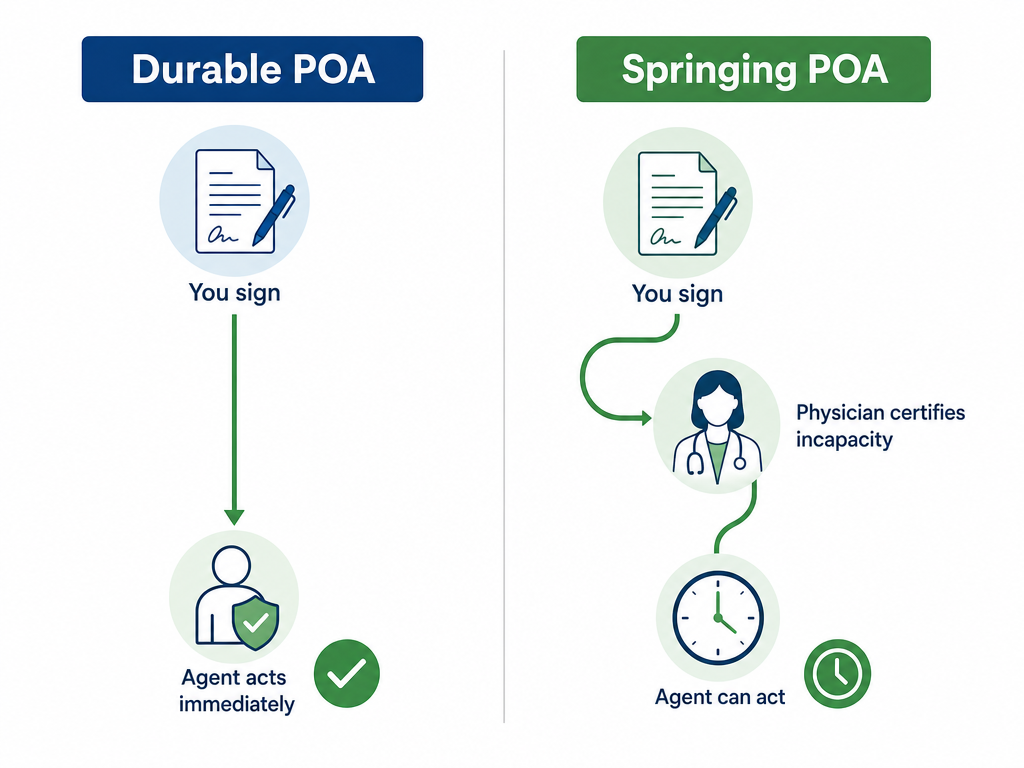
| Durable Power of Attorney (POA) | Grants someone you trust the authority to manage financial and legal matters. Takes effect immediately upon signing. | AARP advises choosing a durable POA over a springing POA because “if something happens, you want to be able to act quickly.” A springing POA only takes effect when a physician certifies incapacity, which can cause delays in an emergency. |
| Healthcare Power of Attorney | Appoints someone to make medical decisions if you are unable to do so. | This is separate from a financial POA and should be the same person or someone who coordinates closely with the financial agent. |
| Living Will (Advance Directive) | Documents your wishes about life-sustaining treatment, such as mechanical ventilation or feeding tubes. | Reduces the burden on family members who might otherwise have to guess what the person would want. |
| Last Will and Testament | Specifies how assets will be distributed after death and names an executor. | While not urgent for caregiving, having a will in place prevents additional legal complexity during an already difficult time. |
These documents must be signed while the person is still legally competent — meaning they understand what they are signing and its implications. Once cognitive decline has progressed, it may be too late. The AARP recommends consulting an elder law attorney to ensure the documents are properly executed and comply with your state’s specific requirements.
Financial First Actions: Consolidate, Protect, and Track
Financial vulnerability often increases as cognitive or physical function declines. The AARP legal checklist recommends three concrete steps that can be completed in a matter of days and dramatically reduce the risk of financial exploitation or missed obligations.
- Consolidate bank accounts. Having fewer accounts makes it easier to monitor for unusual activity, track spending, and ensure bills are paid. If your parent has multiple accounts at different institutions, consider consolidating to one or two primary accounts.
- Designate beneficiaries on all accounts. Check with each financial institution directly — do not rely on online listings alone, as beneficiary designations may not transfer correctly when accounts are consolidated or moved. This includes bank accounts, retirement accounts, and life insurance policies.
- Freeze credit at all three major credit bureaus (Equifax, Experian, TransUnion). A credit freeze is free, easy to lift temporarily when needed, and prevents identity thieves from opening new accounts in your parent’s name. Given that older adults are frequent targets of financial scams, this is one of the most effective protective measures available.
- Set up a system to track bills and receipts. This can be as simple as a shared spreadsheet or a dedicated email address for financial correspondence. The goal is to create visibility so that missed payments or unusual charges are caught quickly.
Your 30-Day Minimal Viable Care Plan
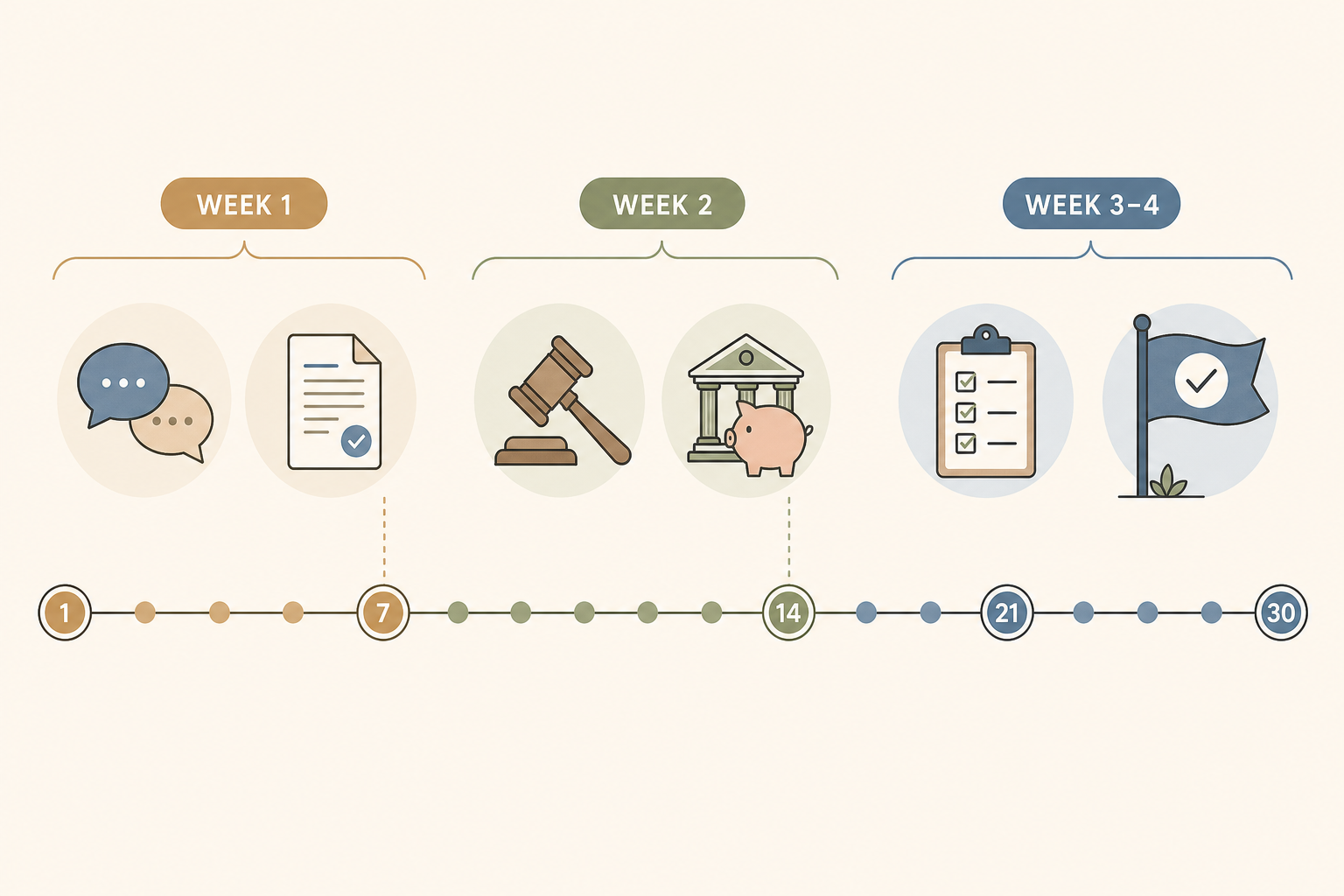
A common objection to pre-crisis planning is that it feels overwhelming — there are too many unknowns, too many documents, too many conversations. The solution is not to do everything at once. It’s to do the most important things first. Below is a structured 30-day plan that covers the essential legal, financial, and relational groundwork.
| Week | Focus Area | Key Actions |
|---|---|---|
| Week 1 | Conversation and Assessment | Have the first values-based conversation with your parent. Complete the NIA-based readiness assessment. Identify which of the five domains (home, health, memory, mood, daily function) need the most attention. If your parent resists, use the strategies from the conversation guide above and revisit the topic. |
| Week 2 | Legal Documents | Consult an elder law attorney or use a state-approved advance directive form. Execute the durable POA, healthcare POA, and living will. Ensure all documents are signed, witnessed, and notarized according to your state’s requirements. Make copies for all relevant family members and the primary care physician. |
| Week 3 | Financial Consolidation | Consolidate bank accounts. Designate or verify beneficiaries on all accounts. Freeze credit at Equifax, Experian, and TransUnion. Set up a bill-tracking system. Gather all financial documents (tax returns, pension statements, Social Security info, insurance policies) into a single secure location. |
| Week 4 | Document Organization and Resource Gathering | Create a “one-stop shop” for all documents — a physical binder or a secure digital folder. Include the legal documents, financial account information, medical history, medication list, and emergency contacts. Download the NIA’s free caregiver worksheets. Program the Eldercare Locator (800-677-1116) into your phone. |
Resources to Keep Handy
The following free resources can support you through the 30-day plan and beyond. Bookmark them, print the worksheets, and keep the contact information accessible.
- NIA Caregiver Worksheets: Free downloadable PDFs covering coordinating caregiving responsibilities, home safety checklists, questions to ask before hiring a care provider, medication management, and important documents and paperwork. Available at nia.nih.gov/health/caregiving/caregiver-worksheets.
- Eldercare Locator: A public service of the U.S. Administration on Aging that connects you to local aging services, including home care, transportation, legal assistance, and housing options. Call 800-677-1116 or visit eldercare.acl.gov.
- AARP Legal Checklist for Family Caregivers: A comprehensive guide to the legal and financial steps every family should take, updated September 2024. Available at aarp.org/caregiving/financial-legal/caregivers-legal-checklist.
- CareWise Guide Eldercare Glossary: A plain-language reference for key terms like durable POA, living will, respite care, and Medicare. Bookmark it for quick lookups as you encounter unfamiliar terminology. See: Elder Care Glossary: 50+ Essential Terms Every New Caregiver Should Know.
The pre-crisis window is a gift of time — time to have conversations while your parent can still participate, time to choose professionals carefully, time to build a plan that reflects your parent’s values, not just the urgency of a hospital discharge. The 54% who wish they had started sooner didn’t have a guide like this. You do.
Related reading
Noticed something outdated or inaccurate on this page? Flag a correction. We review every report against CDC, NIA, and AARP HomeFit guidance before updating a page.
Part of the Fall Prevention section.