
Caregiver decision guide
Elderly Monitoring Without Cameras: A Guide to Passive Sensor Systems That Respect Privacy
Many older adults resist cameras and wearable devices, causing monitoring systems to fail. This guide explains how passive sensor-based monitoring (motion, door, bed, and contact sensors) provides meaningful safety visibility while eliminating the privacy objections and compliance burden that cause most systems to be abandoned.
The Privacy Problem: Why Cameras and Wearables Fail in Practice
Ryan Herd, founder of Caregiver Smart Solutions, learned a hard lesson about elderly monitoring the day he checked the camera he had installed in his father’s home. The lens was pointed at the ceiling. His father had covered it with a dish towel.
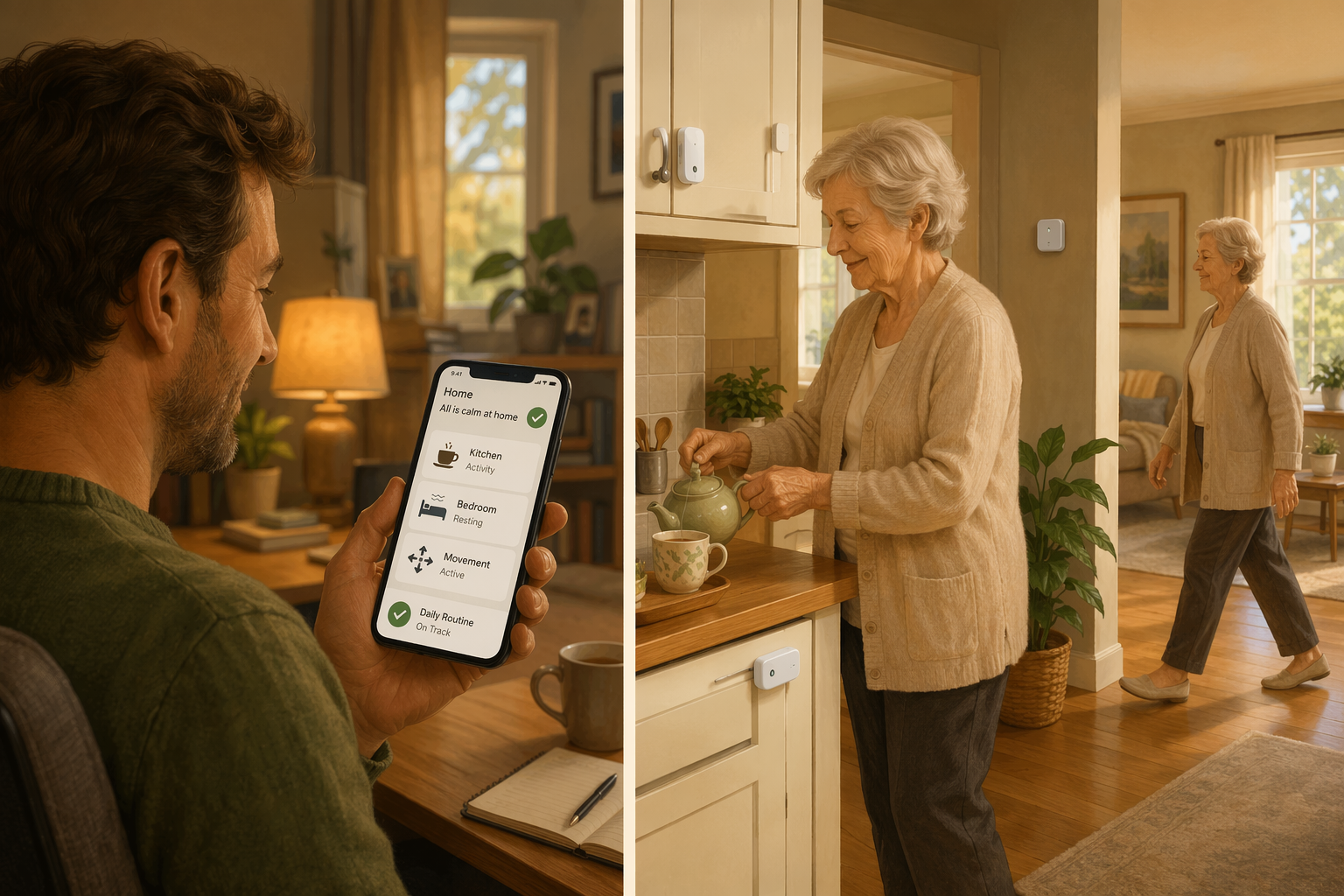
That moment, documented by AARP in 2020, captures the fundamental flaw in camera-based monitoring: many older adults experience it as surveillance, not support. A senior who feels watched will disable the system — covering a lens, unplugging a hub, or simply refusing to stay in camera range. The technology fails not because it doesn’t work, but because the person it’s meant to protect rejects it.
Wearable devices face a different but equally stubborn barrier. The National Council on Aging’s February 2025 survey of more than 1,000 medical alert buyers found that almost 75% purchased a device only after a fall or medical emergency. Most seniors do not adopt monitoring technology proactively — they wait until after a crisis. And once they have a wearable, the compliance challenges multiply. A 2022 NIH scoping review of 30 in-home monitoring studies explicitly excluded wearable sensors from its analysis because older adults with cognitive impairment frequently forget to wear or charge them.
The result is a monitoring gap that affects millions of families. A system that sits in a drawer, gets covered with a towel, or is never charged provides zero safety value. For long-distance caregivers especially, the false sense of security can be worse than no system at all — it delays the search for a solution that actually works.
This is the problem that passive sensor-based monitoring solves. By eliminating cameras and wearable devices entirely, it removes the two most common reasons seniors reject monitoring technology. The trade-off is not lower visibility — it is a different kind of visibility, one that respects privacy while still delivering actionable safety information.
For a deeper look at the specific reasons seniors resist technology, see our guide on four barrier profiles and what actually works.
How Passive Sensors Work: Monitoring Without Cameras or Microphones
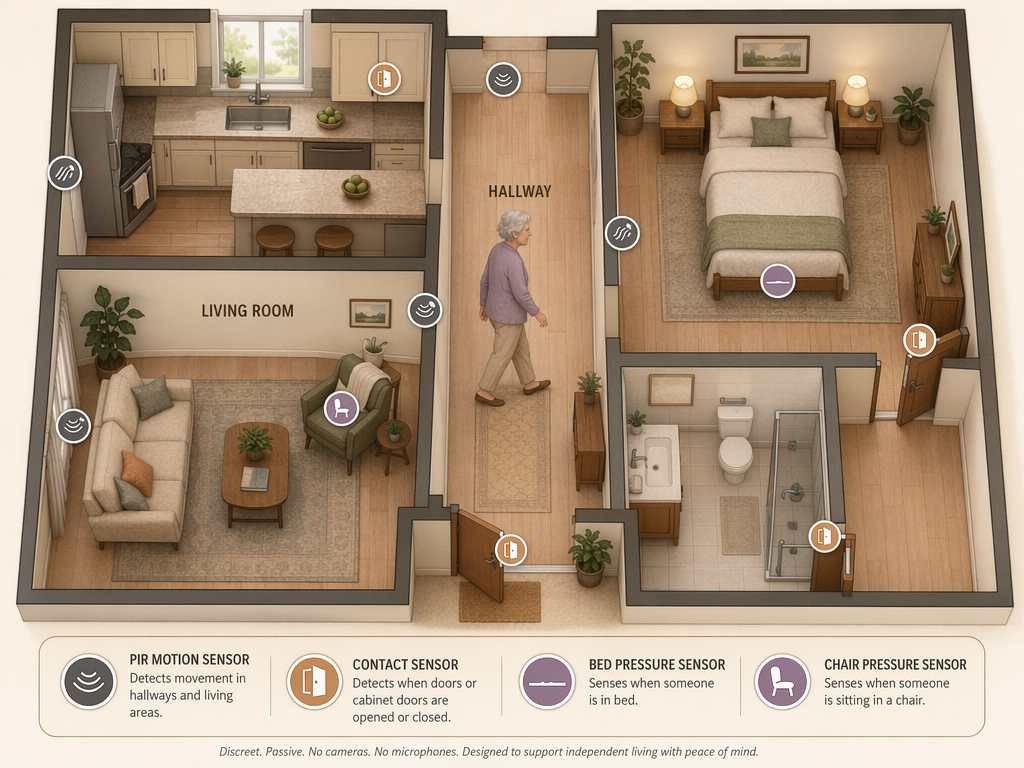
Passive sensor systems use a network of small, unobtrusive devices placed throughout the home that detect activity without recording video, audio, or identifiable images. No one is being watched. No footage is stored. The system tracks patterns — movement, door openings, bed occupancy — and alerts caregivers when those patterns change in meaningful ways.
The NIH scoping review identified the two most common and validated sensor types used in in-home monitoring research:
- Passive infrared (PIR) motion sensors — Used in 21 out of 30 studies reviewed. These detect body heat and movement within a room, registering when someone enters, exits, or remains stationary for extended periods. They are typically placed in hallways, living rooms, kitchens, and bathrooms.
- Contact sensors — Used in 19 out of 30 studies. These magnetic switches attach to doors, cabinets, and drawers. They detect when a door is opened or closed, revealing patterns like medication cabinet access, refrigerator use, and exterior door departures.
- Bed and chair pressure sensors — Thin pads placed under a mattress or cushion that detect occupancy, time spent in bed, and when someone gets up. These are critical for overnight monitoring and fall risk assessment.
- Temperature and humidity sensors — Monitor ambient conditions in the home, which can signal environmental hazards like extreme heat or cold that may go unnoticed by a senior with reduced temperature sensitivity.
Questions to bring to a clinician or OT
This is not medical, legal, or a family's final decision — only a framework. Bring these questions to a clinician, occupational therapist, or your local Area Agency on Aging.
Find Local HelpRelated reading
- Passive Ambient Monitoring for Seniors: The Privacy-Preserving Alternative to Cameras That Detects Falls, Behavior Changes, and Health Decline
- Why the Panic Button Isn't Enough: How Passive Elderly Monitoring Systems Catch What Wearables Miss
- How to Choose an Elderly Monitoring System: A Decision Guide for Family Caregivers
Noticed something outdated or inaccurate on this page? Flag a correction. We review every report against CDC, NIA, and AARP HomeFit guidance before updating a page.