
Caregiver decision guide
When Your Parent Won't Wear the Device: Passive vs. Wearable Elderly Monitoring Systems
If your parent refuses to wear a medical alert pendant or smartwatch, passive monitoring technology may be the solution. This guide explains the trade-offs between wearable and non-wearable systems, why adherence is the biggest challenge, and how to choose a setup that actually gets used.
The Unused Device in the Drawer: Why Adherence Is the Real Problem
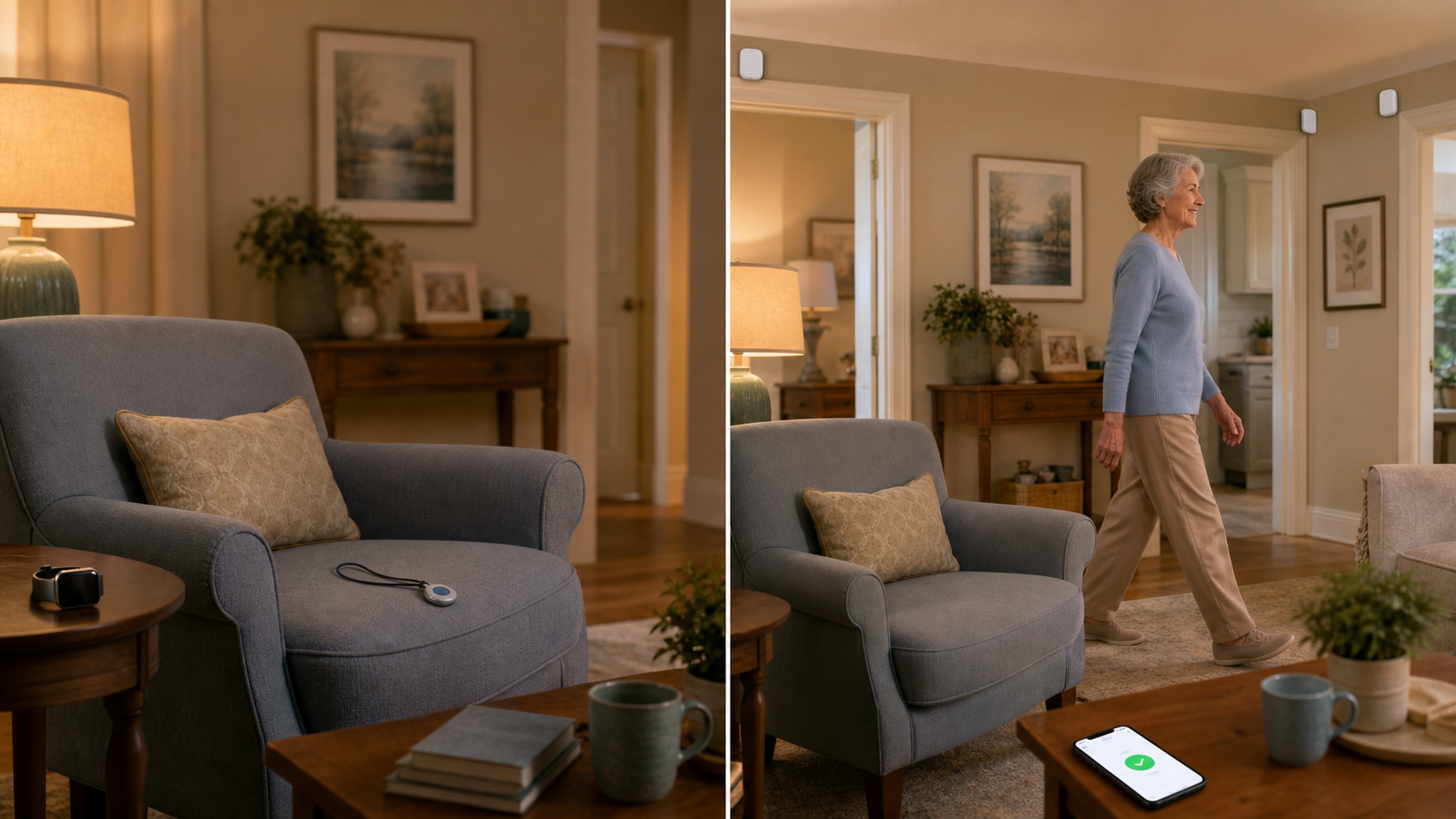
You bought the medical alert pendant. You set up the smartwatch. You explained how it works, showed your parent the fall detection feature, and watched them nod along. A week later, the pendant is sitting in a kitchen drawer. The smartwatch is on the nightstand, battery dead. Your parent says they "forgot" or that it "feels weird." You are not alone — this is the single most common failure point in elderly monitoring, and it has almost nothing to do with the technology itself.
The core problem is adherence. A 2016 study on blood pressure monitors found that 23% of seniors did not wear the devices for the full required time. While that figure comes from a specific medical context, the underlying pattern is widely recognized by geriatric care professionals: the older adults who most need monitoring — those with mild cognitive impairment, early-stage dementia, or simply the forgetfulness that comes with age — are precisely the ones least likely to remember to wear and charge a device consistently.
This is the emotional reality that this guide addresses: you need monitoring, but your parent won't cooperate with the device you bought. The solution is not to buy a better smartwatch or a more expensive pendant. The solution is to reconsider the entire category of device you are using. The fastest-growing segment of elderly monitoring technology — passive, non-wearable systems — exists specifically to solve this problem. It works without requiring the older adult to do anything at all.
How Wearables Work — and Where They Fall Short
Wearable monitoring devices include medical alert pendants, smartwatches with fall detection, and GPS trackers designed for seniors who wander. They share a common design assumption: the user will wear the device during waking hours, keep it charged, and press a button when help is needed. When these conditions are met, wearables are powerful tools.
Strengths of Wearable Systems
- Mobility coverage: Wearables work anywhere the user goes — inside the home, in the yard, at the grocery store, on a walk. This is their primary advantage over any in-home-only system.
- Fall detection: Modern smartwatches and pendants include automatic fall detection that can alert emergency contacts or a monitoring center without the user pressing a button.
- Two-way communication: Most medical alert pendants and smartwatches include a speaker and microphone, allowing the user to speak with a response agent or family member directly from the device.
- GPS tracking: For seniors with wandering risk, GPS-enabled wearables allow caregivers to locate a loved one who has left the home and cannot find their way back.
Where Wearables Break Down
The weaknesses of wearables are not technical — they are behavioral. A device that requires daily charging, consistent wearing, and active maintenance places the entire burden of safety on the person least equipped to carry it.
- Forgetting to wear it: The most common failure mode. The pendant or watch is taken off for sleep, bathing, or comfort, and never put back on.
- Battery anxiety: Smartwatches typically need charging every 18–36 hours. If the user forgets to charge it, the device becomes a dead weight on the wrist.
- Stigma and discomfort: Many older adults associate medical alert pendants with frailty or loss of independence. They remove them when company visits or when leaving the house because they do not want to be seen wearing them.
- Cognitive barriers: A scoping review of 30 studies on in-home monitoring technology found that older adults with cognitive impairment may have difficulty using wearable sensors precisely because the devices must be worn regularly. The very condition that makes monitoring necessary also makes wearable adherence least reliable.
If any of these patterns sound familiar — the pendant in the drawer, the watch on the nightstand, the "I don't need that" response — then a wearable-only approach is unlikely to work for your parent, regardless of which brand or model you choose. For a deeper look at the full range of reasons seniors resist technology, see our guide on the six real barriers to senior tech adoption.
How Passive Monitoring Works — Invisible Safety at Home
Passive monitoring systems are designed around a radically different assumption: the user should not have to do anything. No buttons to press. No device to wear. No battery to charge. The technology operates in the background, collecting data about the person's normal routines and alerting caregivers only when something changes.
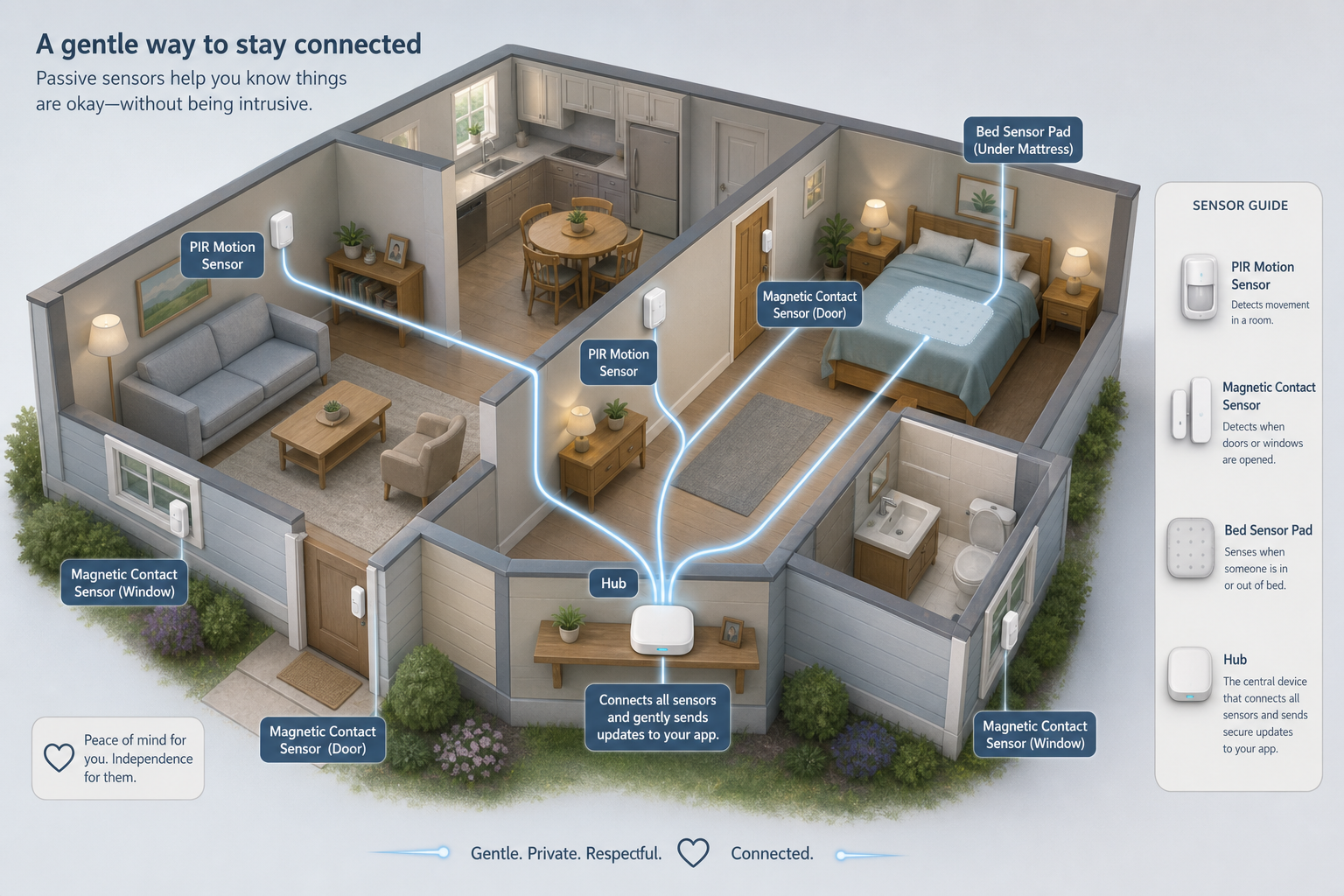
A scoping review published in PMC analyzed 30 studies on in-home monitoring technology conducted between June 2016 and 2021. It identified six core functions that passive systems can perform: monitoring daily activities, detecting abnormal behaviors, identifying cognitive decline patterns, detecting falls, tracking indoor person positioning, and assessing sleep quality. The most common sensor types used across these studies were passive infrared (PIR) motion sensors (used in 21 of the 30 studies) and magnetic contact sensors on doors and cabinets (used in 19 studies).
Common Passive Sensor Types
- PIR motion sensors: Placed on walls or ceilings in key rooms (kitchen, bathroom, hallway, living room). They detect when a person passes through the sensor's field and can establish a baseline of normal movement patterns — when the person typically wakes up, how often they visit the bathroom at night, whether they have left the bedroom by a certain hour.
- Magnetic contact sensors: Attached to doors (front door, refrigerator, medicine cabinet, bedroom door). They report when a door is opened or closed, which helps detect wandering (front door opened at 3 a.m.), medication adherence (medicine cabinet not opened all day), or changes in eating habits (refrigerator not opened during meal hours).
- Bed pressure sensors: A thin pad placed under the mattress that detects presence, movement, and restlessness during sleep. The PMC review noted that a bed-monitoring system using infrared and pressure sensors achieved approximately 90% accuracy in detecting bed occupancy and movement patterns.
- Radar-based fall detectors: Millimeter-wave radar sensors mounted on walls or ceilings can detect falls with 98.74% accuracy and a prediction time of 51.4 milliseconds, according to the same scoping review. These systems do not use cameras and cannot identify specific individuals, which addresses a key privacy concern.
Strengths and Limits of Passive Systems
The primary strength of passive monitoring is that it works regardless of the user's cooperation. The older adult does not need to remember anything, charge anything, or press any button. The system learns their normal patterns over several days and sends alerts only when something deviates — a bathroom visit that lasts unusually long, no movement detected by mid-morning, the front door opening at an unusual hour.
However, passive systems have important limitations. They are in-home only — they cannot detect falls or emergencies that occur outside the house. They do not provide two-way communication; if a fall is detected, the system alerts the caregiver, but the person on the floor cannot speak through the sensors. And they require a stable WiFi connection and power, which can be a barrier for seniors who live in areas with unreliable internet or who are uncomfortable with WiFi-enabled devices in their home.
WiFi Sensing: The Emerging Category That Uses What's Already There
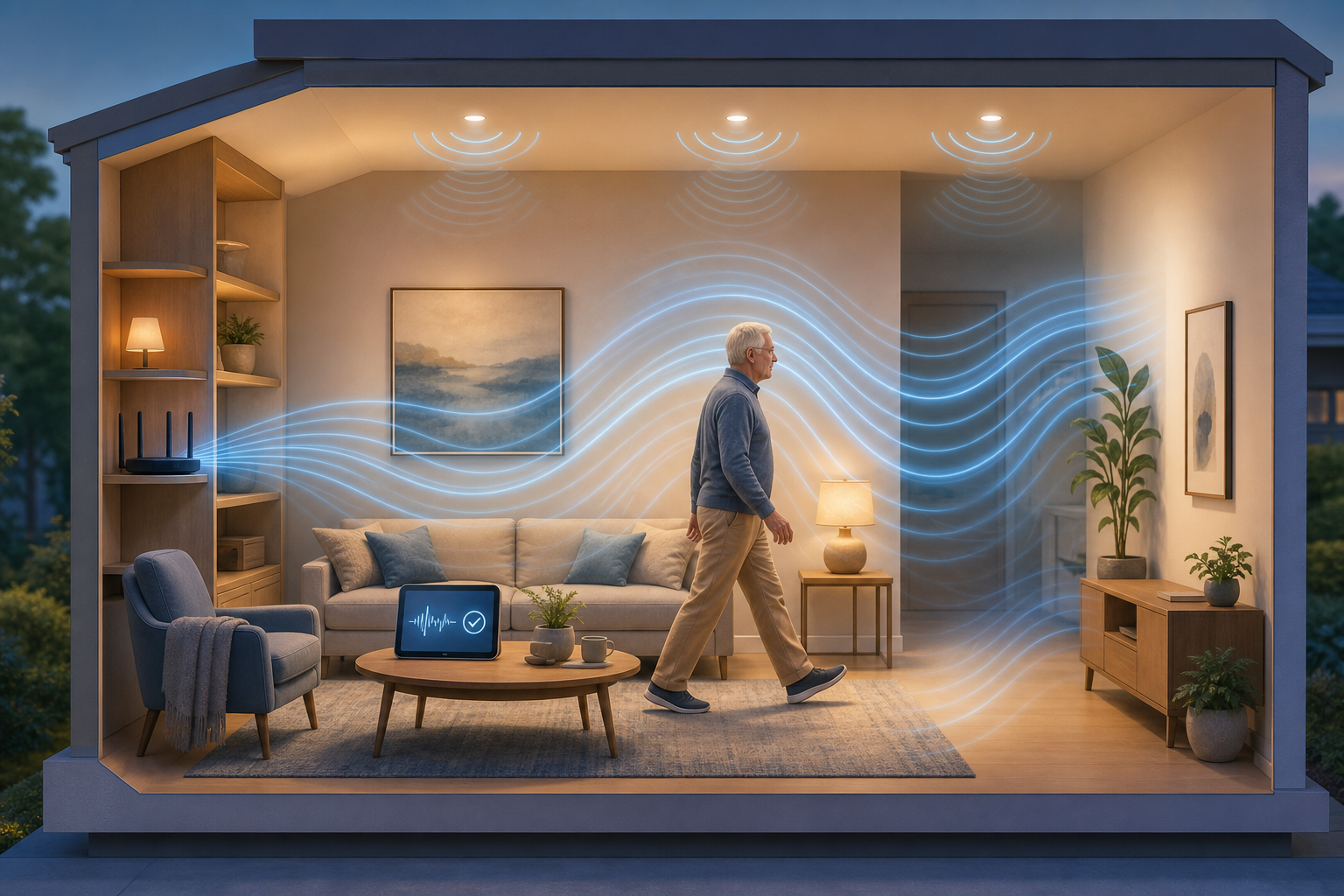
A newer approach to passive monitoring eliminates the need for separate sensors entirely. WiFi sensing technology uses the existing WiFi signals in a home to detect movement, falls, breathing patterns, and even a person's location within a room — without requiring the person to wear anything or interact with any device.
The technology works by analyzing how WiFi waves are disrupted when a person moves through a space. When a person walks, falls, or even breathes, they create subtle disturbances in the WiFi signal that can be detected by a receiver. Companies like Origin Wireless have developed AI-powered platforms that can distinguish between normal movement, a fall, and the absence of movement (indicating a possible emergency). According to a December 2021 article from Origin Wireless, 86% of seniors have WiFi access in their homes, citing a MobiHealthNews report. This means the infrastructure for WiFi-based monitoring is already in place for the vast majority of older adults.
The accuracy data is promising. The PMC scoping review identified a system called "DeFall" that uses a pair of WiFi transceivers to detect falls with a 95% detection rate. Radar-based systems, which use a similar principle but with dedicated hardware, achieved 98.74% accuracy. Camera-based systems exceeded 96% accuracy, but cameras introduce significant privacy concerns that WiFi sensing and radar avoid entirely.
The privacy advantage of WiFi sensing is significant. Unlike cameras, which capture identifiable images and are considered "completely off-limits" in private spaces like bedrooms and bathrooms according to a 2024 study published in the AJOB Empirical Bioethics, WiFi sensing detects only the disruption of radio waves — it cannot identify who is moving, what they look like, or what they are doing. This makes it one of the least intrusive monitoring options available, which directly addresses the privacy concerns that cause many older adults to reject camera-based or wearable systems.
Hybrid Approaches: Combining Passive Awareness with Wearable Emergency Coverage
For many families, the optimal solution is not either/or — it is both. A hybrid approach uses a passive monitoring system as the always-on base layer for in-home safety, combined with a simple wearable emergency button for the times when the older adult leaves the house.
The logic is straightforward: the passive layer handles the 90% of time that the older adult spends at home, where adherence is automatic because no action is required. The wearable layer covers the 10% of time spent outside, where passive sensors cannot reach. The wearable in this scenario does not need to be a full-featured smartwatch with fall detection, GPS, and health tracking. It can be a simple pendant or wristband with a single emergency button and a long battery life — something the older adult only needs to remember when leaving the house, not every day.
What a Hybrid Setup Looks Like in Practice
- Passive base layer: Motion sensors in the kitchen, bathroom, hallway, and living room. Contact sensors on the front door and bedroom door. A bed sensor for nighttime monitoring. The system learns the parent's routine and sends alerts for deviations — no movement by 10 a.m., bathroom visit lasting over 30 minutes, front door opened at 2 a.m.
- Wearable emergency layer: A simple medical alert pendant or wristband with a one-touch emergency button and a battery that lasts weeks or months. The parent wears it only when going outside — to the store, for a walk, to a doctor's appointment. At home, it sits on the nightstand or in a designated spot.
- Caregiver dashboard: A single smartphone app that receives alerts from both systems — passive sensor notifications during the day and emergency alerts from the wearable when the parent is out.
This approach addresses the adherence problem at its root: the passive layer does not depend on the parent's memory or willingness, and the wearable layer is simplified to the point where it is only needed for a specific, limited purpose. For a more detailed discussion of how monitoring technology applies specifically to dementia and wandering risk, see our guide on elderly monitoring systems for dementia and wandering.
Cost Comparison: Wearables vs. Passive Sensor Systems
Cost is often a deciding factor, and the two categories have fundamentally different pricing models. Wearables typically use a monthly subscription model with low upfront costs. Passive systems require a larger upfront investment for the sensor kit but may have lower long-term monthly fees. The table below summarizes typical costs based on current market data.
| Cost Factor | Wearable Systems (Pendants, Smartwatches) | Passive Sensor Systems (Motion, Contact, Radar) |
|---|---|---|
| Upfront equipment cost | $0–$200 (often included with annual subscription) | $300–$900 (sensor kit + hub) |
| Monthly subscription | $25–$50 per month | $50–$60 per month |
| Annual cost (year 1) | $300–$600 (plus any equipment fees) | $900–$1,620 (kit + 12 months subscription) |
| Annual cost (year 2+) | $300–$600 | $600–$720 (subscription only) |
| Typical contract | Month-to-month or annual | Month-to-month or annual |
| Replacement/upgrade costs | New device every 2–3 years | Sensors last 3–5 years; hub may need replacement |
The cost difference between the two approaches narrows significantly over time. A passive system's higher upfront cost is offset by the fact that it actually gets used — a wearable that sits in a drawer provides zero value at any price. When evaluating cost, factor in the likelihood of adherence, not just the monthly fee.
Key Decision Factors: Which Approach Fits Your Parent's Situation?
There is no single right answer. The best monitoring approach depends on your parent's specific circumstances — their mobility, cognitive status, living situation, and attitude toward technology. The following questions can help you match the approach to the situation.
Decision Framework
- Does your parent go outside alone regularly? If yes, you need some form of wearable coverage for out-of-home protection. A passive-only system cannot help if they fall in the yard or get lost on a walk. Consider a hybrid setup with a simple emergency pendant for outings.
- Can they reliably charge and wear a device? If the answer is no — because of forgetfulness, cognitive decline, or simple disinterest — a passive system is likely the only option that will provide consistent coverage. Do not assume you can train or remind them into compliance.
- Is privacy a stated concern? The 2024 study from the AJOB Empirical Bioethics found that privacy is one of the most frequently cited barriers to acceptance of smart home health technologies. If your parent has expressed discomfort with being "watched," emphasize that passive sensors (PIR, contact, radar, WiFi) do not use cameras and cannot identify individuals. Show them how the system works — a smartphone alert that says "no movement detected" is very different from a live video feed.
- Is there cognitive decline or wandering risk? For seniors with dementia or Alzheimer's, a passive system with door contact sensors is essential for detecting wandering. A GPS wearable can provide an additional layer of safety for out-of-home wandering. See our dedicated guide on monitoring systems for dementia and wandering for a deeper discussion.
- Do they live alone? Living alone increases the stakes of any undetected emergency. A passive system with fall detection and daily routine monitoring provides a safety net that does not depend on the person's ability to call for help.
If you are still unsure which approach fits your situation, our broader wearable vs. passive monitoring decision framework provides a more detailed feature-by-feature comparison that can help you narrow down the options. The key is to start with the adherence problem — not with the technology — and work backward to the solution that your parent will actually accept and use.
Questions to bring to a clinician or OT
This is not medical, legal, or a family's final decision — only a framework. Bring these questions to a clinician, occupational therapist, or your local Area Agency on Aging.
Find Local HelpRelated reading
- When the Pendant Isn't Enough: A Caregiver's Guide to Passive vs. Active Monitoring Technology
- Beyond the Pendant: How Passive Monitoring Systems Are Solving the Biggest Failure of Traditional Fall Detection
- Passive Sensors vs. Wearables vs. Cameras: Choosing the Right Monitoring System for Your Aging Parent
Noticed something outdated or inaccurate on this page? Flag a correction. We review every report against CDC, NIA, and AARP HomeFit guidance before updating a page.