
Caregiver decision guide
Help Your Aging Parent Stay Mobile and Independent: A Caregiver's Guide
This guide helps adult children recognize early signs of mobility decline, navigate difficult conversations about assistive devices, and take practical steps—from professional assessments to home modifications—to support their parent's independence at home.
Why Mobility Is the Lynchpin of Independent Aging
When an aging parent begins to slow down, the first thing that slips is often the most consequential: the ability to move safely and freely around their own home and community. Mobility decline is rarely an isolated event. It sets off a cascade — reduced activity leads to muscle weakness, which increases fall risk, which leads to fear and further withdrawal, which accelerates social isolation and functional loss. For adult children watching from a distance, the process can feel both inevitable and invisible until a crisis makes it undeniable.
The data bears this out. According to the American Psychological Association, as cited by AgingCare, fewer than one in five older adults between ages 65 and 74 need assistance with activities of daily living. But that proportion climbs sharply after age 85, and mobility is almost always the first functional domain to erode. Falls remain the leading cause of emergency department visits among older adults, and they are the most common reason a senior loses the ability to live independently.
The encouraging news is that mobility decline is not a switch that flips overnight. It unfolds over months and years, and early intervention — the right combination of professional assessment, assistive devices, home modifications, and activity adaptation — can extend safe independent living by a meaningful margin. This guide is written for the adult children who sense something is changing but aren't sure what to do about it. The goal is not to take over your parent's life. It is to give you a framework for recognizing the early signals, having the conversations that matter, and making decisions that preserve their autonomy rather than erode it.
Recognizing the Red Flags of Mobility Decline
Mobility decline rarely announces itself with a single dramatic event. It accumulates through small adjustments that the older adult themselves may not fully register — taking the handrail more carefully, avoiding the basement stairs, choosing the closer parking spot, letting someone else carry the groceries. These adaptations are rational in the moment, but over time they shrink the radius of daily life.
The National Institute on Aging recommends watching for specific signs that an older adult may need help, including trouble walking or getting around, a noticeable change in gait, and unexplained falls or near-falls. Other indicators include difficulty getting out of a chair without using armrests for leverage, a tendency to hold onto walls or furniture while walking through a room, and a gradual reduction in the distance they are willing to walk.
Here is a practical checklist of observable behaviors that warrant attention:
- Gait changes: A wider stance, shorter stride length, shuffling, or asymmetry in step pattern. These are often the earliest visible signs.
- Stair avoidance: Choosing to stay on one floor of the house, carrying items up and down in a single trip to minimize stair use, or gripping the railing with both hands.
- Reduced activity radius: No longer walking to the mailbox, skipping regular errands, or declining social invitations that involve walking or standing.
- Self-limiting driving: Avoiding night driving, unfamiliar routes, or highways. This is often a proxy for declining confidence in physical reaction time.
- Near-falls: Tripping on a rug edge, stumbling on an uneven sidewalk, or grabbing a counter to avoid going down. A near-fall is a warning, not a pass.
- Changes in daily routines: Skipping showers because standing is tiring, letting housework pile up, or eating less because preparing meals requires too much standing.
How to Talk About Mobility Aids Without Triggering Resistance
For many older adults, the suggestion of a cane or walker lands as a verdict — a public announcement that they are now "old" or "disabled." This stigma is a well-documented barrier to mobility aid adoption, and it is one of the most frustrating obstacles caregivers face. Your parent may be struggling visibly, yet the moment you mention a walker, the conversation shuts down.
The key is to reframe the device not as a symbol of decline but as a tool for preserving the activities they care about most. A walker does not mean your parent can no longer walk. It means they can walk farther, more safely, and with less pain. The conversation should start with what they want to keep doing — gardening, visiting grandchildren, walking to the corner store — and work backward to the tool that makes it possible.
The Dartmouth Health article on starting care conversations recommends an approach called "I wish / I worry / I wonder" — a non-confrontational framing that invites dialogue rather than defensiveness. For example: "I wish we could still take our walks together in the park. I worry that you're not as steady on your feet as you used to be. I wonder if there's a walking aid that could help you feel more confident so we can keep doing that."
Additional strategies that tend to work better than direct recommendations:
- Let a professional introduce the idea. A physical therapist or occupational therapist can recommend a mobility aid as part of a clinical assessment. The same suggestion from a doctor or therapist often lands very differently than from a child.
- Frame it as temporary or situational. "What if you just used the cane for longer walks, not around the house?" This lowers the stakes and lets your parent test the idea without feeling committed.
- Normalize through peers. If a friend or neighbor uses a rollator and still gets around well, that example is more persuasive than anything you can say.
- Focus on safety for others. "I worry about you carrying a hot cup of coffee across the kitchen. A rollator with a tray would let you do that without risking a burn." This shifts the frame from personal limitation to practical problem-solving.
Start with a Professional Assessment, Not a Device
The single most common mistake caregivers make is buying a mobility aid before getting a professional evaluation. A cane purchased at a pharmacy without guidance is likely to be the wrong height, used on the wrong side, or entirely inappropriate for the underlying condition. A walker that is too wide for the home's doorways becomes a hazard rather than a help.
A physical therapy or occupational therapy evaluation should be the first step — not the last. Here is what a thorough assessment typically covers:
- Gait analysis: Observing how your parent walks — stride length, symmetry, arm swing, and foot clearance — to identify the specific deficit the device needs to address.
- Balance testing: Standardized measures like the Berg Balance Scale or Timed Up and Go test quantify fall risk and help determine whether a cane, walker, or rollator is appropriate.
- Strength and range of motion: Assessing lower body strength, grip strength, and joint mobility to ensure the recommended device can be used safely and effectively.
- Home safety recommendations: Many therapists will identify environmental hazards — throw rugs, poor lighting, narrow pathways — that need to be addressed alongside the device.
- Device fitting and training: Ensuring the device is adjusted to the correct height and teaching proper use, including how to navigate stairs, curbs, and uneven surfaces.
Assistive Device Decision Guide: Choosing the Right Tool
Once a professional assessment has identified the specific mobility limitation, the next step is matching the device to the need. The wrong device — or the right device used incorrectly — can actually increase fall risk. The table below summarizes the most common mobility aids, their primary use cases, and key selection considerations.
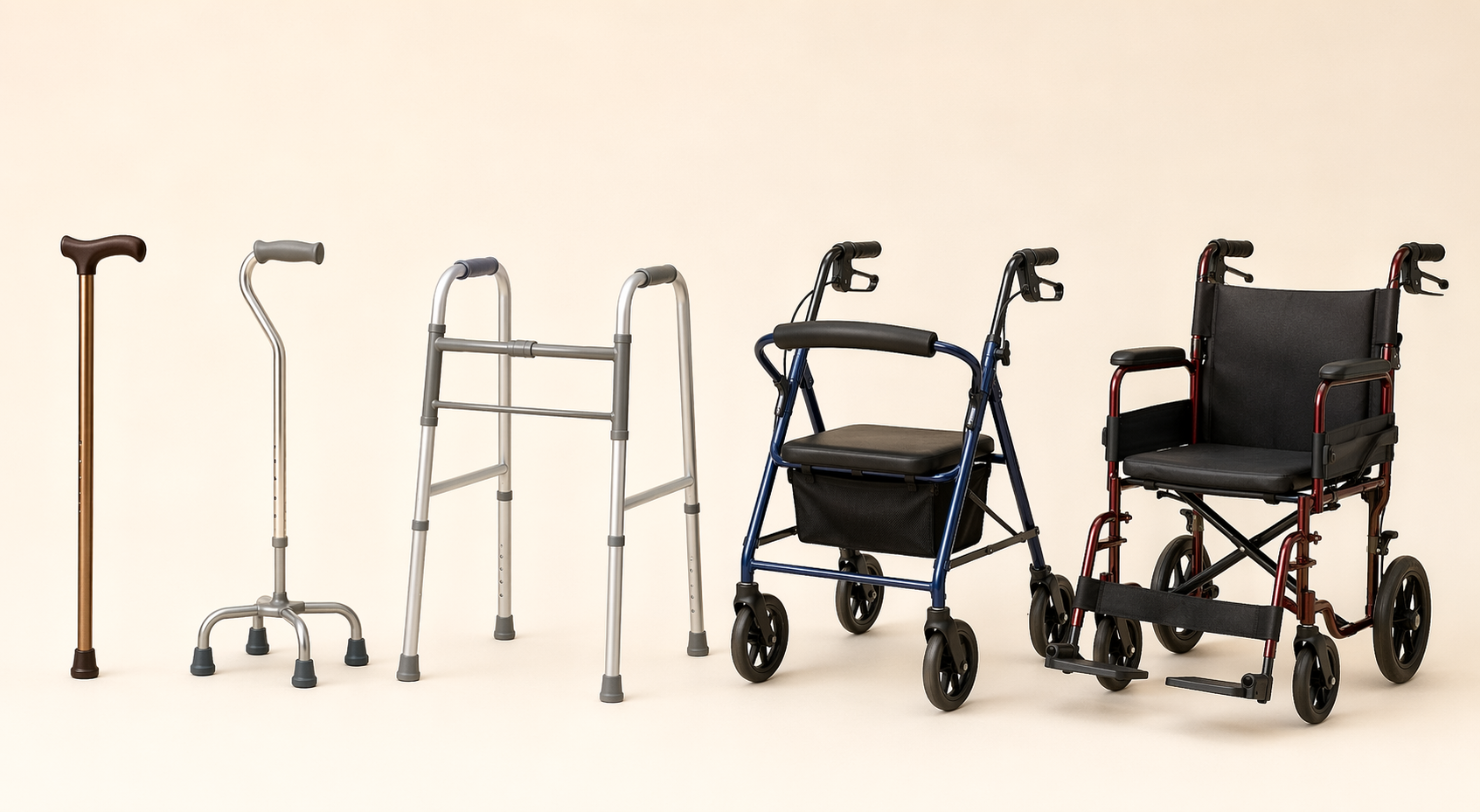
| Device | Best For | Key Features to Look For | When to Avoid |
|---|---|---|---|
| Single-point cane | Mild balance issues; joint pain on one side (e.g., hip or knee arthritis) | Adjustable height; ergonomic handle; rubber tip with good tread | Significant weakness in both legs; requires substantial weight-bearing support |
| Quad cane | Greater stability needs than a single-point cane; post-stroke recovery | Wide base for stability; four-point tip; lightweight but sturdy frame | Needs both hands free; requires slow, deliberate gait pattern |
| Standard walker (no wheels) | Significant weakness or balance impairment; needs maximum support | Adjustable height; comfortable hand grips; must be lifted with each step | Limited upper body strength; difficulty lifting the walker repeatedly |
| Rollator (wheeled walker with seat) | Moderate mobility impairment; needs to rest frequently; wants to walk longer distances | Locking brakes; padded seat; storage pouch or basket; adjustable handle height; large wheels for outdoor use | Poor balance or cognitive impairment (may forget to lock brakes); very narrow home doorways |
| Transport chair | Cannot walk independently for more than short distances; needs caregiver to push | Lightweight frame; removable footrests; padded armrests; easy-fold mechanism | User has sufficient upper body strength for a self-propelled wheelchair |
| Power scooter | Can transfer independently but cannot walk moderate distances; needs outdoor mobility | Battery range sufficient for daily needs; adjustable seat and tiller; portable or disassemblable for transport | Poor trunk control or balance; cannot safely transfer on and off without assistance |
Proper fit matters as much as device type. For canes and walkers, the handle should be at wrist height when the arm hangs naturally at the side, with the elbow bent at approximately 15 to 20 degrees. A device that is too high forces the user to lean to one side. A device that is too low encourages a stooped posture and reduces stability. A physical therapist can adjust the fit in minutes and demonstrate the correct gait pattern.
Home Modifications That Support Safe Mobility
An assistive device is only as good as the environment it operates in. A rollator is useless if it cannot fit through the bathroom door. A cane becomes a hazard on a slippery throw rug. The National Institute on Aging recommends a room-by-room home safety assessment as a foundational step in fall prevention, and the same assessment applies directly to mobility support.
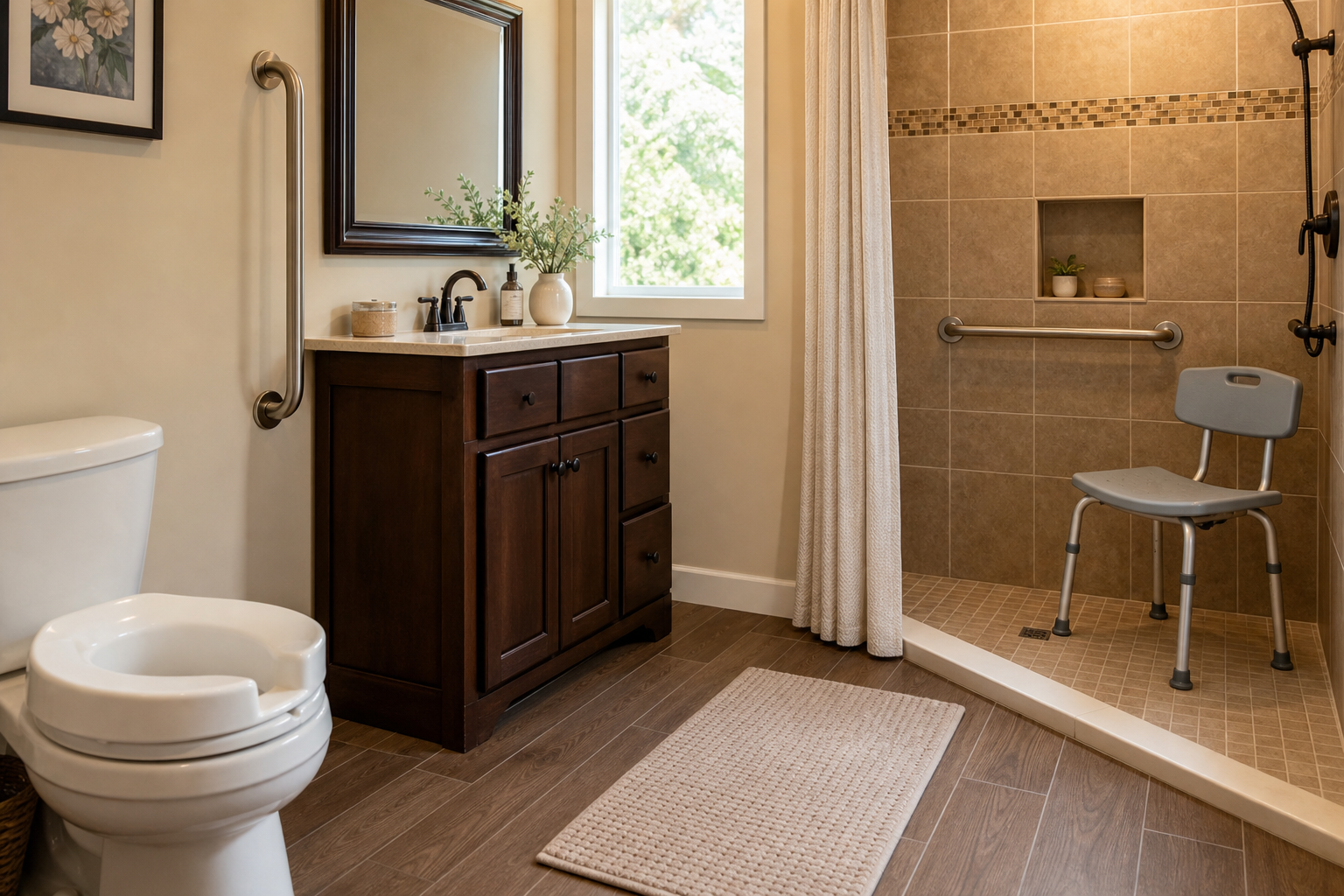
The most impactful modifications are often the least expensive. Here is a priority-ordered list of changes that make the biggest difference for someone with declining mobility:
- Bathroom grab bars: Install beside the toilet and inside the shower or tub. These are the single most effective modification for preventing falls in the most dangerous room in the house. Avoid suction-cup grab bars — they fail without warning. Use bars anchored into wall studs or blocking.
- Improved lighting: Increase wattage in hallways, stairways, and entry points. Add night lights in the bathroom and along the path from bedroom to bathroom. Motion-activated lights are ideal for nighttime trips.
- Non-slip surfaces: Apply non-slip strips or mats in the shower and tub. Use non-slip rug pads under any area rugs, or remove throw rugs entirely — they are one of the most common trip hazards in the home.
- Stair safety: Ensure handrails are present on both sides of the staircase and are securely anchored. Add contrasting tape to the edge of each step to improve depth perception. Repair any loose or uneven treads.
- Remove trip hazards: Secure or remove loose electrical cords, reduce clutter in high-traffic pathways, and ensure furniture is arranged to create clear, wide walking paths — at least 36 inches wide to accommodate a walker or rollator.
- Raised toilet seat: A raised toilet seat or toilet frame reduces the effort required to sit and stand, which is a common challenge for people with hip or knee weakness.
For readers concerned about stairs specifically, our Stair Lift vs. Alternatives decision guide covers the options and trade-offs. And for kitchen-specific hazards, see 5 Kitchen 'Safety' Products That Can Actually Increase Fall Risk.
Activity Modification: Preserving Strength, Balance, and Engagement
Mobility is not just about the ability to walk from point A to point B. It is about the ability to do the things that make life worth living — gardening, cooking, visiting friends, attending religious services, playing with grandchildren. When mobility declines, the natural instinct is to stop doing these activities. The better approach is to adapt them.
The NIA's framework for aging in place emphasizes that maintaining physical function requires ongoing activity. Strength and balance exercises — even simple ones performed at home — can slow the rate of decline and reduce fall risk. The CDC's STEADI program recommends balance training (such as standing on one foot or heel-to-toe walking) and strength exercises (such as sit-to-stand repetitions) as core components of fall prevention.
Practical ways to help your parent stay active and engaged:
- Adapt favorite activities rather than stopping them. If your parent loved gardening, raised garden beds or container gardening on a tabletop eliminates the need to bend and kneel. If cooking is a passion, a stool or perching chair in the kitchen allows them to prepare meals while seated.
- Encourage walking with a purpose. Walking to the mailbox, around the block, or through a local park provides both exercise and social connection. A rollator with a seat allows rest breaks and makes longer walks feasible.
- Consider a structured exercise program. Programs like Otago (a strength and balance program developed for older adults) or Tai Chi for fall prevention have strong evidence for reducing fall risk. Many senior centers and community organizations offer these programs at low or no cost.
- Use professional help strategically. If your parent needs assistance with bathing, dressing, or meal preparation, home health aides and homemaker services can provide support without requiring a move to assisted living. Our Senior Home Services decision framework covers when to hire help, what it costs, and how to start.
Technology Supports: Fall Detection, Medical Alerts, and GPS Tracking
Technology can extend the safety net for a parent who is still mobile but at risk. The right tools provide peace of mind for the caregiver and a lifeline for the older adult — without requiring constant supervision.
Three technology categories are particularly relevant for supporting mobility independence:
- Medical alert systems (PERS): A wearable button or pendant that connects to a monitoring center. Modern systems include automatic fall detection, which can place a call for help even if the user is unable to press the button. These are most useful for a parent who lives alone or spends significant time alone during the day.
- Fall detection devices: Some medical alert systems include fall detection as a built-in feature. Standalone fall detection sensors are also available. The key evaluation criteria are sensitivity (does it detect falls reliably without false alarms?) and response time (how quickly is help notified?).
- GPS trackers: For a parent who still goes out independently — walking to the store, visiting friends, taking public transit — a GPS tracker can provide location information to the caregiver. These are especially valuable for parents with early-stage cognitive decline who may become disoriented outside familiar areas.
For caregivers considering GPS tracking specifically, our GPS Tracker Explainer for Seniors covers what every caregiver should know before purchasing.
Your Role as a Caregiver: Support Without Micromanaging
One of the hardest parts of supporting an aging parent is calibrating the right level of involvement. Too little, and problems escalate unnoticed. Too much, and your parent feels infantilized and resists the very help they need.
According to Pew Research Center's 2026 survey of family caregivers, 68% of adult children who are caregivers regularly help with errands, housework, and home repairs. Only 16% regularly help with personal care like bathing and dressing, though another 15% do so occasionally. This distribution reflects a natural boundary: most adult children can support their parent's independence through practical assistance without crossing into the intimate care that often triggers role reversal distress.
The most effective caregiver role in the mobility context is that of a coordinator and encourager — not a hands-on therapist or a daily attendant. Your job is to:
- Help your parent access professional resources (physical therapy, occupational therapy, home health services) rather than trying to solve mobility problems yourself.
- Create an environment that supports safe mobility (home modifications, clear pathways, good lighting) rather than hovering and warning.
- Encourage and celebrate activity without pressuring or shaming. A walk to the end of the driveway is a win, not a disappointment because it wasn't longer.
- Monitor for changes without turning every visit into an assessment. Notice whether your parent is moving differently, but don't comment on every observation.
- Know your limits. The Pew survey found that 47% of women caregivers and 30% of men report negative emotional impacts from caregiving, while 38% of women and 26% of men report negative physical health impacts. If you are feeling overwhelmed, that is not a failure — it is a signal that you need support too.
When Mobility Loss Signals a Need for More Comprehensive Care
There comes a point in many caregiving journeys when the combination of assistive devices, home modifications, and activity adaptation is no longer sufficient to keep a parent safe at home. Recognizing this threshold is difficult — it feels like a failure, even when it is simply the natural progression of a condition that cannot be fully reversed.
The following signs suggest that mobility decline has progressed beyond what home-based interventions can safely manage:
- Recurrent falls despite using the prescribed assistive device. If your parent is falling while using a walker or rollator correctly, the device is no longer providing adequate protection.
- Inability to perform basic transfers. If your parent can no longer get out of bed, off the toilet, or out of a chair without physical assistance, the home environment may no longer be safe even with modifications.
- Weight loss or dehydration. If your parent is losing weight because they cannot stand long enough to prepare meals or cannot get to the kitchen safely, the mobility limitation is affecting basic nutrition.
- Social withdrawal and isolation. If your parent has stopped leaving the house entirely, or has stopped engaging in activities they previously enjoyed, the emotional and cognitive toll of mobility loss may be accelerating other declines.
- Caregiver exhaustion. If you are the one providing most of the physical assistance and you are feeling burned out, that is a valid reason to consider a higher level of care. Your wellbeing matters in this equation.
When these signs appear, the decision is not about giving up on independence. It is about recognizing that independence looks different at different stages, and that safety — both your parent's and your own — must take priority. Our guide on Aging in Place vs. Assisted Living After a Fall provides a structured decision framework for families weighing this transition. And for a realistic look at the financial side, see The Hidden Costs of Aging in Place in 2026.
Questions to bring to a clinician or OT
This is not medical, legal, or a family's final decision — only a framework. Bring these questions to a clinician, occupational therapist, or your local Area Agency on Aging.
Find Local HelpRelated reading
Noticed something outdated or inaccurate on this page? Flag a correction. We review every report against CDC, NIA, and AARP HomeFit guidance before updating a page.