
Caregiver decision guide
The Safest Vacuum to Prevent Falls Isn't Just a Robot
Robot vacuums remove some fall hazards but add others, like app dependence and units stranded in walkways. The safest choice among robot, stick, and upright vacuums depends on balance, grip, tech comfort, and flooring — and for many homes, it's a robot plus a hand vacuum.
Start with the person, not the appliance
If the real question is, “Should I replace Mom’s vacuum with a robot to reduce fall risk?” the answer is not “buy the most advanced robot.” The safer vacuum is the one that removes the most likely hazards in that particular home without adding a new task the older adult cannot manage safely.
There is also a line worth drawing early: no clinical study directly proves that robot vacuums prevent falls. The fall-prevention argument is indirect. A robot may reduce exposure to known household hazards tied to vacuuming, such as cords, bending, carrying, turning, clutter, and throw rugs. But it can also create its own hazards: a stranded unit in a hallway, a threshold it cannot cross, a required phone app, or a floor-prep routine someone forgets.
So the question behind searches for the best robot vacuum for elderly to prevent falls has a less tidy answer than a buying guide usually gives. For many homes, the safest setup is a robot vacuum for routine floor maintenance plus a small hand vacuum for touch-ups, with a separate plan for deep carpet cleaning when needed.
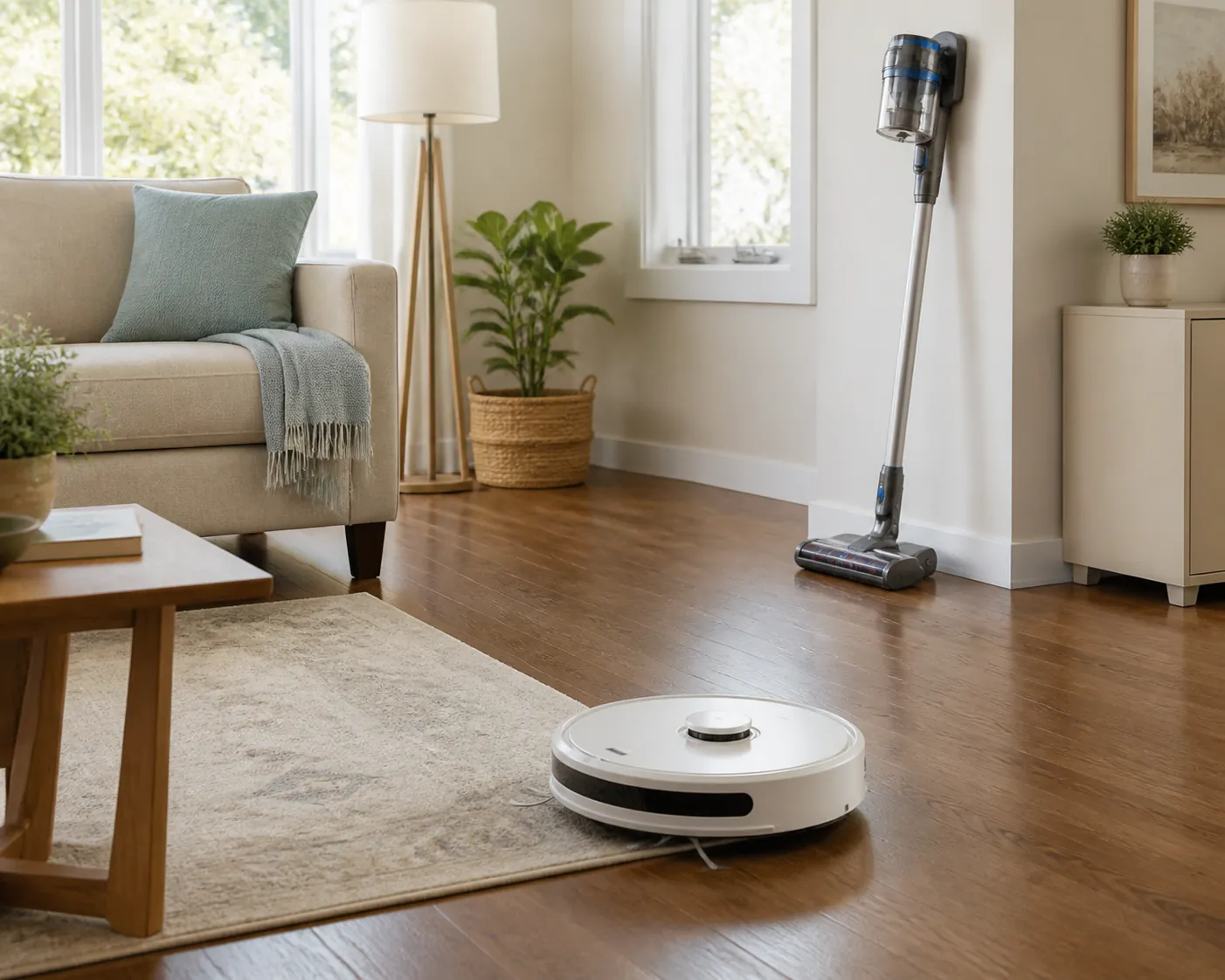
Two facts keep this decision honest. In a 2020 Consumer Reports lab comparison on medium-pile carpet, the top-rated upright picked up more than half of embedded test debris, while the robot picked up under 20 percent; that is a warning about straight replacement, not a current model recommendation. [1] AARP’s long-time-owner advice is just as practical: put away thin cords before robot runs, remove throw rugs that can tangle or trip, expect that most models need a smartphone app, and keep a small hand vacuum for touch-ups. [2]
A first-pass decision table
Use this table before comparing models. It is meant to sort the cleaning tool by the person, the floor plan, and the work left over after the machine finishes.
| Decision factor | Robot vacuum | Cordless stick vacuum | Corded upright vacuum | Robot + small hand vacuum |
|---|---|---|---|---|
| Balance while cleaning | Removes most pushing and turning during routine cleaning, but may require rescue if it gets stuck. | Still requires standing, steering, turning, and reaching, though usually with less weight than an upright. | Often asks for the most pushing, pivoting, and room-to-room handling. | Cuts down routine full-room vacuuming while keeping touch-ups short and localized. |
| Grip strength and upper-body effort | Low during the cleaning run; higher if the user must lift the robot, clean rollers, or empty a bin. | Can be easier than an upright, but trigger buttons, attachments, and overhead use may still be tiring. | Can be harder to maneuver, especially on carpet or around furniture. | Robot handles open floor areas; hand vacuum handles crumbs, chairs, and small messes without dragging a full machine out. |
| Cord trip risk | No operating cord across the room, but the dock cord still needs to be placed out of the walking path. | No operating cord if battery-powered, but charging location matters. | Highest cord-management burden: plugging, unplugging, crossing doorways, and pulling slack around furniture. | Usually avoids live vacuum cords in walking paths if the hand vacuum is stored and charged safely. |
| Bending and reaching | May reduce bending to outlets, but can add bending to retrieve the unit, clear brushes, or empty debris. | May require bending for low areas and emptying; storage height can make a big difference. | Often involves bending to plug in, adjust settings, move cords, and empty or maintain the vacuum. | Best when the robot dock and hand vacuum are placed at easy standing height or reachable wall height. |
| Tech comfort | AARP notes that most models need a smartphone app, which can turn a cleaning decision into a setup-and-troubleshooting job. [2] | Usually simpler: charge, turn on, empty. | Usually simplest technologically, though heavier physically. | Works best when someone can set schedules, update the app, and solve errors without making the older adult crawl around looking for blinking lights. |
| Flooring | Consumer Reports says robots perform best in uncluttered rooms with bare floors or low-pile rugs; thick carpet can drain the battery and may stop the robot before it finishes. [1] | Often useful across mixed floors, stairs, and spots a robot cannot reach. | Still the stronger deep-cleaning tool for carpet in many homes, based on the 2020 Consumer Reports lab comparison. [1] | Robot maintains suitable floors; hand vacuum handles crumbs and edges; deep carpet gets a separate cleaning plan. |
| Thresholds and room transitions | May stop at raised transitions or become stranded where the older adult later has to step around it. | User can carry it across thresholds, if carrying is safe. | User can move it across thresholds, but weight and cord position matter. | Safer when the robot is limited to rooms it can reliably complete and the hand vacuum covers the rest. |
| Clutter, cords, and throw rugs | Needs floor prep. AARP advises putting away thin cords and getting rid of throw rugs that can be sucked up or become a trip hazard. [2] | Can work around more clutter, but the user still has to maneuver around it. | Can pull cords and bunch rugs while also adding its own cord hazard. | Only works safely if the home routine includes simple floor prep before scheduled robot runs. |
| Deep-cleaning needs | Good for maintenance on suitable floors, but not a full replacement for deep carpet cleaning. | Good for small homes, quick cleanups, and places a robot cannot reach. | Often better when embedded carpet debris is the main cleaning problem. | Most realistic for many households: reduce risky routine vacuuming without pretending all vacuuming disappears. |
Where manual vacuums create fall risk
A traditional vacuum does not have to be “heavy” in a showroom to become risky at home. The hard part is usually the sequence: pull it from a closet, carry or roll it over a threshold, bend to plug it in, pull the cord around a doorway, push forward, pull back, half-turn around a chair, then do it again in the next room.
That sequence asks a lot of balance. The person is not just walking. They are walking while managing resistance from carpet, furniture, a hose, a power cord, and the pride that says the room is not done until the visible tracks look right. Fatigue often arrives before the job is finished, and people who have always kept a clean house may push through that warning.
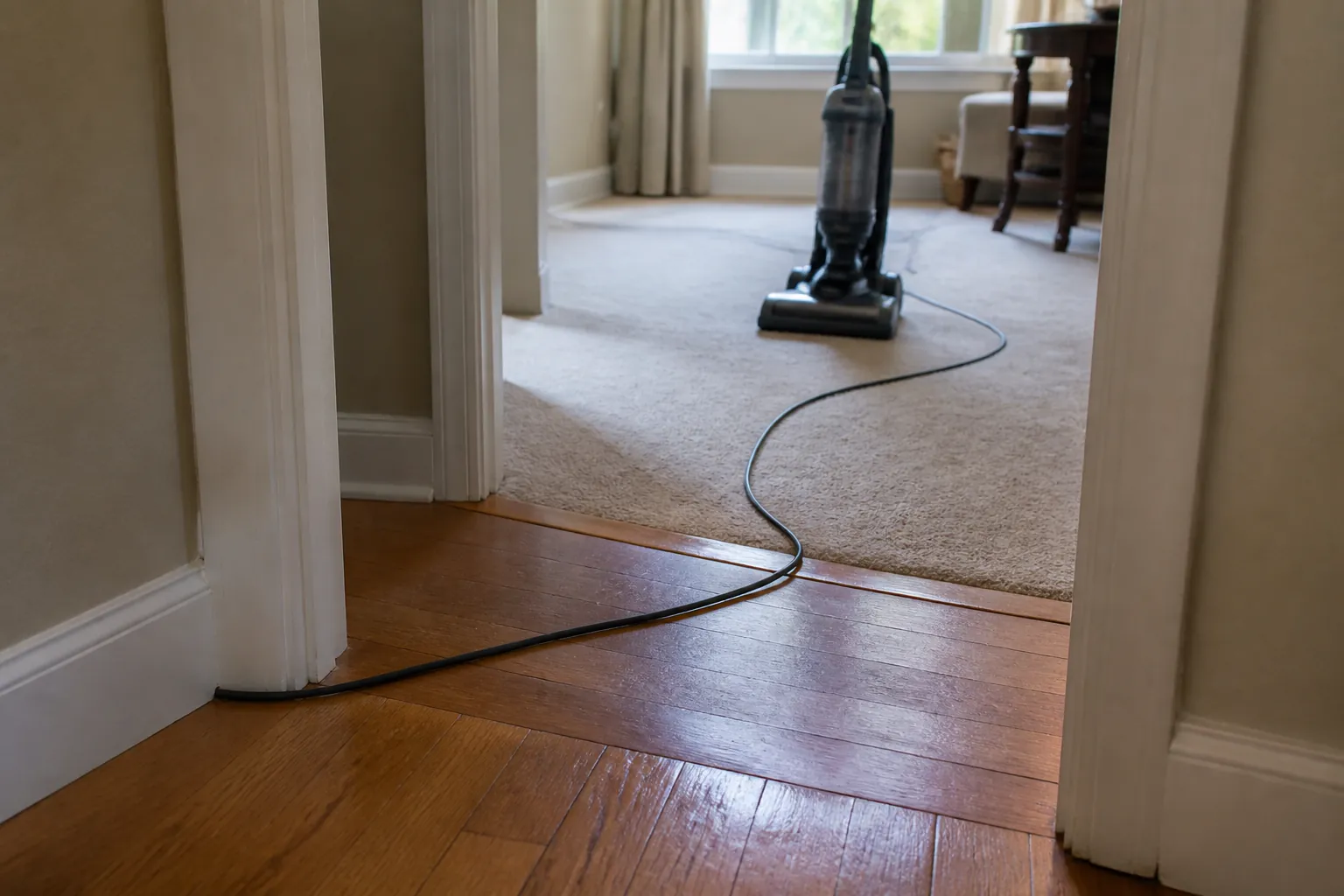
The cord deserves special attention because it moves the hazard into the walking path. It can lie across a doorway, loop behind a heel, or make the user step backward while looking at the floor. AARP’s robot-vacuum advice treats thin cords as both a tangle problem and a trip hazard, which is exactly the kind of plain detail that matters more than a suction chart. [2]
Cordless sticks remove the live cord from the room, which is a real advantage. They do not remove the standing task. The user still has to grip, steer, rotate, reach under furniture, empty the bin, and decide whether a spill is worth getting the vacuum out. For someone with decent balance but poor tolerance for cords and heavy uprights, a lightweight cordless stick may be safer than both an old upright and a robot that constantly needs rescuing.
Uprights still have a place, especially where carpet is the main cleaning problem. But if the goal is fall-risk reduction, the question is not whether an upright cleans well. It is whether the person can use it on a tired day without turning the cord, the weight, or the room transition into the dangerous part of the chore.
Where robot vacuums shift the risk
A robot vacuum can remove a repeated physical chore from the week. That is not small. If it runs reliably on hard floors or low-pile rugs, it may mean fewer sessions of pushing, bending, and cord management. AARP also cites a manufacturer estimate from iRobot that robotic vacuums can save owners up to about 110 hours of cleaning a year, roughly 2 hours per week. [2] Treat that as useful context, not proof of fall prevention.
The catch is that a robot turns vacuuming into a different kind of job. Someone has to set it up, maintain it, keep the floor ready, respond when it errors out, and notice when it has stopped in a bad place. If that person is the older adult, the safety gain can shrink quickly. If that person is an adult child two states away, the problem becomes a different kind of caregiver labor.
Consumer Reports describes robot vacuums as roughly a foot in diameter and 2.875 to 4.75 inches tall, with most current models including cliff sensors. Those dimensions help them fit under some furniture, but they also make them low objects on the floor, easy to miss in peripheral vision and awkward to pick up from under a chair. [1]
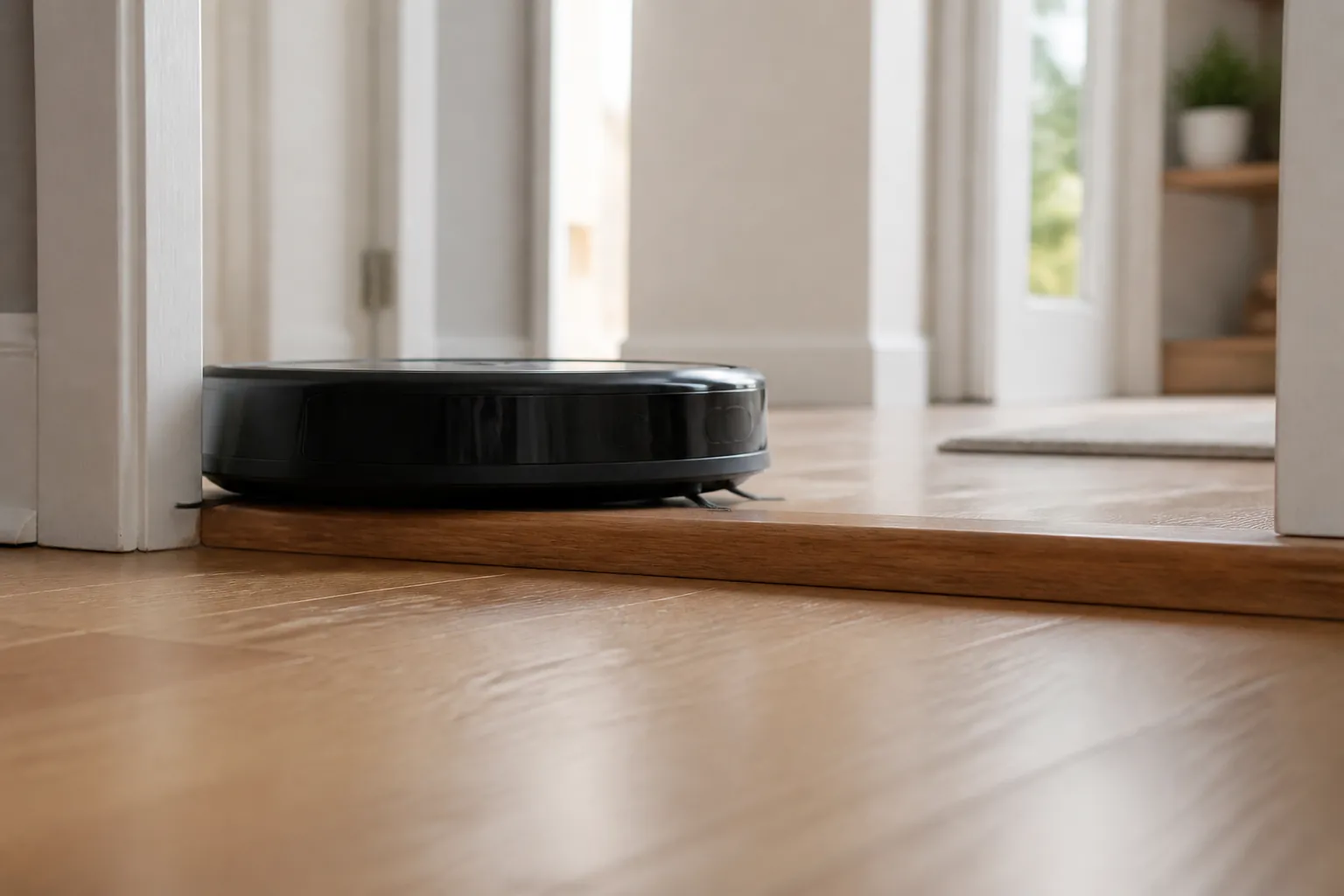
Thresholds are one of the places where marketing optimism meets the actual house. A raised transition between a hallway and bedroom may be unremarkable to a person, but it can stop a robot or leave it angled in a doorway. Now the older adult has a choice: step around it, bend to move it, or leave it there until someone else notices.
Floor prep is another overlooked part of the bargain. Before a robot run, thin charging cables, tassels, small toys, socks, and loose rugs may need to be moved. AARP specifically advises putting away cords before runs and getting rid of throw rugs that can be sucked up by the machine or become an accident waiting to happen. [2] That advice is sensible, but it also proves the point: a robot does not erase housekeeping decisions. It changes when they happen.
There are also privacy and comfort issues, especially with camera-equipped or mapping models. Some households are comfortable with app maps and object recognition. Others are not. For a fall-risk decision, the important question is whether the older adult will actually use the machine consistently and calmly, not whether the feature list looks impressive.
The final robot-specific risk is the false sense that another vacuum is no longer needed. Consumer Reports’ 2020 medium-pile carpet comparison is a useful guardrail here: the upright cleaned embedded debris far better than the robot in that lab test. [1] A robot may keep visible debris from building up, but deep carpet, stairs, upholstery, edges, and sudden messes still need a plan.
When the robot-plus-hand-vacuum setup makes sense
The hybrid answer works best when the home has enough robot-friendly floor to make scheduled maintenance worthwhile, and when the leftover cleaning can be handled without dragging out a full-size machine. It is not a gadget compromise. It is a division of labor.
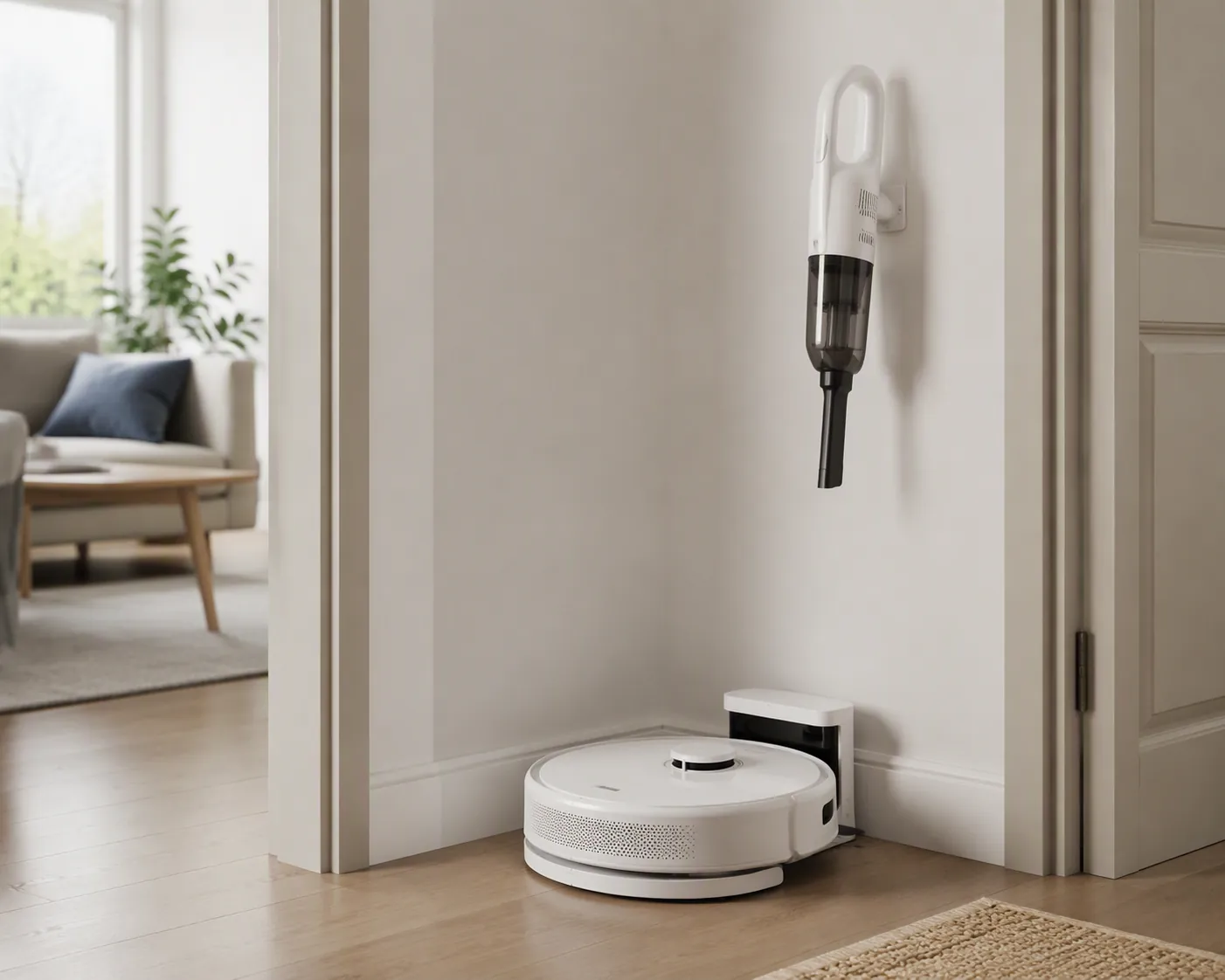
- The robot handles routine debris on open hard floors and low-pile rugs.
- The small hand vacuum handles crumbs, chair areas, car seats, counters, pet hair on a cushion, and the spots a robot misses.
- A separate plan covers deep carpet cleaning, stairs, upholstery, and heavier seasonal cleaning.
AARP’s advice to keep a small hand vacuum for touch-ups is the detail that makes the robot recommendation practical. [2] Without it, the older adult may still reach for the upright for every small spill. With it, the full-size vacuum can stay in the closet more often, and the robot does not have to pretend it can do jobs it cannot do well.
Placement matters. The robot dock should not sit where the unit backs into a narrow hallway, blocks a walker route, or leaves its charging cord exposed. The hand vacuum should be stored where it can be reached from a standing position, not on a low shelf that requires crouching. If a caregiver is setting this up, the first week should be treated as a safety trial: watch where the robot gets stuck, where it parks, which rugs it pulls, and whether the older adult tries to rescue it.
The hybrid setup is strongest in homes where someone can simplify the floor before scheduled runs. That may mean removing throw rugs, tucking cords behind furniture, limiting the robot to certain rooms, or setting a schedule only for times when the older adult is not walking through the main hallway. A clever map is less important than a route that does not create a low obstacle in a place someone uses every hour.
It is weaker when the home has thick carpet throughout, many raised thresholds, lots of small objects on the floor, unreliable Wi-Fi, or an owner who dislikes app-based appliances. In those homes, a lightweight cordless stick, a safer storage location for the existing vacuum, or help with heavier cleaning may reduce more risk than a robot that keeps needing attention.
What to skip in this decision
Do not choose from suction claims alone. Do not assume the newest navigation system is safer for an older adult who will not use the app. Do not treat a self-emptying dock as a safety feature unless it is placed where the bag, bin, and cord can be managed safely.
Model names, prices, availability, and ban-related status can change quickly in 2026. If you are ready to shop specific robots, use current independent testing and check availability against the site’s robot-vacuum coverage, including how to choose a robot vacuum when mobility is limited, whether a robot vacuum can cut fall risk for seniors aging in place, and the latest notes on robot vacuum availability after the FCC ban. Use those pages for model-level shopping; use this one to decide which type of tool is safer.
This is also not medical advice. If falls, dizziness, neuropathy, vision changes, medication side effects, or recent injuries are part of the picture, a vacuum choice should sit inside a broader fall-prevention plan, not stand in for one.
A short fit judgment
- Choose a robot vacuum if the home has mostly open hard floors or low-pile rugs, manageable thresholds, reliable tech support, and a realistic routine for clearing cords and loose rugs before runs.
- Keep or choose a lightweight manual vacuum if the robot would strand itself, demand too much app troubleshooting, or leave the older adult bending and stepping around it.
- Consider robot plus hand vacuum when the real goal is reducing risky routine cleaning without pretending deep cleaning disappears.
References
- Can a Robotic Vacuum Replace Your Upright?, Consumer Reports
- Should a Robot Vacuum Be Your Next Appliance?, AARP
Questions to bring to a clinician or OT
This is not medical, legal, or a family's final decision — only a framework. Bring these questions to a clinician, occupational therapist, or your local Area Agency on Aging.
Find Local HelpRelated reading
Noticed something outdated or inaccurate on this page? Flag a correction. We review every report against CDC, NIA, and AARP HomeFit guidance before updating a page.