
Caregiver decision guide
Best Senior Watch for Fall Detection and Heart Monitoring
Seniors who need both fall detection and heart monitoring face a real trade-off: consumer smartwatches offer FDA-cleared AFib detection but limited real-world fall response, while medical alert watches provide monitored fall help but generally omit ECG features. The right choice comes down to fall-risk level, phone ecosystem, and whether a 24/7 monitoring center matters more than heart-monitoring features.
If you are looking for the best smartwatch for seniors with fall detection and heart monitoring, the real choice is usually not between watch brands. It is between two different jobs: a consumer smartwatch that is strongest on ECG and AFib screening, or a medical alert watch that is strongest on getting a monitored response after a fall.
| What you need the watch to do | Consumer smartwatch | Medical alert watch |
|---|---|---|
| Primary design | A phone-connected watch with health sensors, apps, notifications, and ECG/AFib features on certain FDA-cleared models, including Apple Watch Series 4 and later, Samsung Galaxy Watch3 and later, Fitbit Sense 2, and Withings ScanWatch.[1] | A wearable help button built around emergency response, usually tied to a 24/7 monitoring center. NCOA’s 2026 review tested more than 35 devices, ran 16 tests, and included input from more than 1,000 surveyed users.[2] |
| Fall response | Hard-fall alerts may contact emergency services or chosen contacts, depending on setup. Apple uses a 30-second countdown and can call emergency services if Wrist Detection is on; Samsung requires preset emergency contacts and sends SOS messages by default rather than calling 911 directly.[3][4] | The alert normally goes to a monitoring center, where an operator can assess the situation and contact emergency help or caregivers. |
| Heart monitoring | This is where consumer smartwatches are strongest: ECG and irregular-rhythm/AFib screening on supported models.[1] | Generally weaker. In SeniorLiving.org’s 2026 testing table, Bay Alarm SOS and Medical Guardian MGMove did not offer heart-rate or ECG monitoring.[5] |
| Best fit | A senior who will wear and charge a more complex watch, already has the right phone environment, and cares about heart-rhythm screening. | A senior whose biggest risk is falling and needing a live person to respond, especially if family is not close by. |
| Main catch | A fall alert is not the same thing as a monitored medical alert service, and the watch may miss some falls. | A monitored response does not mean you are also getting ECG or AFib screening. |
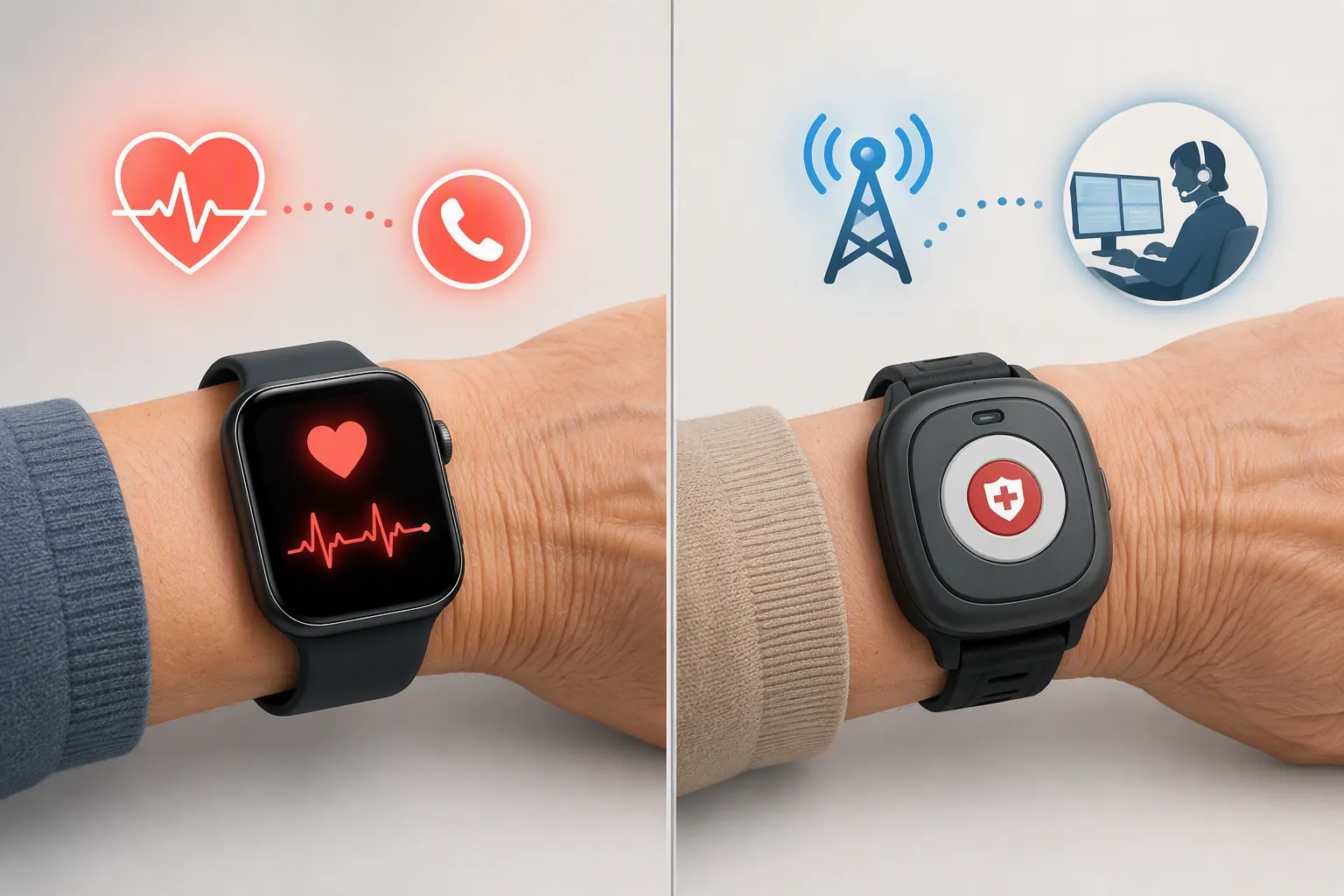
Use three filters before you look at model names
The fastest way to make a bad purchase is to start with a brand list. Start with the older adult’s actual situation.
- Fall-risk level: If falls are already happening, or if the person lives alone and may not be able to explain what happened, monitored response deserves more weight than extra watch apps.
- Phone ecosystem: A consumer smartwatch is only useful if it works cleanly with the phone, the account setup, cellular plan if needed, charger routine, and caregiver notification path. Compatibility is not a minor setup detail when the wearer is older.
- Response preference: Decide whether the priority is ECG/AFib screening or a 24/7 monitoring center. A watch that sends an alert to emergency contacts is not doing the same job as a service that routes the alert to trained operators.
This is especially important if the purchase is happening after a scare. NCOA’s February 2025 survey found that 75% of buyers purchased a medical alert device after they or someone they knew experienced a fall.[2] That timing matters. A family buying under pressure is vulnerable to vague wording like “fall protection” or “heart health” when the details underneath are very different.
Heart monitoring is the consumer smartwatch advantage
If the reason you are considering an Apple Watch, Samsung Galaxy Watch, Fitbit Sense 2, or Withings ScanWatch is heart rhythm monitoring, that is a fair reason. This is the part of the category with the strongest evidence and the clearest medical-style feature set.
A 2024 JMIR systematic review and meta-analysis found that AFib detection by wearable activity trackers had pooled sensitivity of 94.2% and specificity of 95.3%, described as comparable to 12-lead ECG in the included evidence.[6] That does not turn a watch into a cardiologist. It does mean the AFib side of the consumer smartwatch story is much better supported than the fall-detection side.
The Apple Heart Study is useful because it shows both the promise and the boundary. Among 419,297 participants, 0.52% received irregular-pulse notifications. Of those who later wore an ECG patch, 34% had AFib confirmed, and the figure was 35% among participants age 65 and older. The positive predictive value for an irregular-pulse notification was 0.84 overall and 0.78 among those 65 and older.[7] In plain language: an alert is worth taking seriously, but it is still a screening signal that needs clinical follow-up.
The 2026 EQUAL trial pushed the evidence closer to the older-adult shopper’s question. In high-risk adults age 65 and older, Apple Watch screening detected new AFib in 9.6% of participants compared with 2.3% with standard care over 180 days. The number needed to screen was 14, and 43% of detected episodes were asymptomatic. MedPage Today also reported that the raw algorithm positive predictive value was about 54% before clinical adjudication, which is the detail I would not want buried in fine print.[8]
So the heart-monitoring decision is not “Does the watch diagnose AFib?” It does not. The better question is whether the older adult and their clinician would benefit from a watch that can flag possible irregular rhythm and provide ECG-style data from a supported device. If the answer is yes, consumer smartwatches have a real edge.
Fall detection is where the wording gets slippery
Fall detection has to be separated into two questions: did the watch recognize a fall, and what happens next? Marketing often blends those together. Families cannot afford to.
The evidence base for real-world fall detection is much thinner than the heart-monitoring evidence. The same 2024 JMIR review found pooled fall-detection sensitivity of 81.9% with a 95% confidence interval of 75.1% to 88.1%, and pooled specificity of 62.5% with a very wide 95% confidence interval of 14.4% to 100%. The review graded the fall-detection evidence as inconsistent, with a small pooled sample: three fall studies and only two for specificity.[6]
That is not a reason to dismiss fall detection. It is a reason to stop treating it as a guarantee. Apple’s own support page says Apple Watch “cannot detect all falls.” It also says fall detection is turned on automatically for users 55 and older, uses a 30-second countdown, and will contact emergency services only if Wrist Detection is on.[3] Those setup details matter more than the box copy.
Samsung’s setup is different. Its Detect fall feature is off by default, requires emergency contacts to be preset, and sends SOS messages to those contacts by default rather than placing a direct 911 call. Samsung also offers sensitivity modes.[4] For a capable user who wants control, that may be fine. For an older parent who never opens settings, it is a potential failure point.
Reviewer testing points in the same direction, but it should be handled carefully. SeniorLiving.org’s 2026 testing reported that Bay Alarm SOS and MGMove detected 8 to 9 out of 10 simulated falls, while SafeHome.org reported 6 of 10 simulated falls detected on Apple Watch versus 8 to 9 of 10 on medical alert watches.[5][9] These are useful hands-on tests, not peer-reviewed clinical validation. I would use them as a practical signal, not as a promise that a particular device will catch a particular fall in a real kitchen, bathroom, or driveway.
A hard-fall alert is not the same as monitored help
This is the distinction that changes the purchase for many families.
A consumer smartwatch may detect a hard fall, show a countdown, and then contact emergency services or chosen contacts if the wearer does not respond, depending on the device and settings. That can be very valuable. But there is no monitoring-center operator in the middle unless the user has added some separate service outside the watch’s standard function.
A medical alert watch is built around that middle step. The alert goes to a monitoring center, and a person can try to communicate with the wearer, contact caregivers, or dispatch emergency help. If the older adult is confused after a fall, has trouble speaking, or lives alone, that human response layer may matter more than whether the watch can record an ECG strip.
Consumer Reports made the same category distinction in its comparison of smartwatches and medical alert systems: smartwatch emergency features can help, but they are not automatically equivalent to a medical alert system with monitored response.[10]
Where the main devices fit
| Device path | What it is strongest at | What I would check before buying |
|---|---|---|
| Apple Watch Series 4 and later | ECG/AFib screening on supported models, fall detection, emergency calling behavior when properly configured.[1][3] | Confirm the wearer can manage the compatible phone setup, charging, passcode, Wrist Detection, emergency contacts, and notification permissions. |
| Samsung Galaxy Watch3 and later | ECG/AFib screening on supported models and fall alerts with adjustable sensitivity.[1][4] | Confirm Detect fall is turned on, emergency contacts are set, and the family understands that SOS messaging is not the same as a default 911 call.[4] |
| Fitbit Sense 2 or Withings ScanWatch | AFib-related screening features on FDA-cleared models.[1] | Look closely at emergency-response features. Do not assume AFib capability means the same fall-response behavior as Apple or Samsung. |
| Medical Guardian MGMove or Bay Alarm SOS path | Monitored emergency response and medical-alert-style fall help. | Do not assume ECG or irregular-rhythm detection. SeniorLiving.org’s 2026 table showed Bay Alarm SOS and MGMove lacking heart-rate/ECG monitoring.[5] |
This is why I would not call any single watch the universal winner. A consumer smartwatch can be the better health-monitoring tool and still be the weaker fall-response choice. A medical alert watch can be the better emergency-response tool and still leave the heart-rhythm question mostly untouched.
Cost changes the comparison
The cost difference is not only purchase price. It is the difference between buying a watch and paying for a response service.
| Cost question | Consumer smartwatch | Medical alert watch |
|---|---|---|
| Upfront cost | Usually a device purchase, with price depending heavily on model, cellular capability, and retailer. | NCOA’s 2026 medical alert watch review lists device pricing around $199 for some watches.[2] |
| Monthly cost | No standard medical-alert monitoring fee is included with the watch itself, but a phone line, compatible phone, or cellular plan may be part of the real cost. | NCOA lists monthly service pricing around $40 to $43 per month for some medical alert watches, with fall detection often adding about $10 per month.[2] |
| What the monthly fee buys | Not a 24/7 monitoring center by default. | Access to the monitoring-center response model, depending on the plan and provider. |
| Coverage caution | As of August 25, 2026, do not assume Original Medicare will cover the watch. HSA/FSA eligibility and Medicare Advantage extras vary. | Same caution. If coverage is part of the decision, check the plan directly rather than relying on a product page. |
If Medicare coverage or post-fall services are part of the larger budget question, this separate guide to Medicare fall-prevention coverage is the better place to sort that out. I would not let a salesperson’s “may be covered” wording carry the decision.
The decision tree
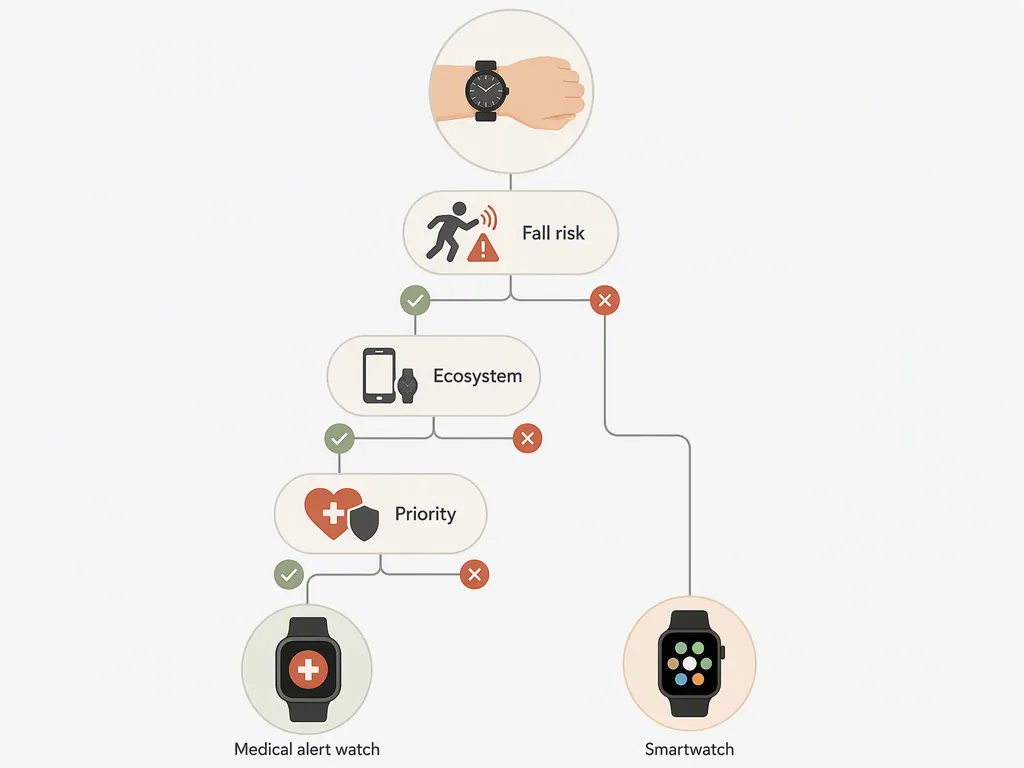
Start with the risk you are actually trying to manage, not the feature list.
- If the older adult has fallen recently, lives alone, has mobility problems, or may not reliably answer a phone after a fall, lean toward a medical alert watch with monitored fall response.
- If the biggest concern is possible AFib or irregular rhythm, and the person already lives comfortably inside a compatible phone ecosystem, lean toward a consumer smartwatch with FDA-cleared ECG/AFib features.
- If both risks are high, decide which failure would be worse: missing a heart-rhythm screening signal, or having a fall alert that does not reach a live monitoring center. That answer should drive the first purchase.
- If setup burden is likely to defeat the device, choose the simpler response path. A technically impressive watch that is not charged, worn, connected, or configured is just jewelry.
For fall-risk context, the CDC says about 1 in 4 older adults falls each year.[11] If you are still trying to understand whether the risk is mild, moderate, or urgent, a structured fall-prevention action plan using the CDC STEADI framework can help you separate a watch purchase from the rest of the safety problem.
So which watch is best?
For a senior whose main danger is falling and needing help when nobody is nearby, the best watch is usually a medical alert watch with monitored response. I would give up ECG before I gave up a live response center in that situation.
For a senior who is steady enough, willing to wear and charge a more complex device, and whose family or clinician values AFib screening, the better choice may be a consumer smartwatch such as an Apple Watch, Samsung Galaxy Watch, Fitbit Sense 2, or Withings ScanWatch, chosen for the phone ecosystem it actually fits.
No wrist device currently does both jobs equally well. The right watch is the one that matches the older adult’s fall risk, phone ecosystem, and response preference: monitored help after a fall, or stronger ECG/AFib screening.
References
- “Tracking your afib with a smart watch? Avoid this pitfall,” Harvard Health, December 2024.
- “The Best Medical Alert Watches of 2026,” NCOA.
- “Use Fall Detection with Apple Watch,” Apple Support.
- “Use the Detect fall feature on your Samsung smart watch,” Samsung Support.
- “Best Medical Alert Watches of 2026, Tested and Reviewed,” SeniorLiving.org.
- “Real-World Accuracy of Wearable Activity Trackers for Detecting Medical Conditions: Systematic Review and Meta-Analysis,” JMIR mHealth and uHealth, 2024.
- “Large-Scale Assessment of a Smartwatch to Identify Atrial Fibrillation,” NEJM, 2019.
- “Apple Watch Raises Afib Diagnoses in High-Risk Patients,” MedPage Today, January 2026.
- “Best Medical Alert Watches in 2026: Expert Tested,” SafeHome.org.
- “Is a Smartwatch As Good As a Medical Alert System?,” Consumer Reports, 2023.
- “Facts About Falls,” CDC.
Questions to bring to a clinician or OT
This is not medical, legal, or a family's final decision — only a framework. Bring these questions to a clinician, occupational therapist, or your local Area Agency on Aging.
Find Local HelpRelated reading
Noticed something outdated or inaccurate on this page? Flag a correction. We review every report against CDC, NIA, and AARP HomeFit guidance before updating a page.