
Caregiver decision guide
6 Criteria for Choosing a Smokeless Fire Pit for Seniors
Learn how to evaluate smokeless fire pits based on the specific needs of an older adult — from fuel type and weight to safety features and seating accessibility. This guide provides a decision framework that goes beyond generic reviews to help caregivers choose the right fire pit for safe, comfortable outdoor enjoyment.
The usual search starts with “best smokeless fire pit,” and the results often look reassuring: cleaner burn, less smoke, beautiful flame, sturdy build. Then the box arrives, and the practical questions begin. Who carries it to the patio? Who bends down to light it? Who hauls wood, empties ash, checks the deck, moves the chairs, and makes sure the coals are actually out?
That is where generic reviews become thin. A fire pit can be excellent for a healthy backyard hobbyist and still be a poor fit for an older adult with weaker grip strength, COPD, balance problems, slower reaction time, or a walker parked nearby. Consumer Reports has tested smokeless fire pits and still cautions that none of the models it tested produced a fire that was truly smokeless.[1] Wirecutter’s testing estimated that some smokeless wood pits reduced smoke by about 70% to 80%, but that estimate came from a rudimentary side-by-side visual assessment, not a controlled lab measurement.[2]
So the better question is not “Which fire pit wins?” It is: can this parent light it, breathe comfortably near it, sit and stand safely around it, shut it down quickly, and leave the area in a condition that does not become tomorrow’s hazard?
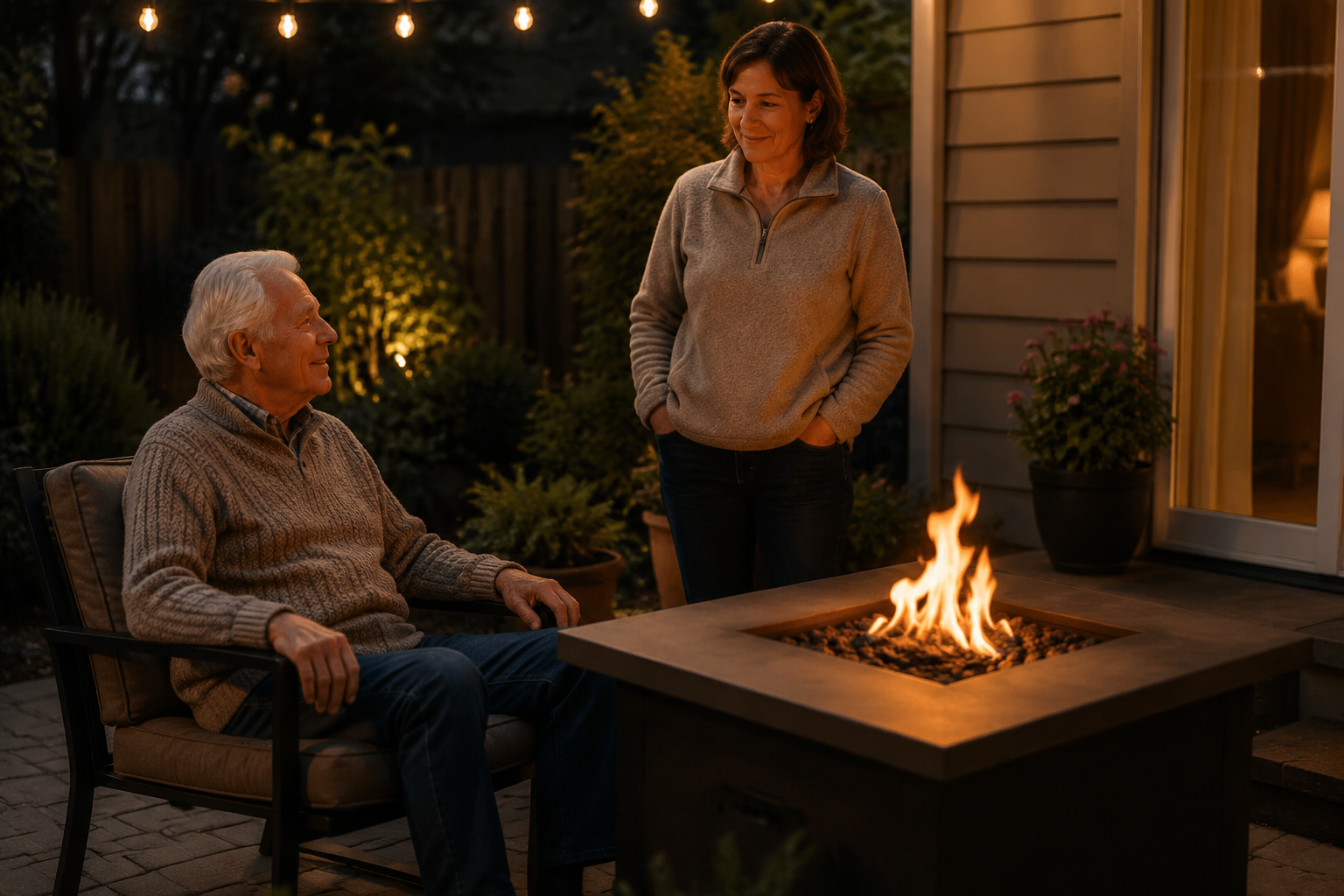
Start With Fuel, Because Fuel Decides Most of the Work
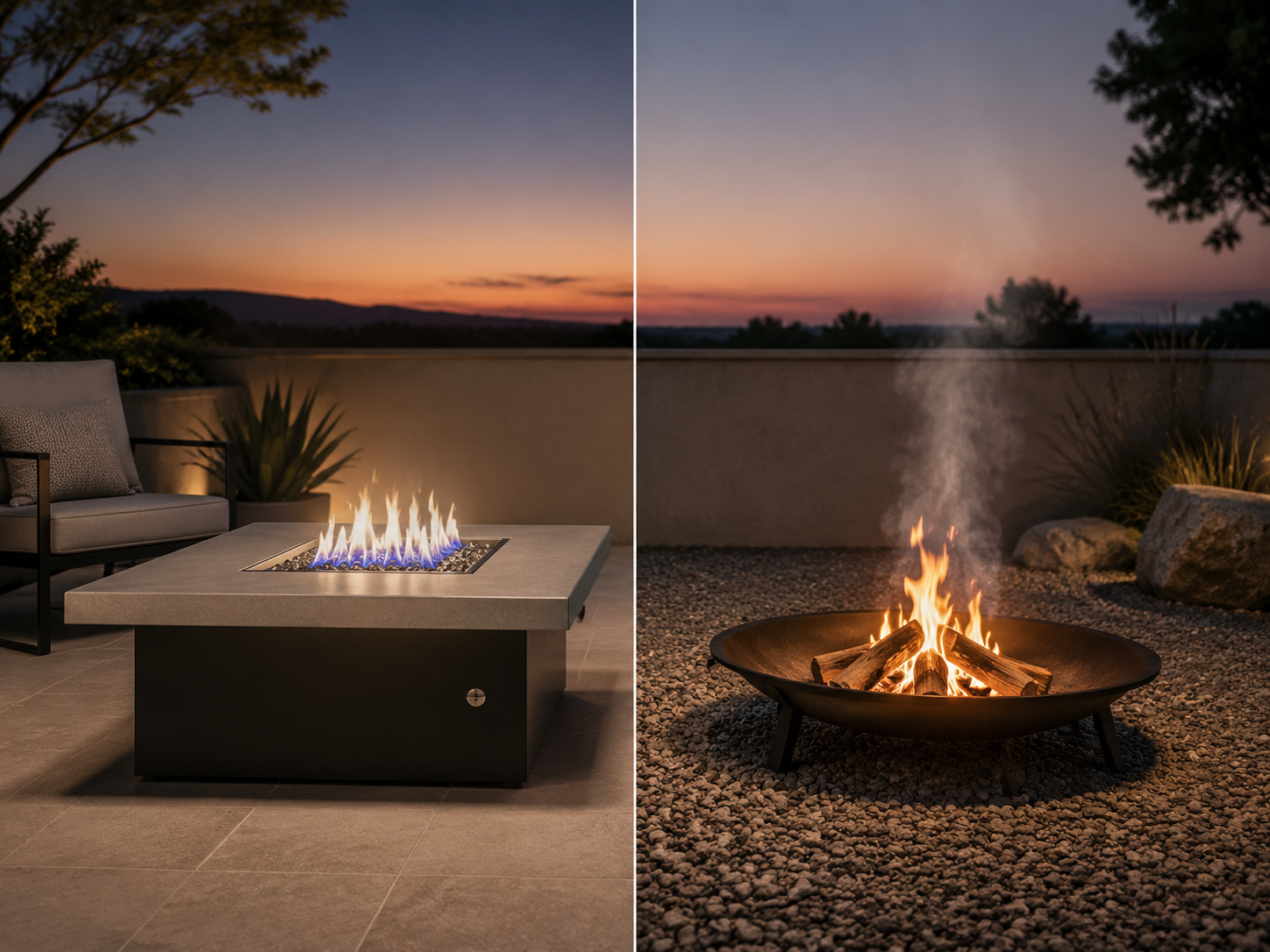
Before comparing brands, compare fuel types. Propane and wood do not ask the same things of an older body.
| Decision Point | Propane Fire Pit | Smokeless Wood Fire Pit |
|---|---|---|
| Smoke exposure | No wood smoke during normal use | Reduced smoke, not smoke-free |
| Lighting | Usually knob, button, or electronic ignition | Requires kindling, fuel placement, and fire-building |
| Shutdown | Can be turned off quickly at the control | Must burn down and be monitored until safe |
| Ongoing chores | Tank checks and refills | Wood storage, ash removal, and coal management |
| Atmosphere | Clean flame, often table-height | Wood crackle, scent, and traditional campfire feel |
For many families, wood has the stronger emotional pull. It looks and sounds like a real fire. It can also cost less to run if dry firewood is easy to get and someone can store it safely. But wood asks for repeated physical tasks: lifting logs, arranging fuel, feeding the flame, waiting for embers, and removing ash. Those tasks do not disappear because a fire pit is marketed as smokeless.
Propane is less romantic, but it solves several senior-specific problems at once. There is no wood to carry, no kindling to manage, no ash to shovel, and no smoldering bed of coals after everyone goes inside. If a parent has limited hand strength, poor balance, or trouble judging when a fire is fully out, that instant shutdown matters.
Respiratory sensitivity pushes the decision even harder. Cleveland Clinic warns that wood smoke can irritate the lungs and may be riskier for older adults and people with lung or heart conditions.[3] That does not mean every older adult must avoid every backyard fire. It does mean a “low-smoke” wood model should not be treated as a health workaround. For individual respiratory concerns, the right person to ask is the parent’s physician, not a product review.
Caregivers already watching air quality may also want to connect this decision with broader household planning, including wildfire smoke and senior air quality and how air quality alerts can affect the aging brain. A backyard fire pit is not the whole air-quality picture, but it is one choice the family can control.
Weight Is Not a Footnote
A surprising number of fire pit reviews use “portable” generously. For a caregiver, the number on the spec sheet is not decorative. It decides whether one person can move the unit, whether the older adult will try to drag it alone, and whether the fire pit will be left in the wrong place because moving it is too much trouble.
Wirecutter’s tested examples show the spread clearly: the Solo Stove Bonfire was listed at 23.3 pounds, while the Breeo X24 was listed at 62 pounds.[2] Both may make sense for different households. They do not create the same caregiving burden.
For an older adult, weight interacts with storage and surface choice. A lighter fire pit that lives in a shed still may not be usable if the route includes steps, gravel, a tight gate, or a door threshold. A heavier fire pit may be acceptable if it can stay permanently on a safe, level, noncombustible surface and no one needs to reposition it before each use.
- If the fire pit must be moved every time, check whether the older adult can do that without twisting, lifting from a low position, or walking backward.
- If the caregiver will be the only person moving it, be honest about whether that chore will still happen after the novelty wears off.
- If the unit is heavy enough to require two people, treat it as stationary when planning the yard.
- If a review calls a model portable, look for the actual weight before trusting the label.
Lighting and Tending Should Match the Parent’s Hands, Eyes, and Balance
Lighting a fire is not one task. It may involve bending, reaching, gripping a lighter, arranging kindling, judging flame growth, stepping around chairs, and reacting quickly if smoke shifts. Those are small actions for one person and a string of hazards for another.
Propane fire pits usually reduce this sequence to opening fuel flow and using an ignition control. That can be easier for someone who has arthritis, tremor, low vision, or limited stamina, though the controls still need to be visible, reachable, and simple enough for the actual user. A tiny knob tucked under a table edge may be technically easy and practically annoying.
Wood-burning smokeless pits ask more during the first 10 to 20 minutes. The fire needs enough airflow and properly placed fuel to reach the hotter burn that reduces visible smoke. If the older adult enjoys building a fire and can do it safely, that may be part of the pleasure. If not, the caregiver has just inherited the most fussy part of the evening.
- Choose propane when instant control matters more than wood-fire atmosphere.
- Choose wood only if someone can reliably handle kindling, logs, fire tools, smoke shifts, and a longer shutdown.
- Avoid ignition systems that require crouching, awkward reach, or repeated clicking with weak hands.
- Check whether the parent can see the control markings in dusk lighting.
Cleanup Is Where Convenience Becomes Safety
Ash cleanup sounds like maintenance, but for an aging household it is also risk control. Ash left in the pit can hold heat, collect moisture, block airflow, and make the next fire harder to manage. A task that requires bending low with a shovel may be postponed, and postponed fire chores have a way of becoming safety chores.
This is one place where a specific feature matters more than brand language. Wirecutter noted removable ash pans on models including the Solo Stove Bonfire 2.0, Blue Sky The Peak 2.0, and Tiki Patio.[2] That does not automatically make any one of them the right choice, and current specifications should be verified before purchase. It does show what to look for: ash that can be removed without turning the whole pit over or digging around the bottom with a tool.
Propane largely avoids this category. There may be a tank to refill or exchange, lava rock or glass media to keep in place, and a cover to use when the unit cools, but there is no ash pan and no hidden bed of embers. For a long-distance caregiver, that difference can be decisive.
Safety Features Are Pre-Purchase Conditions, Not Accessories
The fire pit should fit the yard before anyone falls in love with the flame. Older adults already face higher consequences when fire safety fails: FEMA’s U.S. Fire Administration reports that adults 65 and older had 2.5 times greater risk of dying in a fire than the general population, based on 2020 data.[4] That makes setup choices part of the purchase, not something to improvise on the first cool evening.
Consumer Reports advises against using wood fire pits on covered patios because of carbon monoxide risk and warns against placing them on wood decks, noting that wood can ignite at 175°F. Its fire pit safety guidance also recommends keeping fire pits 10 to 25 feet from structures and avoiding the common habit of dumping a bucket of water on a fire, which can form a crust over still-hot coals; it recommends a hose with a fog-spray nozzle instead.[5]
Wind matters too. Banner Health advises avoiding campfires when winds are above 20 mph and notes that wood-smoke particulates are about 30 times smaller than a human hair.[6] For a senior who moves slowly or uses a mobility aid, shifting smoke and sparks are not minor annoyances.
- Use a stable, level, noncombustible surface; do not rely on a wobbly paver arrangement to solve a slope.
- Look for a broad, stable base that is difficult to tip if someone brushes it with a cane, walker, or chair leg.
- For wood pits, consider whether a spark screen is available and easy to place without reaching over flame.
- For both wood and propane, check whether controls, hoses, tanks, and hot surfaces create trip or burn hazards.
- Plan the full route from house to seat, including lighting, steps, uneven pavement, pets, and the return trip after dark.
If you are already reviewing household hazards, a fire pit belongs in the same conversation as other home safety risks beyond falls. Yard layout matters as well; the safest fire pit is still a problem if the path to it is dark, uneven, or crowded with planters, hoses, or lawn tools. For broader outdoor planning, see these yard safety tips for seniors.
Seating Accessibility Can Make or Break the Whole Purchase
A fire pit is not used in isolation. People sit down, lean forward, reach for drinks, turn to talk, stand back up, and walk around each other. For an older adult, the seating plan may matter as much as the burner.
Low wood pits can be beautiful, but they often encourage low seating and forward leaning. That may be uncomfortable for someone with knee, hip, or balance issues. Table-height propane fire pits can make the gathering feel more like sitting around an outdoor dining table, with the flame visible without requiring everyone to hunch toward the ground.
The Spruce’s fire pit testing includes model dimensions and weights that can help caregivers notice height and footprint differences before buying, though current specifications should still be checked against the manufacturer’s site.[7] The important habit is to read dimensions as a seating plan, not as a shipping detail.
- Use chairs with arms if the parent needs help rising; deep lounge chairs may be harder to exit safely.
- Leave enough clearance for a walker, cane, wheelchair, or caregiver to pass behind seated guests.
- Avoid layouts that require someone to step over a hose, fire tools, wood stack, or uneven edging.
- Check glare and lighting so the parent can see chair legs, patio edges, and the route back inside.
- Place the parent’s preferred seat where smoke, heat, and foot traffic are least likely to become a problem.
How to Use the Six Criteria Without Turning This Into a Brand Contest
A brand table can be useful after the family has already decided what the parent can safely manage. Before that, ratings can distract from the practical fit. A five-star wood fire pit still may be wrong for a parent who cannot carry wood, tolerate smoke, crouch to light kindling, or wait for coals to cool.
| Criterion | Ask This Before Comparing Models |
|---|---|
| Fuel type | Does this parent need instant on/off and no wood smoke, or can they safely manage a real wood fire? |
| Weight and portability | Who moves it, how often, and across what surface? |
| Lighting and tending | Can the parent operate ignition and manage the flame without bending, rushing, or guessing? |
| Cleanup | Does ash removal require low bending, shoveling, or turning the pit over? |
| Safety features | Can the yard provide proper clearance, stable placement, wind control, and safe shutdown? |
| Seating accessibility | Can the parent sit, stand, walk, and use mobility aids around the fire without crowding? |
The answer may still be wood. If the older adult is steady, enjoys the ritual, has help with heavier chores, and has no smoke-sensitive condition that their clinician is concerned about, a well-designed smokeless wood pit can preserve a real pleasure. Look for manageable weight, a removable ash pan, available spark control, and a setup that does not require awkward bending.
The answer may be propane. If the parent has limited strength, respiratory sensitivity, trouble with ignition, or a habit of leaving cleanup for later, propane often gives back more independence than it takes away in atmosphere. The flame may be less traditional, but the parent can host without waiting for someone else to build and shut down the fire.
The right smokeless fire pit for an older adult is the one that preserves the evening: the neighbor who stays a little longer, the cup of coffee outside after dinner, the parent who gets to invite people over instead of only being checked on. It should not pretend that smoke, weight, bending, ignition, cleanup, and seating clearance are minor details.
References
- Best Smokeless Fire Pits of the Year, Consumer Reports, Jan. 2026
- The Best Smokeless Fire Pits, Wirecutter, 2026
- Fire Pits, Bonfires and Your Lungs, Cleveland Clinic
- Older Adults, U.S. Fire Administration
- Fire Pit Safety Advice, Consumer Reports
- How to Minimize Unanticipated Lung Problems Caused by Campfires, Banner Health
- The Best Smokeless Fire Pits, The Spruce, 2026
Questions to bring to a clinician or OT
This is not medical, legal, or a family's final decision — only a framework. Bring these questions to a clinician, occupational therapist, or your local Area Agency on Aging.
Find Local HelpRelated reading
Noticed something outdated or inaccurate on this page? Flag a correction. We review every report against CDC, NIA, and AARP HomeFit guidance before updating a page.