
Caregiver decision guide
Weekly Strength Training Routine for Seniors Over 70
A step-by-step weekly strength plan for adults over 70: how many days to train, which exercises to choose, how many sets and reps, and how hard to push (1–2 reps in reserve). It shows how to progress safely at home over the weeks so the routine stays effective without risking injury.
Before starting a new strength routine after 70, especially with high blood pressure, heart disease, osteoporosis, arthritis, diabetes, a recent fall, dizziness, unexplained shortness of breath, or new pain, get clearance from a physician or physical therapist. This article is educational, not medical advice. If you need the pre-start safety checklist—chair setup, footwear, warning signs, and when to stop—use this safe-start guide for strength training at home before using the routine below.
For seniors over 70 starting a strength routine, the weekly answer is plain enough to fit on one sheet of paper: train strength two non-consecutive days per week, cover the major muscle groups, do 2–3 sets of 6–12 repetitions for most exercises, and stop each set when 1–2 good repetitions are still left. The CDC guideline is written for adults 65 and older—not only for people over 70—but adults in their 70s sit inside that evidence base, and the CDC calls for muscle-strengthening activities at least 2 days per week that work all major muscle groups.[1]
That does not mean every 72-year-old and every 88-year-old should use the same resistance. “Over 70” is an age range, not a strength level. One person may begin with seated leg extensions and wall push-ups. Another may use bands, dumbbells, or a loaded backpack. The dose can be the same while the version changes.
The weekly routine
Pick two days that are not back-to-back, such as Monday and Thursday or Tuesday and Friday. Each session should include lower body, pushing, pulling, core or posture, and a grip or carry option if it can be done safely. Harvard Health’s review of National Strength and Conditioning Association guidance describes a practical older-adult strength dose as 1–2 multi-joint exercises per major muscle group, 2–3 sets, 6–12 reps, with sessions spread through the week.[2]
| Training day | What to do | Sets and reps | Effort target |
|---|---|---|---|
| Day 1, such as Monday | Choose one exercise from each group: legs, push, pull, core/posture, optional carry or grip | Start with 1–2 sets. Build toward 2–3 sets of 6–12 reps. | Stop with 1–2 good reps still possible. |
| Rest or light movement day | Walk, stretch gently, or do usual daily activity if comfortable | No strength sets required | Do not try to “make up” missed reps on a sore day. |
| Day 2, such as Thursday | Repeat the same menu or use the alternate version from each group | Use the same set and rep target | Same rule: leave 1–2 reps in reserve. |
| Other days | Add balance practice only if cleared and safe | Short, easy practice is enough | Use support nearby; balance work is not a test. |
Choose one exercise from each group
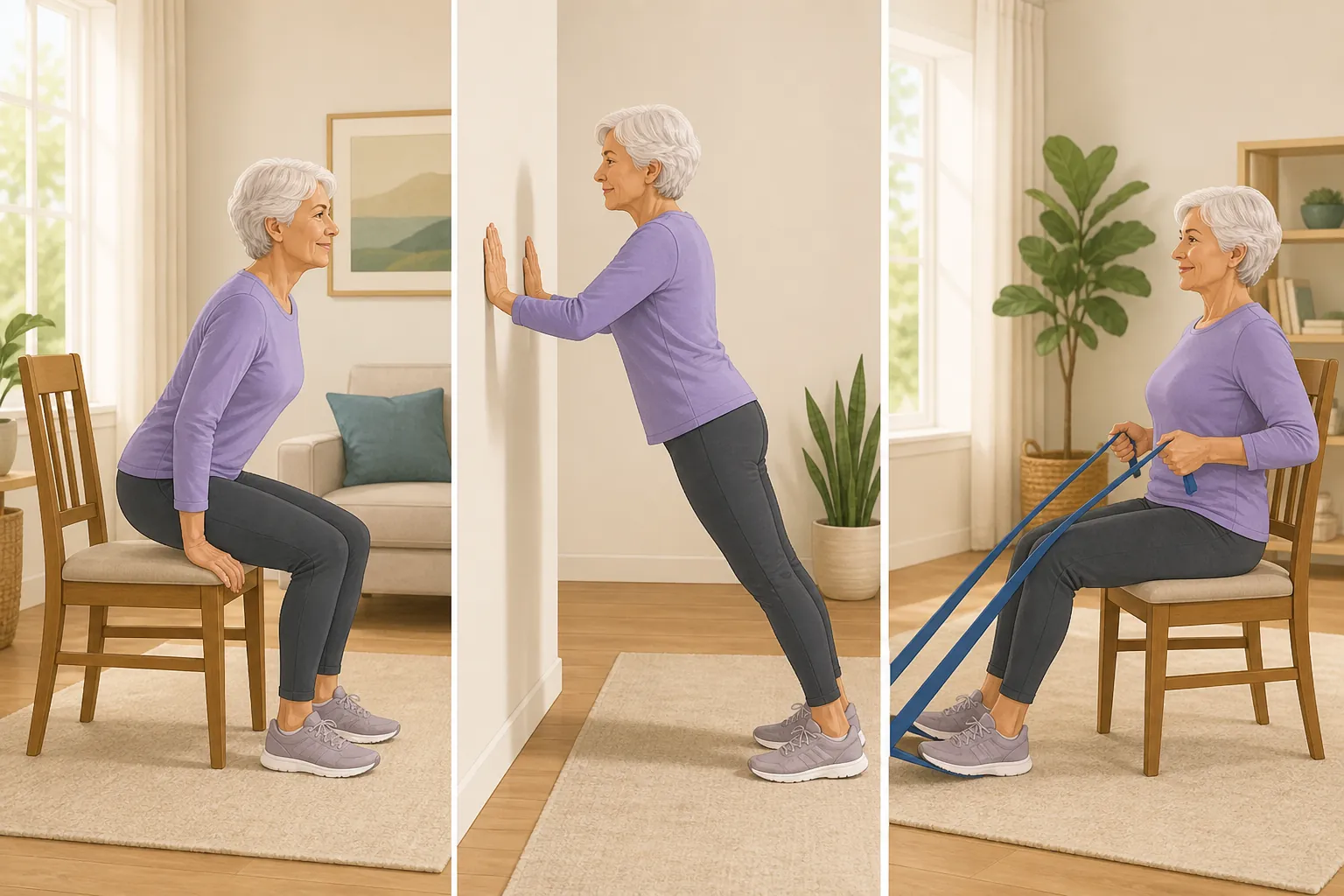
The exercises below are arranged by job, not by difficulty label. A chair version is not a lesser exercise; it is the right version when standing work would make form sloppy or unsafe. Cleveland Clinic’s chair-exercise guidance starts with a sturdy chair with a back, a firm seat, and no wheels, and suggests beginning with 1 set of 10 before building toward 2–3 sets of 10.[3]
| Muscle group or job | Seated or supported entry version | Standing or stronger version | What it should look like |
|---|---|---|---|
| Legs: sit-to-stand pattern | Chair sit-to-stand using hands lightly on armrests if needed | Chair sit-to-stand with arms crossed, or slow squat-to-chair | Sit tall near the front of the chair, feet under knees, stand up under control, then sit down slowly without dropping. |
| Legs: hip hinge or back-of-leg work | Seated heel press into the floor, or very small hip hinge while holding the chair | Supported hip hinge, wall-supported bridge if getting to the floor is safe, or light deadlift pattern with a household object | Keep the back long, move from the hips, and stop before balance or back comfort changes. |
| Push: chest, shoulders, arms | Seated band chest press, or hands pressing gently into a wall from a close distance | Wall push-up; progress by stepping feet slightly farther from the wall | Body stays in one long line. Bend elbows, bring chest toward the wall, then press away. |
| Pull: upper back and arms | Seated resistance-band row with band secured safely, or towel row held by a helper only if stable and controlled | Standing band row, or one-arm row with a light household object while supported by a counter | Pull elbows back, squeeze shoulder blades gently, and avoid shrugging the shoulders toward the ears. |
| Core and posture | Seated marching, seated knee lift, or seated tall-posture hold | Standing march holding a counter, or suitcase hold with a light object on one side | Trunk stays tall. The goal is control, not twisting or straining. |
| Grip and carry, optional | Seated towel squeeze or light object hold | Short farmer carry with one or two light bags, only if walking balance is steady | Hold the object without breath-holding. Walk only in a clear, flat space. |
UCLA Health recommends beginning with bodyweight movements such as squats-to-chair, wall push-ups, and sit-to-stands so form comes first, with resistance added only after 8 repetitions are comfortable.[4] That is a useful rule at home because it prevents the common mistake of buying heavier equipment before the movement itself is steady.
A complete printable session
For the first few weeks, keep the session boring on purpose. Use the same exercises long enough to notice whether they are getting easier, harder, or irritating a joint.
- Chair sit-to-stand: 1–2 sets of 6–10 reps.
- Wall push-up or seated band chest press: 1–2 sets of 6–10 reps.
- Seated or standing band row: 1–2 sets of 6–10 reps.
- Seated march or standing supported march: 1–2 sets of 6–10 reps per side.
- Optional towel squeeze or light carry: 1–2 short sets, only if it feels controlled.
Rest long enough between sets that the next set looks as controlled as the first. For many people training at home, that means sitting or standing quietly until breathing is comfortable again. There is no prize for rushing the rest period.
How hard should a set feel?
The safest home substitute for max testing is “reps in reserve.” Harvard Health explains the gym version as working around 70–85% of a 1-rep maximum, but it also gives a more usable proxy: choose a resistance that allows about 10 repetitions with 1–2 repetitions still in reserve.[2]
Here is what that means in a living room: if the plan says 10 wall push-ups, rep 8 or 9 should feel like work, but rep 10 should still be clean. The person should be able to say, honestly, “I could do one or two more without changing form.” If the last rep comes with breath-holding, wobbling, shoulder shrugging, knee pain, or needing to drop into the chair, the set was too hard or went too long.
| What happens during the set | What to do next time |
|---|---|
| Could have done 4 or more extra reps easily | Keep the exercise but add 1–2 reps next time, up to 12. |
| Could have done 1–2 extra reps with good form | That is the target. Repeat or add 1 rep next time if all sets were clean. |
| Could not finish the planned reps without form changing | Reduce reps, use an easier version, or do fewer sets. |
| Pain, dizziness, chest pressure, unusual shortness of breath, or sudden weakness appears | Stop the session and consult a clinician or physical therapist. |
Avoid testing a true one-rep maximum at home. It is not needed for this routine, and it adds risk without giving a caregiver or beginner much useful information.
Progression over the first 8 weeks
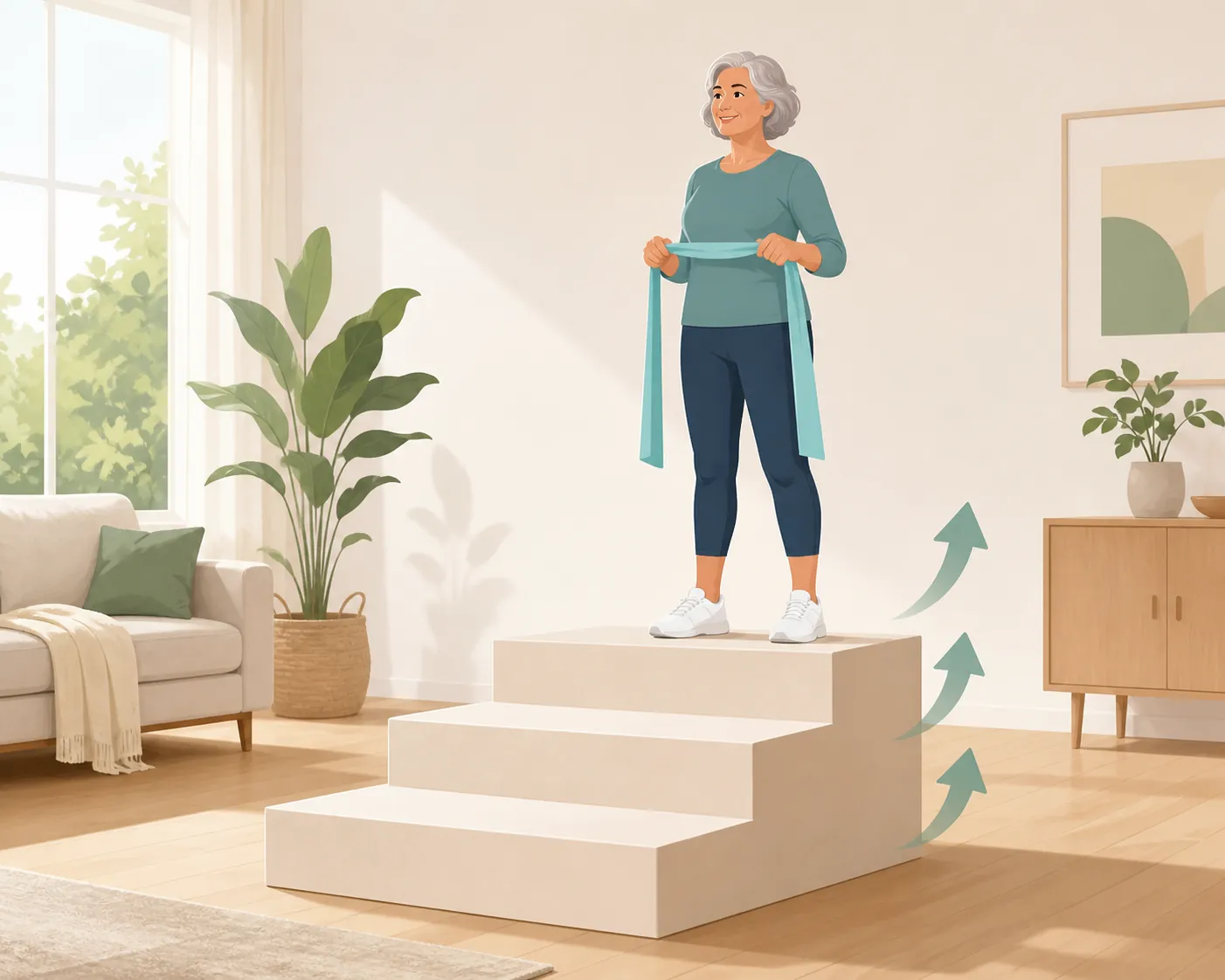
Strength training stops working well when it never changes, but the first change does not have to be heavier weight. Mayo Clinic Press describes progressive overload as gradually increasing the challenge over time, and Harvard Health’s reviewed guidance recommends increasing weight once 12 repetitions become comfortable; it also suggests reassessing the program if there is no change after about 8 weeks.[2][5]
| Weeks | Main job | What to change |
|---|---|---|
| Weeks 1–2 | Find the right exercise versions | Use 1 set if needed. Aim for 6–10 controlled reps. Leave 1–2 reps in reserve. |
| Weeks 3–4 | Build consistency | Move toward 2 sets for the main exercises if recovery is good. Add reps before adding resistance. |
| Weeks 5–6 | Fill out the rep range | Work gradually toward 10–12 reps on clean sets. Keep the same exercise version unless it is clearly too easy. |
| Weeks 7–8 | Decide whether the dose is still enough | If 12 reps are comfortable with 1–2 reps still in reserve, make a small increase in resistance or choose a slightly harder version. |
| After about 8 weeks | Reassess | If nothing is improving—reps, control, ease of standing, or confidence—consider a clinician, PT, or qualified trainer review. |
A small increase can mean a thicker resistance band, standing a little farther from the wall for wall push-ups, holding a light household object during a sit-to-stand, or moving from using both hands on the chair to using one hand. Change one thing at a time. If reps drop from 12 back to 6–8 after the change, that is normal; build back up before increasing again.
When not to progress
Do not add resistance just because the calendar says it is week 5. Hold steady or step back if soreness lasts more than a couple of days, walking feels worse the next day, arthritis symptoms flare, balance feels less secure, or the person starts avoiding the routine because it feels threatening. Progression is useful only when the body is actually absorbing the work.
Why starting after 70 is still worth doing
The reason to bother with this two-day routine is not to chase youth. It is to keep standing up from chairs, carrying groceries, climbing steps, and recovering from ordinary stumbles from becoming harder than they need to be.
The “too late to start” worry is understandable, but it is not well supported. Mayo Clinic Press describes research involving muscle biopsies from 197 people showing that resistance training can slow and often reverse age-related changes in muscle fibers, even when training begins after age 70.[5] That is a muscle-fiber finding, not a promise that aging disappears. It does mean the body can still respond to the right kind of strength work.
If you want the muscle-change explanation without the usual myth that muscle “turns into fat,” see this explanation of aging muscle and fat.
Protein and balance: support the routine without crowding it
Strength work needs enough protein to support muscle repair. Harvard Health describes a commonly recommended protein range for older adults as 1.0–1.2 grams per kilogram of body weight per day, and Mayo Clinic Press gives a similar target of about 1.2 grams per kilogram per day.[5][6] For a detailed food-based breakdown, use the protein guide for seniors rather than trying to turn a strength plan into a diet plan.
Balance deserves a place nearby, too. The CDC includes balance activities along with aerobic and muscle-strengthening guidance for older adults, and the NHS similarly advises older adults to include activities that improve strength, balance, and flexibility on at least 2 days per week.[1][7] Still, balance practice should be progressed carefully, especially after a fall. Use a structured ladder such as these fall-prevention exercises for seniors, or choose guided senior workout videos for strength and balance if following along is easier.
The decision rule for next session
At the end of each exercise, write down the exercise version, reps, sets, and whether 1–2 reps were still in reserve. That small note is enough to choose the next step.
- If the person completed the planned reps with good form and 1–2 reps still in reserve, add 1 rep next time or repeat the same dose.
- If 12 reps are comfortable on all sets, consider a small increase in resistance or a slightly harder version.
- If form changed before the target reps, reduce reps, reduce resistance, or return to the supported version.
- If pain, dizziness, chest pressure, unusual shortness of breath, new weakness, or uncertainty appears, stop and consult a clinician or physical therapist.
References
- Older Adult Activity, CDC, Dec 2025, https://www.cdc.gov/physical-activity-basics/guidelines/older-adults.html
- Resistance training by the numbers, Harvard Health, https://www.health.harvard.edu/healthy-aging-and-longevity/resistance-training-by-the-numbers
- Best Seated Chair Exercises for Seniors, Cleveland Clinic, https://health.clevelandclinic.org/chair-exercises-for-seniors
- Why strength training is critical for older adults, UCLA Health, https://www.uclahealth.org/news/article/why-strength-training-critical-older-adults
- The many benefits of resistance training as you age, Mayo Clinic Press, https://mcpress.mayoclinic.org/healthy-aging/the-many-benefits-of-resistance-training-as-you-age/
- Muscle loss and protein needs in older adults, Harvard Health, https://www.health.harvard.edu/healthy-aging-and-longevity/muscle-loss-and-protein-needs-in-older-adults
- Physical activity guidelines for older adults, NHS, https://www.nhs.uk/live-well/exercise/physical-activity-guidelines-older-adults/
Questions to bring to a clinician or OT
This is not medical, legal, or a family's final decision — only a framework. Bring these questions to a clinician, occupational therapist, or your local Area Agency on Aging.
Find Local HelpRelated reading
Noticed something outdated or inaccurate on this page? Flag a correction. We review every report against CDC, NIA, and AARP HomeFit guidance before updating a page.