
How to Check a Glamping Site's Accessibility Before You Book
Marketing labels like 'accessible' often don't match reality. This guide provides a printable checklist to evaluate ramp slope, doorway width, bed height, pathway firmness, and bathroom grab-bar configuration before you book a glamping stay.
A glamping site can be beautiful, quiet, and still be the wrong place to arrive with a walker after dark. That is the problem with many senior-friendly glamping options: the listing says “accessible,” but the details that decide the trip are often missing.
One 2023 snapshot makes the gap plain. Wonders Within Reach reported that GlampingHub showed 743 wheelchair-accessible destinations in the United States, but when the filter changed to accessible bathrooms, the count dropped to 172. That is not a current census of every property; it is a useful warning about the label itself. “Wheelchair accessible” may mean a ramp to the door. It may not mean a usable bathroom, a firm path, or a bed a person can transfer into safely.[1]
Glamping can still be a good fit for older adults who want fresh air without sleeping on the ground or hauling a full campsite. AARP has described glamping as an appealing option for older travelers because it can combine outdoor settings with beds, bathrooms, and more comfortable amenities than traditional camping.[2] The point is not to drain the pleasure out of the trip. It is to check the parts that become painful when they are wrong.
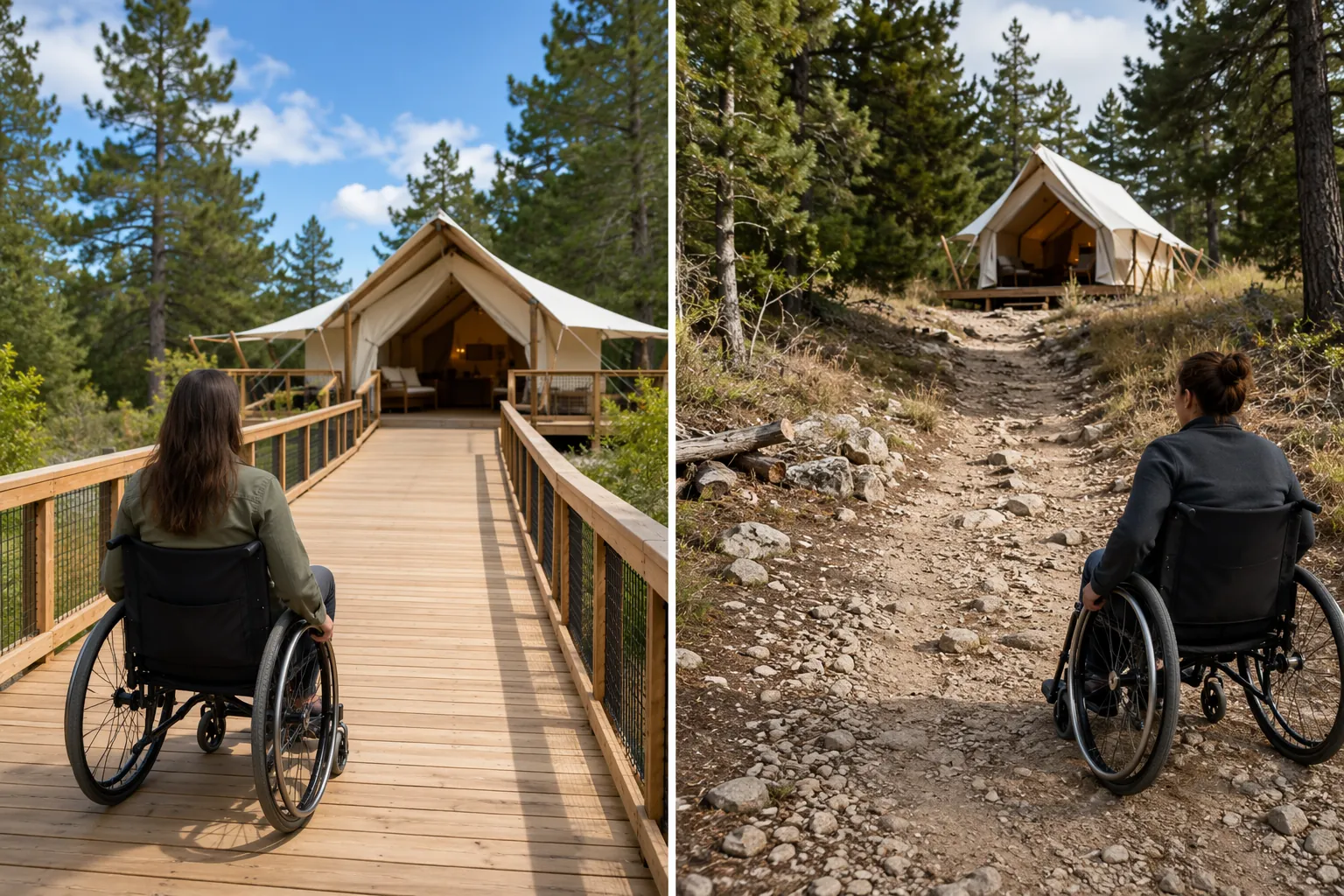
Before you pay, the central question is simple: can this specific site support this specific person’s mobility on the day they arrive? The answer should come from measurements, current photos, and clear host responses, not from a cheerful adjective on a booking page.
This guide is decision support, not medical advice. If travel, transfers, stamina, dizziness, or fall risk are already concerns, discuss the trip with the older adult’s clinician or therapist before booking.
The Pre-Booking Accessibility Checklist
Use this checklist before you book, not after the cancellation window closes. If a host cannot answer an item, ask for a measurement or a current photo. If they still cannot answer, treat the unknown as a real risk.
| What to Check | Ask the Host | What to Request | Why It Matters |
|---|---|---|---|
| Ramp or entry slope | What is the slope of the ramp or entry approach? | Side-view photo and slope measurement | A steep ramp can be exhausting or unsafe for wheelchair users and difficult for walkers. |
| Walkway grade | Is the route from parking to the unit level, or what is the steepest grade? | Photo or short video of the full route | A path that is technically passable may still be too tiring or unstable. |
| Doorway width | What is the clear width of the doorway when the door is open? | Tape-measure photo across the opening | A mobility aid needs usable clearance, not just a wide-looking entrance. |
| Path surface | Is the path paved, boardwalk, packed dirt, grass, mulch, gravel, or sand? | Close-up photo after typical weather conditions | Loose or soft surfaces can stop walkers, rollators, and wheelchairs. |
| Parking-to-unit distance | How far is the nearest accessible parking or drop-off point from the unit? | Distance in feet and a photo of the route | A long route can be the difference between pleasant arrival and a painful one. |
| Bed height and transfer space | How high is the sleeping surface, and is there open space beside it? | Tape-measure photo from floor to mattress top | A bed that is too low, too high, or blocked by furniture can make transfers unsafe. |
| Bathroom access | Is the bathroom inside the unit, nearby, or shared, and is the route step-free? | Photos of the route, doorway, toilet, shower, and grab bars | A usable sleeping area does not make up for an unusable bathroom. |
| Grab-bar configuration | Where are the grab bars around the toilet and shower? | Photos showing bar placement, not just the fixtures | The location of support matters as much as its presence. |
| Night lighting | Is the route to the bathroom and parking area lit at night? | Nighttime photo if available | A route that works at noon may be risky at 9 p.m. |
| Seasonal changes | Has rain, erosion, mud, snow, or flooding changed the site recently? | Current same-week photo before arrival | Outdoor access can change between the listing photo and the travel date. |
For a broader fall-risk conversation before travel, CareWise Guide’s fall prevention framework can help families think beyond the campsite itself. For this booking decision, though, stay close to the physical facts of the property.
Start With the Route, Not the Tent
A listing photo usually shows the tent, cabin, yurt, dome, or safari-style structure. The better first question is how someone gets there. A lovely unit at the end of loose gravel, damp grass, or a sloped dirt path may be reachable in theory and miserable in practice.
For ramps, use the ADA-referenced maximum slope of 1:12 as your plain-language benchmark: for every 1 inch of rise, there should be 12 inches of ramp run. That equals an 8.33% slope. For walking routes, the ADA-referenced maximum running slope commonly used to distinguish a walk from a ramp is 1:20, or 5%.[3] These numbers do not guarantee that every older adult will find the route easy, but they give you something better than “gentle.”
Ask the host: “What is the steepest slope from the parking area to the unit, including the ramp into the unit?” If they do not know, ask for a side-view photo of the ramp and a short video walking from the parking spot to the entrance. A video is useful because it shows the transitions: gravel to boardwalk, boardwalk to threshold, threshold to floor.
Do not ask only whether there are steps. A step-free route can still have a steep ramp, a raised threshold, a muddy dip, or a narrow turn. For someone using a cane, a slope may mean more fatigue. For a walker user, it may mean the walker rolls ahead too quickly. For a wheelchair user, it may mean needing a stronger companion than anyone expected.
What a useful route photo shows
- The parking or drop-off spot and how close it is to the unit
- The full walking or rolling surface, not only the prettiest section
- The ramp from the side, so the incline is visible
- Any turns, lips, thresholds, drainage dips, or uneven transitions
- The condition of the surface now, not when the listing was photographed
Matt Howard, writing for New Mobility, gives one of the most practical pieces of outdoor-access advice: call the ranger or host and ask them to text a photo of the current site condition. His point is that seasonal flooding and erosion can change accessibility from one season to the next.[4] That advice belongs near the top of every glamping checklist because these properties are outdoors by design.
Doorway Width: Measure the Clear Opening
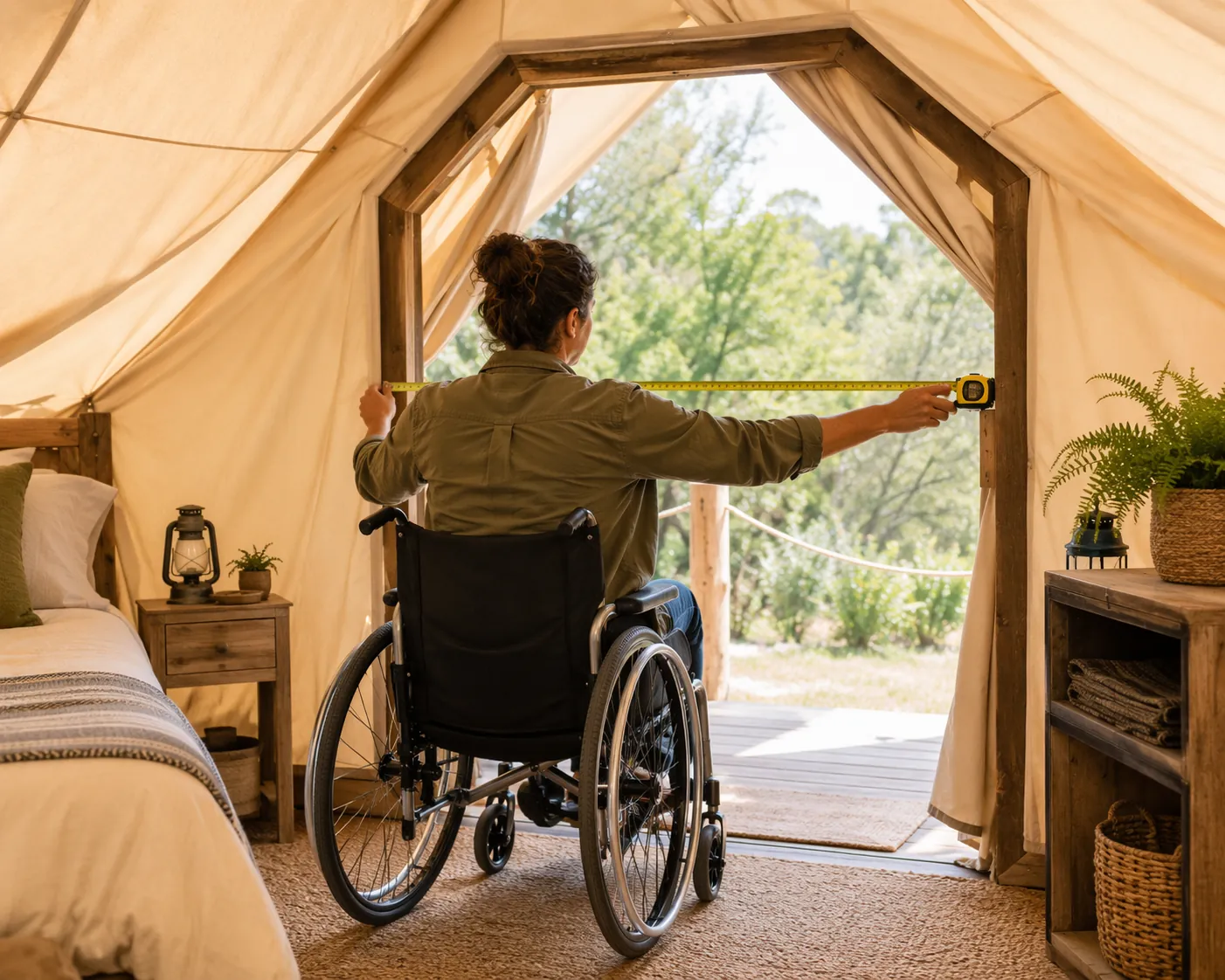
Doorway width is one of the easiest details to verify and one of the easiest to describe badly. “Wide entrance” is not enough. Ask for the clear width of the doorway with the door fully open, measured at the narrowest usable point. Hardware, canvas folds, door frames, and threshold edges can reduce the real opening.
Use 36 inches as the minimum doorway-width benchmark for this checklist.[3] If the traveler uses a wheelchair, scooter, rollator, or wide walker, compare that measurement with the actual device. If the mobility aid is close to the doorway width, remember that people rarely approach a door in a perfect straight line, especially while carrying a bag or moving across an uneven surface.
The exact request is simple: “Could you send a photo with a tape measure across the clear doorway opening, with the door open as it would be for entry?” A host who has already labeled a unit accessible should be able to provide this without treating it as an unusual favor.
Path Surface Matters More Than the Word Rustic
Glamping listings often sell texture: gravel paths, woodland trails, meadow settings, riverbank clearings. Those words may sound charming until a walker sinks, a cane tip slips, or a wheelchair caster catches. The surface has to be described like a surface, not like a mood.
Ask whether the route is paved, wooden boardwalk, packed dirt, grass, mulch, loose gravel, crushed stone, sand, or a mix. Then ask what happens after rain. A firm packed path in dry weather can become soft enough to change the whole trip. A boardwalk can be excellent if it is wide, level, and maintained; it can also be slippery, warped, or missing edge protection.
For cane users, the concern is stable foot placement. For walker users, it is whether the legs or wheels catch. For wheelchair users, it is rolling resistance, small front caster movement, and whether someone will have to push. For a person with limited endurance, even a passable path can become too much if it is long, sloped, or exposed to heat.
Distance belongs with surface. “Close to parking” can mean a few steps or a long path across the property. Ask for the distance in feet from the nearest accessible parking or drop-off point to the unit door. If the host can only estimate, ask them to walk it and send a short video. The person who struggles with the route will not be helped by a prettier description.
Bed Height and Transfer Space
Sleeping arrangements are where many “comfortable outdoor” trips become awkward. A real bed is better than a sleeping bag on the ground, but that does not mean it works for transfers. Too low can be hard to stand from. Too high can make a wheelchair-to-bed transfer unsafe. A beautiful frame can block the side approach. A soft mattress can collapse under a person who needs a stable edge.
Use 18 to 20 inches from floor to the top of the mattress as the checklist benchmark for chair-to-bed transfer practicality. As another comparison point, several wheelchair users cited the Coleman ComfortSmart Deluxe Cot’s 15-inch height as an ideal transfer height, which is useful as a concrete reference rather than a product recommendation.[4] The right height still depends on the traveler’s body, strength, wheelchair seat height, and transfer method.
Ask: “What is the height from the floor to the top of the mattress, and is there open space beside the bed for a wheelchair, walker, or caregiver?” Request a photo with a tape measure from the floor to the mattress top. Also ask for a photo of both sides of the bed, because one open side may not be enough if the traveler transfers from a particular direction.
If the unit uses a platform bed, built-in bunk, loft, low futon, or air mattress, slow down. Those setups can be cozy for some guests and impossible for others. Do not assume the host understands transfer needs unless you ask about height, side clearance, mattress firmness, and whether furniture can be moved before arrival.
The Bathroom Is the Real Test
If the bathroom does not work, the site does not work. It does not matter how accessible the sleeping area looks. This is why the 743-to-172 gap matters so much: filtering for accessible bathrooms sharply reduced the number of supposedly wheelchair-accessible U.S. GlampingHub destinations in that 2023 snapshot.[1]
First, find out where the bathroom is. Inside the unit is different from next door. Next door is different from across a path. A shared bathhouse may be manageable in daylight and unreasonable at night. Ask whether the route is step-free, lit, firm, and protected from mud or standing water.
Then ask about the doorway, turning space, toilet, shower, and grab bars. “Grab bars available” is not enough. Around a toilet, the question is where the bars are placed in relation to the seat and whether they support the traveler’s usual transfer direction. In a shower, the question is whether there is a zero-threshold entry, a stable seat or bench if needed, reachable controls, and grab bars positioned where the person actually needs support.
Request photos that show the whole bathroom, then close-ups of the toilet area and shower area. A tight photo of one shiny grab bar tells you very little. A better photo shows the toilet, adjacent walls, bar placement, floor space, and shower threshold in the same frame.
Bathroom questions worth asking exactly
- Is the bathroom private, shared, inside the unit, or in a separate bathhouse?
- Is the full route from bed to toilet step-free and lit at night?
- What is the clear bathroom doorway width?
- Are there grab bars beside and behind the toilet, and can you send photos showing their placement?
- Is the shower roll-in, low-threshold, or step-in?
- Is there a fixed or portable shower seat, and is it stable on the shower floor?
If the host answers quickly on fire pits and views but vaguely on the bathroom, that tells you something. The bathroom is not a minor amenity for a traveler with mobility needs; it is part of the safety plan.
Collect Proof Before Payment
A good verification call is polite, specific, and written down. You are not asking the host to diagnose anyone’s needs. You are asking them to describe their property accurately enough for your family to decide.
Send the request in writing through the booking platform or email so the answers stay attached to the reservation. If you speak by phone, follow up with a short message: “Thank you for confirming that the parking space is approximately 40 feet from the unit, the path is a wooden boardwalk, the doorway clear width is 36 inches, and the bathroom has grab bars beside the toilet.” Keep the tone calm, but make the details visible.
Current photos matter because glamping sites live outdoors. Rain, erosion, new gravel, landscaping, repairs, and seasonal closures can change the route. Howard’s advice to ask for a current photo is especially useful when booking weeks ahead or visiting during a wet season.[4]
| If the Listing Says | Ask Instead |
|---|---|
| Easy access | How many feet is it from parking to the entrance, and what is the surface? |
| Wheelchair accessible | What are the doorway widths, ramp slope, bathroom layout, and bed height? |
| Accessible bathroom | Where are the grab bars, what type of shower is it, and is the route step-free? |
| Short walk | How far is the walk in feet, and is it level? |
| Rustic path | Is the surface firm and stable after rain? |
| Senior-friendly | Which specific features support cane, walker, wheelchair, or transfer needs? |
If you are comparing several mobility decisions for an older adult, use the same standard everywhere: observable conditions beat labels. A host’s good intention does not make a steep route easier at the end of a travel day.
When a Host Cannot Answer
Some hosts are small operators. They may never have been asked for a ramp slope or bed height. That is not automatically a reason to reject the site. The useful distinction is whether they are willing and able to verify.
A host who says, “I don’t know, but I can measure that this afternoon,” is different from a host who repeats, “It’s accessible,” without details. A host who sends current photos of the full route is different from one who sends the same marketing image already on the website. A host who explains that the path includes packed dirt and may be soft after rain is more helpful than one who promises it will “probably be fine.”
Use this judgment standard before you pay: if a missing detail would change whether the traveler can enter, sleep, toilet, shower, or leave safely, it is not a minor unknown. It is a booking decision.
Bonus Checks for Parks and Public Lands
Some glamping stays operate in or near public recreation areas, and a few extra checks may help. The America the Beautiful Access Pass provides free lifetime entrance to more than 2,000 federal recreation sites for eligible U.S. citizens or permanent residents with permanent disabilities, and REI notes that it can include a 50% campsite discount; the USDA information cited in the same REI guide notes a $10 processing fee.[5] Rules, fees, and whether a particular glamping operation is covered should be verified directly before booking.
Track-chair loan programs can also make some outdoor areas more usable. BraunAbility lists examples in Minnesota, Michigan, Kansas, and Wisconsin.[6] Treat those programs as local leads, not guarantees. Availability, reservations, eligible trails, weather limits, transfer requirements, and staffing can vary by park and date.
The verification questions are the same: where is the chair located, who helps with it, what route does it cover, what surfaces are allowed, and what happens if weather changes? A loan program is helpful only if it matches the traveler’s body, timing, and route.
Make the Booking Decision
After the photos, measurements, and host answers are in front of you, compare them with the traveler’s actual mobility. Do not average the answers into a general feeling. One serious mismatch can outweigh several pleasant features.
- Proceed with more confidence if the route, ramp, doorway, bed, bathroom, parking distance, and current site condition all match the traveler’s needs.
- Ask follow-up questions if the host provides photos but no measurements, or measurements without showing the actual surface and layout.
- Keep looking if the answers are vague, inconsistent, outdated, or dismissive.
- Do not book on the strength of “senior-friendly” alone.
A good glamping trip should still feel like a trip: morning air, a change of scene, a place worth remembering. The way to protect that is to settle the mobility facts before arrival. If the measurements, photos, and answers fit the person who is actually traveling, book. If they do not, let the pretty listing go.
References
- Wheelchair Accessible Glamping Destinations Around the Globe, Wonders Within Reach, 2023.
- Why Glamping is Ideal for Older Adults, AARP, April 2025.
- Creating Accessible Glamping Sites: Trends and Innovations in Inclusivity, CRR Hospitality.
- From 'Roughing It' to Glamping: Adaptive Camping for Wheelchair Users, New Mobility, 2024.
- Guide to Adaptive Camping, REI Expert Advice.
- Top Nine Wheelchair Accessible Campgrounds and Parks, BraunAbility.
Where this decision comes from
Suggest a correction
We keep this content strictly product-neutral and reviewed against CDC STEADI, NIA, and AARP HomeFit guidance. If something here looks outdated, unclear, or inaccurate, tell us — this page does not carry open public comments, because it touches medical urgency, cost, or capacity-adjacent decisions where a discussion thread is a trust liability rather than a trust asset.
See the correction process on our editorial standards page →