Can Monitoring Technology Replace Overnight Caregivers? A Cost and Capability Comparison
For cost-conscious family caregivers, this article compares the costs and capabilities of passive monitoring technology versus human overnight care, providing a decision rubric to determine when tech is a safe alternative and when human care remains necessary.
Features Covered in This Explainer
bed exit alerts, motion pattern tracking, fall detection, night wandering detection, door exit alerts, cue lighting
The cost gap between human overnight care and passive monitoring technology is substantial.
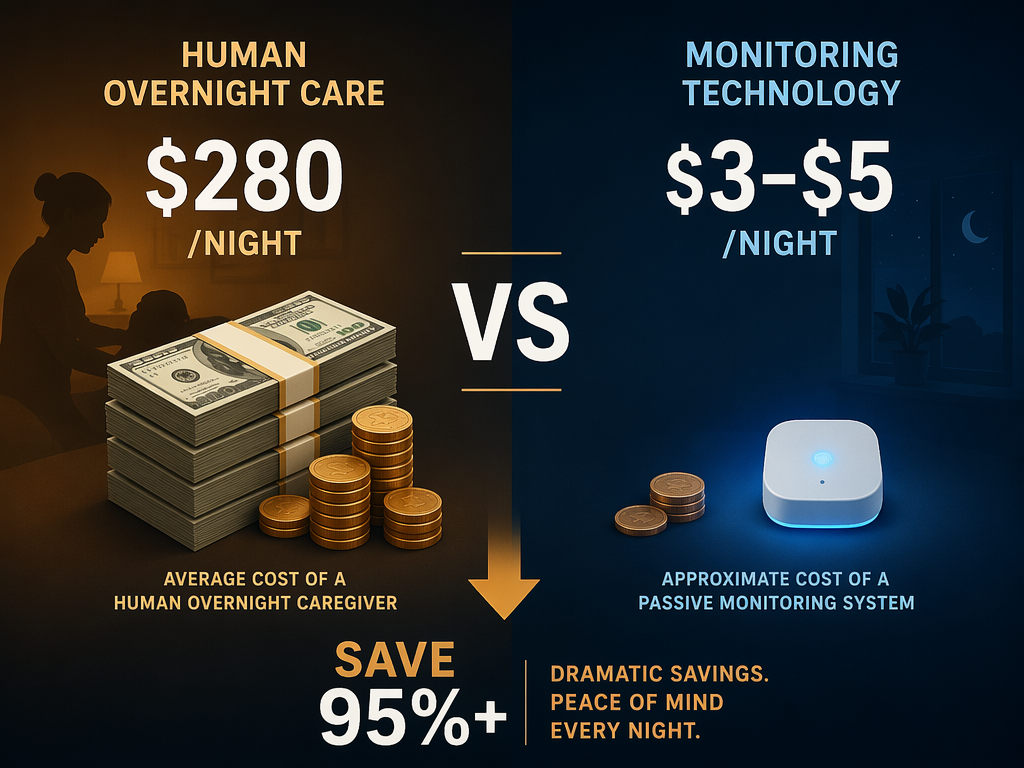
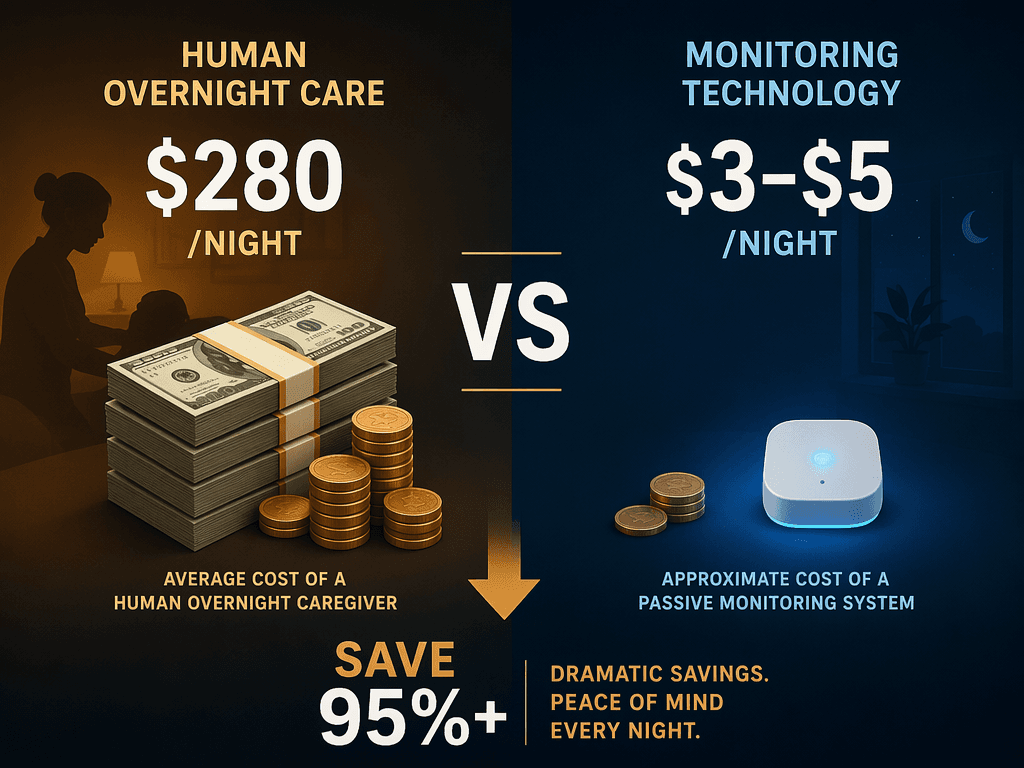
The Cost Disparity: $280/Night vs. $3/Night
For a family caregiver trying to balance safety with a monthly budget, the price difference between hiring a human overnight caregiver and installing a passive monitoring system is not subtle — it is the difference between a second mortgage and a utility bill.
According to the 2025 CareScout Cost of Care Survey, the national median hourly rate for a non-medical caregiver is $35 per hour. An eight-hour overnight shift at that rate comes to $280 per night. Over a 30-day month, that single shift adds up to $8,400 — though most families reduce costs by hiring for fewer nights per week or using a live-in arrangement. A single location page for BrightStar Care in the Cleveland metro area lists sleep/standby overnight care at a flat rate of $120–$200 per night, which still translates to $3,600–$6,000 per month.
On the other end of the spectrum, a passive monitoring system like envoyatHome costs $99 per month plus a one-time equipment fee of $399. That works out to roughly $3.30 per day. The CarePredict @Home kit costs $449.99 upfront plus $69.99 per month. The Caregiver Smart Solutions Deluxe+ kit costs $299 plus $49 per month. Even the most expensive option — CarePredict — comes to about $2.33 per day after the first year.
Cost comparison: human overnight care vs. passive monitoring technology (2025 data).
Option
Upfront Cost
Monthly Cost
Cost Per Night (30 days)
Human overnight caregiver (agency, awake)
$0 (hourly billing)
$8,400 (8 hrs/night @ $35/hr)
$280
Human overnight caregiver (agency, sleep/standby)
$0 (flat nightly rate)
$3,600–$6,000
$120–$200
envoyatHome passive monitoring
$399 (one-time equipment)
$99
$3.30
CarePredict @Home
$449.99 (kit)
$69.99
$2.33
Caregiver Smart Solutions Deluxe+
$299 (kit)
$49
$1.63
The monthly savings are stark: choosing a passive monitoring system over nightly human care can save a family between $3,500 and $8,300 per month. But that savings only matters if the technology actually addresses the safety concern. The critical question is not whether tech is cheaper — it is whether tech is sufficient for your specific situation.
What Monitoring Technology Can Do at Night
Modern passive monitoring systems are designed to address the most common nighttime safety risks without requiring the senior to wear a device, push a button, or interact with technology. They work by placing small sensors around the home — on the bed, doors, cabinets, and in hallways — that detect movement, pressure changes, and door openings.
Here is what these systems can do during overnight hours:
Detect bed exits: A pressure mat placed under the mattress or on top of the sheet alerts the caregiver when the senior gets out of bed — the most common trigger for nighttime falls.
Track motion patterns: Motion sensors in hallways and rooms can detect unusual inactivity (a sign of a fall) or increased nighttime bathroom trips that may signal a urinary tract infection.
Detect falls automatically: Unlike a traditional medical alert pendant that requires the user to press a button, some passive systems use motion and vibration sensors to detect a fall even if the person cannot call for help.
Alert to night wandering: Door sensors trigger an alert when an exterior door is opened. The Alzheimer's Association reports that 6 in 10 people living with dementia will wander at least once, and many do so repeatedly.
Trigger cue lighting and audio prompts: Some smart home systems, like the one tested in the 2020 PMC study by Ault et al., automatically turn on pathway lighting and play a prerecorded audio message redirecting the person back to bed when a bed exit is detected.
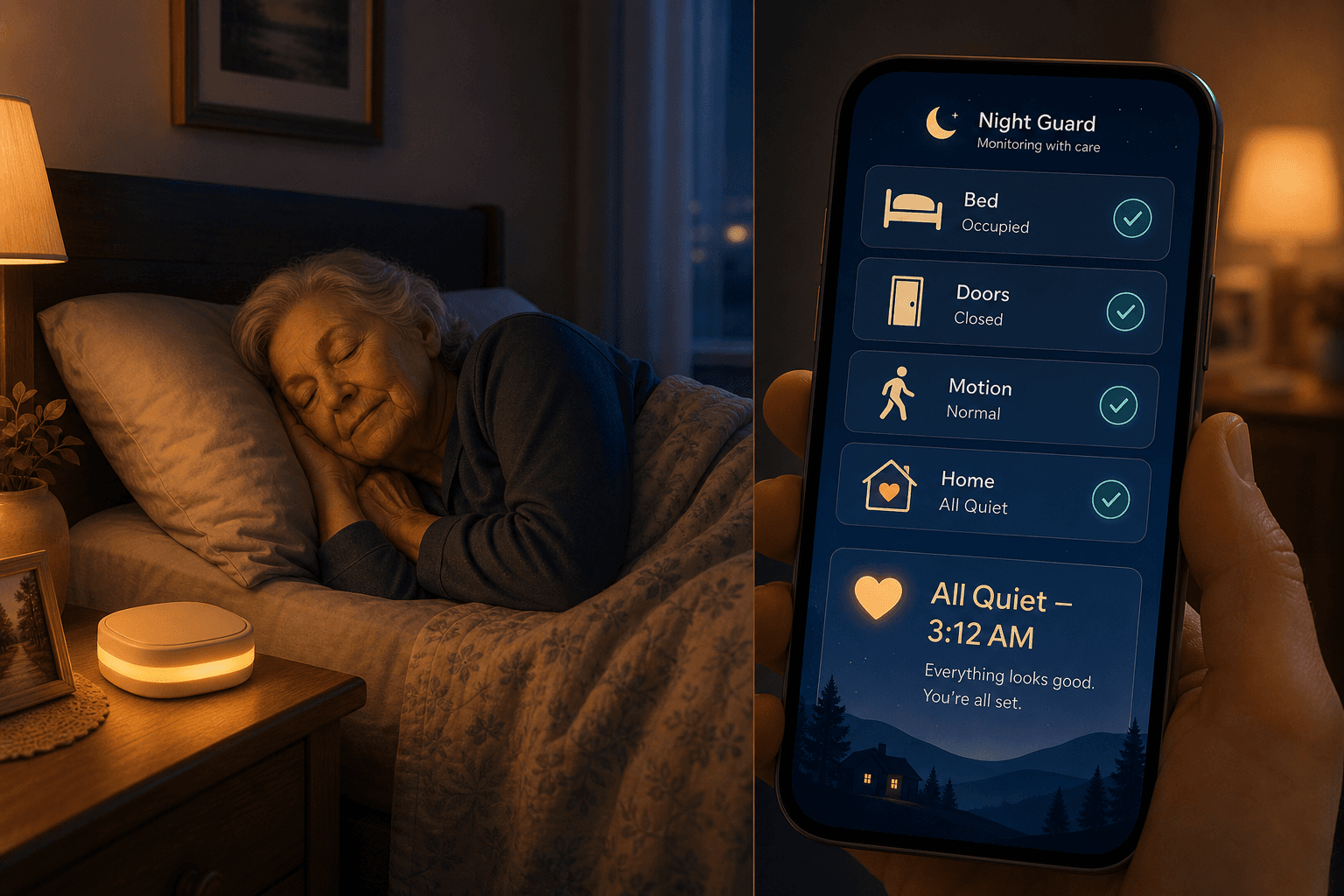
A key advantage of these systems is that they do not use cameras. The envoyatHome system, for example, uses motion sensors, door sensors, and cabinet sensors connected to an internet hub — no cameras, no wearables, and no action required from the senior. This preserves dignity and privacy, which is often a major concern for older adults who resist being watched.
Passive monitoring provides peace of mind without cameras or wearables.
What Monitoring Technology Cannot Do
Understanding the limits of monitoring technology is just as important as understanding its capabilities. A sensor system can alert you to a problem, but it cannot intervene. Here is what no current monitoring system can replace:
Hands-on toileting assistance: If the senior needs help getting to the bathroom, transferring to the toilet, or cleaning up after an accident, a sensor cannot provide physical support.
Repositioning in bed: For seniors who are bedbound or at risk of pressure ulcers, someone must physically turn or reposition them during the night.
Medication administration: Nighttime medications cannot be dispensed or verified by a motion sensor.
Crisis intervention after a fall: A system can detect a fall and send an alert, but someone must still arrive to help the person up, assess for injury, and call emergency services if needed.
Companionship and reassurance: For seniors who experience anxiety, confusion, or loneliness at night, a sensor cannot provide the human presence that calms and orients them.
The distinction matters because the most dangerous scenario is not the one where you choose tech over human care — it is the one where you choose tech believing it provides the same level of protection. A fall alert is only useful if someone can respond within minutes. If the closest family member lives 30 minutes away, a monitoring system without a local responder is a false sense of security.
Evidence: How Monitoring Affects Caregiver Wellbeing
The emotional toll of overnight caregiving is often invisible until it becomes a crisis. A 2020 pilot study published in PMC (Ault et al.) tested an off-the-shelf smart home system — using a pressure mat, motion sensors, door sensors, and a SONOS speaker — to manage night-time wandering in persons with dementia across five dyads in Ottawa, Canada.
The system worked like this: when the pressure mat detected a bed exit, the smart home system automatically turned on cue lighting and played a prerecorded audio message redirecting the person back to bed. The caregiver was only alerted if an exterior door was opened — meaning they were not woken for every bed exit, only for the ones that posed a real safety risk.
The results were striking for caregiver mental health. After 12 weeks:
Average caregiver depression scores decreased from 5.2 to 3.6
Average caregiver anxiety scores decreased from 6.8 to 5.8
Caregivers reported sleeping more peacefully knowing they would be alerted only when needed
The study's most important finding may be the least quantifiable: caregivers reported that the system reduced the constant low-grade vigilance that makes overnight caregiving unsustainable. Instead of waking at every sound or lying awake waiting for a fall, they could sleep through routine movements and only respond to genuine emergencies. For many family caregivers, that shift — from active monitoring to exception-based alerting — is the difference between burning out and lasting through the caregiving journey.
When Tech Is Sufficient vs. When Human Care Is Required
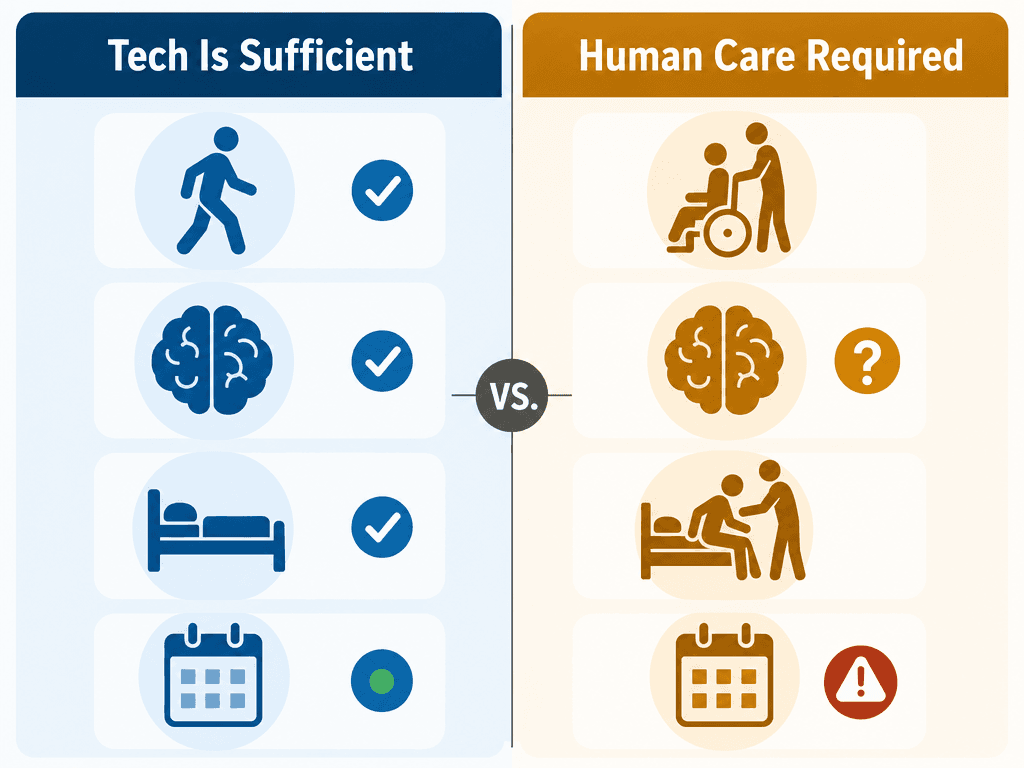
The decision to use monitoring technology instead of human overnight care depends on a specific set of risk factors. The table below provides a framework for matching the senior's profile to the appropriate level of overnight support.
A decision rubric for matching the senior's risk profile to the appropriate overnight support model.
Decision rubric for overnight care: tech vs. human.
Factor
Tech Is Sufficient
Human Care Required
Mobility
Able to get out of bed and walk independently (with or without a cane/walker)
Needs transfer assistance to get out of bed or use the toilet
Cognition
Cognitively intact or mild cognitive impairment; can follow safety instructions
Moderate-to-late dementia; history of wandering; cannot follow redirecting cues
Fall history
No falls in the past 6 months; low fall risk per CDC STEADI assessment
Multiple falls in the past 6 months; high fall risk; history of injurious falls
Toileting
Can use the bathroom independently; nocturia is managed with a bedside commode or urinal
Requires hands-on assistance with toileting or cleaning up after accidents
Medication
No nighttime medications, or medications are pre-dosed and can be taken independently
Requires assistance with nighttime medication administration
Response time
A family member or responder lives within 10–15 minutes and can arrive quickly if alerted
No local responder available; the closest family member lives more than 30 minutes away
The Alzheimer's Association notes that 6 in 10 people with dementia will wander at least once, and wandering can happen at any stage of the disease. For a senior with dementia who is still mobile, the risk of wandering is high enough that passive monitoring alone may not be sufficient — especially if the person has a history of attempting to leave the home at night.
Nocturia — frequent nighttime urination — is another critical factor. Studies estimate that nocturia affects 69–93% of men and approximately 75% of women over age 70. Each trip to the bathroom at night is a fall risk event. A 2009–2010 study from the University of Alabama at Birmingham found that nocturia is associated with a 28% increased risk of falls in older adults. If the senior is making three or four trips to the bathroom each night, the cumulative fall risk is substantial — and a monitoring system can only alert after the fall, not prevent it.
The Hybrid Model: Technology Plus Part-Time Human Check-Ins
For many families, the choice is not between all-tech or all-human. The most practical solution is a hybrid model that combines passive monitoring with scheduled or on-call human visits. This approach addresses the core safety concern — detecting falls and wandering — while keeping costs manageable.
Here are three common hybrid configurations:
Monitoring + family check-in: A passive monitoring system alerts a family member who lives nearby. The family member checks in once per night (e.g., at 11 PM) and responds to alerts. This works best when the responder lives within 10–15 minutes.
Monitoring + paid aide (short shift): A paid caregiver visits for 1–2 hours at bedtime to assist with toileting, medication, and settling into bed. The monitoring system covers the rest of the night. At $35/hour, this costs $35–$70 per night — far less than a full overnight shift.
Monitoring + neighbor or friend responder: For seniors who are relatively independent but at risk of falls, a neighbor or friend can serve as the emergency contact for the monitoring system. This works best when the senior is cognitively intact and can call for help if needed.
The hybrid model is not a compromise — it is often the most appropriate solution for the middle ground of risk. A senior who is mobile and cognitively intact but has a history of falls at night does not need a full-time caregiver. They need a safety net that detects the fall and a responder who can arrive quickly. A monitoring system plus a local family member or paid aide provides exactly that.
Making Your Decision: A Step-by-Step Guide
If you are trying to decide whether monitoring technology can replace overnight human care for your situation, work through these steps in order. Each step narrows the options and clarifies what level of support is actually needed.
Assess ADL dependence and dementia stage. Use the decision rubric above. If the senior needs hands-on assistance with toileting, transferring, or repositioning at night, monitoring technology alone is not sufficient. Human care is required.
Evaluate fall history and nocturia frequency. How many times does the senior get up at night? Have they fallen in the past 6 months? If the answer to either question is concerning, consider a hybrid model rather than tech-only.
Determine your budget and insurance coverage. Medicare does not cover overnight caregivers or passive monitoring systems. Some long-term care insurance policies may cover monitoring technology as a durable medical equipment expense. Check with your insurer.
Choose your model. Based on steps 1–3, select from: pure tech (low risk, independent senior), hybrid (moderate risk, some ADL dependence), or human-only (high risk, significant ADL dependence).
Trial a monitoring system with a backup plan. Most passive monitoring systems do not require contracts. Start with a 30-day trial. During the trial, have a backup plan in place — a family member who can respond to alerts, or a paid aide on standby. Evaluate whether the system reduces your anxiety or increases it.
The goal is not to eliminate human care entirely — it is to use technology where it works well and reserve human care for the tasks that only a person can perform. For many families, that means a hybrid approach that changes over time as the senior's needs evolve. A monitoring system that works today may need to be supplemented with human care tomorrow. The key is to build a system that can adapt.
For individualized recommendations:An occupational therapist or your primary care provider can assess your specific situation and recommend the monitoring category and feature set that best fits the person's functional level, living environment, and caregiver availability. This explainer provides educational context, not a personalized recommendation.

Comments
Join the discussion with an anonymous comment.