
Caregiver decision guide
Passive Ambient Monitoring for Seniors: The Privacy-Preserving Alternative to Cameras That Detects Falls, Behavior Changes, and Health Decline
For family caregivers whose parent rejects cameras or wearables, passive ambient monitoring offers a way to stay informed without intruding. This guide explains how PIR motion sensors, contact sensors, pressure mats, and environmental sensors work together to detect falls, track daily routines, and identify early signs of health decline — all without requiring the senior to wear, charge, or interact with any device.
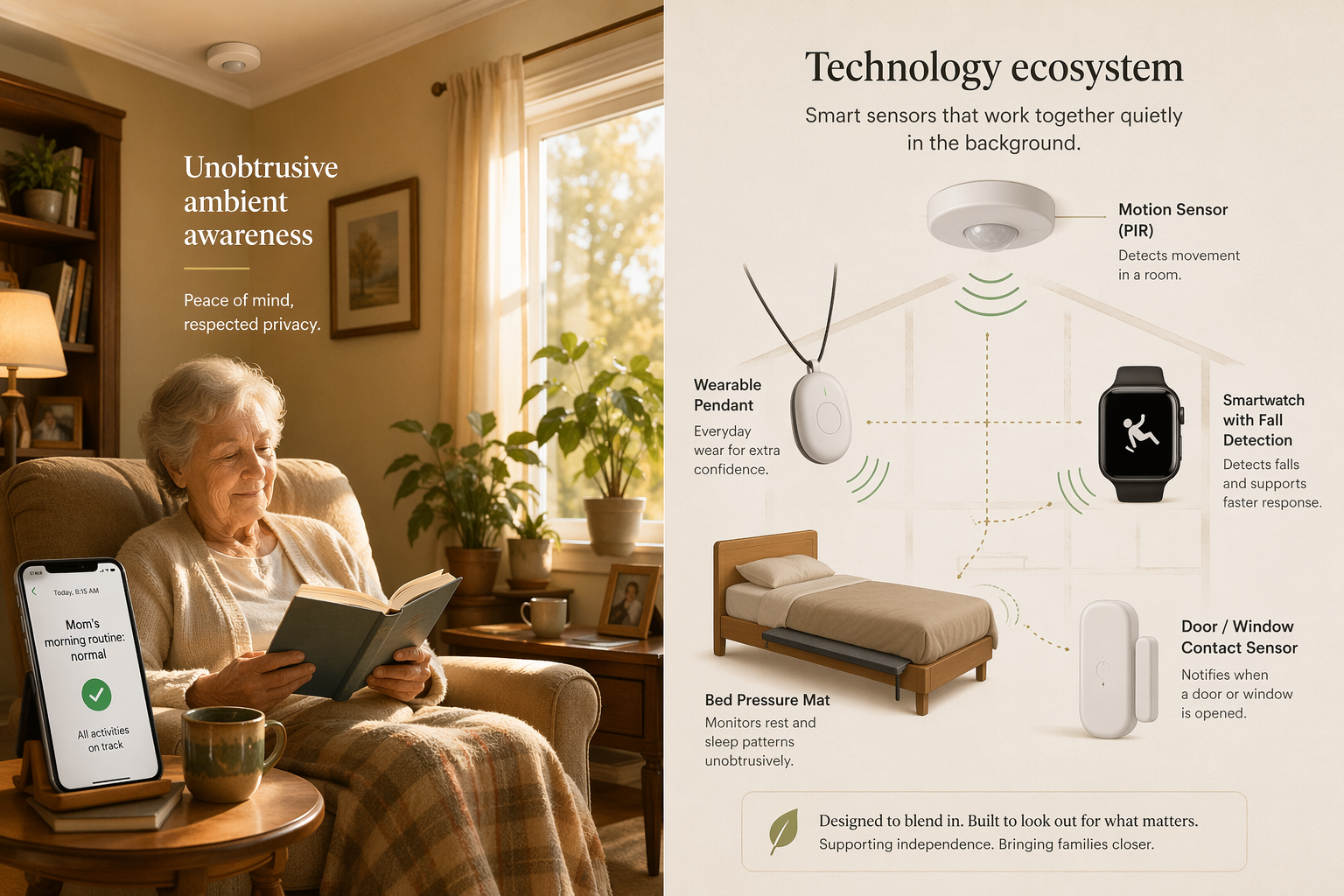
When 'Being Watched' Is the Problem: The Dish Towel Over the Camera
Ryan Herd, the founder of Caregiver Smart Solutions, had the same conversation many family caregivers have had. He installed a camera in his father's home so he could check in remotely. His father responded by covering the camera with a dish towel. The message was unmistakable: I do not want to be watched.
That moment, documented in an AARP article, captures the central tension of modern caregiving: you want 24/7 awareness of your parent's well-being, but the tools that give you that awareness — cameras, wearables, medical alert pendants — often feel like surveillance to the person you are trying to protect. A camera in the living room can feel like a loss of dignity. A wearable pendant can feel like a badge of frailty. A smartwatch that needs daily charging can feel like a chore.
This resistance is not stubbornness. It is a reasonable response to technology that asks an older adult to trade their sense of privacy and autonomy for your peace of mind. And when a parent refuses to cooperate — when the pendant stays in the drawer, the smartwatch runs out of battery, or the camera gets covered — the caregiver is left with no information at all.
There is a third option. Passive ambient monitoring uses sensors placed around the home to detect movement, door openings, pressure, temperature, and other environmental changes — without recording video or audio, and without requiring the senior to wear, charge, or interact with any device. It is the approach Herd built after his father's dish-towel protest, and it is backed by a growing body of research showing that sensor data alone can detect falls, track daily routines, and identify early signs of health decline.
What Passive Ambient Monitoring Is — and How It Differs from Cameras, Wearables, and PERS
Passive ambient monitoring is a category of technology that uses non-intrusive sensors to collect data about a person's activity and environment without requiring any active participation from that person. The system learns what "normal" looks like for a specific individual — when they wake up, how often they visit the bathroom, when they open the refrigerator, how long they spend in the shower — and alerts a caregiver when the pattern deviates in a way that suggests a problem.
This approach is fundamentally different from the three most common monitoring alternatives:
| Approach | How It Works | Primary Barrier for Seniors |
|---|---|---|
| Cameras (video monitoring) | Streams or records video of the home; caregiver checks in remotely or reviews footage | Feels like surveillance; invades privacy; can feel infantilizing; the 'dish towel over the camera' problem |
| Wearables (smartwatches, pendants, wristbands) | Worn on the body; tracks movement, heart rate, falls, and location | Requires remembering to wear it, charge it, and keep it on; older adults with MCI may forget or abandon it; can feel stigmatizing |
| PERS (personal emergency response systems) | A wearable button that the user presses to call for help in an emergency | Requires the user to recognize an emergency and physically press the button; useless if the person is unconscious, confused, or unwilling to wear it |
| Passive ambient monitoring | Sensors placed around the home detect motion, door openings, pressure, temperature, and other environmental signals; no user action required | None — the senior does not need to do anything differently; the system works whether they remember it or not |
The NIH scoping review on in-home monitoring technology for aging in place, published in 2022, identified 30 studies covering 16 types of sensor technologies and six monitoring functions: daily activities, abnormal behaviors, cognitive impairment, falls, indoor person positioning, and sleep quality. The review explicitly excluded wearable sensors due to usability barriers, noting that older adults with mild cognitive impairment (MCI) may forget to wear or charge them — a finding that reinforces the passive approach's suitability for this population.
The Sensor Ecosystem: What Goes Where and What Data It Generates
A passive ambient monitoring system is not a single device. It is a network of sensors, each placed in a specific location to capture a specific type of data. The NIH scoping review found that passive infrared (PIR) motion sensors were the most common, used in 21 of the 30 reviewed studies, followed by contact sensors in 19 of 30. But a complete system typically includes several additional sensor types.
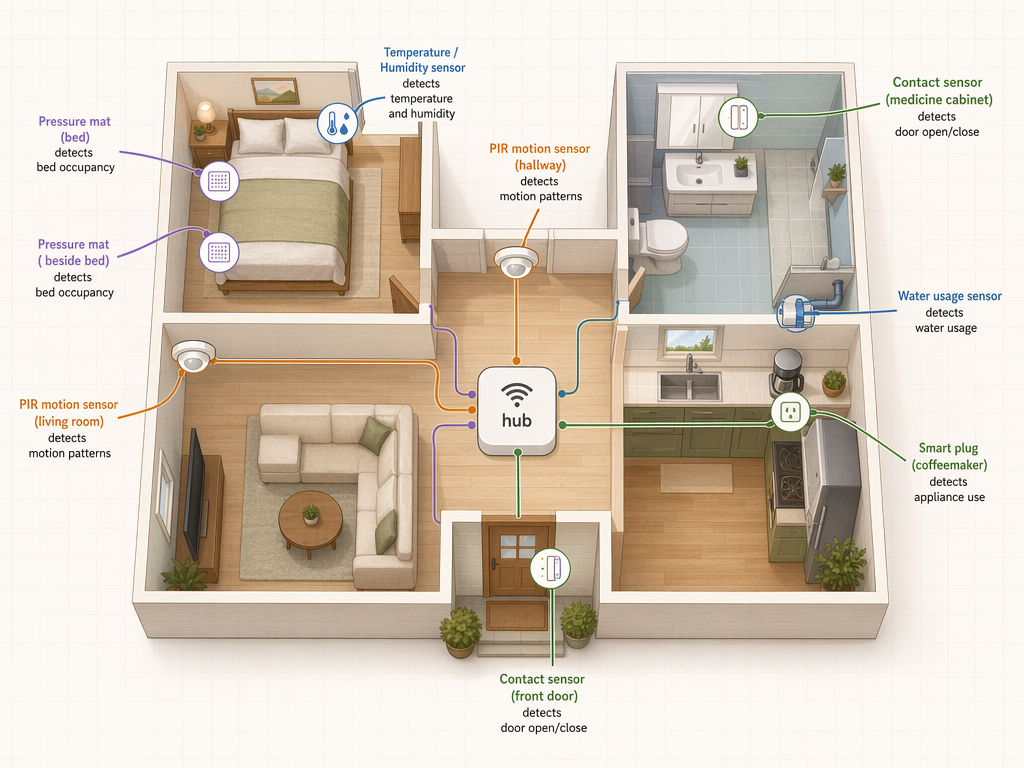
| Sensor Type | Typical Placement | What It Detects |
|---|---|---|
| PIR motion sensor | Hallways, living room, kitchen, bedroom ceiling or wall | Movement in a room; presence/absence; time of day activity patterns; gait speed (with multiple sensors) |
| Contact sensor (magnetic) | Doors (front, back, sliding), cabinet doors (medicine, refrigerator) | When a door or cabinet is opened or closed; entry/exit times; medication access; meal preparation |
| Pressure mat | Under bed mattress, chair cushion, beside the bed | Bed occupancy (sleep/wake times, restless sleep); chair occupancy (time spent sitting); fall detection (sudden pressure change) |
| Temperature/humidity sensor | Bathroom, bedroom | Room temperature extremes (hypothermia risk); humidity levels (shower usage, mold risk) |
| Water usage sensor | On bathroom pipes or near toilet | Toilet flush frequency (UTI detection); shower duration; sink usage |
| Smart plug | Coffeemaker, television, lamp | Appliance usage patterns (morning coffee routine, TV watching time); changes in daily routine |
| Bed occupancy sensor | Under mattress | Sleep quality metrics: time to bed, time out of bed, nighttime restlessness, total sleep duration |
A typical setup, such as the Caregiver Smart Solutions Core Kit described in a Care.com article, includes 14 sensors: movement sensors in five rooms, medicine cabinet and refrigerator contact sensors, temperature and humidity sensors, front and side door sensors, and emergency buttons. The system costs $899 upfront plus $59 per month. A more basic configuration, the Deluxe+ Kit, costs $299 plus $49 per month and covers five rooms with temperature, humidity, and door motion sensors.
What the Data Can Reveal: From Bathroom Trips to Depression Detection
The power of passive ambient monitoring lies not in the sensors themselves but in what the data patterns reveal. A single motion sensor in the hallway tells you someone walked past. But a network of sensors, analyzed over days and weeks, can detect changes that signal health problems before they become emergencies.
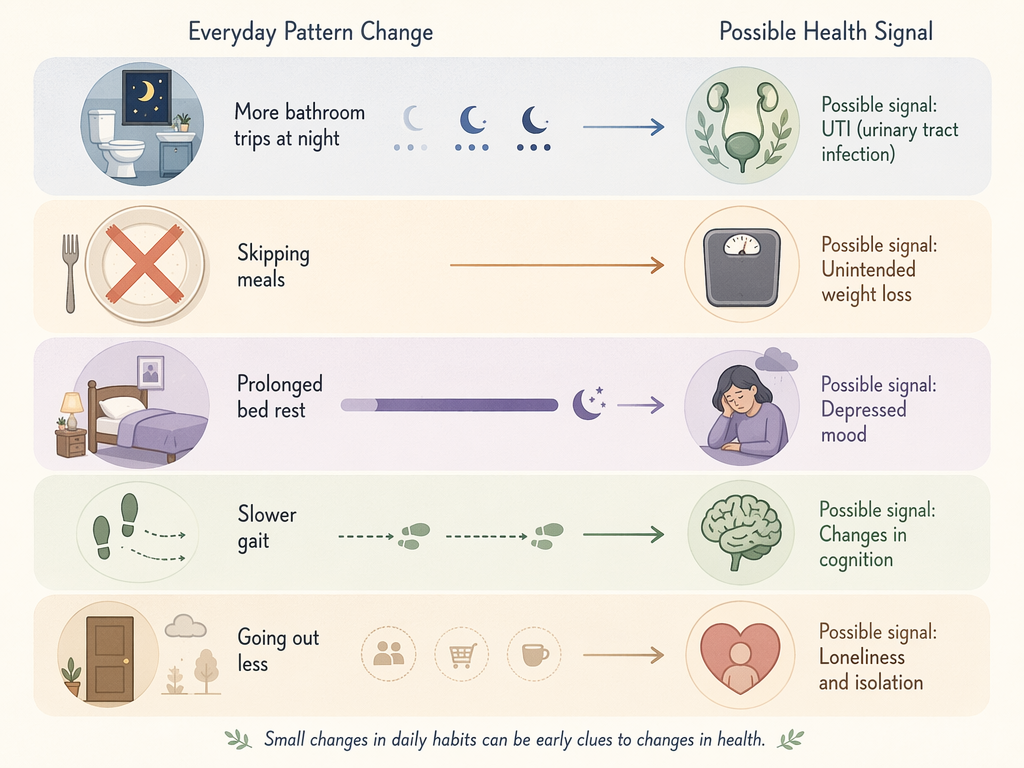
Urinary tract infection (UTI) risk. A sudden increase in nighttime bathroom trips — detected by a bed occupancy sensor showing multiple exits and a water usage sensor registering more flushes — is a classic early sign of a UTI in older adults. Catching this pattern early can prevent the confusion, falls, and hospitalizations that often follow an untreated infection.
Depression detection. Research published in the Journal of Biomedical Informatics (2017) and cited in the NIH scoping review found that machine learning algorithms analyzing daily activity data from passive sensors can detect depression with up to 96% accuracy. The system looks for patterns like prolonged bed rest, skipped meals, reduced movement through the home, and decreased engagement with hobbies (e.g., the TV staying off, the coffeemaker not being used).
Loneliness estimation. A 2016 study published in IEEE and cited in the NIH review demonstrated that loneliness can be estimated from passive sensor data alone by analyzing out-of-home hours, phone call patterns, computer use, walking speed, and mobility measures. A parent who used to go to the senior center three times a week and now stays home every day may be experiencing social isolation — even if they say they are "fine" on the phone.
Cognitive decline. Changes in the ability to perform instrumental activities of daily living (IADLs) — preparing meals, taking medication, managing finances — are early markers of cognitive decline. A contact sensor on the medicine cabinet that stops opening at the usual time, or a refrigerator that goes untouched for longer periods, can signal that a once-routine task has become difficult. The NIH review notes that sensor systems can identify cognitive impairment by tracking these IADL performance changes over time.
Fall detection. While passive sensors cannot detect a fall the way a wearable accelerometer can, they can detect the aftermath. A motion sensor that registers no movement for an extended period during waking hours, combined with a pressure mat that shows the person never got up from a fall, can trigger an alert. Some systems also use audio sensors (sound of a fall, calls for help) as a complement.
Scientific Validation: What the Research Says About Passive Monitoring
Passive ambient monitoring is not experimental. The 2022 NIH scoping review provides a comprehensive evidence base: 30 studies, 16 sensor types, six monitoring functions. The two most researched sensor types — PIR motion sensors (used in 21 of 30 studies) and contact sensors (19 of 30) — have been validated across multiple populations and settings.
| Finding | Source | Key Detail |
|---|---|---|
| PIR motion sensors are the most validated sensor type | NIH scoping review (2022) | Used in 21 of 30 reviewed studies; most common sensor for activity monitoring |
| Contact sensors are the second most validated | NIH scoping review (2022) | Used in 19 of 30 studies; primarily for door and cabinet monitoring |
| Depression detection up to 96% accuracy | Journal of Biomedical Informatics (2017), cited in NIH review | Machine learning analysis of daily activity patterns from passive sensors |
| Loneliness estimation from passive data | IEEE (2016), cited in NIH review | Analyzes out-of-home hours, phone calls, computer use, walking speed, mobility |
| Cognitive decline identification | NIH scoping review (2022) | IADL performance changes detected through sensor data patterns |
| 79% of older adults want to age in place | AARP survey, cited in NIH review | Underlying motivation for in-home monitoring technology adoption |
The NIH review's explicit exclusion of wearable sensors due to usability barriers for older adults with MCI is a critical finding. It reinforces that for the population most likely to benefit from monitoring — older adults living alone who are at risk of cognitive decline — a passive, non-wearable approach is not just a preference but a practical necessity.
Real-World Systems: What a Typical Setup Looks Like and What It Costs
Several companies now sell passive ambient monitoring systems designed for family caregivers. The most frequently cited in consumer and research literature is Caregiver Smart Solutions, founded by Ryan Herd after his own father's camera rejection. Other systems include envoydHome and Smart Caregiver, though product availability and pricing should be verified at time of purchase.
| System | Upfront Cost | Monthly Fee | Sensors Included | Key Features |
|---|---|---|---|---|
| Caregiver Smart Solutions Core Kit | $899 | $59/month | 14 sensors (5-room motion, medicine cabinet, refrigerator, temperature/humidity, front/side door, emergency buttons) | Smart hub; cellular or Wi-Fi; caregiver alerts; no camera |
| Caregiver Smart Solutions Deluxe+ Kit | $299 | $49/month | 5-room sensors, temperature/humidity, door motion | Smaller footprint; same smart hub and alert system |
| CarePredict @Home Kit | $449.99 | $69.99/month | Tempo wearable wrist device + 4 context beacons | AI-driven; tracks eating, bathing, walking, sleep; manufacturer-claimed 40% reduction in hospitalizations and 69% reduction in falls (see caveat below) |
A typical setup involves 5 to 14 sensors placed in key rooms, connected to a central smart hub that processes the data and sends alerts to the caregiver's smartphone. Most systems use cellular connectivity (no home Wi-Fi required) and have battery backup for power outages. Installation is usually DIY — sensors stick to walls, door frames, and under mattresses with adhesive or mounting brackets.
Who Passive Ambient Monitoring Is For — and Who It Is Not For
Passive ambient monitoring is not a universal solution. It works best for a specific profile of older adult and caregiving situation.
Ideal candidates
- Lives alone or with a spouse. The system works best when the sensor data comes from a single person. Multiple occupants create noise that makes pattern detection less reliable.
- Cognitively able to live independently. Passive monitoring is for early detection and reassurance, not for managing advanced dementia or safety crises that require immediate intervention.
- Has health risks. Fall history, early dementia, chronic conditions (diabetes, heart disease), or recent hospital discharge all make monitoring more valuable.
- Resists cameras or wearables. This is the primary use case. If your parent has already rejected a camera or a pendant, passive monitoring is the most likely alternative they will accept.
- Has a long-distance caregiver. The system provides 24/7 awareness without requiring the caregiver to be physically present or to call and interrupt the parent's day.
Situations where passive monitoring alone may be insufficient
- Advanced dementia with wandering. Passive sensors can detect that someone left the house (door contact sensor), but they cannot track where they went. A GPS tracker or a dedicated wandering alarm may be necessary.
- Homes with multiple unrelated occupants. Roommates, visiting grandchildren, or home health aides create sensor data that is difficult to attribute to the senior alone.
- Need for immediate emergency response. Passive monitoring alerts a caregiver, who then must decide what to do. If the caregiver cannot respond quickly, a PERS system with a monitoring center may be a necessary complement.
- Real-time fall detection. As noted, passive sensors detect the aftermath of a fall (prolonged inactivity), not the fall itself. For immediate fall detection, a wearable with accelerometer-based detection may be needed.
How to Introduce Passive Monitoring to a Resistant Parent
The hardest part of setting up passive monitoring is often the conversation that precedes it. Your parent has already told you — directly or indirectly — that they do not want to be watched. Here is how to frame the discussion so it focuses on your peace of mind, not their surveillance.
- Lead with your anxiety, not their safety. Say: "I worry about you and I find myself calling too often and interrupting your day. This system would let me know you're okay without bothering you." The message is: this is for me, not for you.
- Emphasize what it does not do. "There are no cameras. No one is watching you. The sensors just detect motion — like a motion-sensor light. They don't record video or audio."
- Highlight that it requires nothing from them. "You don't have to wear anything, charge anything, or press any buttons. You just live your life exactly as you do now."
- Start small. Offer to install just two or three sensors in the most important areas — the front door (to know when they leave and return) and the kitchen (to know they are eating). You can always add more later if needed.
- Give them control. Let them choose where the sensors go. Ask: "Where would you be comfortable with me putting these?" This simple act of choice can transform the system from something done to them into something they agreed to.
- Frame it as a trial. "Let's try it for two weeks. If you hate it, we'll take them down." Most people find that once the system is in place and they realize they cannot see or feel it, the resistance disappears.
For a broader framework on having these conversations — including how to address privacy concerns, build trust, and handle outright refusal — see our guide on Helping Elderly with Technology: A Caregiver's Guide to Privacy, Trust, and the Conversation That Actually Works.
Limitations and Gaps: What Passive Monitoring Cannot Do
Honesty about limitations is essential for making an informed decision. Passive ambient monitoring is a powerful tool, but it has real constraints.
- No real-time fall detection. Passive sensors detect the absence of movement after a fall, not the fall itself. If immediate fall detection is critical, a wearable with accelerometer-based detection (chest-worn devices achieve 98% accuracy in some studies; wrist-worn devices are less reliable) may be a necessary complement.
- Cannot distinguish between a person and a pet. Basic PIR motion sensors detect any moving object that emits heat. A large dog walking through the living room can trigger the same alert as a person. Some systems use pet-immune sensors or advanced algorithms to filter this out, but it is not foolproof.
- Requires consistent placement and maintenance. Sensors need to stay where they are installed. If a pressure mat gets kicked under the bed or a contact sensor falls off the door frame, the system loses data. Batteries need periodic replacement (typically every 6-12 months).
- False alerts from normal activity changes. A parent who decides to sleep in late one day or skip breakfast because they are not hungry may trigger an alert that looks like a health event. The system learns patterns over time, but false positives are inevitable, especially in the first few weeks.
- Does not replace clinical assessment. Sensor data can flag potential problems, but it cannot diagnose them. A pattern of skipped meals could mean depression, a stomach bug, or simply a change in appetite. Always follow up with a healthcare provider before taking action.
- Privacy concerns remain. While passive sensors are far less intrusive than cameras, they still collect data about a person's daily life. Some older adults may still feel uncomfortable with the idea of their movements being tracked. Transparency about what data is collected, who has access to it, and how it is stored is essential for maintaining trust.
Questions to bring to a clinician or OT
This is not medical, legal, or a family's final decision — only a framework. Bring these questions to a clinician, occupational therapist, or your local Area Agency on Aging.
Find Local HelpRelated reading
Noticed something outdated or inaccurate on this page? Flag a correction. We review every report against CDC, NIA, and AARP HomeFit guidance before updating a page.