
Caregiver decision guide
Wearable vs. Passive Senior Monitoring: What Each Approach Misses — and How to Cover Both
For long-distance caregivers, choosing between a wearable medical alert and a passive sensor system means weighing emergency response against trend detection. This article examines the failure modes and blind spots of each approach — from wearable abandonment by seniors with MCI to passive systems' inability to provide direct voice contact — and offers a research-backed decision framework for combining both.
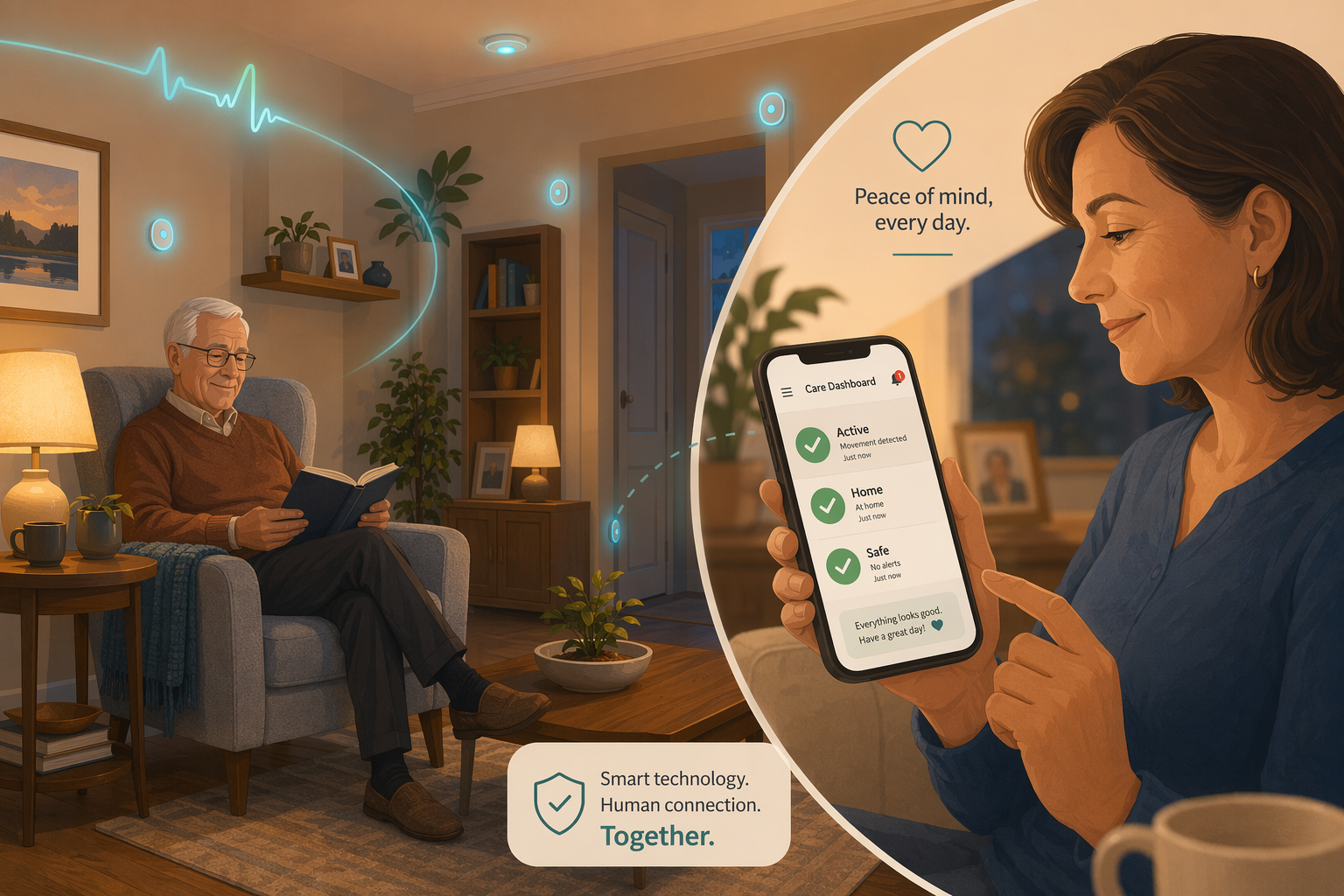
The Core Trade-Off: Emergency Response vs. Trend Detection
When a parent lives alone and you are hundreds of miles away, the question is not whether to get a monitoring system — it is which kind. The answer depends on a fundamental distinction that most product comparisons gloss over: wearable medical alerts and passive ambient sensors solve different problems, and each one leaves a specific kind of blind spot.
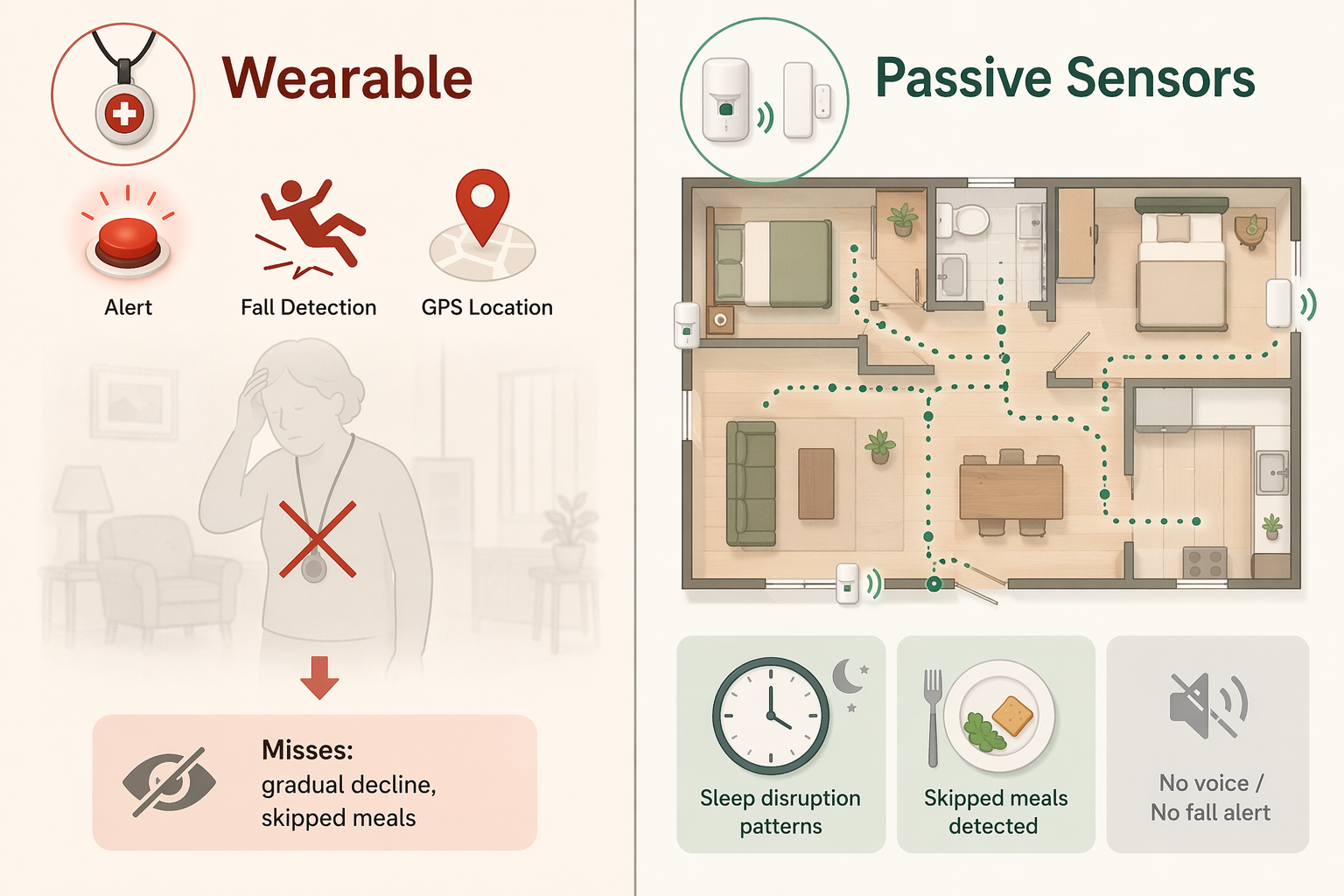
Wearables — pendants, wristbands, smartwatch-style devices — are built for emergency response. They detect falls, provide a button to call for help, and often include GPS location and two-way voice. Their job is to get help to the person within minutes of an incident. They are excellent at that job — when they are worn and charged.
Passive systems — motion sensors, door contacts, pressure mats, smart plugs — are built for trend detection. They learn what a normal day looks like — when the person wakes up, how often they visit the kitchen, whether the front door opens at 2 a.m. — and alert you when the pattern breaks. Their job is to catch the slow, quiet decline that happens weeks before a fall or a hospitalization.
The tension between these two approaches is the central decision point for long-distance caregivers. This article goes deeper than a general feature comparison. It examines the specific failure modes and blind spots of each approach — backed by research from a 2022 NIH scoping review — and offers a framework for combining them based on your parent's cognitive status, risk profile, and willingness to adopt.
Wearable Systems: What They Catch — and What They Miss
What Wearables Do Well
Wearable medical alert systems — whether pendant-style, wristband, or smartwatch — are designed around a single scenario: the user has an emergency and needs help immediately. Their core capabilities include:
- Fall detection: Automatic detection of a fall, followed by an alert to a monitoring center or designated contact.
- Button-press emergency: The user can press a button to speak with a response agent via two-way voice.
- GPS location tracking: Useful for seniors who wander or get disoriented outside the home.
- Activity monitoring: Some wearables track step count, sleep patterns, or heart rate, though this is secondary to the emergency function.
For a senior who is cognitively intact, willing to wear the device daily, and consistent about charging it, a wearable is a reliable safety net. The AARP has noted that these systems represent a meaningful improvement over the old emergency call buttons that were useless if a user could not reach or press them — for example, after a stroke or loss of consciousness.
The Critical Failure Modes
The most significant blind spot of wearable systems is not a technical limitation — it is a human one. The 2022 NIH scoping review on in-home monitoring technology explicitly excluded wearable sensors from its analysis due to usability barriers for older adults with mild cognitive impairment (MCI), who may forget to wear or charge the devices. This is not a hypothetical edge case. It is the central reason that wearables alone are insufficient for a large portion of the aging population.
The specific failure modes include:
- Forgetting to wear the device: A pendant left on the nightstand or a watch that feels uncomfortable is a $40-per-month paperweight.
- Forgetting to charge it: Battery-powered wearables require a charging routine that can be confusing or easy to skip for someone with memory issues.
- Inability to press the button: A fall that causes unconsciousness, a stroke that impairs motor function, or a medical event that prevents the user from pressing the alert button renders the wearable useless.
- No detection of gradual decline: A wearable cannot tell you that your parent has stopped cooking meals, is sleeping 14 hours a day, or has not left the bedroom in 48 hours. It only knows about emergencies.
For a deeper look at matching a wearable to your parent's specific risks — including cognitive status and willingness to wear — see our guide on How to Match a Wearable Health Monitor to Your Aging Parent's Specific Risks.
Passive Ambient Systems: What They Catch — and What They Miss
Sensor Types and Research-Identified Functions
Passive ambient monitoring uses a network of small sensors placed throughout the home. The NIH scoping review identified six core functions that these systems can perform:
| Function | What It Detects | Common Sensor Type |
|---|---|---|
| Daily activities | Movement patterns, meal preparation, bathroom visits | PIR motion, contact |
| Abnormal behaviors | Deviation from baseline routine | PIR motion, pressure |
| Cognitive impairment | Changes in activity complexity or consistency | PIR motion, contact |
| Falls | Sudden impact or absence of movement | Radar, camera, WiFi |
| Indoor positioning | Location within the home, room transitions | PIR motion, pressure |
| Sleep quality | Bed occupancy, restlessness, nighttime activity | Pressure mat, PIR motion |
The most commonly researched sensor types were passive infrared (PIR) motion sensors, used in 21 of the 30 reviewed studies, and contact sensors (door, cabinet, refrigerator), used in 19 studies. Pressure mats, smart plugs, and environmental sensors (temperature, humidity) round out the typical installation.
For a detailed explanation of how each sensor type works — PIR motion, door contacts, stove sensors, and more — see our dedicated guide on Passive Home Sensors for Senior Monitoring. Here, we focus on what passive systems catch that wearables cannot, and what they miss.
What Passive Systems Catch That Wearables Cannot
The real power of passive monitoring is not emergency detection — it is early warning. These systems can detect:
- Sleep disruption: A pressure mat under the mattress can track restlessness, time in bed, and nighttime bathroom trips — all of which can signal a urinary tract infection, medication side effects, or pain.
- Skipped meals: A contact sensor on the refrigerator or a smart plug on the coffee maker can reveal that the person has not opened the fridge or made breakfast.
- Reduced mobility: A gradual decrease in motion sensor triggers across the home can indicate weakness, pain, or declining physical function.
- Wandering: Door sensors can alert you when the front door opens at unusual hours — a critical feature for dementia care.
- Depression and loneliness: Activity analysis can detect withdrawal patterns with remarkable accuracy.
What Passive Systems Miss
Passive systems have their own critical blind spots:
- No direct emergency voice contact: If a fall is detected by a radar or camera sensor, the system can send an alert — but the person cannot speak to a responder through the sensors. There is no two-way voice.
- Fall detection requires specific sensors: Basic PIR motion sensors cannot detect a fall. You need millimeter-wave radar, WiFi-based sensing, or a camera to detect falls passively. These sensors are more expensive and may raise privacy concerns.
- Cannot confirm the person's status: A motion sensor can tell you that no movement has been detected in the bathroom for 30 minutes, but it cannot tell you whether the person is unconscious on the floor or simply sitting on the toilet.
- Privacy concerns with cameras: Camera-based systems offer the highest fall detection accuracy but are often rejected by older adults who feel they are being watched.
What the Research Says: Accuracy, Depression Detection, and Dementia Applications
The NIH scoping review provides concrete accuracy data across several monitoring modalities. These figures help caregivers understand what each technology can realistically deliver:
| Application | Technology | Accuracy |
|---|---|---|
| Heatmap anomaly detection | PIR motion sensors | 88% |
| Depression detection via activity analysis | PIR motion + contact sensors | Up to 96% |
| Fall detection | Millimeter-wave radar | 98.74% |
| Fall detection | WiFi-based (DeFall system) | 95% |
| Fall detection | Camera-based | >96% |
The depression detection finding is particularly striking. By analyzing patterns of activity — how often the person moves between rooms, how long they stay in bed, whether they engage with the kitchen — machine learning models can identify withdrawal patterns that signal depression with up to 96% accuracy. A wearable cannot do this. It has no context for what a "normal" day looks like in that specific home.
The Dementia-Specific Case: Why Passive Sensors Are Critical
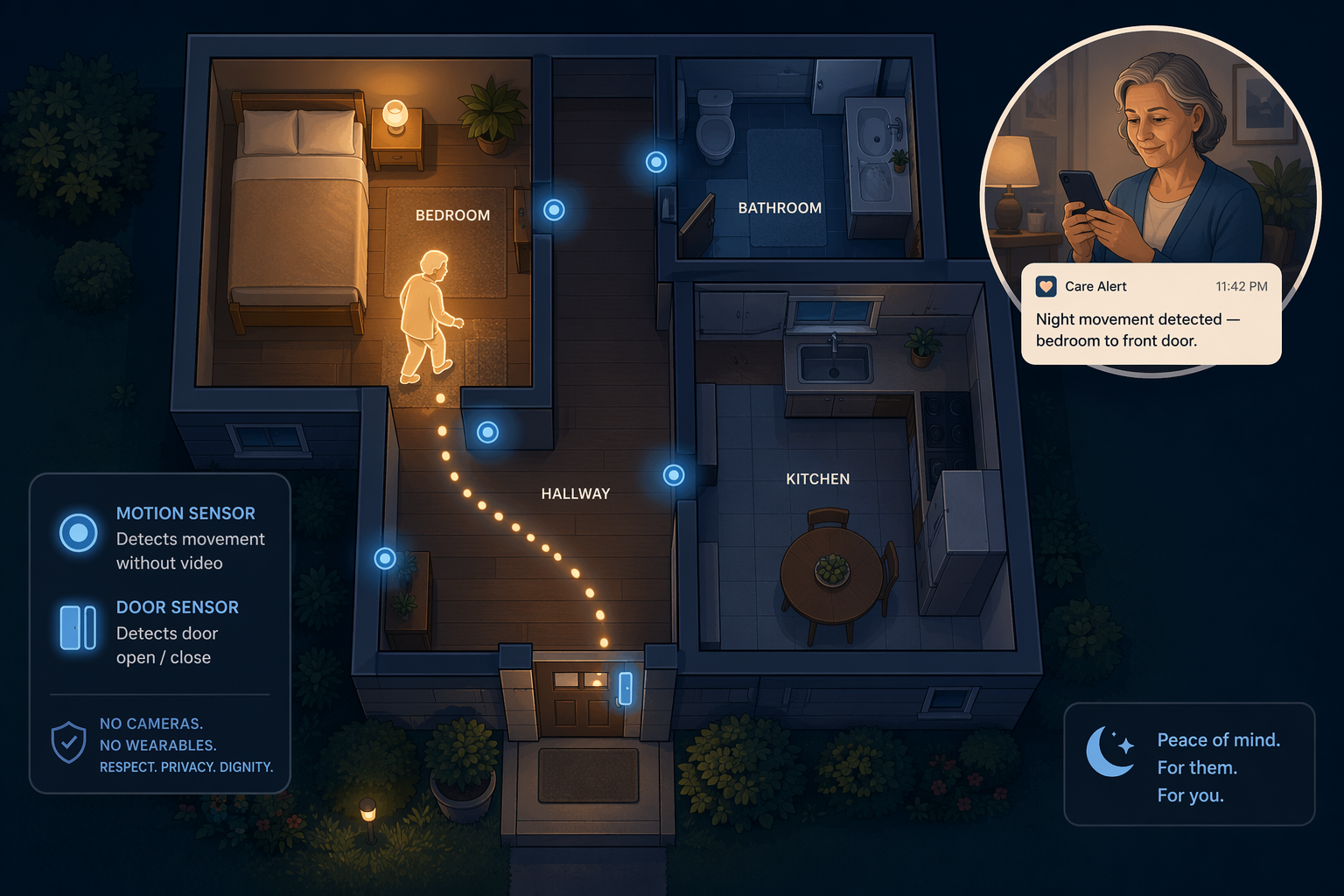
For a senior with dementia or MCI, the wearable failure mode is not a possibility — it is a probability. The cognitive decline that makes monitoring necessary is the same decline that makes a wearable unreliable. The person may forget what the pendant is for, take it off because it feels unfamiliar, or simply not remember to put it on after a shower.
Passive sensors do not require the user to do anything. They sit on walls, doors, and under mattresses, collecting data without any interaction. This makes them the only viable option for the dementia population — a point underscored by the NIH review's exclusion of wearables from its analysis due to MCI usability barriers.
The most compelling evidence comes from a 12-week pilot study included in the review, involving five dementia patients and their caregivers. The study used sensor-based night-wandering interventions — door sensors that triggered alerts when the person attempted to leave the bedroom or home during the night. The result: caregiver depression and anxiety were significantly reduced. The caregivers reported that knowing the system would alert them to nighttime movement allowed them to sleep through the night for the first time in months.
This is the dementia-specific value proposition of passive sensors: they do not just protect the senior — they protect the caregiver's health and ability to continue providing care.
Privacy: Cameras vs. Non-Visual Sensors
The privacy dimension often determines whether a senior accepts monitoring at all. The trade-off is straightforward: camera-based systems offer the highest fall detection accuracy (>96%) but are frequently rejected by older adults. As the AARP noted in its 2020 CES coverage, one monitoring company chose movement sensors over cameras specifically because "people don't want anybody watching them."
Non-visual sensors — PIR motion, door contacts, pressure mats, radar — provide a middle ground. They can detect movement, falls, and changes in routine without transmitting images or video. Radar-based fall detection, for example, achieves 98.74% accuracy without any visual data. The trade-off is that non-visual sensors provide less context: you know someone fell in the bathroom, but you cannot see whether they are conscious or bleeding.
The key considerations for privacy:
- Camera systems: Highest accuracy, lowest acceptance. Best for seniors who are comfortable with the trade-off and for situations where visual context is critical (e.g., advanced dementia with frequent falls).
- Non-visual sensors: Good accuracy for most applications, high acceptance. Best for seniors who value privacy and for caregivers who need trend data more than real-time visuals.
- Radar-based fall detection: Excellent accuracy without visual data. A strong compromise option for seniors who reject cameras but need reliable fall detection.
For a deeper look at the legal and ethical dimensions of home monitoring cameras — including consent requirements for cognitively impaired individuals — see our FAQ: Are Home Monitoring Cameras Legal for Elderly Parents? A Privacy and Consent Guide.
Cost Comparison: Wearables vs. Passive Systems
Cost is a significant factor for most families. Here is a general comparison based on current market ranges:
| Cost Dimension | Wearable Systems | Passive Sensor Systems |
|---|---|---|
| Monthly subscription | $20–$60/month | $30–$60/month |
| Equipment / upfront | $50–$200 (device purchase) | $100–$400 (sensor kit + hub) |
| Installation | Self-install (wearable only) | Self-install or professional ($100–$300) |
| Typical contract | Month-to-month or annual | Month-to-month or annual |
| Additional sensors | N/A | $20–$50 per additional sensor |
Wearable systems tend to have lower upfront costs but require the user to wear and charge the device. Passive systems have higher upfront costs for the sensor kit and hub but no ongoing user burden. For a detailed breakdown of all costs — including hidden fees, cancellation policies, and Medicare coverage — see our complete guide: What Do Elderly Monitoring Systems Actually Cost? A Complete Breakdown.
Practical Decision Guide: Combining Both Approaches Based on Cognitive Status and Risk Profile
The optimal solution for most long-distance caregivers is a combined approach: a wearable for emergency response and passive sensors for trend detection. But the decision depends on the senior's specific profile. Here is a framework based on the key variables:
| Senior Profile | Recommended Approach | Rationale |
|---|---|---|
| Cognitively intact, willing to wear device, no fall history | Wearable only (pendant or watch) | Low risk of abandonment; wearable provides emergency coverage at lower cost. |
| Cognitively intact, willing to wear device, has fall history | Wearable + passive motion sensors | Wearable for emergency; passive sensors for early detection of mobility decline. |
| MCI or early dementia, forgets to wear device | Passive sensors only (radar or camera for fall detection) | Wearable will be abandoned; passive sensors provide coverage without user action. |
| Advanced dementia, night wandering, lives alone | Passive sensors (door, motion, pressure) + caregiver alert system | Wearable is unreliable; passive sensors are the only option for wandering detection. |
| Lives with caregiver, no cognitive issues | Wearable optional; passive sensors for caregiver respite | Wearable provides backup; passive sensors give the caregiver data to rest. |
| Long-distance caregiver, parent lives alone, multiple risks | Combined: wearable + passive sensors (motion, door, pressure, radar) | Covers both emergency response and trend detection; closes all major blind spots. |
The combined approach is not always necessary. For a cognitively intact senior who reliably wears a pendant and has no fall history, a wearable alone may be sufficient. But for the long-distance caregiver whose parent has MCI, lives alone, and has a history of falls or wandering, the combined approach is the only way to close both blind spots: the wearable covers the emergency that happens while the device is worn, and the passive sensors cover the gradual decline and the emergencies that happen when the device is not worn.
The goal is not to choose between wearable and passive. The goal is to understand what each approach misses and to build a system that covers both the emergency you can see coming and the decline you cannot.
Questions to bring to a clinician or OT
This is not medical, legal, or a family's final decision — only a framework. Bring these questions to a clinician, occupational therapist, or your local Area Agency on Aging.
Find Local HelpRelated reading
Noticed something outdated or inaccurate on this page? Flag a correction. We review every report against CDC, NIA, and AARP HomeFit guidance before updating a page.